

Overview
Fully participating in the economy provides Aboriginal Victorians with the resources they need to determine the future they want. Economic participation is therefore key to Aboriginal self‑determination.
Measures under Goal 9 have worsened
The majority of measures under Goal 9 rely on the Census of Population and Housing with data only available every five years. New data is available for Measure 9.1.3 Aboriginal job seekers supported into work
Fewer Aboriginal people have been supported into work by the Victorian Government in 2025.
Goal 9 directly aligns with the following Closing the Gap Outcome and Target
Outcome 8: Strong economic participation and development of Aboriginal and Torres Strait Islander people and communities.
Target 8: By 2031, increase the proportion of Aboriginal and Torres Strait Islander people aged 25-64 who are employed to 62 per cent.
Closing the Gap - How Victoria is tracking nationally
Outcome 8: In 2021, 55.7 per cent of Aboriginal and Torres Strait Islander people aged 25–64 years were employed across Australia, compared to 62 per cent in Victoria. Nationally, based on progress from the baseline year (2016), the target shows improvement and is on track to be met. In Victoria, there has been some improvement since the baseline year.
Data Note
The following measures rely on datasets that are infrequently collected. No new data was available at the time of reporting.
- Measure 9.1.1 Employment to population ratio
- Measure 9.1.2a Proportion employed full-time
- Measure 9.1.2b Proportion employed part-time
- Measure 9.2.1 Workforce participation of women (as measured at 9.1.2)
- Measure 9.3.1a Workforce participation by age group
- Measure 9.3.1b Workforce participation by gender
- Measure 9.3.1c Workforce participation by disability status
- Measure 9.3.1d Workforce participation by regional status
- Measure 9.4.1a Employment by industry with analysis by growth industry
- Measure 9.4.1b Distribution of employment by sector and Aboriginal status
- Measure 9.4.1c Distribution of employment by industry and Aboriginal status
- Measure 9.4.1d Distribution of employment by occupation and Aboriginal status
- Measure 9.4.2 Number of employees within the Victorian Public Service, by Aboriginal status
- Measure 9.4.3 Number of employees within the Victorian Public Service in Management roles (VPS6 or equivalent and above)
- Measure 9.4.4a Number of Aboriginal people participating on government boards
- Measure 9.4.4b Proportion of Aboriginal people participating on government boards
Historical data for these measures is available on the First Peoples – State Relations website
9.1 Increase Aboriginal workforce participation
Measure 9.1.3. Aboriginal jobseekers supported into work
What does the data say?
In 2025, there were 5 Aboriginal women and 9 Aboriginal men who participated in the Jobs Victoria program. In the same year there were 2 Aboriginal women and 3 Aboriginal men who received employment after the program ended.
The Jobs Victoria Program provided targeted mentoring and support for Victorians who faced challenges finding work. This was through several programs such as Jobs Victoria Mentors, Local Employment Transition Service, Community Revitalisation, Social Enterprise.
Does the data show improvement or decline?
Since 2024, the number of Aboriginal men and women in the Jobs Victoria program has reduced. The numbers for both Aboriginal men and women were at the lowest recorded in the Victorian Government Aboriginal Affairs Report in 2025. This is due to the Jobs Victoria program concluding in June 2025. The conclusion of the program creates uncertainty around mechanisms for the Victorian Government to support Aboriginal jobseekers into work in the future.
Mob in Fashion – Brunswick Studio – Wurundjeri Country
SDRF enabler 1: Prioritise culture
Mob in Fashion, led by Whadjuk/Noongar creative Nathan McGuire, is transforming representation of First Peoples in the fashion industry. With $141,645 in Victorian Government funding through the Creative Spaces and Places Program, Mob in Fashion moved from a small home-based operation to a fully equipped studio in Brunswick. This culturally rich hub now supports a growing network of First Peoples designers and creatives, blending traditional knowledge with contemporary innovation.
The studio enables on-the-job training, internships, and industry partnerships, creating pathways into Melbourne Fashion Week, Melbourne Fashion Festival and Australian Fashion Week. As the only program of its kind nationally, Mob in Fashion addresses systemic underrepresentation and empowers First Peoples talent both behind the scenes and on the runway. The initiative demonstrates how government investment in First Peoples-led programs delivers tangible outcomes in employment, cultural visibility and creative leadership.

Cousins Preston and Aavashia at Melbourne Fashion Festival, photo courtesy of ABC News

Mob in Fashion studio in Brunswick, Melbourne (Wurundjeri Country)
9.4 Increase Aboriginal leadership and representation across all sectors and levels
Measure 9.4.2 Aboriginal employees within the Victorian Public Service (VPS)
What does the data say?
In 2025 there were 793 Aboriginal staff in the VPS. This represents 1.4 per cent of all VPS staff.
Does the data show improvement or decline?
Since 2024 the number of Aboriginal VPS staff has increased with 33 more in 2025 than 2024. There is a similar trend over the long term with 315 more Aboriginal staff employed in the VPS since 2017. Over the long term the percentage of Aboriginal VPS staff has increased from 1.1 per cent in 2017 to 1.4 per cent in 2025. Overall, this measure is showing improvement.
How does this compare with non-Aboriginal results?
In 2025 there were 21,182 non-Aboriginal staff in the VPS representing 36.4 per cent of all VPS staff. Since the VGAAR has reported on the numbers of Aboriginal and non-Aboriginal staff in the VPS the largest cohort has recorded “no response” to identifying as Aboriginal and/or Torres Strait Islander with 62.2 per cent.
Measure 9.4.3 Number of Aboriginal people at VPS 6 level and above in the VPS
What does the data say?
In 2025, there were 142 Aboriginal VPS staff members at VPS Grade 6 and above. This represented 1.2 per cent of all VPS Grade 6 and above staff members. This also means that 17.9 per cent of Aboriginal VPS staff members were at VPS Grade 6 level or above.
Does the data show improvement or decline?
Since 2024, the number of Aboriginal VPS Grade 6 and above staff members has increased by 17. There is a similar trend over the long term with 100 more Aboriginal VPS Grade 6 and above staff in 2025 than in 2017.
This means the percentage of VPS Grade 6 and above staff who identify as Aboriginal has increased, up from 0.7 per cent in 2017. There has also been an increase in the percentage of all Aboriginal VPS staff who are employed at the Grade 6 and above level, up from 8.8 per cent in 2017.
How does this compare with non-Aboriginal results?
In 2025 there were 5,069 VPS Grade 6 and above staff members who identified themselves as non-Aboriginal. This represented 41.5 per cent of all VPS Grade 6 and above staff members.
The largest group of VPS Grade 6 and above staff members did not respond to the Aboriginal and Torres Strait Islander status question. This cohort represents 57.3 per cent.
Of all VPS staff members who identified as non-Aboriginal, 23.9 per cent were at VPS grade level or above. However, given that most staff have not responded to the Aboriginal and Torres Strait Islander status question, it is not possible to make accurate comparisons between Aboriginal and non-Aboriginal staff numbers.
Transport and Planning Portfolio First Peoples Staff Conference
SDRF enabler 2: Address racism and promote cultural safety
In May 2025, DTP hosted the fourth annual Transport and Planning Portfolio First Peoples Staff Conference (Conference), held on Bunurong Country in Inverloch. The Conference was attended by 34 First Peoples employees from across the Portfolio, including DTP, Level Crossing Rail Project, Suburban Rail Loop Authority, Development Victoria, Yarra Trams, Rail Projects Victoria, Major Rail Projects Victoria and Metro Trains. It provided First Peoples staff with a chance to connect, network, participate in cultural and professional development workshops and encouraged relationship building, enabling better peer-to-peer support.
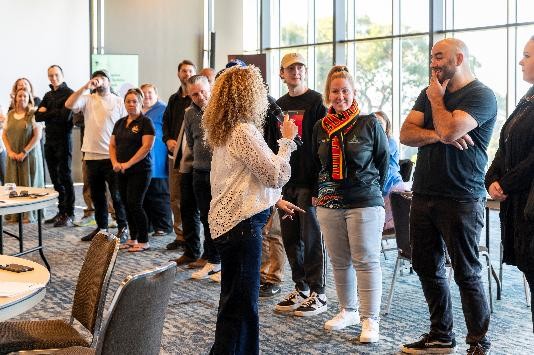
Transport and Planning Portfolio First Peoples Staff Conference 2025
Measure 9.4.4 Number and proportion of Aboriginal people participating on Victorian Government boards
What does the data say?
In 2025 there were 183 Aboriginal members on government boards. This means that 4.8 per cent of all appointees to Victorian government boards identified as Aboriginal. DPC had the highest Aboriginal participation on boards for 2025, with 27.9 per cent of board members identifying as Aboriginal. DEECA had the second highest at 11.3 per cent and DJSIR the third highest with 5.4 per cent.
Does the data show improvement or decline?
In 2025, there were 19 more Aboriginal government board members than in 2024, and 107 more than in 2017. DEECA had the largest increase in number, with 46 more Aboriginal board members since 2017. Increasing numbers and percentage of Aboriginal members of government boards means this measure is improving.
How does this compare with non-Aboriginal results?
In 2025, there were 3,070 non-Aboriginal members on government boards. This means that 81.2 per cent of all appointees to Victorian Government boards identified as non-Aboriginal. The remaining 14 per cent of board members either chose not to disclose their Aboriginal and Torres Strait Islander status or they did not respond.
Goal 9 - Victorian Government Investment and Action
The key Aboriginal Governance Forum for realising outcomes in this Domain is the Yuma Yirramboi Council.
Yuma Yirramboi Strategy
In June 2022, the Minister for Employment and Minister for Aboriginal Affairs together launched the Yuma Yirramboi Strategy (the Strategy) to help create First Peoples employment opportunities, supporting inclusion, wealth creation and seeking to achieve economic parity for First Peoples in Victoria within a generation.
In addition to the $25 million allocated to the Strategy in 2022, the 2024/25 State Budget allocated $8.595 million over three years to continue the work of the Strategy to address economic disparity for First Peoples communities.
Funding was allocated for four initiatives:
- Aboriginal Employment Pathways
- Traditional Owner Corporations Fund
- Aboriginal Tertiary Scholarship Program
- Support for the Yuma Yirramboi Council.
The Strategy supports Victorian Government commitments under the National Agreement on Closing the Gap, self-determination, Treaty preparedness and the work of the Yoorrook Justice Commission.
In 2025, the Strategy delivered key outcomes and grant initiatives to address critical barriers and opportunities for First Peoples economic development:
- Grants provided for the Aboriginal business sector included supporting the Kinaway Chamber of Commerce in delivery of the annual Victorian Aboriginal Business Awards in 2025.
- Delivery of an Aboriginal Business Capital Investment Program addressing the lack of capital investment available for Aboriginal Businesses.
- Delivered Aboriginal Employment Pathways outcomes that included the establishment of an Employment Acceleration Pathways program offering access to job readiness support.
- Delivered significant progress towards enabling business growth and accessing domestic and international opportunities under the First Nation Trade Program.
Diversity, equity, inclusion and cultural safety
Department of Government Services’ Diversity, Equity and Inclusion (DEI) Roadmap
The Victorian Public Sector Commission (VPSC) is implementing the Barring Djinang First Peoples’ Workforce Development Strategy (2025–2028) to increase First Peoples representation, retention and leadership across the Victorian Public Sector. It strengthens entry pathways, supports career progression through targeted development and mentoring, and builds culturally responsive leadership, contributing to a more inclusive, capable and representative public sector aligned with truth-telling and self-determination. DGS launched its DEI Roadmap in 2024-25, which is an interim strategy focused on establishing a diversity, equity and inclusion program that also supports the principles of self-determination.
Consumers Affairs Victoria’s (CAV) cultural awareness training
CAV staff continued to undertake a bespoke cultural awareness training, delivered in partnership with the Koori Heritage Trust and Wadawurrung Traditional Owners Aboriginal Corporation. Ninety per cent of CAV staff have completed training to date.
Public Record Office Victoria’s (PROV) Cultural Safety and Self-Determination training
PROV engaged an Aboriginal consultancy to deliver Cultural Safety and Self-Determination training for staff working with Victorian Aboriginal records and delivering services to the public.
Some staff also completed the University of Melbourne’s ‘Understanding Treaty’ micro-certification to further enhance their knowledge and understanding of self-determination, culture and contemporary issues.
DJSIR’s First Peoples Cultural Safety Framework
Across DJSIR, groups actively encourage and support all First Peoples staff to participate in staff-led network meetings, forums and events. DJSIR also recognises the importance of offering alternatives for the celebration of Australia Day and supporting First Peoples staff in connecting with their country and family when required, to promote their mental health and wellbeing.
In June 2025, DJSIR’s First Peoples Cultural Safety Framework was formally launched. Building a department that is culturally safe and culturally capable is fundamental to:
- supporting First Peoples colleagues’ wellbeing and cultural safety
- strengthening the department’s ability to design and deliver policies and programs that best serve the Victorian First Peoples community
- advancing and embedding First Peoples self-determination across departmental practices
- upholding DJSIR’s commitment to Truth, Justice and Treaty
DJSIR’s vision for First Peoples cultural safety is to be an employer of choice for First Peoples. This will be achieved by fostering a safe, inclusive and respectful workplace that supports First Peoples staff and upholds cultural safety
DFFH and DH’s Aboriginal workforce strategy 2021-2026
DFFH and DH’s Aboriginal workforce strategy 2021-2026 provides a framework for both departments to achieve their vision of becoming employers of choice for Aboriginal people.
The five-year strategy was developed with empowered Aboriginal voice at its core, gathered through extensive consultation with Aboriginal employees and non-Aboriginal employees, including the Wirrigirri Reconciliation program.
Dedicated implementation plans accompany the strategy. These plans are designed to ensure the departments can regularly adapt their implementation actions. The departments will continue to engage Traditional Owners, Aboriginal employees, ACCOs and the tertiary education sector to align the implementation of their strategy to the needs of all First Peoples in Victoria.
DEECA’s Aboriginal Cultural Safety Framework
The Aboriginal Cultural Safety Framework is an Aboriginal-led and evaluated initiative that aims to embed Aboriginal self-determination in DEECA’s practices, policies, procedures, and daily administration. By embedding self-determination, the framework will drive change throughout the department by creating and transforming culturally safe places for Aboriginal staff members, stakeholders and visitors.
DEECA’s commitment to Aboriginal cultural safety is organised around four action areas:
- DEECA staff are culturally capable and demonstrate this capability in all the work they do
- First Nations staff feel valued and supported in their career and career development, have access to culturally appropriate employee support and see DEECA as an employer of choice
- First Nations staff feel culturally safe and supported to express their cultural identity and practice culture
- DEECA is accountable to its commitment to supporting self-determination and building safe and respectful workplaces
DJCS’ Aboriginal Workforce Strategy 2024-2027
The Aboriginal Workforce Strategy 2024-2027 is part of an integrated approach to enhance the DJCS’ cultural capability, support DJCS’ Aboriginal workforce, and benefit Aboriginal communities through improved policy making, well‑informed program design, implementation and evaluation.
The strategy expands on the former Koori Employment and Career Strategy 2017–2020 initiatives and refines existing programs to better serve our Aboriginal workforce. The strategy implements special measures as set out in Section 12 of the Equal Opportunity Act 2010, for the purposes of promoting and realising substantive equality and advancement of Aboriginal people within the department workforce. It addresses key recommendations from the Aboriginal Justice Agreement: Phase Four and the Review of the Adult Custodial Corrections System – Safer Prisons, Safer People, Safer Communities.
Advancing Self-Determination and Cultural Safety in Budget at DTF
DTF is committed to building internal cultural capability and embedding self-determination in budget and business case processes. In late 2024 DTF launched the Early Intervention Investment Framework (EIIF) Cultural Safety Framework which was developed in partnership with VACCA and incorporates input from ACCOs and Victorian Government departments engaged in the EIIF.
The EIIF Cultural Safety Framework aims to improve outcomes for First Peoples by listening and learning from the experiences of First Peoples and implementing actions to better support cultural safety and self-determination. The Framework was utilised throughout 2025 to inform the development of EIIF budget proposals.
and supporting First Peoples staff in connecting with their country and family when required, to promote their mental health and wellbeing.
In June 2025, DJSIR’s First Peoples Cultural Safety Framework was formally launched. Building a department that is culturally safe and culturally capable is fundamental to:
- supporting First Peoples colleagues’ wellbeing and cultural safety
- strengthening the department’s ability to design and deliver policies and programs that best serve the Victorian First Peoples community
- advancing and embedding First Peoples self-determination across departmental practices
- upholding DJSIR’s commitment to Truth, Justice and Treaty
DJSIR’s vision for First Peoples cultural safety is to be an employer of choice for First Peoples. This will be achieved by fostering a safe, inclusive and respectful workplace that supports First Peoples staff and upholds cultural safety
DFFH and DH’s Aboriginal workforce strategy 2021-2026
DFFH and DH’s Aboriginal workforce strategy 2021-2026 provides a framework for both departments to achieve their vision of becoming employers of choice for Aboriginal people.
The five-year strategy was developed with empowered Aboriginal voice at its core, gathered through extensive consultation with Aboriginal employees and non-Aboriginal employees, including the Wirrigirri Reconciliation program.
Dedicated implementation plans accompany the strategy. These plans are designed to ensure the departments can regularly adapt their implementation actions. The departments will continue to engage Traditional Owners, Aboriginal employees, ACCOs and the tertiary education sector to align the implementation of their strategy to the needs of all First Peoples in Victoria.
DEECA’s Aboriginal Cultural Safety Framework
The Aboriginal Cultural Safety Framework is an Aboriginal-led and evaluated initiative that aims to embed Aboriginal self-determination in DEECA’s practices, policies, procedures, and daily administration. By embedding self-determination, the framework will drive change throughout the department by creating and transforming culturally safe places for Aboriginal staff members, stakeholders and visitors.
DEECA’s commitment to Aboriginal cultural safety is organised around four action areas:
- DEECA staff are culturally capable and demonstrate this capability in all the work they do
- First Nations staff feel valued and supported in their career and career development, have access to culturally appropriate employee support and see DEECA as an employer of choice
- First Nations staff feel culturally safe and supported to express their cultural identity and practice culture
- DEECA is accountable to its commitment to supporting self-determination and building safe and respectful workplaces
DJCS’ Aboriginal Workforce Strategy 2024-2027
The Aboriginal Workforce Strategy 2024-2027 is part of an integrated approach to enhance the DJCS’ cultural capability, support DJCS’ Aboriginal workforce, and benefit Aboriginal communities through improved policy making, well‑informed program design, implementation and evaluation.
The strategy expands on the former Koori Employment and Career Strategy 2017–2020 initiatives and refines existing programs to better serve our Aboriginal workforce. The strategy implements special measures as set out in Section 12 of the Equal Opportunity Act 2010, for the purposes of promoting and realising substantive equality and advancement of Aboriginal people within the department workforce. It addresses key recommendations from the Aboriginal Justice Agreement: Phase Four and the Review of the Adult Custodial Corrections System – Safer Prisons, Safer People, Safer Communities.
Advancing Self-Determination and Cultural Safety in Budget at DTF
DTF is committed to building internal cultural capability and embedding self-determination in budget and business case processes. In late 2024 DTF launched the Early Intervention Investment Framework (EIIF) Cultural Safety Framework which was developed in partnership with VACCA and incorporates input from ACCOs and Victorian Government departments engaged in the EIIF.
The EIIF Cultural Safety Framework aims to improve outcomes for First Peoples by listening and learning from the experiences of First Peoples and implementing actions to better support cultural safety and self-determination. The Framework was utilised throughout 2025 to inform the development of EIIF budget proposals.
In 2025, DTF further refined the business case template for budget processes to facilitate collaboration between departments and First Peoples when developing business cases. The templates developed for the 2026-27 budget cycle sought greater specificity on the First Peoples’ involvement and engagement in developing proposals, including accompanying reports, advice and/or letters of endorsement from First Peoples groups or communities.
DTF implemented new information requirements for budget proposals which directly affect or involve First Peoples for the 2026-27 budget process to better integrate First Peoples priorities and perspectives into funding decisions. These changes continue to enhance visibility of how proposals have been developed with First Peoples to enable self-determination and support more informed advice on alignment with Treaty, Truth and Closing the Gap.
Transport and Planning Portfolio First Peoples Cultural Safety Framework and DTP action plan
The Transport and Planning Portfolio First Peoples Cultural Safety Framework (Framework) and DTP Action Plan 2024–2028 were launched during Reconciliation Week 2024.
The Framework consists of 22 actions, with 9 complete, 7 in progress and 6 yet to commence. Some of the key actions in 2025 include:
- extending the First Peoples Employee Assistance Program, delivered by Girraway Ganyi; a Victorian First Peoples-owned consultancy
- supporting people managers to undertake Aboriginal Mental Health Training with Girraway Ganyi
- undertaking a Cultural Safety Audit for First Peoples employees, the first since the implementation of the Framework
- delivering a First Peoples Cultural Safety eLearn module for Portfolio employees
- celebrating First Peoples cultures and histories throughout the year including NAIDOC and Reconciliation Week events.
Victoria Police Aboriginal and Torres Strait Islander Inclusion Action Plan 2023-2025
The Victoria Police Aboriginal and Torres Strait Islander Inclusion Action Plan 2023–2025 is part of the Victoria Police Workforce Diversity and Inclusion Framework 2023-2030. It includes six actions relating to strengthening Aboriginal application attraction strategies, establishing a mentoring program, enhancing Aboriginal Cultural Awareness Training, implementing self-determination reform, convening an annual forum for Aboriginal employees and examining options for a centralised coordination function for Aboriginal Community Liaison Officers.
Local communities
Victorian Aboriginal and Local Government Strategy 2021-2026 (VALGS)
The VALGS provides councils across Victoria with practical guidance to embed the voices and priorities of Aboriginal communities at a local government level. It includes a clear framework for shared decision-making processes and actions for Aboriginal Victorians working together with local government based on mutual control, shared power and decision-making, fairness, respect, and trust.
The VALGS is centred on seven strategic pillars:
- culture, respect and trust
- awareness and engagement
- accountability and direction
- governance and participation
- economic participation
- health and wellbeing
- resourcing and funding.
These seven pillars will help councils meet their commitments and move towards self-determination.
DGS continued to support the implementation of VALGS throughout 2024-2025. DGS met with First Nations groups and peak bodies to explore opportunities to collaborate and establish a coordinated approach to work on strengthening local government and First Peoples relationships.
A Local Government First Peoples Coordination Group was established in 2025 to ensure that initiatives are well communicated across the sector, coordinated and avoid duplication of effort. It is intended that this group will continue to meet in 2026 to explore ways to help councils to build collaborative partnerships with First Peoples and identify pathways to self-determination for Aboriginal Victorians.
Geelong City Deal
Regional Development Victoriahas prioritised meaningful partnerships with Traditional Owners, through the lens of Country Plansin delivering the Geelong City Deal (GCD). This includes advocating for and receivingAustralian Government fundingto support and resource Registered Aboriginal Parties (RAPs) to partner on GCD projects. Thisadvocacy was done in recognition of the resource constrained environment and significant cultural load RAPs and Traditional Owners can experience when partnering on government projects.
In delivery of the GCD Twelve Apostles Precinct Redevelopment, RDV has worked closely with the Traditional Owners in the Eastern Maar Aboriginal Corporation (EMAC) to ensure that culture and Country are respected. This work involved coordinating the design of legal clauses relating to Indigenous Cultural Intellectual Property (ICIP) informed by feedback from EMAC. In addition to this EMAC has been supported through the design of the Immersive Gallery within the new Visitor Experience Centre.
RDV has prioritised cultural safety and connection to Country in the delivery of the GCD Nyaal Banyul Geelong Convention and Event Centre. The delivery team built on the partnership with Traditional Owners in the Wadawurrung Traditional Owners Aboriginal Corporation (WTOAC) that was established in earlier phases of GCD delivery. The partnership with WTOAC has involved the crafting of a project narrative, involvement in the tender evaluation, gifting a name in language and determining a set of design principles to guide a thorough co-design process. This approach has ensured that the cultural heritage and history of the site and its surrounds is properly acknowledged and celebrated in Geelong (or Djilang).
International
International Trade
Victoria is a signatory to the National Statement on First Nations Trade and Investment (the National Statement), which launched in August 2025. The National Statement sets out the strategic intent of participating jurisdictions to work collaboratively to improve trade and investment opportunities for First Peoples.
Global Victoria and the Aboriginal Economic Development branch in DJSIR represented Victoria on the cross-jurisdictional working group that developed the National Statement. Victoria appointed an inaugural First Nations Trade Envoy in October 2025. This role will represent the state globally and provide strategic advice and guidance to government on First Peoples trade activities, capability building, and best practice. The role is held by the Commissioner for Victoria to North Asia, Josh Riley, based in Tokyo.
World Expo 2025
Aboriginal Economic Development (AED) branch in DJSIR delivered an Immersion Program to support First Peoples organisations from Victoria to attend the World Expo 2025 in Osaka, Japan during Te Aratini Indigenous Peoples Week (Te Aratini). Te Aratini showcases Indigenous culture, perspectives and contributions to foster and build international relationships. 10 representatives from 6 First Peoples businesses and Traditional Owner Corporations participated.
Victorian Public Service
Barring Djinang First Peoples’ Workforce Development Strategy (2025-2028)
In 2025, the Victorian Public Sector Commission (VPSC) progressed implementation of the refreshed Barring Djinang First Peoples’ Workforce Development Strategy (2025-2028) (Strategy), consolidating early gains and strengthening impact. The Strategy drives action to increase First Peoples employment and build leadership capability across the Victorian Public Sector.
First Nations employees continue to access targeted career development and leadership pathways, supporting workforce capability and growth. Key initiatives include:
- Barring Djinang First Peoples Leadership Program - redesigned for the Victorian context, equipping First Peoples leaders to navigate a public sector shaped by self-determination, truth-telling and Treaty, with culturally safe, targeted development alongside established First Nations leaders.
- First Peoples Mentoring Pilot Program – fully designed for implementation in 2026, delivering culturally safe, structured mentoring through training, one-on-one support and tailored development to strengthen career progression and leadership capability.
- Nyanak Lotjpa (‘we all talk’) - First Nations staff network fostering connection and collaboration across government, with membership exceeding 215 employees.
In parallel, the VPSC has worked to strengthen cultural capability across the sector through:
- Victorian Government Executive Essentials Program – equipping over 70 new executives with core capabilities, including a dedicated module on Treaty, self-determination, culturally responsive leadership and accountability.
- The Victorian Government Graduate Program, First Peoples Pathway – provides culturally safe, supported entry, strengthening participation and representation of First Nations graduates as part of the Victorian Governments commitment to self-determination and improved social and economic outcomes.
- Expanded deficit discourse training - delivered to Victorian Government Graduate Program participants, their managers and supervisors, promoting strengths-based approaches to over 140 employees.
Collectively, these initiatives are contributing to a more capable, responsive and inclusive Victorian Public Sector.
Yani Bangal Transport and Planning Portfolio First Peoples Careers Strategy 2023 – 2028 (Yani Bangal)
DTP launched Yani Bangal in 2023. Yani Bangal is underpinned by a 2 per cent First Peoples employment target and includes 42 actions. Of the 42 actions, 20 are completed (some ongoing), 15 are in progress and 6 are yet to commence. Some of the key actions completed in 2025 include:
- implementing a Cultural and Ceremonial Leave policy
- developing a suite of cultural safety training programs
- undertaking a cultural safety audit for First Peoples employees and using data to direct actions and monitor progress
- delivering the fifth annual Yani Bangal Scholarship Program
- providing regular opportunities for the First Peoples Staff Network to connect
- holding the fourth annual First Peoples Staff Conference.
Updated