
Acknowledgement
We acknowledge the First Peoples of Victoria and their ongoing strength in practising the world’s oldest living culture. We acknowledge the Traditional Owners of the lands and waters on which we live and work and pay our respect to their Elders, past and present.
We recognise that from time immemorial, First Peoples have practised their law and lore, customs and languages, and nurtured Country through their spiritual, cultural, material and economic connections to land, water and resources.
We acknowledge that the long-lasting, far-reaching and intergenerational consequences of the dispossession of First Peoples of their Country are a direct result of colonisation and the establishment of the State of Victoria. This history, and the systems it gave rise to, continue to harm First Peoples today. It is only through true Aboriginal self-determination that we can begin to right the wrongs of the past.
We acknowledge the strength and resilience of First Peoples in the face of historical and ongoing injustices, and the survival of their living cultures, knowledge and traditions.
Language Statement
Language is important and can change over time. Words can have different meanings for different people.
We recognise the diversity of First Peoples, communities and cultures throughout Victoria. While the terms ‘Koorie’ or ‘Koori’ are commonly used by contemporary First Peoples in southeast Australia to identify and differentiate themselves from First Peoples groups from other parts of Australia, this does not encompass the diversity of all First Peoples in Victoria. Unless overwise stated, we have used the term ‘Aboriginal’ or ‘First Peoples’ to include all people of Aboriginal and/or Torres Strait Islander descent who live in Victoria.
The glossary includes a list of acronyms and other terminology used in the Report.
Message from the Premier
We are the first state in Australia to have signed a Treaty with First Peoples. At this historic moment, the Victorian Government Aboriginal Affairs Report 2025 marks the progress we have made and makes clear the work we must do to close the gap through Treaty.
In December I delivered an official State Apology to First Peoples in the Victorian Parliament that acknowledged the impacts upon First Peoples since colonisation. The apology was a key recommendation of the Yoorrook Justice Commission and a commitment made in the Treaty.
Our history impacts our present. We need to understand how inequality was created to overcome it. This apology was a significant step towards acknowledging the past, building a shared understanding of our history, and addressing past injustices, so that all Victorians can move forward together.
Closing the gap means creating real change and delivering practical outcomes that improve the lives of Aboriginal families. And Victoria's Treaty is a pathway for making real, practical changes to achieve better outcomes for First Peoples. By enshrining Treaty in law, we acknowledge the truth of our past and work towards a future built on respect and partnership.
I offer my heartfelt gratitude to the Aboriginal organisations, leaders and communities that continue to show strength and determination in improving outcomes. Your work lays the foundations of a better future for all Victorians.
The apology I delivered in December ended with a promise to First Peoples that I reaffirm now: “Victoria will not look away. Not from the truth. Not from the work. Not from you.”
Hon Jacinta Allen MP
Premier of Victoria

Message from the Minister for First Peoples
I am pleased to present the Victorian Government Aboriginal Affairs Report (VGAAR) 2025.
The Report provides key data to track the implementation of the Self-Determination Reform Framework, Victoria’s obligations under the National Agreement on Closing the Gap, and the Victorian Aboriginal Affairs Framework 2018-2025 (VAAF), which is Victoria’s overarching framework to improve outcomes for, and with, First Peoples.
The principle of self-determination underpins the VAAF. It means that when Aboriginal people have a say in policies and solutions for their families, we get better outcomes across areas including health, housing, justice and education.
The 2025 VGAAR highlights where Aboriginal Victorian’s lives are improving but also troubling areas where outcomes have stalled or worsened.
We know there is more work to be done and Treaty is how we close the gap.
We know that Treaty is a pathway to practical changes and solutions. Gellung Warl is the entity created under the Statewide Treaty Act 2025 (Vic) that will lead the strengthening of relationships between First Peoples and the State. Working with the Victorian Government, Gellung Warl will use its functions and powers to action the practical outcomes set out in the Statewide Treaty.
Treaty is an opportunity to come to grips with the history we share – and create a better and fairer future together. Because working together, we can Close the Gap.
The Hon Ros Spence MP
Minister for First Peoples
About this Report
The annual Victorian Government Aboriginal Affairs Report (Report) documents government’s progress against four key frameworks:
- the Victorian Aboriginal Affairs Framework (VAAF)
- the Self-Determination Reform Framework (SDRF)
- the National Agreement on Closing the Gap (National Agreement)
- the Victorian Closing the Gap Implementation Plan 2021-2025 (Implementation Plan).
The Report is an outcomes measurement and accountability tool that enables the government to identify areas of improvement as well as challenges that still need to be addressed.
Whilst the action and outcomes contained in this Report are crucial components for supporting Victoria’s commitments to Treaty and Truth, please note that the Report does not include information on the implementation of Yoorrook Justice Commission recommendations, or on specific commitments relating to the Treaty process.
This Report was developed through a coordinated and collaborative approach with all Victorian Government departments and relevant agencies. Aboriginal Governance Forums and Ngaweeyan Maar-oo, the Koorie Caucus of Victoria’s Partnership Forum on Closing the Gap, also provided input.
Victorian Aboriginal Affairs Framework
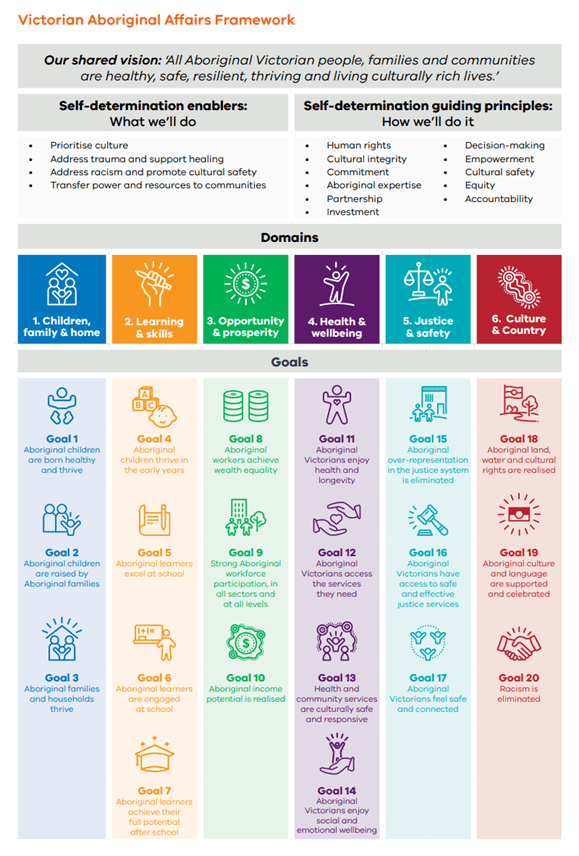
The VAAF is Victoria’s guiding framework in First Peoples affairs. The vision of the VAAF is:
‘That all Aboriginal Victorian people, families and communities are healthy, safe, resilient, thriving and living culturally rich lives.’
The VAAF is organised under six domains:
- Children, family & home
- Learning & skills
- Opportunity & prosperity
- Heath & wellbeing
- Justice & safety
- Culture & Country
Under these, the VAAF sets out 20 goals that provide a clear definition of what the future should look like if we fulfil our vision. To track our progress, the VAAF includes 111 measures which tell us if we are going in the right direction.
The Report includes the most up-to-date available data across the VAAF’s measures. The Report also features case studies about the impact of reform and investment on the lives of First Peoples through policy and programs shaped by the Aboriginal Community Controlled sector.
All government departments and agencies are required to report annually on what they are doing to action the VAAF’s four self-determination enablers (Figure 1).
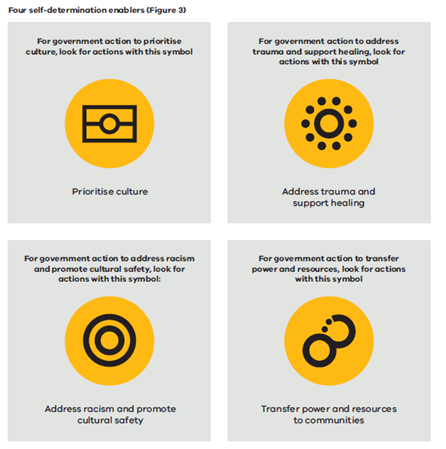
Examples of government actions to enable self-determination reform can be found under the relevant VAAF domain in this Report (identified by the relevant enabler symbol illustrated in figure 3).
About Data
Changes to the Victorian Government Ministry
The Hon Natalie Hutchins MP was the Minister for Treaty and First Peoples until 18 December 2025.
The Hon Ros Spence MP is now the Minister for First Peoples.
Data collection and limitations
This Report provides the latest available information about the Victorian Government’s performance against the 111 measures in the VAAF. It provides an assessment of progress based on available data. Historical data may have been updated since the last edition of the Report.
Data has been sourced from a range of Victorian and Commonwealth administrative collections and surveys. The latest year of available data varies across the Report due to inconsistent frequency of collection. Several measures do not have updated data available for inclusion in this Report. Updated data for these measures will be included in future reports once available.
Some of the data reported against the VAAF measures does not directly align with the measure definition due to the limitations of available data.
Crude rates
Due to the large array of data sources used to calculate progress against each measure, most rate calculations used in this Report are crude rates. Where age standardised rates have been used, this has been noted in the Report.
Closing the Gap data
The National Agreement’s 19 socioeconomic targets are national targets which require a collaborative approach from all jurisdictions to achieve them. National and state-level progress against these targets is included on the overview page for each relevant VAAF goal based on the latest available data. The Productivity Commission is the body responsible for collecting and publishing all jurisdictions’ data to assess the 19 Closing the Gap socioeconomic targets.
There are data gaps for some targets and many supporting indicators due to data collection processes and underreporting. Over time, as more data becomes available, the monitoring of the targets will provide greater insight into what progress is being made.
As Victoria is pursuing more ambitious and comprehensive goals under the VAAF, many VAAF measures do not have a counterpoint under the National Agreement for direct comparison.
Further information on national and jurisdictional progress towards the Closing the Gap targets, including data specifications, can be found at www.pc.gov.au/closing-the-gap-data/dashboard.
VAAF Data Dashboard
In line with the VAAF’s commitment to improve data access, transparency and narration, an interactive VAAF Data Dashboard (Data Dashboard) has been developed. The Data Dashboard can be accessed via the First Peoples–State Relations website at www.firstpeoplesrelations.vic.gov.au/victorian-aboriginal-affairs-framework-data-dashboard.
The Data Dashboard offers a user-friendly platform to access detailed state-level data. It also includes disaggregated data at sub-state level where available. While this Report is limited to the data available during the reporting cycle, the Data Dashboard will be updated to report on measures when new data becomes available.
Indigenous Data Sovereignty
The Victorian Government acknowledges the critical importance of Indigenous Data Sovereignty. Resourcing Aboriginal people and organisations to collect, analyse, disseminate and manage data supports self-determination. The Productivity Commission’s review of the National Agreement also highlights the importance of Indigenous Data Sovereignty as a key enabler of self-determination.
Victorian Aboriginal population
This Report uses revised population estimates for the Victorian Aboriginal cohort released in 2024 by the Australian Bureau of Statistics (ABS), based on 2021 Australian Census data. Estimates and projections presented in this release supersede estimates and projections based on earlier censuses. This includes back cast estimates for First Peoples between 2011 to 2020.
For this reason, historical data included in this Report and data tables may differ to previous reporting years. More information on revising population estimates can be found on the ABS website at www.abs.gov.au/statistics/people/aboriginal-and-torres-strait-islander-peoples/understanding-change-counts-aboriginal-and-torres-strait-islander-australians-census/latest-release.
Between the 2016 and 2021 Censuses, the number of people who self-identified as Aboriginal and Torres Strait Islander in Victoria grew from 47,788 to 65,646 (1.0 per cent of the total Victorian population).
Demographics
Based on the 2021 Census, 50 per cent of Aboriginal Victorians were under the age of 25.
Geography
Based on the 2021 Census, 50.5 per cent of Aboriginal Victorians lived in the greater Melbourne area. The Local Government Areas with the highest density Aboriginal population are located around regional centres, such as Greater Geelong, Greater Bendigo, Greater Shepparton and Mildura
Updated