

- Date:
- 30 June 2026
Introduction
Acknowledgement of Country, language statement, forewords, about the report and about the data.
Acknowledgement
We acknowledge the First Peoples of Victoria and their ongoing strength in practising the world’s oldest living culture. We acknowledge the Traditional Owners of the lands and waters on which we live and work and pay our respect to their Elders, past and present.
We recognise that from time immemorial, First Peoples have practised their law and lore, customs and languages, and nurtured Country through their spiritual, cultural, material and economic connections to land, water and resources.
We acknowledge that the long-lasting, far-reaching and intergenerational consequences of the dispossession of First Peoples of their Country are a direct result of colonisation and the establishment of the State of Victoria. This history, and the systems it gave rise to, continue to harm First Peoples today. It is only through true Aboriginal self-determination that we can begin to right the wrongs of the past.
We acknowledge the strength and resilience of First Peoples in the face of historical and ongoing injustices, and the survival of their living cultures, knowledge and traditions.
Language Statement
Language is important and can change over time. Words can have different meanings for different people.
We recognise the diversity of First Peoples, communities and cultures throughout Victoria. While the terms ‘Koorie’ or ‘Koori’ are commonly used by contemporary First Peoples in southeast Australia to identify and differentiate themselves from First Peoples groups from other parts of Australia, this does not encompass the diversity of all First Peoples in Victoria. Unless overwise stated, we have used the term ‘Aboriginal’ or ‘First Peoples’ to include all people of Aboriginal and/or Torres Strait Islander descent who live in Victoria.
The glossary includes a list of acronyms and other terminology used in the Report.
Message from the Premier
We are the first state in Australia to have signed a Treaty with First Peoples. At this historic moment, the Victorian Government Aboriginal Affairs Report 2025 marks the progress we have made and makes clear the work we must do to close the gap through Treaty.
In December I delivered an official State Apology to First Peoples in the Victorian Parliament that acknowledged the impacts upon First Peoples since colonisation. The apology was a key recommendation of the Yoorrook Justice Commission and a commitment made in the Treaty.
Our history impacts our present. We need to understand how inequality was created to overcome it. This apology was a significant step towards acknowledging the past, building a shared understanding of our history, and addressing past injustices, so that all Victorians can move forward together.
Closing the gap means creating real change and delivering practical outcomes that improve the lives of Aboriginal families. And Victoria's Treaty is a pathway for making real, practical changes to achieve better outcomes for First Peoples. By enshrining Treaty in law, we acknowledge the truth of our past and work towards a future built on respect and partnership.
I offer my heartfelt gratitude to the Aboriginal organisations, leaders and communities that continue to show strength and determination in improving outcomes. Your work lays the foundations of a better future for all Victorians.
The apology I delivered in December ended with a promise to First Peoples that I reaffirm now: “Victoria will not look away. Not from the truth. Not from the work. Not from you.”
Hon Jacinta Allen MP
Premier of Victoria
Message from the Minister for First Peoples
I am pleased to present the Victorian Government Aboriginal Affairs Report (VGAAR) 2025.
The Report provides key data to track the implementation of the Self-Determination Reform Framework, Victoria’s obligations under the National Agreement on Closing the Gap, and the Victorian Aboriginal Affairs Framework 2018-2025 (VAAF), which is Victoria’s overarching framework to improve outcomes for, and with, First Peoples.
The principle of self-determination underpins the VAAF. It means that when Aboriginal people have a say in policies and solutions for their families, we get better outcomes across areas including health, housing, justice and education.
The 2025 VGAAR highlights where Aboriginal Victorian’s lives are improving but also troubling areas where outcomes have stalled or worsened.
We know there is more work to be done and Treaty is how we close the gap.
We know that Treaty is a pathway to practical changes and solutions. Gellung Warl is the entity created under the Statewide Treaty Act 2025 (Vic) that will lead the strengthening of relationships between First Peoples and the State. Working with the Victorian Government, Gellung Warl will use its functions and powers to action the practical outcomes set out in the Statewide Treaty.
Treaty is an opportunity to come to grips with the history we share – and create a better and fairer future together. Because working together, we can Close the Gap.
The Hon Ros Spence MP
Minister for First Peoples
About this Report
The annual Victorian Government Aboriginal Affairs Report (Report) documents government’s progress against four key frameworks:
- the Victorian Aboriginal Affairs Framework (VAAF)
- the Self-Determination Reform Framework (SDRF)
- the National Agreement on Closing the Gap (National Agreement)
- the Victorian Closing the Gap Implementation Plan 2021-2025 (Implementation Plan).
The Report is an outcomes measurement and accountability tool that enables the government to identify areas of improvement as well as challenges that still need to be addressed.
Whilst the action and outcomes contained in this Report are crucial components for supporting Victoria’s commitments to Treaty and Truth, please note that the Report does not include information on the implementation of Yoorrook Justice Commission recommendations, or on specific commitments relating to the Treaty process.
This Report was developed through a coordinated and collaborative approach with all Victorian Government departments and relevant agencies. Aboriginal Governance Forums and Ngaweeyan Maar-oo, the Koorie Caucus of Victoria’s Partnership Forum on Closing the Gap, also provided input.
Victorian Aboriginal Affairs Framework
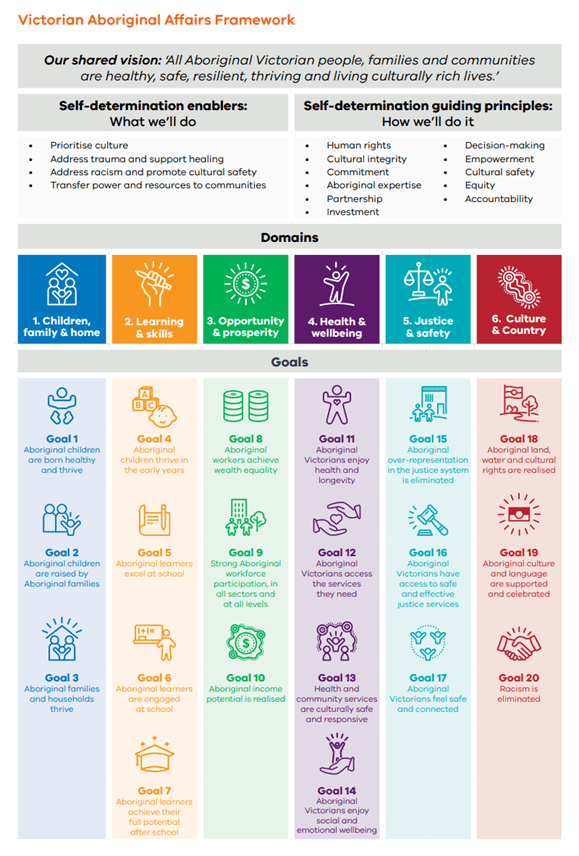
The VAAF is Victoria’s guiding framework in First Peoples affairs. The vision of the VAAF is:
‘That all Aboriginal Victorian people, families and communities are healthy, safe, resilient, thriving and living culturally rich lives.’
The VAAF is organised under six domains:
- Children, family & home
- Learning & skills
- Opportunity & prosperity
- Heath & wellbeing
- Justice & safety
- Culture & Country
Under these, the VAAF sets out 20 goals that provide a clear definition of what the future should look like if we fulfil our vision. To track our progress, the VAAF includes 111 measures which tell us if we are going in the right direction.
The Report includes the most up-to-date available data across the VAAF’s measures. The Report also features case studies about the impact of reform and investment on the lives of First Peoples through policy and programs shaped by the Aboriginal Community Controlled sector.
All government departments and agencies are required to report annually on what they are doing to action the VAAF’s four self-determination enablers (Figure 1).
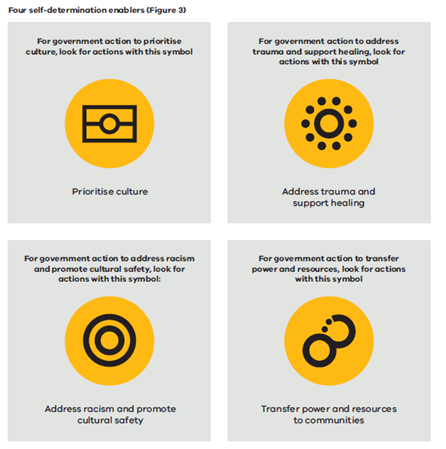
Examples of government actions to enable self-determination reform can be found under the relevant VAAF domain in this Report (identified by the relevant enabler symbol illustrated in figure 3).
About Data
Changes to the Victorian Government Ministry
The Hon Natalie Hutchins MP was the Minister for Treaty and First Peoples until 18 December 2025.
The Hon Ros Spence MP is now the Minister for First Peoples.
Data collection and limitations
This Report provides the latest available information about the Victorian Government’s performance against the 111 measures in the VAAF. It provides an assessment of progress based on available data. Historical data may have been updated since the last edition of the Report.
Data has been sourced from a range of Victorian and Commonwealth administrative collections and surveys. The latest year of available data varies across the Report due to inconsistent frequency of collection. Several measures do not have updated data available for inclusion in this Report. Updated data for these measures will be included in future reports once available.
Some of the data reported against the VAAF measures does not directly align with the measure definition due to the limitations of available data.
Crude rates
Due to the large array of data sources used to calculate progress against each measure, most rate calculations used in this Report are crude rates. Where age standardised rates have been used, this has been noted in the Report.
Closing the Gap data
The National Agreement’s 19 socioeconomic targets are national targets which require a collaborative approach from all jurisdictions to achieve them. National and state-level progress against these targets is included on the overview page for each relevant VAAF goal based on the latest available data. The Productivity Commission is the body responsible for collecting and publishing all jurisdictions’ data to assess the 19 Closing the Gap socioeconomic targets.
There are data gaps for some targets and many supporting indicators due to data collection processes and underreporting. Over time, as more data becomes available, the monitoring of the targets will provide greater insight into what progress is being made.
As Victoria is pursuing more ambitious and comprehensive goals under the VAAF, many VAAF measures do not have a counterpoint under the National Agreement for direct comparison.
Further information on national and jurisdictional progress towards the Closing the Gap targets, including data specifications, can be found at www.pc.gov.au/closing-the-gap-data/dashboard.
VAAF Data Dashboard
In line with the VAAF’s commitment to improve data access, transparency and narration, an interactive VAAF Data Dashboard (Data Dashboard) has been developed. The Data Dashboard can be accessed via the First Peoples–State Relations website at www.firstpeoplesrelations.vic.gov.au/victorian-aboriginal-affairs-framework-data-dashboard.
The Data Dashboard offers a user-friendly platform to access detailed state-level data. It also includes disaggregated data at sub-state level where available. While this Report is limited to the data available during the reporting cycle, the Data Dashboard will be updated to report on measures when new data becomes available.
Indigenous Data Sovereignty
The Victorian Government acknowledges the critical importance of Indigenous Data Sovereignty. Resourcing Aboriginal people and organisations to collect, analyse, disseminate and manage data supports self-determination. The Productivity Commission’s review of the National Agreement also highlights the importance of Indigenous Data Sovereignty as a key enabler of self-determination.
Victorian Aboriginal population
This Report uses revised population estimates for the Victorian Aboriginal cohort released in 2024 by the Australian Bureau of Statistics (ABS), based on 2021 Australian Census data. Estimates and projections presented in this release supersede estimates and projections based on earlier censuses. This includes back cast estimates for First Peoples between 2011 to 2020.
For this reason, historical data included in this Report and data tables may differ to previous reporting years. More information on revising population estimates can be found on the ABS website at www.abs.gov.au/statistics/people/aboriginal-and-torres-strait-islander-peoples/understanding-change-counts-aboriginal-and-torres-strait-islander-australians-census/latest-release.
Between the 2016 and 2021 Censuses, the number of people who self-identified as Aboriginal and Torres Strait Islander in Victoria grew from 47,788 to 65,646 (1.0 per cent of the total Victorian population).
Demographics
Based on the 2021 Census, 50 per cent of Aboriginal Victorians were under the age of 25.
Geography
Based on the 2021 Census, 50.5 per cent of Aboriginal Victorians lived in the greater Melbourne area. The Local Government Areas with the highest density Aboriginal population are located around regional centres, such as Greater Geelong, Greater Bendigo, Greater Shepparton and Mildura
National Agreement on Closing the Gap Priority Reforms
Progress in Victoria to implement the 4 priority reforms under the National Agreement on Closing the Gap.
Closing the Gap Priority Reform One: Formal Partnerships and Shared Decision-Making
Outcome: Aboriginal and Torres Strait Islander people are empowered to share decision-making authority with governments to accelerate policy and place-based progress on Closing the Gap through formal partnership arrangements.
Target: There will be formal partnership arrangements to support Closing the Gap in place between Aboriginal and Torres Strait Islander people and governments in place in each state and territory enshrining agreed joint decision-making roles and responsibilities and where Aboriginal and Torres Strait Islander people have chosen their own representatives.
Overview
The Victorian Government is committed to building and strengthening structures that empower Aboriginal people and communities to share decision-making authority, as outlined in the National Agreement.
Shared decision-making extends beyond individual partnership arrangements and is only a step towards achieving the ultimate goal of First Peoples’ self-determination.
Treaty is the embodiment of First Peoples’ self-determination, and it represents a fundamental reset of the relationship between the State and First Peoples. It provides a pathway to ensure that First Peoples in Victoria have the power and resources to control matters which impact their lives.
Victorian actions
Nginma Ngainga Wara acquits Victoria’s commitment under the National Agreement on Closing the Gap to create an independent accountability mechanism to provide concrete solutions and recommendations to improve outcomes for First Peoples. Nginma Ngainga Wara is a new Outcomes and Justice Commission within the First Peoples’ Assembly. It will evaluate and monitor how effective the Victorian Government is in achieving better outcomes for First Peoples. It will be led by members appointed by the First Peoples’ Assembly.
Victoria is the first jurisdiction in Australia to acquit this commitment under the National Agreement on Closing the Gap.
The Victorian Aboriginal Governance Forums are well-established strategic and coordinating bodies across various sectors. Aboriginal Governance Forums, which comprise senior Aboriginal community leaders and Victorian Government representatives, are responsible for overseeing the development, implementation and direction of Aboriginal-led policy and service delivery agendas. All Aboriginal Governance Forums are resourced to enable shared decision-making with Aboriginal communities and organisations.
Aboriginal governance forum | Summary |
| Aboriginal Children’s Forum (ACF), Department of Families, Fairness and Housing (DFFH) | Established in 2015 to drive the safety and wellbeing of Aboriginal children and young people in, or at risk of entering, out-of-home care. The ACF meets three times a year. It ensures the objectives and actions of Wungurilwil Gapgapduir align and contribute to Closing the Gap targets and the Victorian Aboriginal Affairs Framework (VAAF) priorities and indicators. Relevant Strategy: Wungurilwil Gapgapduir: Aboriginal Children and Families Agreement |
| Aboriginal Justice Forum (AJF), Department of Justice and Community Safety (DJCS) | Established in 2000 to improve Aboriginal justice outcomes, enhance family and community safety, and reduce Aboriginal over-representation in the Victorian criminal justice system. The AJF meets three times a year. Relevant Strategy: Burra Lotjpa Dunguludja: Victorian Aboriginal Justice Agreement Phase 4 |
| Aboriginal Strategic Governance Forum (ASGF), DFFH | Established in 2017 as an advisory and decision-making forum used to set DFFH's strategic direction on relevant portfolios. The ASGF Koorie Caucus is comprised of 26 Aboriginal community members; Chief Executive Officers of 11 Aboriginal Community Controlled Organisations, Chairs of 8 Regional and Metropolitan Governance Groups, 6 representatives from DFFH Statewide Forums, and the CEO Federation of Victorian Traditional Owners Corporation. Relevant Strategies: Aboriginal Governance and Accountability Framework, Korin Korin Balit-Djak: Aboriginal Health, Wellbeing and Safety Strategic Plan 2017-2027 |
| Dhelk Dja Partnership Forum, Family Safety Victoria / DFFH | Established in 2005 through the long-standing leadership of Aboriginal community leaders and Elders in preventing and responding to family violence with a focus on improving outcomes for Aboriginal people, communities and families. The forum meets three times a year. Relevant Strategy: Dhelk Dja: Safe Our Way - Strong Culture, Strong Peoples, Strong Families 2018-2028 |
| Marrung Central Governance Committee (MCGC), Department of Education (DE) | Established in 2016 to ensure all Koorie Victorians achieve their learning aspirations. The MCGC meets three times a year. Relevant Strategy: Marrung: Aboriginal Education Plan 2016-2026 |
| State-wide Caring for Country Partnership Forum (SCfCPF), Department of Energy, Environment and Climate Action (DEECA) | Established in 2020 under Pupangarli Marmarnepu: ‘Owning Our Future’ Aboriginal Self-Determination Strategy 2020-2025 to monitor and evaluate policies and ensure accountability to Aboriginal communities. The SCfCPF meets twice a year as determined by the Traditional Owner Corporation Caucus. Relevant Strategy: Pupangarli Marmarnepu: ‘Owning Our Future’ Aboriginal Self-Determination Strategy 2020-2025 |
| Yuma Yirramboi Council (Council), Department of Jobs, Skills, Industry and Regions: (DJSIR) | Established in 2022 to replace the inaugural Victorian Aboriginal Employment and Economic Council. It provides advice and guidance to government on matters affecting Aboriginal Victorians in business, employment, tourism, culture and broader economic development. The Council meets quarterly. Relevant Strategy: Yuma Yirramboi: Invest in Tomorrow - Aboriginal Employment and Economic Strategy |
| Victorian Aboriginal Health and Wellbeing Partnership Forum (AHWPF), Department of Health (DH) | Established in 2021 to enable strategic collaboration between the Aboriginal Community Controlled health sector, the mainstream health sector and government. The AHWPF meets twice per year. Relevant Strategy: Victorian Aboriginal Health and Wellbeing Partnership Agreement and Action Plan |
| Victorian Aboriginal Housing and Homelessness Framework Implementation Working Group (VAHHF IWG), Homes Victoria / DFFH | Established in 2020 to support actions that ensure a resourced and capable housing and homelessness system within Victoria. The VAHHF IWG meets quarterly. Relevant Strategy: Mana-na woorn-tyeen maar-takoort: Every Aboriginal Person has a Home - Victorian Aboriginal Housing and Homelessness Framework |
Closing the Gap Priority Reform Two: Building the Aboriginal Community Controlled Sector
Outcome: There is a strong and sustainable Aboriginal and Torres Strait Islander community-controlled sector delivering high quality services to meet the needs of Aboriginal and Torres Strait Islander people across the country.
Target: Increase the amount of government funding for Aboriginal and Torres Strait Islander programs and services going through Aboriginal and Torres Strait Islander community-controlled organisations.
Overview
Aboriginal Community Controlled services and Traditional Owner Corporations achieve better results, are more culturally safe, and employ more Aboriginal people than mainstream services. The Victorian Government is committed to building the Aboriginal Community Controlled sector and organisations in line with the strong sector elements in the National Agreement to deliver Closing the Gap services and programs, in partnership with Aboriginal and Torres Strait Islander representatives.
Aboriginal and Torres Strait Islander community control is an act of self-determination, as noted in Clause 44 of the National Agreement. Aboriginal Victorians hold the knowledge and expertise about what is best for themselves, their families and their communities. Local and international evidence shows us that self-determination is the policy approach that best delivers the most effective and sustainable outcomes for Indigenous peoples.
Victorian actions
Key actions contributing to the Priority Reform Two target include:
- DPC is facilitating seven ACCO-led projects delivered through Sector Strengthening funding totalling $3.3 million across the priority sectors of health, housing, disability, children and families, and languages and culture. These include:
- Aboriginal Housing Victoria’s ‘Aboriginal Housing and Homelessness 5-year Regional Growth Plans’
- Rumbalara Aboriginal Co-operative’s ‘Building the capacity of ACCOs to deliver a full range of culturally responsive, financially viable disability services’
- Victorian Aboriginal Community Controlled Health Organisation’s ‘Pathway to Closing the Gap in Social and Emotional Wellbeing for First Peoples living in Victoria (2024-2031)’
- Victorian Aboriginal Child and Community Agency’s ‘Developing a sector strengthening blueprint for Aboriginal children and families across Metropolitan Melbourne and Victoria’
- Ballarat and District Aboriginal Cooperative’s ‘Regional Oral Health Feasibility Study for the Western Districts ACCOs’
- Victorian Aboriginal Corporation for Languages’ ‘Strengthening the Victorian Aboriginal Corporation for Languages, towards sector preparedness and strengthening development with focus on the revitalisation of Aboriginal languages in Victoria’
- Federation of Traditional Owner Corporation’s ‘Development of a state-wide Traditional Owner Corporation Workforce Development Strategy’
- The Ngaweeyan Maar-oo Secretariat is working with members to allocate remaining funds for sector strengthening towards various initiatives in mid-2026.
- DTF and Homes Victoria administrate the Social Housing Growth Fund (SHGF). The SHGF provides funding opportunities for ACCOs to enable the construction and tenancy management of dwellings over a period of 30 years.
- DPC and DEECA worked with Federation of Victorian Traditional Owner Corporations (FVTOC) to engage KordaMentha to conduct an external review of how Traditional Owner Corporations are funded.
- DFFH is working alongside ACCOs to support the government’s response to Yoorrook Recommendation 9, which will better inform the proportion of funding in children and families service delivery in government, mainstream Community Service Organisations (CSOs) and ACCOs.
- DJCS is administering approximately $70 million in community grants funding (both Commonwealth and State) to improve Aboriginal justice outcomes – this is more than a three-fold increase from the approximately $20 million in AJA grants administered in 2021-22.
Closing the Gap Priority Reform Three: Transforming Government Organisations
Outcome: Improving mainstream institutions: Governments, their organisations and their institutions are accountable for Closing the Gap and are culturally safe and responsive to the needs of Aboriginal and Torres Strait Islander people, including through the services they fund.
Target: Decrease in the proportion of Aboriginal and Torres Strait Islander people who have experiences of racism.
Overview
Under the VAAF, SDRF, National Agreement and Victoria’s Implementation Plan, Victoria has committed to structural transformation of government organisations and mainstream service providers to respond to the needs of First Peoples. This means doing more to tackle systemic racism and promote cultural safety.
Victoria’s nation-leading work on Treaty and Truth is central to the transformation of government, the transfer of power and resources to communities and the improvement of outcomes.
Victorian action
Key actions contributing to the Priority Reform Three target include:
- DPC continues to support the Anti-Racism Taskforce and implementation of the Victorian Anti-Racism Strategy.
- In June 2025, DE released its policy on Preventing and Addressing Racism in Schools, outlining the requirements for schools to strengthen their culture and practice to prevent and address racism, religious intolerance and racial and religious vilification. DE also delivered an anti-racism e-learning course to 2,790 DE and school staff.
- DFFH continues to deliver Aboriginal Cultural Safety Workshops and Anti-Racism Workshops which are interactive, coaching style 2-hour development opportunities for all staff. 10 per cent of DFFH staff have completed the Aboriginal Cultural Safety Workshop and over 14 per cent of DFFH staff have completed the Anti-Racism Workshop.
Closing the Gap Priority Reform Four: Shared Access to Data and Information at a Regional level
Outcome: Aboriginal and Torres Strait Islander people have access to, and the capability to use, locally relevant data and information to set and monitor the implementation of efforts to close the gap, their priorities and drive their own development.
Target: Increase the number of regional data projects to support Aboriginal and Torres Strait Islander communities to make decisions about Closing the Gap and their development.
Overview
Victoria is working towards increasing Aboriginal ownership and control of data. This includes shared access to local and disaggregated data and information for Aboriginal communities and organisations. Indigenous Data Sovereignty is a key enabler of self-determination. By having greater access to and control of data and information, Aboriginal and Torres Strait Islander People can make informed decisions so that they can meet the needs of their communities.
Victorian actions
Key actions contributing to the Priority Reform Four target include:
- In late 2025, the Traditional Owner Corporation Caucus (TOC Caucus) authorised DEECA to partner with FVTOC to co-design a process for a dedicated IDS Policy.
- Homes Victoria provides a deidentified disaggregated quarterly report on the social housing waitlist to the Victorian Aboriginal Housing and Homelessness Forum, focussed on the local area in which each Forum is held.
- DJCS facilitates standing updates to the Aboriginal Justice Forum which share data with members that is not otherwise publicly accessible. Youth Justice also provides quarterly regional data dashboards to each Regional Aboriginal Justice Advisory Committee (RAJAC), in accordance with the Wirkara Kulpa Performance Measurement Framework.
Children, Family & Home
Supporting Aboriginal children and families to be strong in culture and proud of their unique identity can ensure that every Aboriginal child has the best start in life.
Our shared commitment
All Aboriginal children and young people are safe, resilient, thriving and living in culturally rich, strong Aboriginal families and communities.
Families and Aboriginal child-rearing practices are fundamental to raising strong Aboriginal children and young people. Providing Aboriginal families with safe and effective services enables better outcomes.
Supporting Aboriginal children and families to be strong in culture and proud of their unique identity can ensure that every Aboriginal child has the best start in life.
This means ensuring Aboriginal children and families have access to culturally appropriate services throughout pregnancy and early childhood, and reducing the over-representation of Aboriginal young people in care.
Goal 1: Aboriginal children are born healthy and thrive
Measures under Goal 1 relate to maternal and infant health and children's first 1000 days.
Goal 2: Aboriginal children are raised by Aboriginal families
Measures under Goal 2 relating to rate of Aboriginal children aged 0-17 in child protection and out of home care
Goal 3: Aboriginal families and households thrive
Measures under Goal 3 relate to safety and security of Aboriginal families and households
Goal 1: Aboriginal children are born healthy and thrive
Overview
The first five years of a child's life are fundamental to shaping their future. Delivering better maternal and early childhood services means removing barriers, promoting genuine and effective partnerships and supporting Aboriginal families to access culturally safe services.
Measures under Goal 1 have varied in performance
Aboriginal infant health has declined with low birth weight, preterm birth and perinatal mortality all increasing in between 2024 and 2025.
Aboriginal children are receiving more health support from Koorie maternity services and are being immunised at higher rates.
Goal 1 directly aligns with the following Closing the Gap Outcome and Target
Outcome 2: Aboriginal Children are born healthy and strong.
- Target 2: By 2031, increase the proportion of Aboriginal and Torres Strait Islander babies with a healthy birth weight to 91 per cent.
Closing the Gap - How Victoria is tracking nationally
Outcome 2: In 2023, 88.9 per cent of Aboriginal and Torres Strait Islander babies born were of a healthy birth weight across Australia. This is the same for the proportion in Victoria. Nationally and in Victoria, there has been no change since the baseline year (2017).
Data Note
All measures under this goal are reported on.
1.1 Improve maternal and infant health
Measure 1.1.1 Rate of low birth weight
What does the data say?
In 2023, 173 babies of Aboriginal mothers were born with low birth weight. This is 13.2 per cent of all babies of Aboriginal mothers born in Victoria.
Does the data show improvement or decline?
There were 35 more babies of Aboriginal mothers born with low birth weight in 2023 than 2022, and 45 more babies than 2014. This is an increase in the percentage of low birthweight babies of Aboriginal mothers compared to all babies of Aboriginal mothers by 2.4 percentage points. This represents a worsening of results.
How does this compare with non-Aboriginal results?
In 2023 4,822 non-Aboriginal babies were born with low birth weight. That is one fewer baby than in 2022. There were 400 fewer non-Aboriginal babies born with low birth weight than in 2014. Over the short and long term, the percentage of non-Aboriginal babies born with low birth weight has remained the same, around 6.7 per cent as recorded in 2023.
Measure 1.1.2 Rate of pre-term birth
What does the data say?
In 2023, 160 babies of Aboriginal mothers were born pre-term. This represents 12.2 per cent of all babies of Aboriginal mothers born in Victoria.
Does the data show improvement or decline?
There was one more baby born pre-term to Aboriginal mothers in 2023 than in 2022. During the same period, the percentage of babies born pre-term to Aboriginal mothers has remained the same. Over the long term, there were 19 more babies born pre-term to Aboriginal mothers in 2023 than in 2014.
Although the number has been increasing, the percentage of pre-term births for Aboriginal mothers has been decreasing over the long term. This indicates an improvement of results.
How does this compare with non-Aboriginal results?
In 2023, 5,695 babies of non-Aboriginal mothers were born pre-term. This is 7.9 per cent of all births to non-Aboriginal mothers in Victoria. That is 38 fewer babies born pre-term than in 2022, and 717 fewer than in 2014. Comparing the percentage of pre-term births for Aboriginal and non-Aboriginal mothers, babies born to Aboriginal mothers are 1.5 times as likely to be born pre-term.
Measure 1.1.3 Rate for perinatal mortality
What does the data say?
In 2021–23, 42 babies of Aboriginal mothers died before birth or within 28 days of birth. This represents a rate of 10.8 babies of Aboriginal mothers per 1,000.
Does the data show improvement or decline?
Two more babies of Aboriginal mothers died before birth or within 28 days of birth in 2021-23 than in 2020–22. Over the long term, 10 more babies of Aboriginal mothers died before birth or within 28 days of birth than in 2014–16. These increases in the number of perinatal deaths have not resulted in a large increase in the rate of Aboriginal perinatal mortality per 1,000, which has remained steady.
How does this compare with non-Aboriginal results?
In 2021–23, 2,089 babies of non-Aboriginal mothers died before birth or within 28 days of birth. This represents a rate of 9.2 babies of non-Aboriginal mothers per 1,000.
In 2021-23, 37 fewer babies of non-Aboriginal mothers died before birth or within 28 days of birth than in 2020-22, and 132 fewer than in 2014–16. Since 2014-16, the rate of perinatal mortality for non-Aboriginal mothers per 1,000 has not changed significantly.
Measure 1.1.4 Smoking during pregnancy
What does the data say?
In 2023, 443 Aboriginal women smoked during their pregnancy. This represents 35.9 per cent of all pregnant Aboriginal women in Victoria.
Does the data show improvement or decline?
There were 19 fewer Aboriginal women who smoked during their pregnancy in 2023 than in 2022. This is a 1.8 per cent reduction in Aboriginal women smoking during pregnancy in this period.
Over the long term, 42 more Aboriginal women smoked during their pregnancy in 2023 than in 2014. Although that is an increased number, the percentage of Aboriginal women who smoked during pregnancy has declined by 5.2 percentage points over the decade. This is an improvement in results.
How does this compare with non-Aboriginal results?
In 2023 3,982 non-Aboriginal women smoked during their pregnancy. This represents 5.6 per cent of all pregnant non-Aboriginal women in Victoria. In the short term, the percentage of non-Aboriginal women smoking during pregnancy has not changed, but it has declined 3.9 per cent over the last decade.
When comparing the per cent of Aboriginal and non-Aboriginal pregnant women. Aboriginal pregnant women are 6.4 times more likely to smoke during their pregnancy.
1.2 Children thrive in their first 1,000 days
Measure 1.2.1 Participation rates for Maternal and Child Health Key Ages and Stages Consultation
What does the data say?
In 2024-25, 14,911 Key Age Consultations were conducted with Aboriginal children across 10 key ages and stages. Of those, 1,805 were at the ‘home visit’ stage (within two weeks of a baby’s birth or arrival at home), 1,691 were at 2 weeks, 1,697 were at 4 weeks, 1,690 were at 8 weeks, 1,671 were at 4 months, 1,481 were at 8 months, 1,422 were at 12 months, 1,229 were at 18 months, 1,220 were at 2 years, and 1,005 were at 3.5 years.
Of the 10 key ages and stages, home visit had the highest participation rate for Aboriginal children, at 99.2 per cent. The 3.5-year visit had the lowest participation rate, at 58.4 per cent.
Does the data show improvement or decline?
Since 2023-24, the proportion of Aboriginal children participating in home visits and 2-week visits declined. In the same period, 4-week and 8-week visits remained steady, and participation in every other key age and stage visit increased.
Since 2015-16, the participation of Aboriginal children in all key ages and stages visits has increased. The largest increase is at the 4-month visit, with 21.9 per cent higher participation.
Increasing participation in key age consultations means this measure is improving.
How does this compare with non-Aboriginal results?
In 2024-25, Aboriginal children were less likely than all children to participate in key ages and stages consultations for home visit, 2 weeks, 4 weeks, 8 weeks, 4 months, 8 months, 12 months and 18 months.
Aboriginal children were as likely as all children to participate in 2-year and 3.5-year visits.
Measure 1.2.2 Attendance at Koori Maternal Health Service
What does the data say?
In 2024–25, 897 Aboriginal women attended Koori Maternity Services in Victoria. This is the highest number since 2018-19.
Does the data show improvement or decline?
In 2024-25, 27 more Aboriginal women attended Koori Maternity Services than in 2023-24. Over the long term, 412 more Aboriginal women attended Koori Maternity Services in 2024-25 than in 2018–19.
Increasing attendance at Koori Maternity Services means this measure is improving.
Measure 1.2.3 Immunisation rates at 12, 24, and 60 months
What does the data say?
In 2025, 90.8 per cent of Aboriginal 1-year-olds, 89.5 per cent of Aboriginal 2-year-olds and 95.6 per cent of Aboriginal 5-year-olds were immunised.
Does the data show improvement or decline?
Since 2024, the proportion of immunised Aboriginal 1- and 5-year-old children did not change.
In the same period, immunisation rates for Aboriginal 2-year-olds increased by 5.8 per cent. It should be noted that 2-year-old immunisation rates in 2024 were lower than previous years, making 2025 rates similar to historic figures.
How does this compare with non-Aboriginal results?
In 2025, 92.4 per cent of all 1-year-olds, 90.8 per cent of all 2-year-olds and 94.5 per cent of all 5-year-olds in Victoria were immunised. This means that Aboriginal 5-year-olds were as likely to be immunised than their peers. Aboriginal 1- and 2-year-olds were less likely to be immunised than their peers.
Measure 1.2.4 Participation in facilitated playgroups (0-5 years)
What does the data say?
In 2025, 555 Aboriginal children (0-5 years old) participated in Supported Playgroups (SPG). This represented 5.4 per cent of all Aboriginal children in Victoria.
In 2025, 591 Aboriginal children participated in Koorie Supported Playgroups (KSPG). This represented 5.8 per cent of Aboriginal children.
SPG and KSPG are free programs for Victorian families facing disadvantage with children from birth to school age. A qualified facilitator leads these sessions where parents develop their skills and confidence to support their child’s wellbeing and development.
KSPG are specifically tailored for Aboriginal families, fostering cultural safety, strengthening community connections, building parenting confidence and providing culturally appropriate early intervention. KSPG are delivered by ACCOs statewide.
Does the data show improvement or decline?
There were 92 fewer Aboriginal children participating in SPG in 2025 than in 2024. Although this is a reduction in numbers, the percentage of Aboriginal children participating has not changed. In 2025, 369 more Aboriginal children participated in SPG than in 2017, representing a 1.1 percentage point increase in the proportion of Aboriginal children participating in SPG.
In contrast, 206 more Aboriginal children participated in KSPG in 2025 than in 2024. The proportion of Aboriginal children participating in KSPG rose by 2 percentage points in that period. There were 362 more Aboriginal children participating in KSPG in 2025 than in 2019. This represents 3.1 percentage point increase in the proportion of Aboriginal children participating.
How does this compare with non-Aboriginal results?
In 2025, Aboriginal children’s participation in facilitated playgroups was higher than non-Aboriginal children in Victoria.
In 2025, 1,146 Aboriginal children participated in either an SPG or KSPG. This represents 11.2 per cent of Aboriginal children in Victoria (5.4 per cent SPG and 5.8 per cent KSPG). In comparison, 16,399 children participated in a SPG in 2025. This represents 3.5 per cent of all children in Victoria.
KSPG is a facilitated playgroup designed and delivered by ACCOs to Aboriginal children only.
Goal 1 – Victorian Government Investment and Action
The key Aboriginal Governance Forums for realising outcomes in this Domain are the Aboriginal Children’s Forum, Aboriginal Strategic Governance Forum, Dhelk Dja Partnership Forum, Victorian Aboriginal Health and Wellbeing Partnership Forum, and Victorian Aboriginal Housing and Homelessness Framework Implementation Working Group.
Maternal and child health
Aboriginal Maternal and Child Health (MCH) program
Throughout 2025, DH continued to fund the Aboriginal MCH program, supporting 15 Aboriginal Community Controlled Health Organisations (ACCHOs) operating across 17 sites. This includes funding for Aboriginal MCH service delivery; additional funding to boost flexible support to meet the growing Aboriginal population; and funding to enable staff to undertake lactation training and provide lactation support.
MCH Key Ages and Stages (KAS) consultations
Access to healthcare in the early stages of life is essential for achieving better health outcomes later on. MCH KAS consultations are provided free of charge to all Victorian children from birth to school age.
Koorie Maternity Services
Throughout 2024-25, DH continued to fund Koori Maternity Services (KMS), supporting 11 ACCHOs and three sites in public hospitals. This included funding for service delivery and funding to enable staff to undertake lactation training and provide lactation support.
KMS have continued to provide culturally safe care for First Nations women and families throughout the maternity journey, supported by multidisciplinary teams including (but not limited to) Aboriginal Health Practitioners, Aboriginal Health Workers and midwives.
Baluk Balert Barring
In 2024-25, $697,033 was provided to support Victoria’s first Aboriginal-dedicated Early Parenting Centre (EPC), Baluk Balert Barring. Operated by First Peoples’ Health and Wellbeing, the EPC opened in Frankston in October 2024 and delivers culturally safe and responsive antenatal and early parenting supports to Aboriginal women and families with children up to primary school age.
Virtual Hospital Pilot
DH has commenced a Virtual Hospital Pilot to test the delivery of admitted inpatient care in home or remote settings. As part of this, the Royal Women’s Hospital (RWH) is trialling a remote foetal medicine service, in which clinicians from the RWH will provide consultation and support to patients in regional Victoria with suspected foetal concern or complex pregnancies, seeking to prioritise care for First Nations women.
The aim is to improve access to care and reduce the number of patients who need to travel to Melbourne. This pilot service commenced in early 2026.
Safer Care Victoria
Safer Care Victoria has partnered with Women’s Healthcare Australasia for Phase 2 of the National Preterm Birth Prevention Collaborative, building on the learning from the ‘Every Week Counts’ Collaborative (2022-2024), with the aim of reducing pre-term and early-term birth by 20 per cent among participating Victorian maternity services by June 2026. There are four Victorian health services participating in Phase 2 of this work.
Phase 2 of the collaborative places a strong emphasis on partnering with First Nations communities to deliver culturally safe preterm birth prevention care. This work is vital in supporting improved health outcomes for First Nations women and babies.
Partnering with KMS and ACCHOs delivers culturally connected care that enhances protective factors and improves health outcomes for First Nations women and babies. Safer Care Victoria, in collaboration with the Victorian Aboriginal Community Controlled Health Organisation, is supporting sites to build strong partnerships with their local ACCHOs and KMS.
Co-design of culturally safe perinatal services
Through the co-design of culturally safe perinatal emotional wellbeing screening practices. Aboriginal health practitioners have contributed as members of the Expert Advisory Group, while practitioners and parents have participated in co-design workshops, focus groups and surveys. This collaborative process has helped develop screening practices that are responsive to the needs and lived experiences of Aboriginal communities, with Aboriginal perspectives and leadership incorporated.
Records
Registry of Births, Deaths and Marriages Victoria (BDM)
In Victoria, children require a birth registration and a legal birth certificate issued by BDM to establish their identity, enrol in early childhood education and for immunisation processes and in turn, support children to thrive.
In 2024-25, BDM delivered targeted initiatives to increase the number of birth registrations and birth certificate possession for Aboriginal children born in Victoria. Initiatives focused on workforce education, sector engagement and place-based community outreach.
As part of this work, BDM delivered information sessions on registering a birth and applying for birth certificates, both at the time of birth and later in a child’s life. Sessions were tailored for ACCO, MCH and Early Childhood Education providers—aiming to increase the workforce’s awareness of and access to BDM resources, so that community professionals can better support parents and families in navigating and completing registration and application processes.
In 2024-25, BDM also participated in Community Justice Days, NAIDOC events and Bring Your Bills Days, providing face-to-face assistance in regional areas of Victoria, including the Mallee region and Gippsland. BDM worked collaboratively with Aboriginal organisations to educate and support parents with registering the birth of their child(ren) and applying for a certificate. Applicants with complex or intersecting needs – for example, family violence, homelessness or socio-economic disadvantage – were provided with tailored assistance, including access to a fee waiver (see Domain 4 for further detail about BDM’s Fee Waiver policy).
BDM delivered a series of Community Outreach Days to First Nations communities in regional Victoria. Community Outreach Days were on-site, tailored to community need, provided culturally safe assistance to complete Birth Registration Statements (BRS), resolved outstanding BRS and improved access to essential services through digital applications.
Community Outreach Days also focussed on building ACCO capacity to support parents and families in completing online registrations and applications – a pathway that is more efficient than the paper-based or manual process. This included staff training, document readiness support and practical tools to enhance digital inclusion, to enable ACCOs to deliver tailored, self-determined support.
In collaboration with the Australian Bureau of Statistics, DGS reviewed how births, deaths and marriages data can be used to improve how Victoria assesses performance against Closing the Gap targets.
As a result, the BDM data analytics were enhanced to improve reporting on the number of First Peoples born in Victoria and their access to birth registration processes. BDM death data also contributes to work on life expectancy.
Children, Family & Home
Supporting Aboriginal children and families to be strong in culture and proud of their unique identity can ensure that every Aboriginal child has the best start in life.
Goal 2: Aboriginal children are raised by Aboriginal families
Overview
Culture, language and connection to community and Country all support children and young people to thrive. Community-led responses that focus on prevention and early intervention are critical for reducing the number of Aboriginal children and young people in child protection and care.
Measures under Goal 2 have worsened
More Aboriginal children and young people are in the care system, but fewer are in care with a cultural plan. Most Aboriginal children in the care system are in the care of relatives or kin and more children on a protection order are under the direct authority of an ACCO in 2024-25.
There are more Aboriginal children reunified with their parents within 12 months but also more children returning to the care system within 12 months.
Goal 2 directly aligns with the following Closing the Gap Outcome and Target
Outcome 12: Aboriginal children are not over-represented in the child protection system.
- Target 12: By 2031, reduce the rate of Aboriginal and Torres Strait Islander children in out of home care by 45 per cent.
Closing the Gap - How Victoria is tracking nationally
Outcome 12: In 2024, the rate of Aboriginal and Torres Strait Islander children aged 0–17 years in out of home care was 50.3 per 1,000 children across Australia, compared to 90.5 per 1,000 children in Victoria. Nationally and in Victoria, these rates are worsening compared to the baseline year (2019).
Data Note
All measures under this goal are reported on.
2.1 Eliminate the over-representation of Aboriginal children and young people in care
Measure 2.1.1 Rate and number of children and young people in care
What does the data say?
In 2024–25, there were 3,047 Aboriginal children in out of home care in Victoria. This is a rate of 95.8 children per 1,000.
Does the data show improvement or decline?
There were 180 more Aboriginal children in out of home care in 2024-25 than in 2023-24, and 1,171 more than in 2015-26. When looking at the rate per 1,000 children, this figure has grown by 15.9 in the last decade, from 79.9 in 2015–16. The rate of Aboriginal children in out of home care has been increasing since 2017–18.
How does this compare with non-Aboriginal results?
In 2024–25, 6,350 non-Aboriginal children were in out of home care in Victoria. This is a rate of 4.4 children per 1,000. Aboriginal children were 21.8 times more likely to be in out of home care than their non-Aboriginal peers in 2024-25.
Over the long term, the rate of non-Aboriginal children in out of home care has remained relatively stable. In 2017-18, it was 4.3 per 1,000.
Measure 2.1.2 Number of children engaged with intensive family support services
What does the data say?
In 2024–25, there were 2,401 Aboriginal children engaged with intensive family support services. This is the highest number since 2007-08. Aboriginal children represent 27.8 per cent of all children in Victoria engaging with intensive family support services.
Does the data show improvement or decline?
In 2024-25, there were 359 more Aboriginal children engaged with intensive family support services than in 2023-24. There were 1,805 more Aboriginal children engaged than in 2015-16.
This improvement is due to increased investment in intensive family support services over the last 10 years, meaning that more families are able to access the support they need.
How does this compare with non-Aboriginal results?
In 2024–25, 6,233 non-Aboriginal children engaged with intensive family support services. This is a decrease of 132 since 2021-22. In comparison, since 2021-22 the number of Aboriginal families receiving a service has increased by 425 families.
2.2 Increase Aboriginal care, guardianship and management of Aboriginal children and young people in care
Measure 2.2.1 Number and proportion of Aboriginal children and young people in care placed with i) relatives/kin and ii) other Aboriginal carers
What does the data say?
In 2024–25, 2,524 Aboriginal children were placed with relatives/kin or other Aboriginal carers. Of those, 40.7 per cent were placed with Aboriginal relatives/kin and 40.2 per cent were placed with non-Aboriginal relatives/kin. This means that most Aboriginal children in care were placed with relatives/kin.
Does the data show improvement or decline?
There were 42 more Aboriginal children placed with Aboriginal relatives/kin in 2024-25 than in 2023–24. In the same period, 107 more children were placed with non-Aboriginal relatives/kin and 10 more were placed with an Aboriginal carer. The proportion of children placed with Aboriginal relatives/kin reduced in the same period. There were 1.1 percentage point fewer children placed with Aboriginal relatives and kin and 1.2 percentage point more children placed with non-Aboriginal relatives/kin. One fewer child was placed with a non-Aboriginal carer, and 18 more children were placed with residential care or a family group home.
Since 2015–16 where an Aboriginal child is placed in the care system has changed. Since 2015-16 less children, as a percentage, have been placed with Aboriginal relative/kin. Other Aboriginal carer, Other Non–Aboriginal carer with the largest change being 10.4 percentage point less children were placed with other non-Aboriginal carers. At the same time more Aboriginal children, as a percentage, are being placed with non–Aboriginal relative/kin, and residential care or family group homes with non–Aboriginal relative/kin increasing 12.4 percentage points. As these percentages are a calculation using the total number of Aboriginal children in care, we can interpret that over the decade Aboriginal children have been diverted from other non–Aboriginal carers to non–Aboriginal relatives/kin.
While being placed with non-Aboriginal relatives/kin is preferable to being placed in residential care, the long-term lack of growth for children being placed with Aboriginal relatives/kin means that this measure is worsening.
Measure 2.2.2 Number and proportion of Aboriginal children and young people in care with a cultural plan
What does the data say?
In 2024–25, 1,268 Aboriginal children in care had a cultural plan. This represents 65 per cent of all Aboriginal children in care in Victoria.
Does the data show improvement or decline?
There were 131 fewer Aboriginal children in care with a cultural plan in 2024-25 than in 2023-24. This is a drop of 9.4 percentage points in the proportion of all Aboriginal children in care.
Over the long term, 586 more Aboriginal children in care had a cultural plan in 2024-25 than in 2015-16. This is an increase of 85.9 percentage points in the proportion of all Aboriginal children in care. This means that over the long term, this measure is improving.
In the short term, the decline in the number of children with a cultural plan can be attributed to changes DFFH has implemented to record cultural plan compliance. DFFH is working with ACCOs to improve timeliness and accuracy of cultural plan recording through cultural planning revision in 2026.
Measure 2.2.3 Number and proportion of Aboriginal children and young people in care on contractable orders managed by Aboriginal Community Controlled Organisations (ACCOs)
What does the data say?
In 2024–25, 599 Aboriginal children were on a contractable order managed by an ACCO. A contractable order means that the child is being case managed by the ACCO for their time in care. This represents 36 per cent of all Aboriginal children in care who were on a contractable order managed by an ACCO.
This measure refers to Aboriginal children on Children’s Court protection orders where DFFH has contracted case management to an ACCO. This data excludes Aboriginal children on Children’s Court protection orders where the Secretary, DFFH, has delegated functions and powers to an ACCO through Section 18 of the Children, Youth and Families Act 2005 (Vic) (known as the Aboriginal Children in Aboriginal Care Program), reflected in Measure 2.2.4.
Does the data show improvement or decline?
There were 173 fewer Aboriginal children on a contractable order managed by an ACCO in 2024-25 than in 2023–24. This is a 7 percentage point decline in the proportion of all Aboriginal children in care on a contractable order managed by an ACCO.
In the long term, there were 466 more Aboriginal children on a contractable order managed by an ACCO in 2024-25 than in 2015-16. This is a 27.3 percentage point increase in the proportion of all Aboriginal children in care. The short-term decrease in contractable orders managed by an ACCO means results for this measure are worsening (noting increases in Measure 2.2.4, where ACCOs are increasingly accepting Aboriginal children and young people under Section 18).
Measure 2.2.4 Number and proportion of Aboriginal children and young people on protection orders under the direct authority of an ACCO (Section 18)
What the data say?
In 2024–25, 499 Aboriginal children on protection orders were under the direct authority of an ACCO. This represents 14.9 per cent of all Aboriginal children on a protection order in Victoria.
Section 18 of the Children, Youth and Families Act 2025 (Vic) enables the Secretary, DFFH, to delegate certain legal functions and powers to the Principal Officer of an approved ACCO. The Principal Officer must be an Aboriginal person.
This measure refers to Aboriginal children on Children’s Court protection orders where Section 18 has been applied.
Does the data show improvement or decline?
Since 2023–24, the number of Aboriginal children on protection orders under authority of an ACCO rose by 191. In 2024-25, Aboriginal children on protection orders were as likely to be under the authority of an ACCO than ever before. The long-term increase in Aboriginal children and young people on protection orders under the direct authority of an ACCO means that this measure is improving.
Njerna Gap Gap Dyirr Program (To Hear Families)
SDRF enabler 1: Prioritise culture
SDRF enabler 2: Address racism and promote cultural safety
Goolum Goolum Aboriginal Co-operative led a two-year review which identified opportunities to achieve stronger outcomes by engaging families prior to statutory child protection involvement. This led to an initiative to reposition the Aboriginal Family Led Decision Making (AFLDM) program from post substantiation to an early intervention and prevention strategy.
Goolum Goolum Aboriginal Co-operative also developed the Njerna Gap Gap Dyirr Program (Njerna), a culturally grounded, family-led program to proactively support families at an earlier point with the explicit aim of providing proactive supports and in-turn diverting families away from the statutory system.
In 2024, there were 122 meetings facilitated by Goolum Goolum Aboriginal Co-operative relating to AFLDMs and Njerna. There were 55 were Njerna meetings (to hear families) and 67 were AFLDM meetings. All 55 Njerna meetings were internal or self-referred community members.
Results have included:
- Providing culturally safe family led intervention
- Strengthening family and community connections
- Reducing escalations to a statutory child protection investigation/intervention
- Improved safety, stability and wellbeing for Aboriginal children
- Building trust and collaboration in community
- Embedding self-determination principles
Community Protecting Boorais (CPB)
SDRF enabler 3: Address trauma and support healing
Keira*, an Aboriginal woman, was removed from her parents as a child and has had her first two children removed from her who are currently in kinship placements. Pregnant with her third child, an unborn report was made to child protection. Keira feared her baby would be removed by child protection. Concerns related to Keira’s substance use, homelessness, and significant family violence. At the time, Keira resided in a refuge and had no contact with her older children.
The Victorian Aboriginal Child and Community Agency (VACCA) used a Big Aunty Energy approach to have tough conversations and walked alongside Keira to help her change her life and address protective concerns. VACCA’s CPB team sought an Interim Accommodation Order (IAO) for Keira, with a condition that her father reside in the home as a safe person.
Ultimately, once satisfied that protective concerns were addressed, CPB went back to court and sought an amendment to the IAO, removing the condition that her father reside at the property as Keira was managing motherhood with their baby very well.
Keira and her baby continue to thrive. Keira’s care team at VACCA found her permanent housing, where she now resides. CPB plans to go back to court and step out as CPB are satisfied that with the supports in place, the statutory involvement is no longer required. Nugel (Aboriginal Children in Aboriginal Care) continue to work closely with Keira’s other children and have changed their case plans to a long-term goal of family reunification. The baby remained with Keira on the court order whilst VACCA provided intensive support to her through Big Aunty Energy.
Keira held a lot of fear about her baby being removed, based on her previous involvement with government child protection. The referral to Aboriginal-led Case Conferencing (ALCC) gave Keira the opportunity to engage through a fresh set of eyes, without the judgement of her past. CPB and ALCC used Big Aunty Energy to have tough conversations about what needed to change in Keira’s life.
VACCA’s approach to working with children and families undoubtedly changed Keira’s trajectory and is working to break the cycle of trauma resulting from involvement in the child protection system.
*A pseudonym has been used.
2.3 Increase family reunification for Aboriginal children and young people in care
Measure 2.3.1 Number of children and young people reunified with parent(s) within 12 months of admission to care as a proportion of all Aboriginal children and young people admitted into care
What does the data say?
In 2024–25, 579 Aboriginal children in care were reunified with their parents within 12 months of admission to care. This represents 65 per cent of all Aboriginal children admitted to care in that period.
Does the data show improvement or decline?
Since 2023–24, the number of Aboriginal children reunited with their parents within 12 months rose by 86, from 493 children. This also means that the proportion of children reunified increased from 57 per cent in 2023–24 to 65 per cent in 2024–25. The proportion of reunifications for Aboriginal children is the highest since 2015-16. This is an improvement of results.
How does this compare with non-Aboriginal results?
In 2024–25, 2,480 non-Aboriginal children in care were reunified with their parents within 12 months of admission to care. This represents 60.8 per cent of all non-Aboriginal children admitted to care in that period.
Aboriginal children are more likely to be reunified with their parents within 12 months of admission to care than their non-Aboriginal peers.
Measure 2.3.2 Number of Aboriginal children and young people who exit care and do not return to care within 12 months as a proportion of all Aboriginal children and young people who exit care
What does the data say?
In 2024–25, 801 Aboriginal children exited care. Of those, 643 did not return within 12 months. This represents 80.3 per cent of all Aboriginal children who exited care in that period.
Does the data show improvement or decline?
In the short term, the proportion of Aboriginal children who did not return to care within 12 months has dropped, from 83.1 per cent in 2023-24. Since 2015–16, the proportion of Aboriginal children who did not return to care within 12 months has increased, up from 72.1 per cent. This represents an improvement of results over the long term.
How does this compare with non-Aboriginal results?
In 2024–25, 2,428 non-Aboriginal children exited care, of which 2,144 did not return within 12 months. This represents 88.3 per cent of all non-Aboriginal children who exited care.
Aboriginal children are more likely to return to care within 12 months than their non-Aboriginal peers.
Goal 2 – Victorian Government Investment and Action
The key Aboriginal Governance Forums for realising outcomes in this Domain are the Aboriginal Children’s Forum, Aboriginal Strategic Governance Forum, Dhelk Dja Partnership Forum, Victorian Aboriginal Health and Wellbeing Partnership Forum, and Victorian Aboriginal Housing and Homelessness Framework Implementation Working Group.
Children, youth and family
Wungurilwil Gapgapduir: Aboriginal Children and Families Agreement (Wungurilwil Gapgapduir)
Wungurilwil Gapgapduir and its associated four-year Strategic Action Plans continue to drive critical and necessary work in partnership with the Aboriginal Children’s Forum to improve outcomes for Aboriginal children and families.
Collaborative work to deliver progress through Wungurilwil Gapgapduir has resulted in a number of achievements in 2025, including:
- Continued roll-out of the Aboriginal Children in Aboriginal Care Program, which saw a 74 per cent increase in Aboriginal children authorised to an ACCO over 12 months (June 2024-June 2025).
- Early, positive outcomes through the roll-out of Community Protecting Boorais, including that ACCOs are slowing the entry into out of home care and where Children’s Court applications are required, they are resolved sooner and appear to be less adversarial, with an increased likelihood of court outcomes being reached by agreement.
- Development of the Integrated Model of Care with Rumbalara Aboriginal Cooperative to pilot in 2026, which aims to strengthen local, holistic approaches to delivering four key child protection programs (Aboriginal Child Specialist Advice and Support Service, AFLDM, Aboriginal Kinship Finding Service and Cultural Planning).
Strengthening Aboriginal leadership, decision-making and oversight through the Aboriginal Children’s Forum
Since 2015, the Aboriginal Children’s Forum (ACF) has brought together representatives from Victorian ACCOs, CSOs and government to work in partnership to implement and monitor Wungurilwil Gapgapduir.
Over 2025, the ACF met three times – with the focus, approach and strategic direction for each forum guided by the ACCO Caucus and the ACF Co-Chairs: VACCA and the Victorian Aboriginal Children and Young People’s Alliance.
This included:
- ACF 31 in March 2025 hosted by VACCA on Wurundjeri Woi-wurrung Country to discuss transitioning resources and children to ACCOs in a way that empowers local ACCO-decision making
- ACF 32 in July 2025 hosted by Gippsland & East Gippsland Aboriginal Co-operative on Gunaikurnai Country to consider critical enablers across workforce, infrastructure and research to support sustainable ACCO service delivery
- ACF 33 in October 2025, hosted by DFFH on Wurundjeri Woi-wurrung Country to strengthen cross-portfolio work with Department of Education (DE) and Department of Health (DH) to improve earlier intervention and prevention.
The October 2025 ACF meeting was a milestone event that brought together the three Secretaries from DFFH, DE and DH and the Minister for Children to support greater collaboration with ACCOs to improve the health, wellbeing and education outcomes for their communities.
Delivering more Aboriginal-led Family Services Initiatives
Despite increased investment, demand for Aboriginal Family Services including intensive case management programs for those at risk of child protection involvement is higher than capacity.
Through the continued roll-out of 2023/24 State Budget investment of $49.7 million over 4 years, work has continued to design and deliver Aboriginal-led models of family services. This includes through the delivery of Koori Supported Playgroups statewide and for services aimed at diverting Aboriginal children and families from statutory services by 2026-27.
Aboriginal-led early intervention is critical to reducing the over-representation of Aboriginal babies in, or at risk of engagement with, statutory child protection. This work has included growth of VACCA’s Pre-birth Response model to provide a culturally safe, integrated pathway for expectant Aboriginal families, aiming to prevent removals and strengthen family outcomes.
This model comprises two key components:
- the referral of unborn reports to the Aboriginal-led Case Conferencing program for culturally safe support, and
- Intensive case management though the Bringing Up Aboriginal Babies at Home program for expectant mothers at risk of child protection involvement.
This work has supported promising early outcomes for Aboriginal children and families.
Goal 3: Aboriginal families and households thrive
Overview
Family violence has a disproportionate impact on Aboriginal people in Victoria, particularly women and children, regardless of whether they live in rural, regional or urban areas. Aboriginal communities in Victoria have consistently led the way in developing strategic priorities and actions to prevent family violence.
Measures under Goal 3 have worsened
Family violence incidents and affected family members have increased. This has coincided with more notifications to child protection where family violence is identified.
The proportion of Aboriginal adults who ran out of food and could not afford to buy more has also increased in 2025.
Goal 3 directly aligns with the following Closing the Gap Outcomes and Targets
Outcome 9: Aboriginal people secure appropriate, affordable housing that is aligned with their priorities and needs.
- Target 9: By 2031, increase the proportion of Aboriginal and Torres Strait Islander people living in appropriately sized (not overcrowded) housing to 88 per cent.
Outcome 13: Aboriginal families and households are safe.
- Target 13: By 2031, the rate of all forms of family violence and abuse against Aboriginal and Torres Strait Islander women and children is reduced at least by 50 per cent, as progress towards zero.
Closing the Gap - How Victoria is tracking nationally
Outcome 9: In 2021, 81.4 per cent of Aboriginal and Torres Strait Islander people were living in appropriately sized (not overcrowded) housing across Australia, compared to 88.8 per cent in Victoria. Nationally, based on progress from the baseline year (2016), Target 9A shows improvement but is not on track to be met.
While Victoria has reached the national target threshold, data collection methodologies do not adequately capture the circumstances of Aboriginal and Torres Strait Islander people in Victoria experiencing, or at risk of, homelessness. The Victorian Government has commenced a process to set its own homelessness target to measure and respond to the specific needs of Aboriginal and Torres Strait Islander people in Victoria.
Target 9B, which aims to ensure Aboriginal communities receive essential services that meet or exceed jurisdictional standards, is not able to be reported against as there is no data source currently available that includes all required data elements.
Outcome 13: In 2018–19, 8.4 per cent of Aboriginal and Torres Strait Islander females, aged 15 years and over, experienced domestic physical or threatened physical harm across Australia, compared to 7.5 per cent in Victoria. This target relies on National Aboriginal and Torres Strait Islander Health Survey data. No new data is available since the baseline year (2018–19).
Data Note
The following measures rely on datasets that are infrequently collected. No new data was available at the time of reporting.
- Measure 3.2.2.a Median weekly gross household income
- Measure 3.2.2b Proportion of households with approximately less than 50 per cent median equivalised income
- Measure 3.2.3a Proportion of households experiencing rental stress
- Measure 3.2.3b. Proportion of households in mortgage stress
- Measure 3.2.5a Proportion living in overcrowded dwellings
- Measure 3.2.5b Proportion of households that are overcrowded
Historical data for these measures is available on the First Peoples – State Relations website
3.1 Reduce the incidence and impact of family violence affecting Aboriginal families
Measure 3.1.1 Number and proportion of family violence incident reports involving an Aboriginal other party; and proportion of those who were the subject of a previous family incident report1 and proportion of those who were the subject of a previous family incident report
What does the data say?
In 2024, there were 9,024 Aboriginal other parties recorded for family violence incident reports. Of those, 8,055 (89.3 per cent) were a repeat incident.
Of the 9,024 other parties, 3,519 (39 per cent) were charged. Repeat incidence accounted for 3,357 of those charges.
Does the data show improvement or decline?
Since 2023, the number of Aboriginal other parties recorded has increased by 1,760. Since 2015, it has increased by 4,220.
The number of reported family violence incidents which involved repeat incidence, and where charges were laid, have increased alongside the number of reports overall.
How does this compare with non-Aboriginal results?
In 2024, there were 92,907 non-Aboriginal other parties recorded for family violence incident reports. Of those, 69,464 (74.8 per cent) were a repeat incident.
Of the 92,907 family violence incident reports with non-Aboriginal other parties, 28,114 (30.3 per cent) resulted in charges. Repeat incidence accounted for 69,464 of those charges.
1. In family incident reporting, the ‘other party’ is the person deemed to be the predominant aggressor. This could be a current partner, former partner or a family member.
Measure 3.1.2 Number and proportion of family violence incident reports involving an Aboriginal affected family member; and proportion of those who were the subject of a previous family incident report2, and proportion of those who were the subject of a previous family incident report
What does the data say?
In 2024, there were 7,087 Aboriginal affected family members recorded for family violence incident reports. Of those, 6,023 (85 per cent) were a repeat incident.
Of the 7,087 incidents with Aboriginal affected family members, 2,410 (34 per cent) resulted in charges. Repeat incidence accounted for 2,228 of those charges.
Does the data show improvement or decline?
Since 2023, the number of Aboriginal affected family members recorded has increased by 1,093. Since 2015, it has increased by 2,944.
The number of reported family violence incidents which involved repeat incidence, and where charges were laid, have increased alongside the number of reports overall.
How does this compare with non-Aboriginal results?
In 2024, there were 93,631 non-Aboriginal affected family members recorded for family violence incident reports. Of those, 66,496 (71 per cent) were a repeat incident.
Of the 93,631 family violence incident reports with non-Aboriginal affected family members, 28,794 (30.7 per cent) resulted in charges. 24,200 of those charges were for repeat incidences.
2. In family violence incident reporting, the ‘affected family member’ is someone deemed to be most harmed and affected by events occurring during the incident.
Measure 3.1.3 Number and proportion of notifications to child protection for children and young people where family violence is identified
What does the data say?
In 2024–25, family violence was identified in 8,162 child protection notifications for Aboriginal families. This accounts for 51.9 per cent of all child protection notifications for Aboriginal families.
Does the data show improvement or decline?
Since 2023–24, the number of notifications where family violence has been identified has increased by 1,542. The proportion of notifications where family violence has been identified has also increased by 7 percentage points, up from 44.9 per cent.
Since 2015–16, the number of notifications where family violence has been identified has increased by 2,651. The proportion of notifications where family violence has been identified has decreased by 3 percentage points, from 54.9 per cent.
Both the increase in number and the increase in proportion of notifications where family violence is identified over the short term means that results are not improving for this measure.
How does this compare with non-Aboriginal results?
In 2024–25, family violence was identified in 58,443 child protections notifications for non-Aboriginal families.
A third Aboriginal Access Point established in the Mallee
SDRF enabler 4: Transfer power and resources to community
Aboriginal Access Points complement The Orange Door network to provide access to culturally safe information, planning, referral and exit pathways for Aboriginal families affected by family violence. The self-determined approach to delivering the Aboriginal Access Points supports increased accessibility of the family violence and children and families service systems, expanding choice and ensuring greater agency in accessing and utilising culturally safe services.
Two Aboriginal Access Points marked 12 months of operation in 2024, following extensive community consultation to design and implement the Aboriginal-led service model. Building on the success of the existing services, DFFH worked closely with Mallee District Aboriginal Services and the Mallee Dhelk Dja Action Group to establish the third Aboriginal Access Point in October 2025. Three Aboriginal Journey Walkers were successfully appointed to their positions in July 2025, working with community to raise awareness of the new service.
Implementation of the access point has been governed by a project control group with representation from the Mallee Dhelk Dja Action Group.
A local Aboriginal artist, Mandy Smith, was commissioned to develop artwork for the service. The artwork, ‘Keeping Our Mob Safe’, represents community members and families who are currently experiencing or have experienced the impacts of family violence. It honours those who have felt alone and afraid to speak out or seek help and support. The Bilyara (Wedge Tailed Eagle), in Barkindji, also known as Bunjil in some parts of Victoria, serves as a symbol of protection, reminding us that reconnecting with Country, culture and community is a powerful path to embrace in the healing journey.
3.2 Increase income and housing security for Aboriginal households
Measure 3.2.1 Proportion of adults who ran out of food in the previous 12 months and couldn’t afford to buy more
What does the data say?
In 2024, 38.7 per cent of Aboriginal adults ran out of food and could not afford to buy more.
Does the data show improvement or decline?
More Aboriginal adults ran out of food in 2024 than in 2023. In 2023, 26.0 per cent of Aboriginal adults ran out of food, a 12.7 percentage point increase in food insecurity within a year. Since 2017, food insecurity for Aboriginal adults has increased by 22.9 percentage points.
How does this compare with non-Aboriginal results?
In 2024, Aboriginal adults were 3 times more likely to run out of food than their non-Aboriginal peers. While non-Aboriginal food insecurity has also grown, it has been by less. In 2024, 12.8 per cent of non-Aboriginal adults ran out of food and could not afford to buy more. This was an increase from 2023 and 2017 of 7.7 per cent and 6.1 per cent respectively.
Measure 3.2.4 Proportion of Victorians accessing homelessness services
What does the data say?
In 2024–25, 14,032 Aboriginal people in Victoria accessed homelessness services. This accounted for 17.0 per cent of all Aboriginal people living in Victoria.
Does the data show improvement or decline?
Since 2023–24, 1,207 more Aboriginal people accessed homelessness services. This means the proportion of Aboriginal people accessing homelessness services has decreased in the short term.
Since 2015–16, 5,955 more Aboriginal people accessed homelessness services. This means the proportion of Aboriginal people accessing homeless services has increased by 2.9 percentage points over the decade.
It is difficult to assess whether this measure is improving or declining. Increase in access to homelessness services could mean that more people are accessing the services they need, or it could mean that more people require those services who did not need it before.
How does this compare with non-Aboriginal results?
In 2024–25, 87,554 non-Aboriginal people in Victoria accessed homelessness services. This accounted for 1.4 per cent of the non-Aboriginal population. Since 2015–16, while the number of non-Aboriginal people accessing homelessness services has increased by 5,472, the percentage of the population has not increased. In 2024–25, Aboriginal Victorians were 12.6 times more likely to access homelessness services than their non-Aboriginal peers.
Goal 3 – Victorian Government Investment and Action
The key Aboriginal Governance Forums for realising outcomes in this Domain are the Aboriginal Children’s Forum, Aboriginal Strategic Governance Forum, Dhelk Dja Partnership Forum, Victorian Aboriginal Health and Wellbeing Partnership Forum, and Victorian Aboriginal Housing and Homelessness Framework Implementation Working Group.
Family violence
Dhelk Dja - Safe Our Way: Strong Culture, Strong Peoples, Strong Families (Dhelk Dja)
Dhelk Dja is the key Aboriginal-led Victorian Agreement that commits the signatories – Aboriginal communities, Aboriginal services and government – to work together and be accountable for ensuring that Aboriginal people, families and communities are stronger, safer, thriving and living free from family violence. Dhelk Dja is built upon the foundation of Aboriginal self-determination.
In 2024, implementation of the second Three-Year Action Plan under the Dhelk Dja Agreement (the Plan) continued. The Plan was publicly released in April 2024 by the Minister for Prevention of Family Violence.
The Plan includes 116 activities to be delivered by DFFH, DE, DJCS and Victoria Police across the five strategic priority areas of the Dhelk Dja Agreement. The Plan also aligns strongly to Victoria’s commitment to deliver on Target 13 of the National Agreement on Closing the Gap.
The following department led activities were marked as completed for Dhelk Dja Koori Caucus endorsement in 2025:
- Strengthening resources and support for ACCOs and Dhelk Dja Action Groups to restore culture in a strengths-based way.
- Development of Aboriginal measures of success in Aboriginal-led prevention and family violence funded activities.
- Activities related to data for Aboriginal family violence service users.
Aboriginal family violence and sexual assault services funding
The Victorian Government has significantly increased funding to ACCOs for family violence and sexual assault service delivery from approximately $5.2 million in 2017–18 to approximately $83 million in 2024–25. This funding represents approximately 13 per cent of total family violence service delivery funding provided across Victoria in 2024-25. DFFH is committed to ensuring that funding and service agreements support self-determination by ensuring alignment to the Dhelk Dja 10-Year Agreement’s vision and strategic priorities. Family Safety Victoria has consistently set a target that at least 10 per cent of all new funding is provided to ACCOs. This practice was formalised as an action in the third action plan under Ending family violence: Victoria’s plan for change.
The 2023/24 State Budget committed $31 million to maintain Aboriginal-led family and sexual violence service delivery. A component of this budget outcome includes $6.1 million per annum in ongoing funding to Aboriginal frontline family violence services. DFFH is working with Aboriginal-led groups, the Dhelk Dja Koori Caucus and the ACCO Family Violence Sector Forum, to implement a self-determined, phased funding approach that includes service development, baseline, and equity (weighted demand) components.
Aboriginal Community Initiatives Fund (CIF) 2024-25
In May 2025, funding of $1.1 million was allocated by the 11 Dhelk Dja Action Group regions to 27 culturally appropriate, place-based community-led projects dedicated to preventing and responding to family violence in Victorian Aboriginal communities. Examples of CIF funded projects include:
- a local Aboriginal women’s group to support victim-survivors to build on their confidence and connect with each other
- a two-day ‘hoops against violence’ basketball event and community sports day working with young people impacted by family violence
- a Neernan (gathering) for Elders to raise awareness of elder abuse and yarn about solutions to prevent family violence.
The CIF has been operating for over 20 years and has funded more than 404 projects over the past decade.
Aboriginal Access Points
Staffed by an Aboriginal workforce, Aboriginal Access Points support Aboriginal women, children, men and families to navigate the family violence service system.
Implementation of the Aboriginal Access Points is a key deliverable of the first Dhelk Dja 3-Year Action Plan 2019–2022. Two Aboriginal Access Points have been servicing the Barwon and Bayside Peninsula areas since 2023. The Aboriginal Access Points are designed to be culturally safe and culturally responsive, underpinned by self-determination, and provide an Aboriginal-led service choice for Victorian Aboriginal communities. A third site was established in the Mallee area in October 2025.
Aboriginal Sexual Assault Services
In May 2024, Victoria’s Strengthening Women’s Safety Package provided additional investment to Aboriginal sexual assault services over three years to ensure that Aboriginal people who are victim survivors of sexual assault, including Aboriginal children and young people, can access culturally safe and appropriate holistic services delivered by Aboriginal-led services.
DFFH has worked with the Aboriginal Sexual Assault Working Group to collectively determine how the investment will be implemented. The working group is Aboriginal-led, and membership consists of the four ACCOs delivering the sexual assault services to Community. In 2024-25, the Working Group engaged in a series of workshops to determine the implementation approach that provided a boost to existing service delivery commencing in 2025-26 and will support expansion to an additional site in 2027-28.
The services align to Nargneit Birrang, the Aboriginal-led and co-designed statewide family violence holistic healing framework for Aboriginal communities across Victoria. Nargneit Birrang describes what Aboriginal holistic healing is, why healing is needed and how healing works to heal family violence and associated trauma including sexual assault for Aboriginal people.
Perpetrator responses - Aboriginal-led fathering project
The Family Domestic Sexual Violence National Partnership 2023-25 included funding to engage two ACCOs to design and deliver a program for Aboriginal fathers who have used family violence.
Following an invited submission process, Yoowinna Wurnalung Aboriginal Healing Service, on the land of the Gunaikurnai People (Outer Gippsland), and Rumbalara Aboriginal Co-operative in the Greater Shepparton region were allocated funding in 2025 to undertake these projects.
Rumbalara commenced delivering its program in late 2025. The program creates a space for Aboriginal fathers to heal, change their behaviour and strengthen their relationships with family and community through cultural connection, therapeutic support and peer mentorship. It provides a combination of group work, individual therapeutic sessions and cultural activities on country.
Yoowinna Wurnalung will be commencing its program in early 2026 and will build on its existing Men’s Behaviour Change Program and its Building Strong Dads Yarning Together program. The fathering program will also provide both group work and individual therapeutic case work, providing mental health and wellbeing support.
Both programs will also safely connect with and ensure appropriate supports are provided to victim survivors.
Perpetrator responses - Brokerage funding to ACCOs to provide accommodation-based responses
Victoria’s Strengthening Women’s Safety Package included brokerage funding for alternative accommodation for people using family violence, to enable victim survivors to remain safely at home.
Funding was allocated to ACCOs in 2025. Brokerage will complement the programs delivered by ACCOs to support people using violence to heal and be accountable for their harmful behaviour, including case management, Time Out, Holistic Healing and Men’s Behaviour Change Programs.
Housing
Mana-na woorn-tyeen maar-takoort: Every Aboriginal Person Has a Home
Mana-na woorn-tyeen maar-takoort, the Victorian Aboriginal Housing and Homelessness Framework (VAHHF), released in 2020, provides a 20-year plan to guide policy reform in responding to specific housing needs for Aboriginal Victorians. The VAHHF provides the vehicle for the sector to work together with the Victorian Government to deliver on Aboriginal self-determination by transitioning power and responsibility to community to determine the approaches required to address housing and homelessness.
The Victorian Government is committed to supporting the governance arrangements for the Aboriginal Housing and Homelessness sector to progress the strategic objectives of VAHHF. This includes the VAHHF Implementation Working Group (IWG), Aboriginal Housing and Homelessness Forum (AHHF) and Blueprint Steering Committee, which have Aboriginal organisation representation, and the VAHHF Interdepartmental Committee.
The “Blueprint for an Aboriginal-specific homelessness system” (the Blueprint) was developed in 2022 to support the vision and principles of strategic goal four ‘an Aboriginal focused homelessness system’ in the VAHHF. The Blueprint extends the work of the VAHHF, and its deliverables include:
- Establishing an Aboriginal-specific homelessness system that is culturally safe.
- Providing tailored support for those who are homeless or at high risk.
- Increasing the supply of crisis and transitional housing for First Peoples.
The Blueprint Steering Committee oversees numerous priorities including:
- Aboriginal Homelessness Entry Points (Entry Points), which provide access to Aboriginal-led and culturally appropriate Aboriginal homelessness services in the Bayside Peninsula, Melbourne CBD and in the Barwon Region. All sites are fully operational, providing Intake Assessment and Planning (IAP), case management and multidisciplinary team support and brokerage. As of 30 June 2025, both Entry Points provided IAP services to approximately 960 clients.
- The Aboriginal Homes First Program, which commenced on 1 July 2025. Ngwala Willumbong Aboriginal Corporation and Wathaurong Aboriginal Co-operative are delivering the Aboriginal Homes First program as an extension of their Homelessness Entry Point service. As of 24 November 2025, 18 support packages from a total of 24 have been allocated.
- Funding of $16.1 million over four years allocated to Aboriginal homelessness reform as part of the 2024/25 State Budget. Aligning with self-determination and led by the AHHF, ACCOs were funded to deliver place-based homelessness service response.
Supports for vulnerable First Peoples
As part of the Big Housing Build, the Victorian Government has invested $50 million to deliver over 130 new homes for young people to address youth homelessness. This investment includes three Village 21 sites which will accommodate and support young First Peoples leaving care, and/or those at risk of or experiencing homelessness.
Two of the Village 21 sites will be delivered as partnerships between Kids Under Cover and ACCOs in Shepparton (Rumbalara Aboriginal Co-operative) and Bairnsdale (Gippsland and East Gippsland Aboriginal Co-operative). Both sites are anticipated to become operational by mid-2026.
The Aboriginal Corrections Housing Pathways Initiative pilot is designed to provide self-determined pre and post release housing support response for First People who are currently incarcerated or recently released from custody. The program is currently funded and available in the Mallee (until November 2026) and North-East Metropolitan regions (until June 2026).
The Aboriginal Private Rental Assistance Program (APRAP) commenced in 2020 with more than 2,000 First Peoples households have receiving support and around 70 per cent successfully finding or keeping their housing, In March 2025, the Victorian Government announced more than $17 million in additional funding to continue the Aboriginal Private Rental Assistance Program to 2028. The following are the providers for APRAP:
- The Victorian Aboriginal Child and Community Agency
- The Victorian Aboriginal Community Services Association Limited,
- Ngwala Willumbong Aboriginal Corporation
- Murray Vallay Aboriginal Co-operative,
- Gippsland and East Gippsland Aboriginal Co-operative
- Bendigo and District Aboriginal Co-operative
- Rumbalara Aboriginal Co-operative.
Strengthening cultural safety in the housing and homelessness sector
The Victorian Government is leading and commissioning two significant streams of work to improve Aboriginal cultural safety in the public housing, community housing and homelessness systems. These include:
- The Social Housing Regulation Review (SHRR) Final Report (commissioned by the Victorian Government and released publicly in 2024). The Review emphasised the importance of shifting to a more renter focused, transparent, and culturally safe housing system. The Victorian Housing Registrar, in consultation with the AHHF, has developed a new Aboriginal cultural safety standard with the aim to implement in mid-2026
- The Strengthening Cultural Safety initiative. Funding of $230,000 has been provided to both Community Housing Industry Association Victoria (CHIA Vic) and Council to Homeless Persons (CHP) to work with the Aboriginal housing and homelessness sector to design and deliver programs that will strengthen cultural safety practice in the mainstream sector in line with existing cultural safety frameworks for the community housing and specialist homelessness sectors.
First Peoples social housing demand and supply
In 2024, Homes Victoria continued the delivery of major housing reforms supporting Aboriginal Victorians through the $5.3 billion Big Housing Build (BHB), announced in November 2020. The BHB includes a commitment that 10 per cent of all net new social housing supports Aboriginal housing needs, equating to an 820-dwelling target.
In addition to the BHB, further funding for housing was announced. This included:
- $496.5 million of Commonwealth funding that supported the delivery of the Social Housing Accelerator Program (SHAP). Of this, 10 per cent was committed to the delivery of 78 metropolitan dwellings for First Nations housing. In 2025 all 78 dwellings were delivered and allocated to First Nations tenants.
- the $1 billion Victorian Government Regional Housing Fund which progressed to implementation in 2024. Of this, 10 per cent was committed to delivering 130 social homes for Aboriginal Victorians as part of more than 1,300 new regional homes.
The following projects funded through milestone payments under the Sector Development Fund are expected to be delivered by the end of 2026:
- Supporting Aboriginal Registration project- This project aims to support and increase the number of registered Aboriginal housing providers in Victoria. This project includes a grants program to assist ACCOs and Traditional Owner Corporations (TOCs) to strengthen organisational capacity and readiness for housing registration.
- Local Government Partnerships project- This project aims to increase the understanding of the housing needs of Aboriginal people in selected local government areas. The project looks to apply strategies to promote First Peoples housing outcomes, support First Peoples projects, codify commitments, and foster connection between councils, ACCOs and TOCs.
- Breaking down barriers for ACCOs to the Big Housing Build project- This project aims to increase the number of ACCOs and TOCs accessing social housing development funding through the Victorian Government and similar programs. The project includes a grant program. The grant funding can contribute to building internal business capacity towards developing proposals for the development of land, including feasibility studies and other required technical assessments.
- Regional Planning Project Officer – Unspent funds from an earlier Community Housing Sector Development Fund project have been re-allocated to a position which provides administrative and project support to the ‘Developing Aboriginal Housing and Homelessness 10 Year Regional Growth Plans’ project, funded by Department of Premier and Cabinet (Closing the Gap, $540,000). The support role is focussed on delivering tools and templates for local use as well as coordinating centralised information for use across the ACCO and TOCs to support their development needs to grow the Aboriginal Housing Sector
The growth of Aboriginal registered housing providers, under the Housing Act 1983, to eight organisations reflects a strengthening Aboriginal-led housing sector. These providers are uniquely placed to deliver locally informed, culturally safe housing outcomes that respond to the needs and priorities of their communities. With a growing number of registered Aboriginal housing agencies, Homes Victoria continues to achieve significant progress across multiple major housing programs with the following milestones and accomplishments:
- As 31 December 2025, through the Big Housing Build 262 homes have been transferred on Interim General Leases (IGL’s) to Aboriginal Housing agencies. Longer term management arrangements will be sought with an Aboriginal registered Aboriginal Housing agency in 2026.
- Social Housing Growth Fund (420 Homes Delivery Target) - As of 31 December 2025, a total of 464 homes have been contracted.
- Social Housing Accelerator Program (78 Homes Delivery Target) - 78 homes have been contracted. 61 are on IGLs. An additional 17 properties are pending lease execution but have been allocated to an organisation.
- Regional Housing Fund (130 New Social Homes Target) - A total of 73 executed land contracts of sale have been secured with building contacts yet to be finalised. These are expected to be finalised in 2026.
- Homes Victoria has successfully secured funding through Commonwealth Housing Australia Future Fund Round 2 (HAFF) to deliver 1,275 new homes for Victorians. 10 per cent (128 dwellings) of these dwellings will be allocated to First Nations across Victoria across 12 locations.
As a result of the increased supply of housing, Aboriginal allocations have grown by 2.8 per cent from 2023-24 to 2024-25 (1,083 allocations in 2023-24, in comparison to 1,113 allocations in 2024-25).
To support the development of a strategic approach to First Nations housing into the future, funding of $540,000 provided by DPC in 2024–25 is going towards the development of Aboriginal housing and homelessness ten-year regional growth plans, with a minimum of five regional plans to be delivered by December 2026. The regional plans will aim to capture key activities to implement the VAHHF, including new social and affordable housing supply, homelessness reforms to improve service delivery, improve accommodation and long-term housing outcomes, identify capacity building activities to support workforce development, and support the scaling up of Aboriginal housing and homelessness providers.
Aboriginal Private Rental Access Project (APRAP)
The APRAP is a project designed to improve access to private rental housing for Aboriginal Victorians. The APRAP is a collaboration between the Commissioner for Residential Tenancies, Aboriginal Housing Victoria and others, including the AHHF. The APRAP has provided a series of recommendations to enhance rental access for First Peoples.
Separately, the APRAP recommendation for cultural awareness training for real estate agents and the offer of scholarships for Aboriginal Victorians to train to become property managers is being developed through a collaboration between the Real Estate Institute of Victoria and the Aboriginal Housing Victoria.
The implementation of APRAP recommendations is being overseen by a committee comprised of the project partners and representatives of various ACCOs and is co-chaired by the Deputy Executive Director of the Victorian Aboriginal Child and Community Agency and the Commissioner for Residential Tenancies. Implementation has led to progressing the development of an anti-discrimination and rental access campaign.
Yarrka Barring
Consumer Affairs Victoria (CAV) launched a dedicated phoneline and website to assist Aboriginal consumers and renters with culturally relevant and accessible content, developed in response to feedback from Aboriginal communities and organisations about the issues that affect them most. These changes aim to provide safe and supportive ways for Aboriginal communities to access CAV’s services and support, including help and advice about renting rights.
First Peoples Home Ownership
The $20 million First Peoples Home Ownership program will enable more First Nations to realise home ownership in Victoria by providing financial assistance to prospective homebuyers in the form of one-off grants to contribute to the upfront costs of purchasing a home. The grants include:
- Deposit grant: up to $20,000 to match the house deposit of applicants, with an additional $5,000 co-contribution for new builds.
- Home buyer booster: up to $2,500 for legal conveyancing and administrative costs.
- Stamp duty contribution: up to $10,000 for stamp duty where applicants have previously owned a property (and do not currently).
First Peoples Home Ownership program opened for applications on 3 November 2025.
Aboriginal Housing and Homelessness Data
Indigenous data sovereignty and data governance is a consistent theme raised by the AHHF with members committed to ensure that the work progressed through the VAHHF is aligned with and embedded in whole-of-government reforms aligned with Closing the Gap Priority Reform Four, Data Sovereignty and the Aboriginal Strategic Governance Forum (ASGF) Priority Reform Four Working Group on data sovereignty.
Homes Victoria have committed to a data sharing approach with the AHHF since May 2023. This data includes:
- Providing deidentified Victorian Housing Register (VHR) waitlist data to support the Aboriginal housing and homelessness sector to understand the housing need and demand.
- Housing delivery data on all housing programs and their contributions towards the target of building 1,500 properties over the next five years (2029) for First Nations across Victoria. Programs include Social Housing Growth Fund, BHB, Social Housing Accelerator Program and Regional Housing Fund.
- The development of the Portfolio Optimisation model will ultimately provide an external facing dashboard that is accessible to AHHF members to operationalise the data to inform strategic directions and future investment.
Learning & Skills
Culturally-supportive and responsive learning spaces are vital for creating an environment where Aboriginal students feel supported to achieve their learning aspirations and excel.
Our Shared Commitment:
Every Aboriginal person achieves their potential, succeeds in life, and feels strong in their cultural identity.
A quality education includes a place of learning that is responsive, welcoming and supportive. Creating culturally inclusive learning environments is vital to ensuring Aboriginal students feel safe and supported to achieve their learning aspirations.
Goal 4: Aboriginal children thrive in the early years
Measures under Goal 4 relate to early childhood development.
Goal 5: Aboriginal learners excel at school
Measures under Goal 5 relate to achievement, safety and connectedness at school.
Goal 6: Aboriginal learners are engaged at school
Measures under Goal 6 relate to secondary schooling certificates.
Goal 7: School leavers achieve their potential
Measures under Goal 7 relate to work and further education and training.
Victorian Government Aboriginal Affairs Report 2025
This report looks at how we've tracked against our commitments to improving outcomes for Aboriginal Victorians, measured against the Victorian Aboriginal Affairs Framework.
Goal 4: Aboriginal children thrive in the early years
Measures under Goal 4 relate to early childhood development.
Overview
Education is well known to be linked to improved wellbeing and increased equity, with kindergarten and early schooling a critical starting point to set Aboriginal children up for life.
Measures under Goal 4 have remained steady
The proportion of Aboriginal children funded for four-year-old kindergarten has remained steady. While the percentage of Aboriginal children funded to participate in Early-Start kindergarten has decreased.
The proportion of Aboriginal children who are vulnerable on one or more domains of the Australian Early Development Census (AEDC) has also remained steady since the last AEDC in 2021.
Closing the Gap - How Victoria is tracking nationally
Outcome 3: In 2024, an estimated 94.2 per cent of Aboriginal and Torres Strait Islander children in the Year Before Full-time Schooling (YBFS) age cohort were enrolled in a preschool program across Australia, compared to 121.2 per cent in Victoria. Enrolment proportions may exceed 100 per cent due to enrolment and population data being from different sources and limitations in the accuracy of Australian Bureau of Statistics Aboriginal population estimates for kindergarten aged children. Nationally, based on progress from the baseline year (2016), the target shows improvement and is on track to be met. Victoria has exceeded the target and is now focused on improving preschool attendance rates.
Outcome 4: In 2024, 33.9 per cent of Aboriginal and Torres Strait Islander children across Australia commencing school were assessed as being developmentally on track in all five AEDC domains, compared to 35.8 per cent in Victoria. Nationally, based on progress from the baseline year (2018), the target is worsening. In Victoria this target shows improvement, however, there remains significant work to do.
Goal 4 directly aligns with the following Closing the Gap Outcomes and Targets
Outcome 3: Aboriginal and Torres Strait Islander children are engaged in high quality, culturally appropriate early childhood education in their early years.
- Target 3: By 2025, 95 per cent of Aboriginal and Torres Strait Islander children are enrolled in preschool in the Year Before Full-time Schooling.
Outcome 4: Aboriginal and Torres Strait Islander children thrive in their early years.
- Target 4: By 2031, increase the proportion of Aboriginal and Torres Strait Islander children assessed as developmentally on track in all five domains of the Australian Early Development Census (AEDC) to 55 per cent.
Data Note
All measures under this goal are reported on.
4.1 Optimise early childhood development and participation in kinder
Measure 4.1.1 Number and proportion of eligible children enrolled in a funded four-year-old kindergarten program in the year before school
What does the data say?
In 2024, there were 2,024 Aboriginal children enrolled in a funded four-year-old kindergarten program in the year before school. This is 100 per cent of the eligible Aboriginal children in Victoria.
Does the data show improvement or decline?
The number of enrolments in funded four-year-old kindergartens has remained high over the past 5 years. Victoria’s sustained proportion of over 90 per cent of eligible Aboriginal children enrolled means results are improving.
The result of 100 per cent should be treated with caution, however it does indicate a sustained improvement in this measure. Figures of 100 per cent and above are achievable with this measure due to undercounts in population figures for Aboriginal children in Victoria.
How does this compare with non-Aboriginal results?
In 2024, 96 per cent of all eligible Victorian children were in funded four-year-old kindergarten programs. Since 2018, Aboriginal children have been enrolled at the same rate as or higher than all children.
VAEAI Early Years Engagement Program (EYEP)
SDRF enabler 2: Address racism and promote cultural safety
The Early Years Engagement Program (EYEP) is a statewide initiative managed by the Victorian Aboriginal Education Association Incorporated (VAEAI) that supports early childhood services across Victoria to strengthen culturally inclusive practice and embed Koorie perspectives into everyday service design, delivery and practice.
Building on the existing work of VAEAI’s Early Years Program, the EYEP assists services with building confidence in Aboriginal inclusion to ensure Koorie children and families experience early years settings as welcoming, culturally strong and respectful.
The EYEP utilises a range of mechanisms to assist with improving the cultural inclusivity of early years services, including: Supporting services to better incorporate Koorie perspectives into their service design and delivery, through promoting the importance of connection with local Aboriginal organisations and community, Supporting services to establish relationships with Aboriginal Community Controlled Organisations and Traditional Owners in their local area, Building the capability of services to improve access and participation for Koorie families through promoting awareness and use of Koorie-specific Early Years resources, Enhancing the skills and knowledge of services to improve their practice and develop an understanding of protocols to respectfully engage with the Koorie community.
Early Years Engagement Program Facilitators assist with building the capability of early childhood services to create welcoming, culturally safe environments for Koorie children and families, regardless of whether Aboriginal children are currently enrolled at the service. Through the program, EYEP Facilitators can:
•Support services to embed First Nations perspectives into planning, pedagogy, and daily practice
•Provide guidance on culturally inclusive environments, celebrations and engagement approaches
•Provide information and support to connect with local Aboriginal organisations and community supports
•Support implementation of the VAEAI Koorie Early Years: Best Practice and Protocols – A Practitioner’s Guide
•Strengthen understanding of Aboriginal culture, identity and self determination in early years education.
Across the 2024-25 financial year, the EYEP received 418 referrals from services seeking support with cultural inclusion. Early Years Engagement Facilitators provided information to all referred services and visited 172 services (which accounted for almost half of all services) to provide more tailored support for services and staff.
The EYEP also works in collaboration with a range of early years initiatives, including bupup balak wayipungang, Aboriginal Best Start, the Department of Education’s Koorie Education Workforce (KEW) and Early Childhood Improvement Branches (ECIBs).
Measure 4.1.2 Number of children funded to participate in Early Start Kindergarten
What does the data say?
In 2024, 1,680 Aboriginal children were enrolled in Three-Year-Old Kindergarten. Of these, 1,573 Aboriginal children were funded to participate in Early Start Kindergarten. 93.5 per cent of eligible Aboriginal children were enrolled in Three-Year-Old Kindergarten in 2024 (including Early Start Kindergarten enrolments). Children enrolled in Early Start Kindergarten are a portion of those enrolled in three-year-old kindergarten.
Does the data show improvement or decline?
Kindergarten participation rates are calculated using ABS Estimated Residential Populations. Following a methodology review, these estimates increased for Aboriginal populations in 2024.
While the proportion of children enrolled in Early Start Kindergarten and Three-Year-Old Kindergarten indicates a decrease in 2024, the number of children enrolled in these programs continued to increase (from 1,578 in 2023 to 1,680 in 2024). Note also that some Aboriginal children have been enrolled in Three-Year-Old Kindergarten but not Early Start Kindergarten since the introduction of statewide Three-Year-Old Kindergarten in 2022. This should be considered when comparing historical enrolment and participation rates.
The number and proportion of Aboriginal children in both programs have remained high over the past 3 years showing a sustained improvement in results. Although the proportion of children funded in Early Start Kindergarten has decreased since 2023, it is still an increase over the long term and improving.
Supporting First Nations children to thrive at kindergarten: Ballarat and District Aboriginal Co-operative
SDRF enabler 1: Prioritise culture
SDRF enabler 2: Address racism and promote cultural safety
In 2025, the Ballarat and District Aboriginal Co-operative (BADAC) became Victoria’s first ACCO-led Early Years Manager (EYM). EYMs provide professional leadership and centralised management of high-quality, inclusive kindergarten services.
BADAC has over 40 years’ experience working with the Aboriginal and Torres Strait Islander community, providing early childhood, health, social, welfare and community development programs across the Central Highlands region of Victoria. Long daycare and kindergarten are provided within a holistic program that also includes wrap around services, such as maternal and child health services and Koorie family services. These culturally aware supports for children and their families promote service engagement, empower self-determination and enable connection to culture and identity.
Becoming an EYM has given BADAC increased capacity to deliver high-quality early learning services. BADAC operates three early learning services that deliver culturally welcoming and nurturing educational services, including the Perridak Burron Early Learning Centre in Brown Hill, the Yirram Burron Early Learning Centre in Sebastopol, and the Yaluk Burron Early Learning Centre in Ballan. In 2026, BADAC is opening a new kindergarten at Gordon Primary School, making BADAC the first ACCO appointed to deliver a kindergarten on a school site.
Measure 4.1.3 Proportion of children vulnerable on one or more domain on the Australian Early Development Census
What does the data say?
In 2024, 41.3 per cent of Aboriginal children were assessed as vulnerable on one or more domain on the Australian Early Development Census (AEDC). AEDC results can help identify and monitor trends in how children in Australia develop by the time they begin their first year of full-time school. It highlights what is working well and what needs to be addressed to better support children and their families. The regular collection of AEDC data enables governments, educators, researchers, and communities to better support the wellbeing of children and families.
Does the data show improvement or decline?
Results for Aboriginal children have not improved since the last AEDC in 2021, which assessed 41.3 per cent of Aboriginal children as vulnerable. Results have also not improved largely since 2009, when 42.4 per cent of Aboriginal children were assessed as vulnerable.
How does this compare with non-Aboriginal results?
In 2024, 22.3 per cent of all Victorian children were assessed as vulnerable. This has increased since 2021 (19.9 per cent) and 2009 (20.3 per cent). This means that while results for Aboriginal children remain consistent, the results for all Victorian children are getting worse. When comparing the two populations, Aboriginal children are 1.9 times more likely to be assessed as vulnerable.
Goal 4 – Victorian Government Investment and Action
The Victorian Government is driving action through Marrung: Aboriginal Education Plan 2016-2026 (Marrung) and the Best Start, Best Life reform to ensure that all Aboriginal Victorians achieve their learning aspirations. The key Aboriginal Governance Forum for realising outcomes in this Domain is the Marrung Central Governance Committee.
Pre-prep
From 2026, 4-year-old First Nations children can access more hours of Pre-Prep (up to 25 hours a week). This will increase to up to 30 hours in 2028.
Initiatives include funding for ACCOs to deliver 3- and 4-year-old kindergarten as well as work with early childhood services to improve cultural safety and inclusion. Koorie Kids Shine (KKS), launched in 2015, continues to promote and communicate the benefits of kindergarten for First Nations children in ways that resonate with their families and the broader First Nations community.
Initiatives such as bupup balak wayipungang (formerly Koorie Preschool Assistants) and Balert Gerrbik: Koorie Families as First Educators continue to support a strong foundation to early childhood learning and wellbeing for First Nations children.
The Early Childhood Language Program provides funding for participating early childhood services to deliver part of their 4-year-old kindergarten program in a language other than English, including First Nations languages. Six Aboriginal languages are currently being taught through this program, in the following locations:
- Berrimba Child Care (Njernda Aboriginal Corporation)
- Dala Yooro (Gippsland and East Gippsland Aboriginal Co-operative Limited)
- Barmah Outreach Kindergarten, Dederang Primary School Care
- Eastwood Early Learning Centre and Kindergarten
- Harrietville Bush Kinder
- Little Beacons Learning Centre
- Lulla's Children and Family Centre (Lulla's Children and Family Centre Aboriginal Corporation)
- Mortlake & District Kindergarten
- Port Fairy Community Services Centre
- Yappera Childrens Centre (Yappera Childrens Service Co-operative Limited)
Training
First Peoples-led Early Childhood Education & Care training
Bubup Wilam Aboriginal Child and Family Centre Incorporated were successful in entering the Skills First program through the offer of a 2025 VET Funding Contract. This increases funded opportunities for First Peoples-led Early Childhood Education & Care training.
Bubup William’s addition to the Skills First program means that all members of the Victorian VET Alliance are now funded under the program, with the other two members being the Victorian Aboriginal Community Controlled Health Organisation and the Victorian Aboriginal Community Services Association Ltd
Goal 5: Aboriginal learners excel at school
Overview
Cultural safety and connection to culture is a critical foundation that supports Aboriginal children to be confident learners and makes schools more inclusive of Aboriginal students and their aspirations.
Measures under Goal 5 have improved
More Aboriginal students from years 4 to 12 feel connected to their schools. Aboriginal students also report less bullying and more schools have undertaken community understanding and safety training.
NAPLAN results for Aboriginal students have also generally increased across reading and numeracy in the past year.
Closing the Gap – Relevant Outcomes and Targets for Goal 5
The National Agreement does not contain outcomes and targets that align with this VAAF goal. Victoria is pursuing more ambitious and comprehensive goals under the VAAF, which are reported on in this chapter and the Data Dashboard.
Closing the Gap - How Victoria is tracking nationally
Not applicable.
Data Note
The following measure relies on datasets that are infrequently collected. No new data was available at the time of reporting.
- Measure 5.2.6 Number of schools teaching Aboriginal language
Historical data for this measure is available on the First Peoples – State Relations website
5.1 Bring Aboriginal achievement at school in line with learners’ aspirations
Measure 5.1.1 Percentage of students scoring strong or exceeding– Reading and Numeracy (NAPLAN) in Years 3, 5, 7 and 9
What does the data say?
Reading
In 2025, 47.2 per cent of Year 3, 55.6 per cent of Year 5, 44.7 per cent of Year 7 and 41.6 per cent of Year 9 Aboriginal students achieved strong or exceeding on their NAPLAN results.
Numeracy
In 2025, 44.3 per cent of Year 3, 45.0 per cent of Year 5, 40.3 per cent of Year 7 and 36.2 per cent of Year 9 Aboriginal students achieved strong or exceeding on their NAPLAN results.
Does the data show improvement or decline?
Reading
Year 3 is the sole year level Aboriginal students recorded a decline in the strong or exceeding category since 2024, with a decrease of 1.5 percentage points. For all other year levels, there were improvements. Year 5 improved by 5.0 percentage points, Year 7 improved by 2.1 percentage points and Year 9 improved by 4.9 percentage points. All year levels reported improved reading results since the new proficiency standards were introduced for the NAPLAN in 2023.
Numeracy
Aboriginal children at all year levels reported improved results since 2024. Year 3 improved by 1.6 percentage points, Year 5 improved by 4.0 percentage points, Year 7 improved by 2.9 percentage points and Year 9 improved by 3.0 percentage points. All year levels reported improved numeracy results since the 2023 NAPLAN.
How does this compare with non-Aboriginal results?
Reading
The proportion of non-Aboriginal students achieving strong or exceeding reading results was nearly double that of their Aboriginal peers in 2025. For non-Aboriginal students, 72.1 per cent of Year 3, 78.1 per cent of Year 5, 74.7 per cent of Year 7, and 69.7 per cent of Year 9 achieved strong or exceeding.
Numeracy
Again, the proportion of non-Aboriginal students achieving strong or exceeding results was nearly double that of their Aboriginal peers in 2025. For non-Aboriginal students, 70.6 per cent of Year 3, 74.2 per cent of Year 5, 73.5 per cent of Year 7, and 69.7 per cent of Year 9 achieved strong or exceeding.
5.2 Increase the proportion of Aboriginal students who feel safe and connected at school
Measure 5.2.1 Proportion of students who feel connected to their school
What does the data say?
In 2025, 74.0 per cent of Aboriginal students in Years 4 to 6, 45.8 per cent in Years 7 to 9, and 44.3 per cent in Years 10 to 12 felt connected to their school. Taken together, this means that 58.2 per cent of Aboriginal students in Years 4 to 12 felt connected to their school.
Does the data show improvement or decline?
The proportion of Aboriginal students across all year levels who felt connected to their school remained consistent or increased in 2025 compared with 2024. Years 4 to 6 increased 0.8 percentage points, Years 7 to 9 increased 3.4 percentage points and Years 10 to 12 increased 2.2 percentage points. The average increase for all years (4 to 12) was 1.6 percentage points.
Aboriginal students felt less connected to their school in 2025 than they did in 2017. In 2017, 62.6 per cent of Years 4 to 12 felt connected to their school, compared with 58.2 per cent in 2025.
How does this compare with non-Aboriginal results?
In 2025, 77.1 per cent of Years 4 to 6, 50.6 per cent of Years 7 to 9, and 49.5 per cent of Years 10 to 12 for all students felt connected to their school. This is higher in each year level than for Aboriginal students.
Measure 5.2.2 Student attendance rates in government schools
What does the data say?
In 2025, Aboriginal students attended Victorian government schools at the following rates: 84.2 per cent in Year 1; 83.9 per cent in Year 2; 84.1 per cent in Year 3; 83.3 per cent in Year 4; 83.2 per cent in Year 5; 81.6 per cent in Year 6; 77.3 per cent in Year 7; 72.5 per cent in Year 8; 69.5 per cent in Year 9; and 70.4 per cent in Year 10.
Does the data show improvement or decline?
In 2025, attendance rates for Aboriginal students improved in two year levels compared with 2024: Year 8 increased by 2.8 percentage points and Year 10 increased by 1.9 percentage points. Year 4 was the only year level to record a decline, with attendance falling by 1.2 percentage points. Changes in all other year levels were less than one percentage point.
Aboriginal students attended school less in 2025 than they did 10 years ago.
In 2016, Aboriginal students attended Victorian government schools at the following rates: 89.4 per cent in Year 1; 89.6 per cent in Year 2; 89.8 per cent in Year 3; 89.2 per cent in Year 4; 89.3 per cent in Year 5; 89.4 per cent in Year 6; 87 per cent in Year 7; 83.2 per cent in Year 8; 82.8 per cent in Year 9; and 82 per cent in Year 10.
How does this compare with non-Aboriginal results?
In 2025, the Year 1–10 attendance rate for Aboriginal students was 79.2 per cent, compared with 88.0 per cent for non-Aboriginal students; a difference of 8.8 percentage points. The data shows Aboriginal students become progressively less likely to attend school than their non-Aboriginal peers as they move into higher year levels.
Measure 5.2.3 Number of Aboriginal people on school councils
What does the data say?
In 2025, 74 Victorian government schools (10 per cent of the schools that responded to the Term 3 Principal Survey) reported 94 Aboriginal people on their school councils.
Does the data show improvement or decline?
An accurate year-to-year comparison of the Term 3 Principal Survey is not possible as the survey is not compulsory and the number of schools responding varies every year.
Measure 5.2.4 Proportion of Aboriginal students who report bullying at school
What does the data say?
In 2025, 21.8 per cent of Year 4-6, 24 per cent of Year 7-9 and 15.4 per cent of Year 10-12 Aboriginal students reported experiencing bullying at school in Victoria.
Does the data show improvement or decline?
Since 2024, the proportion of Aboriginal students experiencing bullying at school has stayed the same or decreased. In 2024, 23.7 per cent of Year 4-6, 24.2 per cent of Year 7-9 and 16.6 per cent of Year 10-12 Aboriginal students experienced bullying at school.
The proportion of Aboriginal students who experienced bullying has also stayed the same or decreased over the long term. In 2021, 23.2 per cent of Year 4-6, 24.8 per cent of Year 7-9 and 16.8 per cent of Year 10-12 Aboriginal students experienced bullying at school.
How does this compare with non-Aboriginal results?
Aboriginal students have experienced more bullying than their non-Aboriginal peers every year and at every year level since 2017.
South-West Victoria Region – Community Anti-Racism initiative
SDRF enabler 2: Address racism and promote cultural safety
In 2025, in consultation with the Koorie Education Workforce, the Wathaurong Aboriginal Cooperative, and other community members, the Barwon Local Aboriginal Education Consultative Group (LAECG) developed an Anti-Racism Statement along with resources to assist schools and community members when addressing and reporting incidents of racism. The Anti-Racism Statement was burnt onto a kangaroo skin, with space surrounding the statement left for schools and early years services to sign as they commit to uphold the intent of the statement within their educational setting, through universal strategies that prevent racism, targeted strategies that address racism and ensuring all incidents are reported through the DE reporting hotline.
The core purpose of the project was to support a strengthened understanding of racism among schools in the Barwon area, to decrease incidents of racism through proactive universal strategies, and to provide clarity on appropriate practices and processes for addressing and reporting incidents of racism as they occur.
The Anti-Racism Statement and accompanying resource complement and support the intent and implementation of the statewide Preventing and Addressing Racism in Schools policy (which came into effect Term 3, 2025) in local schools.
The Barwon LAECG presented the project in November 2025 at the World Indigenous Peoples’ Conference in Education in Auckland, with support from DE and VAEAI.
Measure 5.2.5 Number and proportion of school-based Aboriginal education workers across all schools
What does the data say?
In 2025, there were 326.4 FTE education staff in Victoria who identified as Aboriginal and/or Torres Strait Islander, which accounted for 0.4 per cent of the total education workforce. This number is Full Time Equivalent (FTE) and includes casual and part-time staff.
Education staff fall into three categories: Education Support, Teachers and Principals.
Education Support
In 2025, there were 205.4 FTE education support staff who identified as Aboriginal and/or Torres Strait Islander. This represents 0.8 per cent of the education support workforce.
Aboriginal people were predominantly employed as education support staff and accounted for 62.9 per cent of the overall Aboriginal education workforce.
Teachers
In 2025, there were 109.2 FTE teachers who identified as Aboriginal and/or Torres Strait Islander. This represents 0.2 per cent of all teachers in Victoria.
Aboriginal teachers accounted for 33.5 per cent of the overall Aboriginal education workforce.
Principals
In 2025, there were 11.8 FTE school principals who identified as Aboriginal and/or Torres Strait Islander. This represents 0.3 per cent of all principals.
Aboriginal school principals accounted for 3.6 per cent of the overall Aboriginal education workforce.
Does the data show improvement or decline?
The number of education staff identifying as Aboriginal and/or Torres Strait Islander has increased year-on-year since 2018, with 137.2 more in 2025 than in 2018. However, when considering the overall education workforce, the proportion of Aboriginal education staff has not increased.
Education Support
In 2018, there were 114.3 FTE Education Support Staff identifying as Aboriginal and/or Torres Strait Islander accounting for 0.7 per cent of the Education Support workforce. This means that although the number of Aboriginal Education Support staff is 91.1 FTE higher in 2025, proportionally, the Aboriginal Education Support workforce has not increased.
Teachers
In 2018, there were 65.9 FTE Teachers, accounting for 0.2 per cent of all teachers. While the number of Aboriginal teachers was 43.3 FTE higher in 2025, the proportion of all teachers who are Aboriginal has not increased.
Principals
In 2018, there were 9.0 FTE Aboriginal school principals, accounting for 0.3 per cent of all principals. While the number of Aboriginal school principals was 2.8 FTE higher in 2025, the proportion of all principals who are Aboriginal has not increased.
How does this compare with non-Aboriginal results?
The education workforce in Victoria has increased year-on-year since 2018, with 17,814 more education staff in 2025 than in 2018. This means the education workforce in Victoria has increased by 28.5 per cent. There was an increase in the Aboriginal education workforce between 2018 (189.2 FTE) to 2025 (326.5 FTE). While this represented a 72.5 per cent increase in the Aboriginal education workforce, this only represented a 0.1 per cent increase as a proportion of the entire education workforce.
Measure 5.2.7 Number and proportion of government schools having undertaken Community Understanding and Safety Training (CUST)3
What does the data say?
In 2025, 16 more schools completed CUST, bringing the total rate of Victorian government schools that have now undertaken this training to 98 per cent. CUST empowers school staff to foster culturally inclusive environments that enhance Koorie students' wellbeing.
Does the data show improvement or decline?
The number of school campuses undertaking CUST has steadily increased since the beginning of the program in 2018.
3. Formerly ‘Cultural’ Understanding and Safety Training.
Goal 5 – Victorian Government Investment and Action
The Victorian Government is driving action through Marrung: Aboriginal Education Plan 2016-2026 (Marrung) and Best Start, Best Life reforms to ensure that all Aboriginal Victorians achieve their learning aspirations.The key Aboriginal Governance Forum for realising outcomes in this Domain is the Marrung Central Governance Committee.
The Koorie Literacy and Numeracy Program (KLNP)
KLNP continues to support First Nations students from Foundation to Year 6 who need additional support. The 2025/26 State Budget allocated an additional $18.5 million over four years to support the continued delivery of the program, with an additional $5.2 million invested on an ongoing basis.
Preventing and Addressing Racism in Schools
In June 2025, DE launched the Preventing and Addressing Racism in Schools Policy, which makes clear that racism is not tolerated in Victorian Government schools. Initially released in 2024, the Victorian Teaching and Learning Model 2.0 (VTLM 2.0) is a revision of the original VTLM, developed in consultation with the Australian Education Research Organisation (AERO). VTLM 2.0 is focused on effective teaching practices and approaches to achieve strong learning outcomes for students, including priority cohorts. This includes the Inclusive Classroom and Cultural Responsiveness guides, which were developed in collaboration with VAEAI and AERO’s First Nations Reference Group. First Nations authors and perspectives have also been featured in the Victorian Lesson Plans.
First Nations Teachers
In October 2025, DE launched its refreshed Aboriginal Employment Plan 2025-2029, which outlines 10 actions to increase First Nations employment across Early Learning Victoria centres, schools, and corporate workspaces, including in leadership roles. This plan is a key action under DE’s Dhelk Wukang: Aboriginal Inclusion Plan 2022-2026.
The Koorie Staff Network was established as a peer-led network to connect First Nations staff in DE and schools and to promote First Nations inclusion, fostering a culturally safe work environment.
The Aspiring Koorie Teachers Now (AKT Now) program supports First Nations peoples to become teachers or Education Support staff by helping them complete education qualifications while undertaking paid employment in schools. In 2025, the program supported 25 candidates in securing employment in Education Support positions.
Community Understanding and Safety Training (CUST)
The CUST program has effectively strengthened connections between schools and their local First Nations communities and encouraged reflection and planning on how to improve outcomes at the local level through self-determination.
Goal 6: Aboriginal learners are engaged at school
Overview
Remaining engaged in school and completing and excelling at Year 12 or equivalent can provide Aboriginal learners with greater opportunities and choice for their future pathways.
Measures under Goal 6 have varied results
Fewer Aboriginal students are continuing their education through to Year 12 in 2025 as a proportion of their year 10 cohort in 2015.
In contrast more Aboriginal students are completing Year 12 than ever before. This reflects that the cohort of Aboriginal students in Victoria is increasing.
Goal 6 directly aligns with the following Closing the Gap Outcome and Target
Outcome 5: Aboriginal and Torres Strait Islander students achieve their full learning potential.
- Target 5: By 2031, 96 per cent of Aboriginal and Torres Strait Islander people (aged 20-24) attain a Year 12 or equivalent qualification.
Closing the Gap - How Victoria is tracking nationally
Outcome 5: In 2021, 68.1 per cent of Aboriginal and Torres Strait Islander people aged 20–24 years had attained Year 12 or equivalent qualification across Australia, compared to 72.6 per cent in Victoria. Nationally, based on progress from the baseline year (2016), the target shows improvement but is not on track to be met. In Victoria, there has been some improvement since the baseline year.
Data Note
The following measures rely on datasets that are infrequently collected. No new data was available at the time of reporting.
- Measure 6.1.1 Proportion of young people aged 20-24 with Year 12 or equivalent
Historical data for this measure is available on the First Peoples – State Relations website
6.1 Increase Year 12 or equivalent attainment
Measure 6.1.2 Apparent retention rates for students in Years 10 to 12
What does the data say?
In 2025, 56.2 per cent of Year 10 to 12 Aboriginal students in Victorian government schools continued their secondary studies for a second year or until graduation.
Does the data show improvement or decline?
Since 2016 the apparent retention rate for Year 10 to 12 Aboriginal government school students in Victoria has been declining. In 2016, 65.6 per cent of Aboriginal students in Victorian government schools continued their studies for a second year or until graduation.
How does this compare with non-Aboriginal results?
In 2025, 80.2 per cent of Year 10 to 12 non-Aboriginal students in Victorian government schools continued their secondary studies for a second year or until graduation. Since 2016 the apparent retention rate for Year 10 to 12 non-Aboriginal students decreased by 1.9 percentage points.
Measure 6.1.3 Number of Aboriginal students who complete the VCE, VCAL or VET in Schools Certificate
What does the data say?
In 2025, 758 Aboriginal students completed the Victorian Certificate of Education (VCE), including VCE Vocational Major (VCE VM), and the Victorian Pathways Certificate (VPC). This measure was updated for the 2024 VGAAR as a result of the Senior Secondary Pathways Reform. Data from 2011 to 2023 is not comparable to data from 2024 onwards.
Does the data show improvement or decline?
The number of Aboriginal people who completed secondary schooling in 2025 has increased in comparison to 2024.
Goal 6 – Victorian Government Investment and Action
The Victorian Government is driving action through Marrung: Aboriginal Education Plan 2016-2026 (Marrung) and Best Start, Best Life reforms to ensure that all Aboriginal Victorians achieve their learning aspirations. The key Aboriginal Governance Forum for realising outcomes in this Domain is the Marrung Central Governance Committee.
The Senior Secondary Pathways Reform
The Senior Secondary Pathways Reform have been delivering universal change to the schooling system since 2021 to improve vocational and applied learning in senior secondary years. These reforms were designed to support more students in considering pathways that align with their strengths and interests, and to more successfully transition to post-school pathways.
My Career Insights
A career advisory service known as My Career Insights is available to every Year 9 student in a government school and provides access to a world-leading career diagnostic tool, followed by a one-on-one career counselling session by a qualified career practitioner trained in the tool. For some students, additional support is provided over a longer period to undertake career planning activities including work experience through the Enhanced My Career Insights pilot program. This began in July 2024, providing four individual sessions with a career practitioner to students from priority backgrounds, including First Nations young people. To date, over 100 First Nations young people have participated in the pilot.
Career Advice Service
The Career Advice Service is a program that is available for all early school leavers, which includes a dedicated program of culturally safe, targeted supports that is being piloted for First Nations early school leavers. This dedicated program promotes self-determination and fosters a culturally safe environment that supports and empowers First Nations young people to actively shape their educational and career pathways as early school leavers. The supports are being delivered by the Bendigo and District Aboriginal Co-operative, the Victorian Aboriginal Child and Community Agency, and the TAFE Koorie Transition unit at GOTAFE.
The Victorian Early Leaver Connection Initiative (VELCI)
VELCI supports Victorian early school leavers to stay engaged in education and training, which can also include successfully completing a Year 12 or a vocational education and training certificate. The 2025/26 State Budget invested $91 million into the VELCI, which will deliver a pilot career advice service for Victorian early school leavers, mentoring and other supports for First Nations young people and young people with disabilities who are early school leavers, and supporting options to complete Year 12 at TAFE. In 2025, 32 First Nations young people participated in the career advisory service and 96 First Nations young people participated in targeted support services.
Yani Bangal Transport and Planning Portfolio First Peoples Careers Strategy 2023 – 2028
The Yani Bangal Transport and Planning Portfolio First Peoples Careers Strategy 2023–2028 (Yani Bangal) was launched in 2023. Yani Bangal is underpinned by a 2 per cent First Peoples employment target and includes 42 actions. Of the 42 actions, 20 are completed (some ongoing), 15 are in progress and 6 are yet to commence. Some of the key actions completed in 2025 include:
- implementing a Cultural and Ceremonial Leave policy
- developing a suite of cultural safety training programs
- undertaking a cultural safety audit for First Peoples employees and using data to direct actions and monitor progress
- providing regular opportunities for the First Peoples Staff Network to connect
- holding the fourth annual First Peoples Staff Conference
- delivering the fifth annual Yani Bangal Scholarship Program.
The Yani Bangal Scholarship Program (Scholarship Program) provides financial support to First Peoples students, supports educational completion and strengthens pathways into further training and employment. Since the inception of the Yani Bangal First Peoples Scholarship Program in 2020, a total of 75 scholarships have been awarded, comprising 49 secondary school, five TAFE and 21 university scholarships.
In 2025, the Transport and Planning Portfolio provided 15 scholarships under the Scholarship Program. The Scholarship Program provided scholarships to four secondary school students, three TAFE students and eight university students.
Goal 7: School leavers achieve their potential
Overview
Aboriginal learners must be supported to pursue their pathway of choice, whether that be further education, training or formal employment. This means making these opportunities more accessible for Aboriginal young people, as well as ensuring young people feel supported to follow their ambitions.
Measures under Goal 7 have worsened
Fewer Aboriginal 20–64-year-old government-funded VET graduates are employed or in further study. While the completions of VET studies have remained steady in the same year.
Alternatively there are more Aboriginal students commencing university, with Aboriginal access, participation and completion rates of university studies remaining steady.
Goal 7 directly aligns with the following Closing the Gap Outcomes and Targets
Outcome 6: Aboriginal and Torres Strait Islander students reach their full potential through further education pathways.
- Target 6: By 2031, increase the proportion of Aboriginal and Torres Strait Islander people aged 25-34 years who have completed a tertiary qualification (Certificate III and above) to 70 per cent.
Outcome 7: Aboriginal and Torres Strait Islander youth are engaged in employment or education.
- Target 7: By 2031, increase the proportion of Aboriginal and Torres Strait Islander youth (15-24 years) who are in employment, education or training to 67 per cent.
Closing the Gap - How Victoria is tracking nationally
Outcome 6: In 2021, 47 per cent of Aboriginal and Torres Strait Islander people aged 25–34 years had completed non-school qualifications of Certificate III or above across Australia, compared to 58.5 per cent in Victoria. Nationally, based on progress from the baseline (2016), the target shows improvement but is not on track to be met. In Victoria, there has been some improvement since the baseline year.
Outcome 7: In 2021, 58 per cent of Aboriginal and Torres Strait Islander people aged 15–24 years were fully engaged in employment, education or training across Australia, compared to 65.5 per cent in Victoria. Nationally, based on progress from the baseline year (2016), the target shows improvement but is not on track to be met. In Victoria, there has been some improvement since the baseline year.
Data Note
The following measures rely on datasets that are infrequently collected. No new data was available at the time of reporting.
- Measure 7.1.1 Destinations of Year 12 completers
- Measure 7.1.2a Proportion of 17-24 year old school leavers participating in full-time education and training and/or employment
- Measure 7.1.2b Number of 17-24 year old school leavers participating in full-time education and training and/or employment
- Measure 7.1.2c Proportion of 17-24 year old school leavers participating in full-time education and training and/or employment
- Measure 7.1.4a Proportion of 20–64 year olds with qualifications at Certificate III level or above
- Measure 7.1.4b Proportion of 20-64 year olds with non-school qualification at Certificate III level or above and/or currently studying at Certificate III level or above
- Measure 7.1.6 Proportion of graduates and cadets employed in VPS; retention, progression and satisfaction
Historical data for these measures are available on the First Peoples – State Relations website
7.1 Increase the proportion of Aboriginal young people in work or further education
Measure 7.1.3 Proportion of 18–24-year-olds participating and completing tertiary education
What does the data say?
VET studies
In 2024 5,727 Aboriginal students enrolled in VET studies in Victoria. Of those, 5,326 were in non-university settings and 401 were in university settings. There were 1,077 completions of these programs in 2024, with 999 being in non-university settings and 78 in university settings. This means that of those enrolled, 18.8 per cent of Aboriginal students in non-university settings completed their VET studies, and 19.5 per cent of Aboriginal students in university settings completed their VET studies.
In 2024, 49.6 per cent of the Victorian 18–24-year-old Aboriginal population enrolled in VET studies in non-university settings, and 3.7 per cent enrolled in university settings.
University study
In 2024, there were 1,265 commencing Aboriginal students in Victorian universities and 3,068 Aboriginal students in total.
Does the data show improvement or decline?
VET studies
There were 12 fewer Aboriginal students enrolled in VET studies in non-university settings and one fewer at university in 2024 than in 2023. Lower Aboriginal enrollment in VET could be because of students choosing other pathways. Completions have also declined in the same period, with 63 fewer students completing VET studies in non-university settings in 2024 than in 2023. In contrast, there were more students completing VET studies at university, with 9 more in 2024 than 2023.
Since 2015, there have been 225 fewer Aboriginal students enrolled in VET studies in non-university settings and 170 more enrolled at university. Completions have also declined in the same time period, with 279 fewer Aboriginal students completing VET studies in non-university settings and 22 more completing VET studies at universities.
In 2024, 18.8 per cent of Aboriginal students enrolled in non-university VET completed their studies. This remained the same as 2023 (18.4 per cent). This is a decline of 3.6 percentage points from 2015, when 22.3 per cent of Aboriginal students enrolled in non-university VET completed their studies .
In 2024, 19.4 per cent of Aboriginal students enrolled in VET at university completed their studies. This was higher than in 2023 (14.8 per cent). However it is a decline of 4.2 percentage points from 2015, when 23.7 per cent of Aboriginal students enrolled in VET in university settings completed their studies.
University study
There were 79 more Aboriginal students commencing at Victorian universities in 2024 than in 2023, and 215 more Aboriginal students at university in total.
Since 2015 there has been a steady increase in the access, participation, and completion rates for Aboriginal university students. In 2024 the Aboriginal access rate was 1.3 per cent, participation rate was 1.2 per cent, and the Aboriginal attainment rate was 1.0 per cent. In 2015 the Aboriginal access rate was 0.9 per cent, participation rate was 0.8 per cent, and the Aboriginal attainment rate was 0.6 per cent
The access rate is the number of commencing Aboriginal students as a proportion of all domestic commencing students. The participation rate is the number of all Aboriginal students as a proportion of all domestic students, and the attainment rate is the number of Aboriginal students receiving award course completions as a proportion of all domestic students’ receiving award course completions.
How does this compare with non-Aboriginal results?
VET studies
In 2024, 29.9 per cent of non-Aboriginal students enrolled in non-university VET completed their studies. Compared to Aboriginal students, non-Aboriginal students were 1.6 times more likely to complete their studies.
VET at university follows a similar pattern, with 27.5 per cent of non-Aboriginal students completing their studies. This means non-Aboriginal students at VET at university are 1.4 times more likely to complete their studies.
Measure 7.1.5 Proportion of 20–64-year-old government-funded and total VET graduates employed and/or in further study after training
What does the data say?
In 2024, 80.1 per cent of total Aboriginal VET graduates were employed and/or in further study after training. For government-funded VET, 82.9 per cent of Aboriginal VET graduates were employed and/or in further study after training.
Does the data show improvement or decline?
The total Aboriginal VET graduates employed and/or in further study decreased by 7.5 percentage points in 2024 compared with 2023. For government-funded VET graduates, there was a 3 percentage point decline.
Since 2020, there has been no substantial change in either the total or the government-funded Aboriginal VET graduates employed and/or in further study.
Declines in the percentage of Aboriginal VET graduates in employment or further study represents worsening results.
How does this compare with non-Aboriginal results?
In 2024, 85.2 per cent of all VET graduates were employed and/or in further study after training. For government-funded VET, 86.3 per cent of all graduates were employed and/or in further study after training.
In the short term, the percentage of VET graduates employed and/or in further study has declined but has grown in the long term. Since 2020, VET graduates employed and/or in further study has increased by 5 percentage points for all VET graduates and 7.2 percentage points for government-funded VET graduates.
Goal 7 – Victorian Government Investment and Action
The Victorian Government is driving action through Marrung: Aboriginal Education Plan 2016-2026 (Marrung) and Best Start, Best Life reforms to ensure that all Aboriginal Victorians achieve their learning aspirations. The key Aboriginal Governance Forum for realising outcomes in this Domain is the Marrung Central Governance Committee.
Opportunity & Prosperity
Fully participating in the economy provides Aboriginal Victorians with the resources they need to determine the future they want. Economic participation is key to Aboriginal self-determination.
Our Shared Commitment
Building opportunity and economic prosperity for all Aboriginal Victorians.
Fully participating in the economy provides Aboriginal Victorians with the resources they need to self-determine their future. The Victorian Government is committed to supporting Aboriginal Victorian workers, employers and businesses to thrive, including supporting them to recover from the financial impacts of the coronavirus pandemic. As part of the government's efforts, fostering inclusive economic growth is key.
This means stimulating work and additional economic development and business opportunities for Aboriginal young people, people living with a disability and those in regional areas, and ensuring Aboriginal Victorians are represented at all levels, across all sectors and in other pursuits.
Goal 8: Aboriginal workers achieve wealth equity
Measures under Goal 8 relate to household income, home ownership, business ownership and support for entrepreneurs.
Goal 9: Strong Aboriginal workforce participation, in all sectors and at all levels
Measures under Goal 9 relate to workforce participation and Aboriginal leadership and representation in sectors.
Goal 10: Aboriginal income potential is realised
Measures under Goal 10 relate to income.
Victorian Government Aboriginal Affairs Report 2025
This report looks at how we've tracked against our commitments to improving outcomes for Aboriginal Victorians, measured against the Victorian Aboriginal Affairs Framework.
Goal 8: Aboriginal workers achieve wealth equity
Overview
Aboriginal Victorians have a long history of enterprise. Raising Aboriginal household income supports personal and collective agency and enables Aboriginal Victorians to have equal access to opportunities.
Measures under Goal 8 have improved
Only measure 8.3.2 Victorian State Government direct spend with Victorian Aboriginal businesses has updated data for the 2025 Report.
The Victorian government has spent over $56 million dollars in direct spend with Victorian Aboriginal businesses in 2025.
Closing the Gap – Relevant Outcomes and Targets for Goal 8
The National Agreement does not contain outcomes and targets that align with this VAAF goal. Victoria is pursuing more ambitious and comprehensive goals under the VAAF, which are reported on in this chapter and the Data Dashboard.
Closing the Gap - How Victoria is tracking nationally
Not applicable.
Data Note
The following measures rely on datasets that are infrequently collected. No new data was available at the time of reporting.
- Measure 8.1.1a Median household income
- Measure 8.1.1b Median equivalised household income
- Measure 8.2.1. Proportion of home owners versus other tenure types
- Measure 8.3.1. Number of Victorian business owner‑managers who are Aboriginal
Historical data for these measures is available on the First Peoples – State Relations website
8.3 Increase Aboriginal business ownership and support Aboriginal entrepreneurs
Measure 8.3.2 Aboriginal businesses that government enters into a purchase agreement with as a proportion of small to medium enterprises government enters into a purchase agreement with
What does the data say?
In 2024-25, the Victorian Government spent approximately $56.1 million with 118 Aboriginal businesses for products and services. The average spend was $475,423.73 per business.
Does the data show improvement or decline?
From 2018-19, the number of Aboriginal businesses that the Victorian Government spends with has increased, as well as the dollar amount procured. In 2018-19, the direct spend with Aboriginal businesses was approximately $11.1 million across 53 Aboriginal businesses. The average spend was $209,433.96 per business. The direct spend in 2024-25 involved nearly double the number of businesses and five times the dollar amount compared with 2018-19.
Gunaikurnai Land and Waters Aboriginal Corporation (GLaWAC) Sydney rock oyster aquaculture project
SDRF enabler 4: Transfer power and resources to community
The Victorian Fisheries Authority (VFA) has partnered closely with the GLaWAC over the past three years to establish a commercial aquaculture industry on the Gippsland Lakes. The Sydney rock oyster aquaculture trial has demonstrated significant success during this time.
Gunaikurnai people have a strong interest in leading the development of a new native shellfish industry in East Gippsland, providing real opportunities to work on Country while fostering meaningful connections to land and water. Native oysters were historically a valuable food source for Gunaikurnai, people making this initiative deeply resonant with their community. The project brings the promise of much-needed local and long-term jobs, centred on producing world-class, locally grown, sustainable seafood to meet increasing demand. '
In 2025, VFA and GLaWAC secured a $400,000 Fisheries Research and Development Corporation grant to further demonstrate its commercial potential. The Victorian Government has also provided ongoing support to develop the skills, training, and mentoring of GLaWAC on-Country workers. Additionally, a 3-year testing and assessment program has been completed to ensure the project meets the rigorous requirements of shellfish quality assurance.
Goal 8 - Victorian Government Investment and Action
The key Aboriginal Governance Forum for realising outcomes in this Domain is the Yuma Yirramboi Council.
Support for Aboriginal businesses
Victorian Government’s Social Procurement Framework (SPF)
The Victorian Government’s SPF aims to ensure value-for-money considerations in procurement are not solely focused on price but also on opportunities to deliver social and sustainable outcomes that benefit the Victorian community.
One of the objectives of the SPF is opportunities for Victorian Aboriginal people. This objective seeks two outcomes: purchasing from Victorian Aboriginal businesses and employment of Victorian Aboriginal people by suppliers to the Victorian Government.
In 2024-25, DGS continued its partnership with Kinaway Chamber of Commerce to support the SPF by providing culturally informed business support to Victorian Government buyers and advice to Victorian Aboriginal businesses to improve visibility, strengthen relationships and create opportunities for Victorian Aboriginal businesses.
Aboriginal Business Support Initiative and amendments to the Local Jobs First Act 2003
The Local Jobs First Policy, legislated through the Local Jobs First Act 2003, ensures that small and medium-sized enterprises in Victoria, including First Peoples owned and operated businesses, are given a full and fair opportunity to compete for both large and small government contracts.
Local Jobs First, through the Major Projects Skills Guarantee, also provides opportunities to Victorian apprentices, trainees and cadets to work on high-value government construction projects. This includes opportunities for First Peoples apprentices, trainees and cadets.
To advance opportunities for First Peoples businesses to participate in Local Jobs First projects, DJSIR has funded the delivery of the Aboriginal Business Support Initiative which included a range of activities such as the delivery of an Aboriginal Business Showcase. The Aboriginal Business Showcase, held on 4 June 2025 at Federation Square, brought together 246 attendees, including over 100 First Peoples businesses, 64 bidders and 57 exhibitors. The program featured government and industry leaders, cultural elements and sector-specific networking opportunities.
Recent amendments to the Local Jobs First Act 2003, which came into effect on 20 August 2025, have introduced additional objectives to inform the development of the Local Jobs First Policy and the Minister responsible for Local Jobs First in setting new requirements for projects to provide equitable opportunities for First Peoples businesses.
Goal 9: Strong Aboriginal workforce participation, in all sectors and at all levels
Overview
Fully participating in the economy provides Aboriginal Victorians with the resources they need to determine the future they want. Economic participation is therefore key to Aboriginal self‑determination.
Measures under Goal 9 have worsened
The majority of measures under Goal 9 rely on the Census of Population and Housing with data only available every five years. New data is available for Measure 9.1.3 Aboriginal job seekers supported into work
Fewer Aboriginal people have been supported into work by the Victorian Government in 2025.
Goal 9 directly aligns with the following Closing the Gap Outcome and Target
Outcome 8: Strong economic participation and development of Aboriginal and Torres Strait Islander people and communities.
Target 8: By 2031, increase the proportion of Aboriginal and Torres Strait Islander people aged 25-64 who are employed to 62 per cent.
Closing the Gap - How Victoria is tracking nationally
Outcome 8: In 2021, 55.7 per cent of Aboriginal and Torres Strait Islander people aged 25–64 years were employed across Australia, compared to 62 per cent in Victoria. Nationally, based on progress from the baseline year (2016), the target shows improvement and is on track to be met. In Victoria, there has been some improvement since the baseline year.
Data Note
The following measures rely on datasets that are infrequently collected. No new data was available at the time of reporting.
- Measure 9.1.1 Employment to population ratio
- Measure 9.1.2a Proportion employed full-time
- Measure 9.1.2b Proportion employed part-time
- Measure 9.2.1 Workforce participation of women (as measured at 9.1.2)
- Measure 9.3.1a Workforce participation by age group
- Measure 9.3.1b Workforce participation by gender
- Measure 9.3.1c Workforce participation by disability status
- Measure 9.3.1d Workforce participation by regional status
- Measure 9.4.1a Employment by industry with analysis by growth industry
- Measure 9.4.1b Distribution of employment by sector and Aboriginal status
- Measure 9.4.1c Distribution of employment by industry and Aboriginal status
- Measure 9.4.1d Distribution of employment by occupation and Aboriginal status
- Measure 9.4.2 Number of employees within the Victorian Public Service, by Aboriginal status
- Measure 9.4.3 Number of employees within the Victorian Public Service in Management roles (VPS6 or equivalent and above)
- Measure 9.4.4a Number of Aboriginal people participating on government boards
- Measure 9.4.4b Proportion of Aboriginal people participating on government boards
Historical data for these measures is available on the First Peoples – State Relations website
9.1 Increase Aboriginal workforce participation
Measure 9.1.3. Aboriginal jobseekers supported into work
What does the data say?
In 2025, there were 5 Aboriginal women and 9 Aboriginal men who participated in the Jobs Victoria program. In the same year there were 2 Aboriginal women and 3 Aboriginal men who received employment after the program ended.
The Jobs Victoria Program provided targeted mentoring and support for Victorians who faced challenges finding work. This was through several programs such as Jobs Victoria Mentors, Local Employment Transition Service, Community Revitalisation, Social Enterprise.
Does the data show improvement or decline?
Since 2024, the number of Aboriginal men and women in the Jobs Victoria program has reduced. The numbers for both Aboriginal men and women were at the lowest recorded in the Victorian Government Aboriginal Affairs Report in 2025. This is due to the Jobs Victoria program concluding in June 2025. The conclusion of the program creates uncertainty around mechanisms for the Victorian Government to support Aboriginal jobseekers into work in the future.
Mob in Fashion – Brunswick Studio – Wurundjeri Country
SDRF enabler 1: Prioritise culture
Mob in Fashion, led by Whadjuk/Noongar creative Nathan McGuire, is transforming representation of First Peoples in the fashion industry. With $141,645 in Victorian Government funding through the Creative Spaces and Places Program, Mob in Fashion moved from a small home-based operation to a fully equipped studio in Brunswick. This culturally rich hub now supports a growing network of First Peoples designers and creatives, blending traditional knowledge with contemporary innovation.
The studio enables on-the-job training, internships, and industry partnerships, creating pathways into Melbourne Fashion Week, Melbourne Fashion Festival and Australian Fashion Week. As the only program of its kind nationally, Mob in Fashion addresses systemic underrepresentation and empowers First Peoples talent both behind the scenes and on the runway. The initiative demonstrates how government investment in First Peoples-led programs delivers tangible outcomes in employment, cultural visibility and creative leadership.

Cousins Preston and Aavashia at Melbourne Fashion Festival, photo courtesy of ABC News

Mob in Fashion studio in Brunswick, Melbourne (Wurundjeri Country)
9.4 Increase Aboriginal leadership and representation across all sectors and levels
Measure 9.4.2 Aboriginal employees within the Victorian Public Service (VPS)
What does the data say?
In 2025 there were 793 Aboriginal staff in the VPS. This represents 1.4 per cent of all VPS staff.
Does the data show improvement or decline?
Since 2024 the number of Aboriginal VPS staff has increased with 33 more in 2025 than 2024. There is a similar trend over the long term with 315 more Aboriginal staff employed in the VPS since 2017. Over the long term the percentage of Aboriginal VPS staff has increased from 1.1 per cent in 2017 to 1.4 per cent in 2025. Overall, this measure is showing improvement.
How does this compare with non-Aboriginal results?
In 2025 there were 21,182 non-Aboriginal staff in the VPS representing 36.4 per cent of all VPS staff. Since the VGAAR has reported on the numbers of Aboriginal and non-Aboriginal staff in the VPS the largest cohort has recorded “no response” to identifying as Aboriginal and/or Torres Strait Islander with 62.2 per cent.
Measure 9.4.3 Number of Aboriginal people at VPS 6 level and above in the VPS
What does the data say?
In 2025, there were 142 Aboriginal VPS staff members at VPS Grade 6 and above. This represented 1.2 per cent of all VPS Grade 6 and above staff members. This also means that 17.9 per cent of Aboriginal VPS staff members were at VPS Grade 6 level or above.
Does the data show improvement or decline?
Since 2024, the number of Aboriginal VPS Grade 6 and above staff members has increased by 17. There is a similar trend over the long term with 100 more Aboriginal VPS Grade 6 and above staff in 2025 than in 2017.
This means the percentage of VPS Grade 6 and above staff who identify as Aboriginal has increased, up from 0.7 per cent in 2017. There has also been an increase in the percentage of all Aboriginal VPS staff who are employed at the Grade 6 and above level, up from 8.8 per cent in 2017.
How does this compare with non-Aboriginal results?
In 2025 there were 5,069 VPS Grade 6 and above staff members who identified themselves as non-Aboriginal. This represented 41.5 per cent of all VPS Grade 6 and above staff members.
The largest group of VPS Grade 6 and above staff members did not respond to the Aboriginal and Torres Strait Islander status question. This cohort represents 57.3 per cent.
Of all VPS staff members who identified as non-Aboriginal, 23.9 per cent were at VPS grade level or above. However, given that most staff have not responded to the Aboriginal and Torres Strait Islander status question, it is not possible to make accurate comparisons between Aboriginal and non-Aboriginal staff numbers.
Transport and Planning Portfolio First Peoples Staff Conference
SDRF enabler 2: Address racism and promote cultural safety
In May 2025, DTP hosted the fourth annual Transport and Planning Portfolio First Peoples Staff Conference (Conference), held on Bunurong Country in Inverloch. The Conference was attended by 34 First Peoples employees from across the Portfolio, including DTP, Level Crossing Rail Project, Suburban Rail Loop Authority, Development Victoria, Yarra Trams, Rail Projects Victoria, Major Rail Projects Victoria and Metro Trains. It provided First Peoples staff with a chance to connect, network, participate in cultural and professional development workshops and encouraged relationship building, enabling better peer-to-peer support.
Transport and Planning Portfolio First Peoples Staff Conference 2025
Measure 9.4.4 Number and proportion of Aboriginal people participating on Victorian Government boards
What does the data say?
In 2025 there were 183 Aboriginal members on government boards. This means that 4.8 per cent of all appointees to Victorian government boards identified as Aboriginal. DPC had the highest Aboriginal participation on boards for 2025, with 27.9 per cent of board members identifying as Aboriginal. DEECA had the second highest at 11.3 per cent and DJSIR the third highest with 5.4 per cent.
Does the data show improvement or decline?
In 2025, there were 19 more Aboriginal government board members than in 2024, and 107 more than in 2017. DEECA had the largest increase in number, with 46 more Aboriginal board members since 2017. Increasing numbers and percentage of Aboriginal members of government boards means this measure is improving.
How does this compare with non-Aboriginal results?
In 2025, there were 3,070 non-Aboriginal members on government boards. This means that 81.2 per cent of all appointees to Victorian Government boards identified as non-Aboriginal. The remaining 14 per cent of board members either chose not to disclose their Aboriginal and Torres Strait Islander status or they did not respond.
Goal 9 - Victorian Government Investment and Action
The key Aboriginal Governance Forum for realising outcomes in this Domain is the Yuma Yirramboi Council.
Yuma Yirramboi Strategy
In June 2022, the Minister for Employment and Minister for Aboriginal Affairs together launched the Yuma Yirramboi Strategy (the Strategy) to help create First Peoples employment opportunities, supporting inclusion, wealth creation and seeking to achieve economic parity for First Peoples in Victoria within a generation.
In addition to the $25 million allocated to the Strategy in 2022, the 2024/25 State Budget allocated $8.595 million over three years to continue the work of the Strategy to address economic disparity for First Peoples communities.
Funding was allocated for four initiatives:
- Aboriginal Employment Pathways
- Traditional Owner Corporations Fund
- Aboriginal Tertiary Scholarship Program
- Support for the Yuma Yirramboi Council.
The Strategy supports Victorian Government commitments under the National Agreement on Closing the Gap, self-determination, Treaty preparedness and the work of the Yoorrook Justice Commission.
In 2025, the Strategy delivered key outcomes and grant initiatives to address critical barriers and opportunities for First Peoples economic development:
- Grants provided for the Aboriginal business sector included supporting the Kinaway Chamber of Commerce in delivery of the annual Victorian Aboriginal Business Awards in 2025.
- Delivery of an Aboriginal Business Capital Investment Program addressing the lack of capital investment available for Aboriginal Businesses.
- Delivered Aboriginal Employment Pathways outcomes that included the establishment of an Employment Acceleration Pathways program offering access to job readiness support.
- Delivered significant progress towards enabling business growth and accessing domestic and international opportunities under the First Nation Trade Program.
Diversity, equity, inclusion and cultural safety
Department of Government Services’ Diversity, Equity and Inclusion (DEI) Roadmap
The Victorian Public Sector Commission (VPSC) is implementing the Barring Djinang First Peoples’ Workforce Development Strategy (2025–2028) to increase First Peoples representation, retention and leadership across the Victorian Public Sector. It strengthens entry pathways, supports career progression through targeted development and mentoring, and builds culturally responsive leadership, contributing to a more inclusive, capable and representative public sector aligned with truth-telling and self-determination. DGS launched its DEI Roadmap in 2024-25, which is an interim strategy focused on establishing a diversity, equity and inclusion program that also supports the principles of self-determination.
Consumers Affairs Victoria’s (CAV) cultural awareness training
CAV staff continued to undertake a bespoke cultural awareness training, delivered in partnership with the Koori Heritage Trust and Wadawurrung Traditional Owners Aboriginal Corporation. Ninety per cent of CAV staff have completed training to date.
Public Record Office Victoria’s (PROV) Cultural Safety and Self-Determination training
PROV engaged an Aboriginal consultancy to deliver Cultural Safety and Self-Determination training for staff working with Victorian Aboriginal records and delivering services to the public.
Some staff also completed the University of Melbourne’s ‘Understanding Treaty’ micro-certification to further enhance their knowledge and understanding of self-determination, culture and contemporary issues.
DJSIR’s First Peoples Cultural Safety Framework
Across DJSIR, groups actively encourage and support all First Peoples staff to participate in staff-led network meetings, forums and events. DJSIR also recognises the importance of offering alternatives for the celebration of Australia Day and supporting First Peoples staff in connecting with their country and family when required, to promote their mental health and wellbeing.
In June 2025, DJSIR’s First Peoples Cultural Safety Framework was formally launched. Building a department that is culturally safe and culturally capable is fundamental to:
- supporting First Peoples colleagues’ wellbeing and cultural safety
- strengthening the department’s ability to design and deliver policies and programs that best serve the Victorian First Peoples community
- advancing and embedding First Peoples self-determination across departmental practices
- upholding DJSIR’s commitment to Truth, Justice and Treaty
DJSIR’s vision for First Peoples cultural safety is to be an employer of choice for First Peoples. This will be achieved by fostering a safe, inclusive and respectful workplace that supports First Peoples staff and upholds cultural safety
DFFH and DH’s Aboriginal workforce strategy 2021-2026
DFFH and DH’s Aboriginal workforce strategy 2021-2026 provides a framework for both departments to achieve their vision of becoming employers of choice for Aboriginal people.
The five-year strategy was developed with empowered Aboriginal voice at its core, gathered through extensive consultation with Aboriginal employees and non-Aboriginal employees, including the Wirrigirri Reconciliation program.
Dedicated implementation plans accompany the strategy. These plans are designed to ensure the departments can regularly adapt their implementation actions. The departments will continue to engage Traditional Owners, Aboriginal employees, ACCOs and the tertiary education sector to align the implementation of their strategy to the needs of all First Peoples in Victoria.
DEECA’s Aboriginal Cultural Safety Framework
The Aboriginal Cultural Safety Framework is an Aboriginal-led and evaluated initiative that aims to embed Aboriginal self-determination in DEECA’s practices, policies, procedures, and daily administration. By embedding self-determination, the framework will drive change throughout the department by creating and transforming culturally safe places for Aboriginal staff members, stakeholders and visitors.
DEECA’s commitment to Aboriginal cultural safety is organised around four action areas:
- DEECA staff are culturally capable and demonstrate this capability in all the work they do
- First Nations staff feel valued and supported in their career and career development, have access to culturally appropriate employee support and see DEECA as an employer of choice
- First Nations staff feel culturally safe and supported to express their cultural identity and practice culture
- DEECA is accountable to its commitment to supporting self-determination and building safe and respectful workplaces
DJCS’ Aboriginal Workforce Strategy 2024-2027
The Aboriginal Workforce Strategy 2024-2027 is part of an integrated approach to enhance the DJCS’ cultural capability, support DJCS’ Aboriginal workforce, and benefit Aboriginal communities through improved policy making, well‑informed program design, implementation and evaluation.
The strategy expands on the former Koori Employment and Career Strategy 2017–2020 initiatives and refines existing programs to better serve our Aboriginal workforce. The strategy implements special measures as set out in Section 12 of the Equal Opportunity Act 2010, for the purposes of promoting and realising substantive equality and advancement of Aboriginal people within the department workforce. It addresses key recommendations from the Aboriginal Justice Agreement: Phase Four and the Review of the Adult Custodial Corrections System – Safer Prisons, Safer People, Safer Communities.
Advancing Self-Determination and Cultural Safety in Budget at DTF
DTF is committed to building internal cultural capability and embedding self-determination in budget and business case processes. In late 2024 DTF launched the Early Intervention Investment Framework (EIIF) Cultural Safety Framework which was developed in partnership with VACCA and incorporates input from ACCOs and Victorian Government departments engaged in the EIIF.
The EIIF Cultural Safety Framework aims to improve outcomes for First Peoples by listening and learning from the experiences of First Peoples and implementing actions to better support cultural safety and self-determination. The Framework was utilised throughout 2025 to inform the development of EIIF budget proposals.
and supporting First Peoples staff in connecting with their country and family when required, to promote their mental health and wellbeing.
In June 2025, DJSIR’s First Peoples Cultural Safety Framework was formally launched. Building a department that is culturally safe and culturally capable is fundamental to:
- supporting First Peoples colleagues’ wellbeing and cultural safety
- strengthening the department’s ability to design and deliver policies and programs that best serve the Victorian First Peoples community
- advancing and embedding First Peoples self-determination across departmental practices
- upholding DJSIR’s commitment to Truth, Justice and Treaty
DJSIR’s vision for First Peoples cultural safety is to be an employer of choice for First Peoples. This will be achieved by fostering a safe, inclusive and respectful workplace that supports First Peoples staff and upholds cultural safety
DFFH and DH’s Aboriginal workforce strategy 2021-2026
DFFH and DH’s Aboriginal workforce strategy 2021-2026 provides a framework for both departments to achieve their vision of becoming employers of choice for Aboriginal people.
The five-year strategy was developed with empowered Aboriginal voice at its core, gathered through extensive consultation with Aboriginal employees and non-Aboriginal employees, including the Wirrigirri Reconciliation program.
Dedicated implementation plans accompany the strategy. These plans are designed to ensure the departments can regularly adapt their implementation actions. The departments will continue to engage Traditional Owners, Aboriginal employees, ACCOs and the tertiary education sector to align the implementation of their strategy to the needs of all First Peoples in Victoria.
DEECA’s Aboriginal Cultural Safety Framework
The Aboriginal Cultural Safety Framework is an Aboriginal-led and evaluated initiative that aims to embed Aboriginal self-determination in DEECA’s practices, policies, procedures, and daily administration. By embedding self-determination, the framework will drive change throughout the department by creating and transforming culturally safe places for Aboriginal staff members, stakeholders and visitors.
DEECA’s commitment to Aboriginal cultural safety is organised around four action areas:
- DEECA staff are culturally capable and demonstrate this capability in all the work they do
- First Nations staff feel valued and supported in their career and career development, have access to culturally appropriate employee support and see DEECA as an employer of choice
- First Nations staff feel culturally safe and supported to express their cultural identity and practice culture
- DEECA is accountable to its commitment to supporting self-determination and building safe and respectful workplaces
DJCS’ Aboriginal Workforce Strategy 2024-2027
The Aboriginal Workforce Strategy 2024-2027 is part of an integrated approach to enhance the DJCS’ cultural capability, support DJCS’ Aboriginal workforce, and benefit Aboriginal communities through improved policy making, well‑informed program design, implementation and evaluation.
The strategy expands on the former Koori Employment and Career Strategy 2017–2020 initiatives and refines existing programs to better serve our Aboriginal workforce. The strategy implements special measures as set out in Section 12 of the Equal Opportunity Act 2010, for the purposes of promoting and realising substantive equality and advancement of Aboriginal people within the department workforce. It addresses key recommendations from the Aboriginal Justice Agreement: Phase Four and the Review of the Adult Custodial Corrections System – Safer Prisons, Safer People, Safer Communities.
Advancing Self-Determination and Cultural Safety in Budget at DTF
DTF is committed to building internal cultural capability and embedding self-determination in budget and business case processes. In late 2024 DTF launched the Early Intervention Investment Framework (EIIF) Cultural Safety Framework which was developed in partnership with VACCA and incorporates input from ACCOs and Victorian Government departments engaged in the EIIF.
The EIIF Cultural Safety Framework aims to improve outcomes for First Peoples by listening and learning from the experiences of First Peoples and implementing actions to better support cultural safety and self-determination. The Framework was utilised throughout 2025 to inform the development of EIIF budget proposals.
In 2025, DTF further refined the business case template for budget processes to facilitate collaboration between departments and First Peoples when developing business cases. The templates developed for the 2026-27 budget cycle sought greater specificity on the First Peoples’ involvement and engagement in developing proposals, including accompanying reports, advice and/or letters of endorsement from First Peoples groups or communities.
DTF implemented new information requirements for budget proposals which directly affect or involve First Peoples for the 2026-27 budget process to better integrate First Peoples priorities and perspectives into funding decisions. These changes continue to enhance visibility of how proposals have been developed with First Peoples to enable self-determination and support more informed advice on alignment with Treaty, Truth and Closing the Gap.
Transport and Planning Portfolio First Peoples Cultural Safety Framework and DTP action plan
The Transport and Planning Portfolio First Peoples Cultural Safety Framework (Framework) and DTP Action Plan 2024–2028 were launched during Reconciliation Week 2024.
The Framework consists of 22 actions, with 9 complete, 7 in progress and 6 yet to commence. Some of the key actions in 2025 include:
- extending the First Peoples Employee Assistance Program, delivered by Girraway Ganyi; a Victorian First Peoples-owned consultancy
- supporting people managers to undertake Aboriginal Mental Health Training with Girraway Ganyi
- undertaking a Cultural Safety Audit for First Peoples employees, the first since the implementation of the Framework
- delivering a First Peoples Cultural Safety eLearn module for Portfolio employees
- celebrating First Peoples cultures and histories throughout the year including NAIDOC and Reconciliation Week events.
Victoria Police Aboriginal and Torres Strait Islander Inclusion Action Plan 2023-2025
The Victoria Police Aboriginal and Torres Strait Islander Inclusion Action Plan 2023–2025 is part of the Victoria Police Workforce Diversity and Inclusion Framework 2023-2030. It includes six actions relating to strengthening Aboriginal application attraction strategies, establishing a mentoring program, enhancing Aboriginal Cultural Awareness Training, implementing self-determination reform, convening an annual forum for Aboriginal employees and examining options for a centralised coordination function for Aboriginal Community Liaison Officers.
Local communities
Victorian Aboriginal and Local Government Strategy 2021-2026 (VALGS)
The VALGS provides councils across Victoria with practical guidance to embed the voices and priorities of Aboriginal communities at a local government level. It includes a clear framework for shared decision-making processes and actions for Aboriginal Victorians working together with local government based on mutual control, shared power and decision-making, fairness, respect, and trust.
The VALGS is centred on seven strategic pillars:
- culture, respect and trust
- awareness and engagement
- accountability and direction
- governance and participation
- economic participation
- health and wellbeing
- resourcing and funding.
These seven pillars will help councils meet their commitments and move towards self-determination.
DGS continued to support the implementation of VALGS throughout 2024-2025. DGS met with First Nations groups and peak bodies to explore opportunities to collaborate and establish a coordinated approach to work on strengthening local government and First Peoples relationships.
A Local Government First Peoples Coordination Group was established in 2025 to ensure that initiatives are well communicated across the sector, coordinated and avoid duplication of effort. It is intended that this group will continue to meet in 2026 to explore ways to help councils to build collaborative partnerships with First Peoples and identify pathways to self-determination for Aboriginal Victorians.
Geelong City Deal
Regional Development Victoriahas prioritised meaningful partnerships with Traditional Owners, through the lens of Country Plansin delivering the Geelong City Deal (GCD). This includes advocating for and receivingAustralian Government fundingto support and resource Registered Aboriginal Parties (RAPs) to partner on GCD projects. Thisadvocacy was done in recognition of the resource constrained environment and significant cultural load RAPs and Traditional Owners can experience when partnering on government projects.
In delivery of the GCD Twelve Apostles Precinct Redevelopment, RDV has worked closely with the Traditional Owners in the Eastern Maar Aboriginal Corporation (EMAC) to ensure that culture and Country are respected. This work involved coordinating the design of legal clauses relating to Indigenous Cultural Intellectual Property (ICIP) informed by feedback from EMAC. In addition to this EMAC has been supported through the design of the Immersive Gallery within the new Visitor Experience Centre.
RDV has prioritised cultural safety and connection to Country in the delivery of the GCD Nyaal Banyul Geelong Convention and Event Centre. The delivery team built on the partnership with Traditional Owners in the Wadawurrung Traditional Owners Aboriginal Corporation (WTOAC) that was established in earlier phases of GCD delivery. The partnership with WTOAC has involved the crafting of a project narrative, involvement in the tender evaluation, gifting a name in language and determining a set of design principles to guide a thorough co-design process. This approach has ensured that the cultural heritage and history of the site and its surrounds is properly acknowledged and celebrated in Geelong (or Djilang).
International
International Trade
Victoria is a signatory to the National Statement on First Nations Trade and Investment (the National Statement), which launched in August 2025. The National Statement sets out the strategic intent of participating jurisdictions to work collaboratively to improve trade and investment opportunities for First Peoples.
Global Victoria and the Aboriginal Economic Development branch in DJSIR represented Victoria on the cross-jurisdictional working group that developed the National Statement. Victoria appointed an inaugural First Nations Trade Envoy in October 2025. This role will represent the state globally and provide strategic advice and guidance to government on First Peoples trade activities, capability building, and best practice. The role is held by the Commissioner for Victoria to North Asia, Josh Riley, based in Tokyo.
World Expo 2025
Aboriginal Economic Development (AED) branch in DJSIR delivered an Immersion Program to support First Peoples organisations from Victoria to attend the World Expo 2025 in Osaka, Japan during Te Aratini Indigenous Peoples Week (Te Aratini). Te Aratini showcases Indigenous culture, perspectives and contributions to foster and build international relationships. 10 representatives from 6 First Peoples businesses and Traditional Owner Corporations participated.
Victorian Public Service
Barring Djinang First Peoples’ Workforce Development Strategy (2025-2028)
In 2025, the Victorian Public Sector Commission (VPSC) progressed implementation of the refreshed Barring Djinang First Peoples’ Workforce Development Strategy (2025-2028) (Strategy), consolidating early gains and strengthening impact. The Strategy drives action to increase First Peoples employment and build leadership capability across the Victorian Public Sector.
First Nations employees continue to access targeted career development and leadership pathways, supporting workforce capability and growth. Key initiatives include:
- Barring Djinang First Peoples Leadership Program - redesigned for the Victorian context, equipping First Peoples leaders to navigate a public sector shaped by self-determination, truth-telling and Treaty, with culturally safe, targeted development alongside established First Nations leaders.
- First Peoples Mentoring Pilot Program – fully designed for implementation in 2026, delivering culturally safe, structured mentoring through training, one-on-one support and tailored development to strengthen career progression and leadership capability.
- Nyanak Lotjpa (‘we all talk’) - First Nations staff network fostering connection and collaboration across government, with membership exceeding 215 employees.
In parallel, the VPSC has worked to strengthen cultural capability across the sector through:
- Victorian Government Executive Essentials Program – equipping over 70 new executives with core capabilities, including a dedicated module on Treaty, self-determination, culturally responsive leadership and accountability.
- The Victorian Government Graduate Program, First Peoples Pathway – provides culturally safe, supported entry, strengthening participation and representation of First Nations graduates as part of the Victorian Governments commitment to self-determination and improved social and economic outcomes.
- Expanded deficit discourse training - delivered to Victorian Government Graduate Program participants, their managers and supervisors, promoting strengths-based approaches to over 140 employees.
Collectively, these initiatives are contributing to a more capable, responsive and inclusive Victorian Public Sector.
Yani Bangal Transport and Planning Portfolio First Peoples Careers Strategy 2023 – 2028 (Yani Bangal)
DTP launched Yani Bangal in 2023. Yani Bangal is underpinned by a 2 per cent First Peoples employment target and includes 42 actions. Of the 42 actions, 20 are completed (some ongoing), 15 are in progress and 6 are yet to commence. Some of the key actions completed in 2025 include:
- implementing a Cultural and Ceremonial Leave policy
- developing a suite of cultural safety training programs
- undertaking a cultural safety audit for First Peoples employees and using data to direct actions and monitor progress
- delivering the fifth annual Yani Bangal Scholarship Program
- providing regular opportunities for the First Peoples Staff Network to connect
- holding the fourth annual First Peoples Staff Conference.
Goal 10: Aboriginal income potential is realised
Overview
Aboriginal people, organisations and businesses already make valuable contributions to Victoria’s diverse economy. If the talent and aspiration of Aboriginal Victorians is given full expression in the Victorian economy, there is significant opportunity for Aboriginal income growth.
Measures under Goal 10 have no new data
All measures under Goal 10 rely on the Census of Population and Housing and are therefore only available every five years.
Closing the Gap – Relevant Outcomes and Targets for Goal 10
The National Agreement does not contain outcomes and targets that align with this VAAF goal. Victoria is pursuing more ambitious and comprehensive goals under the VAAF, which are reported on in this chapter and the Data Dashboard.
Closing the Gap - How Victoria is tracking nationally
Not applicable.
Data Note
The following measures rely on datasets that are infrequently collected. No new data was available at the time of reporting.
- Measure 10.1.1 Victoria's Aboriginal income as sum of all income earned by Aboriginal workers
- Measure 10.1.2 Opportunity cost: Aboriginal gross income at parity minus actual
Historical data for these measures is available on the First Peoples – State Relations website
Goal 10 – Victorian Government Investment and Action
The key Aboriginal Governance Forum for realising outcomes in this Domain is the Yuma Yirramboi Council.
Tourism
The First Peoples Tourism Plan for Victoria 2025-2030
The First Peoples Tourism Plan (the Plan) has been developed with and for Victoria’s First Peoples to support tourism operators – from entrepreneurs and small business owners to RAPs and Traditional Owner Corporations (TOCs) – encompassing the full range of First Peoples businesses.
It aims to build intergenerational wealth, strengthen cultural pride, and create a sustainable ecosystem for First Peoples tourism. The Plan has been developed with, and driven by, the aspirations and assertions of First Peoples. It has evolved through iterative engagement to ensure the Plan authentically reflects their aspirations for First Peoples-led tourism. It has been informed by meaningful on-the-ground discussions with TOCs, RAPs, business owners, thought leaders and entrepreneurs. This Plan outlines a roadmap for success, including clear objectives, a compelling vision, and commitments to action to achieve meaningful outcomes. This Plan seeks to:
- Enable economic empowerment by fostering tourism enterprises and partnerships that drive prosperity for First Peoples.
- Preserve and celebrate cultural heritage by integrating authentic First Peoples narratives and practices into existing tourism experiences.
- Enhance community pride and wellbeing through sharing cultural stories, knowledge, and traditions.
First Peoples Tourism Industry Strengthening Fund
The $3.96 million First Peoples Tourism Industry Strengthening program was designed to support all 12 Registered Aboriginal Parties to build their capabilities, undertake tourism product analysis and develop Cultural Tourism Plans or implement against existing tourism plans and strategies to realise tourism opportunities on Country.
Targeted grants of up to $300,000 have been made available to all Registered Aboriginal Parties. 11 projects have been approved for funding.
First Peoples Tourism Growth Program
The $2.945 million First Peoples Tourism Growth program supports Traditional Owners and First Peoples tourism businesses in the areas of workforce development, industry excellence and planning, cultural heritage stewardship and purchase of assets and equipment to expand or deliver new tourism products.
Competitive grants of up to $125,000 are available through the program. Thirty projects have been approved by the Minister for Tourism, Sport and Major Events to apply for funding following a competitive Expression of Interest stage.
Health & Wellbeing
Improving health outcomes and having a good quality of life will ensure all Victorian Aboriginal communities can thrive.
Our shared commitment:
Self-determining, healthy and safe Aboriginal people and communities.
Holistic approaches to Aboriginal health and wellbeing are critical to improving outcomes. This includes not only considering the physical, mental and social determinants of Aboriginal health, wellbeing and safety, but also the cultural determinants, such as connection to culture and Country. While many Aboriginal Victorians report good health, health inequities remain.
Together, government service providers, Aboriginal organisations and communities must take significant steps to ensure that all Aboriginal Victorians have access to high-quality, culturally safe and responsive health care services. Improving overall health outcomes and having a good quality of life is a basic necessity to ensure all Victorian Aboriginal communities can thrive.
Goal 11: Aboriginal Victorians enjoy health and longevity
Measures under Goal 11 relate to health status, quality of life and life expectancy.
Goal 12: Aboriginal Victorians access the services they need
Measures under Goal 12 relate to access to health and community services.
Goal 13: Health and community services are culturally safe and responsive
Measures under Goal 13 relate to cultural safety and responsiveness of health and community services.
Goal 14: Aboriginal Victorians enjoy social and emotional wellbeing
Measures under Goal 14 relate to mental health and social and emotional wellbeing.
Victorian Government Aboriginal Affairs Report 2025
This report looks at how we've tracked against our commitments to improving outcomes for Aboriginal Victorians, measured against the Victorian Aboriginal Affairs Framework.
Goal 11: Aboriginal Victorians enjoy health and longevity
Overview
While many Aboriginal Victorians report good health, improving health outcomes and having a good quality of life will ensure all Victorian Aboriginal communities can thrive.
Measures under Goal 11 have mixed results
Rates of daily smoking reduced while self-reported health has remained steady.
The other measures under this goal are complex in nature and need to be considered in full in the chapter below.
Goal 11 directly aligns with the following Closing the Gap Outcome and Target
Outcome 1 People enjoy long and healthy lives.
- Target 1 Close the gap in life expectancy within a generation, by 2031.
Closing the Gap - How Victoria is tracking nationally
Outcome 1: Nationally, Aboriginal and Torres Strait Islander males born in 2020–22 are expected to live to 71.9 years and females to 75.6 years, and non-Indigenous males and females to 80.6 years and 83.8 years respectively. Nationally, based on progress from the baseline year (2005-07), the target shows improvement but is not on track to be met for males or females.
Aboriginal and Torres Strait Islander estimates of life expectancy are currently not produced for Victoria due to under-identification in deaths records, small sample sizes, data collection issues and statistical challenges associated with the calculation methods. There are ongoing efforts to improve the quality of data on Aboriginal and Torres Strait Islander deaths.
Data Note
The following measures rely on datasets that are infrequently collected. No new data was available at the time of reporting.
- Measure 11.1.1 Expectation of life at birth, by sex
Historical data for this measure is available on the First Peoples-State Relations website: Victorian Government Aboriginal Affairs Report | firstpeoplesrelations.vic.gov.au
11.1 Improve Aboriginal health status, quality of life and life expectancy
Measure 11.1.2 Proportion reporting ‘excellent or very good’ health status
What does the data say?
In 2024, 30 per cent of Aboriginal respondents to the Victorian Population Health Survey (VPHS) assessed their health as ‘excellent or very good’.
Does the data show improvement or decline?
In both the long and short term, the percentage of Aboriginal respondents assessing their health as excellent/very good has remained steady. In 2019, a high point of 32.2 per cent of Aboriginal respondents self-assessed excellent/very good health, and in 2018 a low point of 27.7 per cent of respondents self-assessed excellent/very good health. With results remaining similar to previous years, this does not indicate improving results.
How does this compare with non-Aboriginal results?
In 2024, 36.6 per cent of non-Aboriginal respondents to the VPHS assessed their health as excellent/very good. This is less than in 2023 (40 per cent) and is also less than the median across all years of the VPHS (40.6 per cent).
Victorian Aboriginal Community Services Association Ltd (VACSAL)
SDRF enabler 4: Transfer power and resources to community
From September 2019, VACSAL are a recognised State Sport and Active Recreation Body (SSARB). VACSAL is a state-wide agency that provides advice to the Victorian Government on a range of community development issues and provides extensive services to First Peoples in both metropolitan Melbourne and regional Victoria. It is regarded as a key advocate for First Peoples in Victoria, with representation on over 85 local, regional and State reference or advisory bodies.
VACSAL works with Sport and Recreation Victoria to coordinate information out to and from First Peoples. This acknowledges the key role VACSAL plays in the sport and active recreation sector and their contribution to creating participation opportunities for First Peoples in Victoria.
Following this recognition, VACSAL are eligible to apply for program funding through the various participation programs delivered through the Community Sport portfolio. VACSAL currently received funding of $200,000 over 4 years under the Together More Active 2023-27 Program to deliver junior sporting carnivals to community, $100,000 over 2 years to deliver senior sporting carnivals and $80,000 over 2 years to support Workforce Development for First Peoples’ volunteers.
Measure 11.1.3 Rate of daily smoking
What does the data say?
In 2024, 13.7 per cent of Aboriginal respondents to the VPHS aged 18 and above said they are daily smokers. This is the lowest recorded yearly percentage for Aboriginal adults in the VPHS.
It should be noted that a relative standard error (a measure of how well a survey sample represents a larger population) of 24.7 per cent is still considered accurate but is close to the threshold being treated with caution.
Does the data show improvement or decline?
Since the 2023 VPHS, the proportion of Aboriginal respondents saying they smoke daily decreased by 11.6 percentage points. This is a large decrease and points to improving results for this measure. Over the long term there have also been large decreases. The percentage of daily smokers declined by 21.4 percentage points in 2024 compared with 2017.
While these results point to large improvements, they should be treated with some caution. Smoking behaviours in general have changed in the past 5 to 10 years with the prevalence of vaping and other non-cigarette smoking. The VPHS also has an expanded sample every three years and this may have affected the results.
How does this compare with non-Aboriginal results?
In 2024, 9.4 per cent of non-Aboriginal respondents to the VPHS said they were daily smokers. This is a decrease of 2.8 percentage points compared with 2017.
In 2024, Aboriginal adults were 1.5 times more likely to be daily smokers than their non-Aboriginal peers. This has halved since 2017, when Aboriginal people were 2.9 times more likely be daily smokers than their non-Aboriginal peers.
Measure 11.1.4 Rate of hospitalisations for potentially preventable causes (vaccine preventable, acute, chronic and all)
What does the data say?
In 2023-24, 62 per 1,000 Aboriginal people were in hospital for potentially preventable causes. For specific causes; 6.7 per 1,000 potentially preventable hospitalisations were for vaccine-preventable causes, 24 per 1,000 were for acute conditions, and 32.6 per 1,000 were for chronic conditions.
Potentially preventable hospitalisations (PPHs) are conditions where the hospitalisation could have potentially been prevented through the provision of appropriate individualised preventative health interventions or early disease management. These interventions would normally be delivered in primary care and community-based care settings (including by general practitioners, medical specialists, dentists, nurses and allied health professionals).
Does the data show improvement or decline?
From 2022–23, the rate of all Aboriginal separations (that is, a period of care in hospital) increased by 7.2 per 1,000 Aboriginal people. Over the long term, the rate of all Aboriginal separations has increased by 15.4 per 1,000 Aboriginal people since 2014–15.
Breaking this down by reason for hospitalisation; most of the growth in potentially preventable separations for Aboriginal people is for acute conditions (short severe injury or disease).
This trend points to worsening results for Aboriginal people in Victoria. An improved result would see fewer separations per 1,000 for potentially preventable hospitalisation.
How does this compare with non-Aboriginal results?
In 2023-24, 25.1 per 1,000 non-Aboriginal people were in hospital for potentially preventable reasons. When breaking that number down by causes; 2.2 per 1,000 potentially preventable hospitalisations were for vaccine-preventable causes, 11.1 per 1,000 were for acute conditions, and 12 per 1,000 were for chronic conditions.
When comparing rates, Aboriginal people were 2.5 times more likely to experience potentially preventable hospitalisations in 2023-24. The highest difference between Aboriginal and non-Aboriginal potentially preventable hosptialisations is between those admitted for vaccine-preventable causes, with Aboriginal people 3 times more likely to be hospitalised.
Measure 11.1.5 Incidence of selected cancers
What does the data say?
Cancer incidence site
In the period 2019–23, there were 2,191 new diagnoses of cancer for Aboriginal people in Victoria. The top new diagnoses of cancers for Aboriginal people were for lung (339 incidences), prostate (245 incidences), breast (221 incidences), bowel (203 incidences), and head and neck (100 incidences). Lung cancer alone represented 15.5 per cent of all new cancer diagnoses in Aboriginal people in Victoria.
Cancer by age and gender
In the period 2019–23 Aboriginal males and female aged 70-plus years had the highest incidence rate among all age cohorts. Aboriginal men had a cancer incidence rate of 710.6 per 10,000 and Aboriginal women had a rate of 493.6 per 10,000. Results for other age cohorts are as follows:
Does the data show improvement or decline?
Since 2018–22 there were 126 more incidences of cancer among Aboriginal people in Victoria with lung and prostate cancer accounting for the 20.6 per cent and 23.8 per cent of that growth. In 2019–2023 Aboriginal men under 50 years of age were less likely to be diagnosed with cancer than in 2018–2022. Aboriginal men 50 and over were more likely in the same period. For Aboriginal women under 50 years of age, age specific rates of cancer remained steady between 2018–2022 and 2019–2023. Aboriginal women 50 years of age and over were more likely to be diagnosed with cancer between 2018–2022 and 2019–2023.
It is difficult to determine whether increasing incidence of cancer is positive or negative. For example, it could indicate that fewer cancers are going undetected. However, it could indicate increased incidences.
How does this compare with non-Aboriginal results?
The standardised incidence ratio (SIR) for cancer is a measure of how likely it is for Aboriginal people to have a cancer incidence compared to their non-Aboriginal peers. Aboriginal people have equal incidence of cancer where the SIR is equal to one, more incidence where it is greater than one and less incidence where it is less than one.
In 2019–2023 Aboriginal women and men were more likely to have cancer than their non-Aboriginal peers. Aboriginal women were 4.7 times as likely to have lung cancer, 5.4 times as likely to have liver cancer, 2.3 times as likely to have head and neck cancer and 3.2 times as likely to have cervix cancer than their non-Aboriginal peers. Aboriginal men were 4.0 times as likely to have lung cancer, 5.1 times as likely to have liver cancer, and 3.0 times as likely to have head and neck cancer than their non-Aboriginal peers.
Measure 11.1.6 Rate of emergency department presentations for alcohol or drug-related harm
What does the data say?
In 2024–25, there were 2,420 presentations to emergency departments among Aboriginal people for alcohol or drug related harm. This is a rate of 29.2 presentations per 1,000 Aboriginal people.
For Aboriginal people aged 15-24 years specifically, there were 509 presentations to emergency departments for alcohol or drug related harm in 2024–25. This is a rate of 31.4 presentations per 1,000 Aboriginal people aged 15-24 years old.
Does the data show improvement or decline?
There were 172 more presentations to emergency departments for alcohol or drug related harm in 2024-25 than in 2023–24 for Aboriginal people. The number of presentations for alcohol or drug related harm has increased by 1,326 for Aboriginal people since 2015–16.
There were 17 fewer Aboriginal 15–24-year-olds emergency departments presentations for alcohol or drug related harm in 2024-25 than in 2023–24. However, the number of presentations for alcohol or drug related harm has increased by 239 for Aboriginal 15–24-year-olds since 2015–16.
In the short term, there has not been substantial change in the rate of all Aboriginal presentations for alcohol or drug related harm. This is similar for presentations by Aboriginal 15–24-year-olds. Over the long term, there were 13.6 per 1,000 more emergency presentations by Aboriginal people in 2024-25 than in 2015-16. Similarly, for Aboriginal 15–24-year-olds, there were 13.2 per 1,000 more emergency presentations in 2024-25 than in 2015-16.
Over the long term with more emergency presentations for alcohol and drug related harm for both all Aboriginal people and Aboriginal 15–24-year-olds means that results for this measure are declining.
How does this compare with non-Aboriginal results?
In 2024–25, there were 4.0 per 1,000 presentations by non-Aboriginal people to emergency departments for alcohol or drug related harm, and 5.5 per 1,000 for non-Aboriginal 15–24-year-olds. Over time, the rate of presentations for alcohol or drug related harm for non-Aboriginal people has remained stable for all ages and has declined slowly for 15-24-year-olds.
When comparing the rate of presentations between Aboriginal and non-Aboriginal people in 2024-25, Aboriginal people of all ages were 7.2 times more likely to present at emergency departments for alcohol and drug related harm, and Aboriginal 15–24 year olds were 5.7 times more likely.
Measure 11.1.7 Specialist alcohol and other drug treatment services provided to Aboriginal Victorians
What does the data say?
In 2023–24, there were 10,693 closed episodes for alcohol and other drug treatment services for Aboriginal people. This represents 129.0 closed episodes per 1,000 people.
A treatment episode is period of contact between a client and a treatment provider, or team of providers. An episode is closed when treatment is completed, and there has been no further contact between the client and the treatment provider for three months.
Does the data show improvement or decline?
In 2023-24, there were 365 more closed episodes for alcohol and other drug treatment services used by Aboriginal people than in 2022-23, representing an increase of 1.8 per 1,000 people. Over the long term, there were 7,152 more closed episodes for alcohol and other drug treatment services used by Aboriginal people than in 2014-15, representing an increase of 78.7 per 1,000 people.
It is difficult to determine whether this is an improvement or a decline of results. The growing number of Aboriginal people recorded using alcohol or other drug treatment services could be because those services are more accessible than they have been in the past, enabling more people to get the support they need. Alternatively, it could be because the demand for those services has gone up, because there is more use of alcohol or other drugs.
How does this compare with non-Aboriginal results?
In 2023–24, there were 10,693 closed episodes for alcohol and other drug treatment services for non-Aboriginal people. This represents 12.2 closed episodes per 1,000 non-Aboriginal people. In 2023–24, Aboriginal people were 10.6 times more likely to access alcohol and other drug treatment services than their non-Aboriginal peers.
Goal 11 – Victorian Government Investment and Action
Health and wellbeing
Strengthening Lifelong Aboriginal Health and Wellbeing (Urgent Care Pathways Funding)
The 2023/24 State Budget allocated $34.04 million for ACCHOs to deliver Strengthening Lifelong Aboriginal Health and Wellbeing (Urgent Care Pathways) from 2023-24 to 2026-27.
Urgent Care Pathways will improve the health of Aboriginal Victorians by redirecting treatment for potentially preventable hospitalisations from mainstream hospitals to ACCHOs. Greater access to primary care will enable ACCHOs to better treat chronic health conditions or even identify them early before they become problematic for the individual.
By shifting demand from acute health services and hospitals to ACCHOs who deliver culturally responsive, prevention-focussed health care, DH and ACCHOs are working towards closing the gap in Aboriginal health and wellbeing.
During 2024-25, the total number of Aboriginal Health Checks completed (Medicare Benefit Schedule 715) reported were approximately 4,000 and the Episodes of Care delivered through ACCHO services was over 150,000 through the Urgent Care pathways funding investment.
These increases indicate improved access to culturally safe primary care, which is expected to reduce potentially preventable hospitalisations over time.
More Support for Elders Living Longer
In 2024, the Victorian Government entered into the Strengthening Medicare Supporting Older Australians Federation Funding Agreement (FFA) aiming to improve the health and wellbeing of older people by:
- intervening early;
- diverting emergency department presentations and hospital admissions where it is safe and appropriate; and
- addressing discharge delays.
Victoria will receive $144.2 million over four years from 2024/25, for nine pilot initiatives through the FFA.
The More Support for Elders Living Longer pilot has been allocated $9.94 million over four years from 2024-25. DH is partnering with the VACCHO to deliver this initiative through a self-determined approach.
The pilot aims to improve the health and wellbeing outcomes of Aboriginal Elders aged 50 and over, by enabling them to stay at home and reduce their avoidable emergency department presentations and hospital admissions.
Two ACCHOs will be funded to design initiatives that respond to local needs and will commence service delivery in 2026.
Treating women’s health issues
The 2023/24 State Budget provided funding of $153 million over four years to change the way women’s health issues are treated including for the:
- expansion of the Women’s Sexual and Reproductive Health Hubs (SRH Hubs) network from 11 to 20. The network of 20 SRH Hubs, includes 8 metro and 12 regional sites that provide free to low-cost sexual and reproductive healthcare for women, girls and gender diverse people, including Aboriginal women and girls.
- establishment of 20 Women’s Health Clinics over four years in public hospitals to provide specialist multidisciplinary services under the one roof for women and girls, including Aboriginal women and girls. Ten clinics have been opened, with additional five to become fully operational by end of the year and final five to be announced in early 2026.
- the introduction of new Mobile and Virtual Women’s Health Clinics to improve access to women’s health services in the community and remove common access barriers associated with cultural safety, service costs and distance. The Mobile Women’s Health Clinic, a bus named Nina, operated by Breast Screen Victoria, is travelling across regional and rural Victoria, and provides primary care women’s health services, including for First Nations women and girls at their doorstep. The clinic has partnered with local ACCHOs to deliver services for Aboriginal women and girls in a trusted and culturally safe environment.
- the establishment of a dedicated and first-of-its-kind Aboriginal Women’s Health Clinic to provide free to low-cost women’s health services and wrap around support for Aboriginal women and girls. The Aboriginal Women’s Health Clinic which opened in early July 2025 is operated by First People’s Health and Wellbeing from their Thomastown and Frankston locations.
Health promotion
2024-25 Health Promotion funding supports First Peoples through a variety of mechanisms, including place based programs – Local Public Health Units (LPHUs) and Community Health-Health promotion, tailored services delivered by Quit Victoria, and fixed-term activity funding to VACCHO and the Working Together for Health initiative.
- DH continued support for the Best Practice Aboriginal Forum on Reducing Tobacco and E-Cigarette Related Harms, where ACCHOs and government funded health organisations shared progress and learning from their local initiatives and built awareness and capacity to reducing smoking and vaping. Self-determined implementation of the Commonwealth funded Tackling Indigenous Smoking and Vaping (TIS) program, led by the Victorian Aboriginal Health Service, continued across the wider Victorian community.
- All four ACCHOs within Loddon Mallee continue to be funded to deliver Working Together for Health, a place-based and community driven model focusing on reducing tobacco and e-cigarette related harms; increasing cancer screenings, immunisations and health checks; improving mental health, healthy eating and active living; and oral health promotion.
- Quit Victoria continues to support Aboriginal Quitline as a culturally safe service for First Peoples to quit smoking and vaping. Quit Victoria is also working with DH to better meet the needs of Aboriginal Victorians through the Commonwealth funded Quitline expansion rolling out from 2023 to 2027.
- VACCHO distributed 300 clinical smoking and vaping information pamphlets to 20 ACCOs, and supported ACCOs to maintain and update smokefree and vape free policies. They presented at the Statewide Social and Emotional Wellbeing Gathering in June 2025 to engage with Community, are developing three new clinical resources for smoking and vaping cessation in pregnancy, and are increasing ACCO knowledge of the Aboriginal Quitline and referral pathways. VACCHO also participated in the National Tackling Indigenous Smoking Flip the Vape social media campaign, led by Victorian Aboriginal Health Service. This campaign reached over 15,000 people.
- VACCHO supported eight ACCHOs to deliver locally driven projects through flexible grant coordination relating to Food Connections and encouraging healthy and traditional eating habits. VACCHO has also been involved in sharing and preserving cultural knowledge through food sharing events and community meals, cultural workshops, combining food, storytelling and cultural practices and healthy eating education, delivered by Aboriginal Health workers and local Elders and partnered with the Stephanie Alexander Kitchen Garden Foundation to improve food security.
- The Healthy Eating Advisory Service (HEAS), delivered by the National Nutrition Foundation with support from the Victorian Government, manages the Catering for Good Directory to promote healthier and more sustainable caterers. HEAS is actively promoting Victorian Aboriginal businesses certified by Kinaway Chamber of Commerce, including Jarrah Catering, Pawa Catering and Djambana Catering, which are listed in the directory. HEAS also produced a promotional case study video for Pawa Catering, highlighting its use of native ingredients, sustainability practices and employment for Aboriginal communities. DH has supported these business by increasing the uptake of Aboriginal owned businesses across departmental activities.
- A number of Community Health-Health Promotion program agencies have worked through local networks on place-based initiatives to address food insecurity and support mental wellbeing, while Local Public Health Units manage regional population health catchment planning to promote equity and ensure programs are inclusive and responsive to the needs of their communities. For example, under its Priority Populations Grants Program, North East Public Health Unit funded the Victorian Aboriginal Health Service to deliver a time limited project in Banyule, Darebin, Whittlesea and Yarra Ranges that provided culturally designed nutrition education and interactive workshops. These workshops supported healthy food choices, diabetes management and increased consumption of nutritious foods, with an evaluation to inform a sustainable service.
Health-led response to public intoxication
Following the decriminalisation of public intoxication on 7 November 2023, the Victorian Government invested $84.3 million over three years for health-led, culturally safe and consent-based alternatives to police custody for people who are intoxicated in public.
The public intoxication reform service model provides outreach and transport to a nominated safe place or to a dedicated service to sober up safely, supported by a statewide central intake, referral and dispatch service. Public intoxication reform activities are monitored and overseen by a dedicated, Aboriginal-led Implementation Monitoring and Oversight Group (IMOG).
Victoria’s public intoxication services are delivered by five ACCHOs and one community health service (cohealth) in ten physical locations, and the statewide central Intake, Referral and Dispatch (IRD) service is delivered by the Victorian Aboriginal Health Service.
ACCHO-led and self-determined public intoxication services employ 170 people as 79 FTE across the state.
In areas without a dedicated public intoxication service response, consent-based support including transport to a safe place is facilitated by police and ambulance services.
From November 2023 to September 2025, public intoxication services have delivered more than 3,000 on-demand outreach supports, over 2,000 stays at sobering services, and over 77,000 instances of assertive outreach and community engagement, including brief interventions to reduce alcohol and other drug harms, and supported referral into relevant services including alcohol and drug, health, family violence and housing.
Sport
Aboriginal Sport Participation Grant (ASPG) program
The ASPG program provides a single-entry point for First Peoples to access funding that assists in addressing a range of barriers to community sport participation right across the state. The ASPG Program is led and directed by Sport and Recreation Victoria (SRV)’s Aboriginal Programs Team (APT). The ASPG program administers two rounds per year to First Peoples in Victoria to increase participation in carnivals and community sport. Since 2020, the ASPG program has provided more than 511 grants, totalling more than $903,000 to ACCOs and sporting clubs and associations.
Sport and Recreation Victoria Funding Service Agreements
The APT in SRV continue to embed First Peoples outcomes in SRV funding service agreements, including Community Service Agreements with professional clubs through major infrastructure investments.
Surfing Victoria’s Indigenous Surfing Program
The Together More Active 2023-27 program is providing funding of $200,000 over four years to Surfing Victoria to support its Indigenous Surfing Program. The Indigenous Surfing Program utilises surfing as a vehicle to connect First Peoples in Victoria with the ocean, their community and nature whilst learning new skills, water safety knowledge and healthy habits. It aims to enrich First Peoples across Victoria through surfing and stand up paddleboarding; being physically active in a safe, fun environment, whilst building confidence, social cohesion and connection to community whilst reducing barriers to participation and teaching water safety skills.
Victorian Aboriginal Sporting Partnership (VASP)
In March 2024, the Victorian Aboriginal Sporting Partnership Working Group (the Working Group) was established by SRV to design and develop a model and action plan for the VASP. In alignment with First Peoples self-determination principles, the Working Group consists of 10 First Peoples community leaders with roles across the sport, government and primary prevention sectors.
The Working Group plays an important role in helping shape SRV’s approach to policy, programs and projects. The VASP will provide a formal agreement to increase sport and active recreation participation opportunities for First Peoples in Victoria through a self-determined approach. The VASP will be a positive mechanism for First Peoples sporting bodies to come together to share experiences, connect and have a voice on sport and recreation to the Victorian Government. In October 2025, a self-determined draft VASP Strategy was provided to Government for consideration.
Goal 12: Aboriginal Victorians access the services they need
Overview
Access to primary health care is essential for supporting equitable health outcomes. Primary health care also plays an important role in prevention and early detection. Ensuring all Aboriginal Victorians can access the services they need means responding to the diversity of clients’ needs.
Measures under Goal 12 have improved
More Aboriginal people are attending health checks or assessments and breast cancer screenings.
Access to both disability services through the National Disability Insurance Scheme (NDIS) and aged care services have also increased in 2025.
Goal 12 directly aligns with the following Closing the Gap Outcome and Target
The National Agreement does not contain outcomes and targets that align with this VAAF goal. Victoria is pursuing more ambitious and comprehensive goals under the VAAF, which are reported on in this chapter and the Data Dashboard.
Closing the Gap - How Victoria is tracking nationally
Not applicable.
Data Note
The following measure relies on datasets that are infrequently collected. No new data was available at the time of reporting.
- Measure 12.1.5 Number and proportion of people aged 55 years or over who had an annual health assessment.
Historical data for these measures is available on the First Peoples – State Relations website
12.1 Improve access to health and community services for all Aboriginal Victorians
Measure 12.1.1 Proportion who received a health check or assessment by age
What does the data say?
In 2024–25, there were 3,802 Aboriginal children aged 0 –14 years old, 6,175 Aboriginal people aged 15-54 years old, and 2,464 Aboriginal adults aged 55 years old or above who received a health check or assessment. This represents 14.4 per cent, 13.2 per cent, and 21.6 per cent of 0–14-year-olds, 15–54-year-olds, and 55 and above respectively.
Does the data show improvement or decline?
Over time, the number of health checks has risen at every age range. However, when analysing the portion of populations receiving health checks, results are more static. For Aboriginal people aged 15-54 years old, the proportion of people receiving a health check has declined by 2.1 percentage points since 2015-16. In the same time period, for 0–14 years old the proportion has remained the same, and for 55 years old and above the proportion has increased by 2.9 percentage points.
Measure 12.1.2 Participation rates for breast cancer screening
What does the data say?
In 2023–24, 24.7 per cent of Aboriginal women aged 40 years old and above and 37.2 per cent of 50–74-year-old Aboriginal women participated in BreastScreen Australia cancer screenings.
Does the data show improvement or decline?
Since 2022–23, participation rates for Aboriginal women aged 40 and above in BreastScreen Victoria’s program has improved by 3.0 percentage points, while participation rates for 50–74-year-old Aboriginal women have improved by 3.6 percentage points.
Since 2014-15, Aboriginal women aged 40 years old and above participated at a rate 5.5 percentage points higher in 2023-24 than in 2014-15, and 50–74-year-old Aboriginal women participated at a rate 8.8 percentage points higher.
The increase in participation in breast cancer screening is an improvement of the measure.
How does this compare with non-Aboriginal results?
In 2023–24, 31.7 per cent of all women aged 40 and above and 52.3 per cent of all 50–74-year-old women participated in the BreastScreen Victoria program.
Measure 12.1.3 Proportion and number accessing the National Disability Insurance Scheme (NDIS)
What does the data say?
In 2024–25, 7,380 Aboriginal people access the National Disability Insurance Scheme (NDIS) in Victoria. This is a rate of 92.4 people per 1,000.
Does the data show improvement or decline?
Since 2023–24, the number of Aboriginal people accessing the NDIS increased by 1,162. This means that the proportion of the Aboriginal population accessing the NDIS increased 12.5 percentage points.
Since 202–21, the number of Aboriginal people accessing the NDIS increased by 3,665. This means that the proportion of the Aboriginal population accessing the NDIS increased 25.6 percentage points.
More Aboriginal people accessing the NDIS is an improvement in this measure.
How does this compare with non-Aboriginal results?
In 2024–25, 165,226 non-Aboriginal people accessed the NDIS. This represents 23.9 people per 1,000.
This means Aboriginal people in Victoria are 3.9 times more likely to access the NDIS than their non-Aboriginal peers.
Measure 12.1.4 Number and proportion accessing aged care services
What does the data say?
In 2024–25, 1,831 Aboriginal people aged 50 years and over access aged care services. This accounted for 11.9 per cent of Aboriginal people aged 50 years and over.
Does the data show improvement or decline?
There were 562 more Aboriginal people aged 50 years and over accessing aged care services in 2024-25 than in 2023–24. Since 2015–16, the number has risen by 1,206.
How does this compare with non-Aboriginal results?
Access rates to aged care services between Aboriginal and non-Aboriginal older people are very similar. In 2024–25, 12.9 per cent of non-Aboriginal people aged 65 years and over accessed aged care services. That is an increase from 7.2 per cent in 2015–16.
Note: A broader age group is used when measuring access to aged care for Aboriginal people because there is a greater need for care at a younger age compared with non-Aboriginal people.
Measure 12.1.6 Services implement strategies, partnerships and campaigns, and offer care and support that is inclusive and address the needs of Aboriginal people who are LGBTQIASB+
Working with Rainbow Mob (LGBTIQA+ First Nations people) to strengthen inclusion across ACCOs
DFFH piloted system-level reform by partnering with Victorian Aboriginal Community Controlled Health Organisation (VACCHO) and Rainbow Health Australia (RHA) to strengthen Rainbow Mob inclusion within ACCOs across Victoria. The initiative centred self-determination, leadership, mentoring and cultural safety to support ACCOs to build readiness for Rainbow Tick Accreditation. The work has aimed to increase sector capability, strengthen accountability to community, and create safer, more inclusive environments for Rainbow Mob, while highlighting the importance of sustained investment to maintain momentum.
Rainbow Mob experience barriers to safe and inclusive access within health and community services, including ACCOs. Historical exclusion and systemic intersectional discrimination have compounded these challenges. Prior Rainbow Mob inclusion work by VACCHO and sector partners provided a solid foundation to further build on this coordinated Aboriginal-led system reform. This initiative occurred throughout 2025 across metropolitan and regional Victoria, within a policy context focused on self-determination and culturally safer service delivery.
VACCHO and a dedicated First Nations program lead from RHA engaged in consultation with ACCOs and established a Project Advisory Committee comprised of ACCO staff, Rainbow Mob Elders, and experts in Rainbow Mob to ensure self-determination and LGBTIQA+ cultural safety was central to implementation efforts.
The initiative achieved strong engagement and measurable outcomes. There were 43 consultations with ACCOs, 767 enrolments in Rainbow Mob Health training, and 442 course completions. Six in-person group training sessions, six communities of practice, and two Rainbow Mob Gatherings strengthened connection and pride. Four ACCOs progressed toward Rainbow Tick Accreditation through HOW2 training, and three completed readiness workshops, strengthening long-term accountability and inclusion across the sector.
Goal 12 – Victorian Government Investment and Action
Health services
BreastScreen Victoria
In 2022-23, the age standardised participation rate for Aboriginal Victorians aged 50-74 years in the BreastScreen Australia program was 33.6 per cent, which is below the national rate for Aboriginal women of 35.8 per cent.
Participation in the program by Aboriginal Victorians has been steadily increasing since the COVID-19 disruptions to the program. The Victorian participation rate is higher than the 2016-17 rate for Aboriginal women of 27.3 per cent.
Participation rates in the BreastScreen Victoria program by Aboriginal women continue to be lower than that of all Victorian women. To support program participation, the Beautiful Shawl Project provides culturally safe breast screening services to Aboriginal clients through the use of cultural screening shawls and improved access to services through mobile visits and group bookings.
The Beautiful Shawls Project is delivered as a partnership between BreastScreen Victoria, the Victorian Aboriginal Community Controlled Health Organisation (VACCHO), Aboriginal Community Controlled Organisations, and other Aboriginal-led services.
In 2024-25, 307 Aboriginal and Torres Strait Islander women were screened through the Beautiful Shawl Project. Of those screened, 31 per cent were first-time screeners, and 18 per cent were lapsed screeners who were encouraged to return.
Community Pharmacist Program
The Community Pharmacist Statewide Pilot (the Pilot) began in October 2023 to improve access to primary care for common, low-risk conditions. Initially, pharmacists provided treatment for conditions such as uncomplicated urinary tract infections (for women and gender diverse people aged 18–65) and mild plaque psoriasis flare-ups (aged 18+).
In May 2025, the Victorian Government announced the program would become permanent from 1 July 2025 and expand over two years to include treatment of additional conditions such as expanded hormonal contraception options (for women and gender diverse people aged 16-50) and impetigo (ages 2+) to a total of 23 health conditions and wellbeing services by June 2027.
VACCHO was a key member of the Pilot’s Advisory Group, contributing to program design and evaluation. VACCHO will continue to participate in the Advisory Group during the expansion phase, including providing feedback on clinical protocols for the program’s new services. . An Aboriginal community pharmacist participated in the Clinical Reference Group, and Aboriginal and Torres Strait Islander people engaged in the Consumer Group meetings.
Services are provided with no consultation fees. During the pilot, medications were available at concession prices, including for those eligible under the Closing the Gap program.
Pathway to Good Health Program
The Pathway to Good Health program provides health screening and assessment for all children and young people entering care through the Child Protection system in Victoria.
The program received $37.7 million over four years in the 2023/24 State Budget and a phased rollout of services commenced in 2024. In July 2025 the full statewide service was commissioned with health services including ACCHOs commencing implementation of the program in each of the seventeen local Child Protection Areas.
During 2024-25 the Pathway to Good Health program has supported 1,904 children and young people including 524 Aboriginal children and young people to receive health support, comprehensive assessment for more complex needs and referral for ongoing health and wellbeing support.
The program has also supported and funded VACCHO to work with its local members to establish three self-determined demonstration models that have commenced in 2025. These demonstration models provide both metropolitan and rural service delivery as well as a statewide network for Aboriginal carers to support resourcing around health and wellbeing needs for children and young people.
VACCHO’s advocacy to the Victorian Government resulted in the allocation of $5.445 million over four years to support the design and demonstration of Aboriginal-led models of health and wellbeing care. This is the first time an Aboriginal and self-determined model are being implemented and led by ACCOs.
VACCHO supports implementation and evaluation of the ACCO-led Pathways to Good Health program. The ACCO-led Pathways to Good Health models are different by design. They are ACCO-led, and privilege Aboriginal ways of knowing, being and doing. ACCO-led Pathways to Good Health models are focused on the provision of culturally safe, responsive, and accessible health and wellbeing services for Aboriginal children and young people in out of home care, which:
- reflects the values and practices of Victorian Aboriginal and Torres Strait Islander communities, respecting and reinvigorating Aboriginal and Torres Strait Islander knowledges and practices that existed prior to colonisation.
- grounded in Aboriginal and Torres Strait Islander concepts of health and SEWB that span far wider than biomedical explanations of mental health and illness.
- incorporates Aboriginal and Torres Strait Islander perspectives of family-centred care, healing-informed practices, the use of natural environments or Country during care and support, the re-drawing of geographical boundaries to reflect cultural boundaries, and the use of Aboriginal language.
Training
Dental care
A total of 14 Aboriginal and Torres Strait Islander Health Practitioners have completed training to provide fluoride varnish (a preventive dental treatment that reduces the risk of tooth decay) to Aboriginal children and adults of all ages. This follows approval by the Secretary of DH in 2023, authorising Aboriginal and Torres Strait Islander Health Practitioners to administer fluoride varnish.
The number and proportion of Aboriginal Victorians receiving public dental care has increased from 10,219 in 2020-21 (3.8 per cent of total people treated) to 16,996 in 2024-25 (6.1 per cent). This follows the extension of eligibility and priority access for public dental care to all Aboriginal and Torres Strait Islander people (regardless of concession card status) from July 2021.
In 2024-25, DH has continued to support the transition of dental services provided by the Victorian Aboriginal Health Service (VAHS) to the Dental Health Program.
DH continues to maintain and increase the participation of students from Aboriginal and Torres Strait Islander backgrounds in the Smile Squad school dental program. The Smile Squad evaluation indicated that of the 115,538 students who received a Smile Squad service during 2021-2024, 3.5 per cent of students identified as being Aboriginal and/or Torres Strait Islander. This shows proportionate representation of Aboriginal and/or Torres Strait Islander students in the Smile Squad program.
Records
Registry of Births, Deaths and Marriages Victoria (BDM) Aboriginal Relationship Officer (ARO)
In Victoria, a legal birth certificate issued by the BDM is used to establish an individual’s identity and access healthy and community services.
In 2024-25, the BDM ARO provided advice and guidance to community organisations and agencies, to support birth registrations and applications for First People in Victoria at the local level. The ARO operated a dedicated phoneline and email and undertook targeted outreach to regional communities. The ARO played an integral role in facilitating access to medical, social and financial services, by helping First Peoples with identification and to access legal certificates.
In 2024-25, the ARO responded to more than 1,500 email enquiries, to support First People applicants with registrations and applications. The ARO also assisted BDM Registry staff to deliver culturally safe services for First People applicants that were not directly engaged with the ARO.
BDM’s Fee Waiver policy is available for people experiencing financial hardship or systemic or socio-economic disadvantage when registering a life event or applying for a legal certificate. Fee waivers can assist some people when cost is a barrier to obtaining a legal birth certificate.
In 2024-25, 675 birth certificates were issued to First Peoples with a fee waiver, enabling access to a Commencement of Identity document that is commonly required for identity verification, community participation and accessing other services.
Goal 13: Health and community services are culturally safe and responsive
Overview
It is important that Aboriginal Victorians can access culturally safe and culturally responsive health services when they need it – whether this is from an Aboriginal organisation or a mainstream service.
Measures under Goal 13 have worsened
Only one measure has new data under goal 13; Measure 13.1.3 Hospitalisations where patients left against medical advice/were discharged at own risk.
More Aboriginal people are leaving hospital against medical advice in 2025.
Closing the Gap – Relevant Outcomes and Targets for Goal 13
The National Agreement does not contain outcomes and targets that align with this VAAF goal. Victoria is pursuing more ambitious and comprehensive goals under the VAAF, which are reported on in this chapter and the Data Dashboard.
Closing the Gap - How Victoria is tracking nationally
Not applicable.
Data Note
The following measures rely on datasets that are infrequently collected. No new data was available at the time of reporting.
- Measure 13.1.1 Proportion of Aboriginal Victorians who experienced racism in the last 12 months and did so in a health care setting
- Measure 13.1.2 Proportion of Aboriginal Victorians reporting positive client experience of GP services
- Measure 13.1.4 Number and proportion of Aboriginal people employed in the health or social services sector
Historical data for this measure is available on the First Peoples – State Relations website
13.1 Increase the cultural safety and responsiveness of services
Measure 13.1.3 Hospitalisations where patients left against medical advice/were discharged at own risk
What does the data say?
In 2024–25, 1,388 Aboriginal patients left hospital against medical advice. This represents 21.1 patients per 1,000 Aboriginal people leaving hospitals against medical advice.
Does the data show improvement or decline?
There were 313 more Aboriginal patients leaving hospital against medical advice in 2024-25 than in 2023–24. The rate of discharges against medical advice has also increased by 4.8 patients per 1,000 Aboriginal people in the same time period.
Since 2015–16, the number of Aboriginal patients leaving hospital against medical advice has gone up by 910. In the same period, there were 12.9 more patients per 1,000 Aboriginal people leaving hospital against medical advice.
Both the short- and long-term increase in number and rate of hospital discharges against medical advice mean a decline in results.
How does this compare with non-Aboriginal results?
In 2024–25, there were 18,805 patients left hospital against medical advice. This represents a rate of 3.1 patients per 1,000 non-Aboriginal people. There has not been large change in the rate of non-Aboriginal patients leaving hospital against medical advice in either the short or long term.
In 2024-25, Aboriginal people were 6.9 times more likely to leave hospital against medical advice than their non-Aboriginal peers.
Aboriginal Women’s Health Clinic (WHC)
SDRF enabler 2: Address racism and promote cultural safety
The Aboriginal WHC is a dedicated health service for Aboriginal women in Victoria and is delivered by First Peoples' Health and Wellbeing, an ACCHO. Between October and December 2025, the Aboriginal WHC supported eight Aboriginal women to access the Medical Termination of Pregnancy (MTOP) service. The Aboriginal WHC delivers culturally safe, trauma-informed and client-led reproductive health care, addressing barriers that Aboriginal women often experience when navigating mainstream health systems.
One client, an Aboriginal woman, accessed the MTOP service via the 1800 MYOPTIONS referral pathway. At the time of referral, the client had no local support networks and required assistance to attend diagnostic appointments to confirm gestation prior to proceeding with a termination of pregnancy. Recognising the complex social and logistical barriers faced by the client, the Aboriginal WHC provided coordinated, wrap-around support aligned with the clinic’s culturally safe model of care.
Due to the flexibility and uniqueness of the service model, the Aboriginal WHC was able to provide transport to ultrasound and pathology appointments, ensuring continuity of care and minimising the need for multiple face-to-face visits. Care was delivered in a culturally safe and trauma-informed manner, with emotional support provided throughout the process. Client-led counselling occurred organically during transport with the midwife, initiated by the client and guided by her needs. Following receipt of diagnostic results, the Aboriginal WHC facilitated electronic prescribing of medications and provided clear instructions, enabling timely access to care.
The client expressed significant gratitude for the service, highlighting the importance of practical support, minimal appointments and culturally safe care during a vulnerable time. This case study demonstrates the effectiveness of the Aboriginal WHC’s model in reducing access barriers, strengthening autonomy and delivering holistic reproductive health care for Aboriginal women.
Goal 13 – Victorian Government Investment and Action
Cultural safety
Department of Health’s Performance Monitoring Framework (PMF)
DH’s PMF provides for public health services to be assessed against core Victorian Government priorities. Where a health service is assessed as not progressing agreed priorities, the health service becomes subject to enhanced performance monitoring arrangements, including a higher level of engagement with the department and a requirement to develop and implement performance improvement plans.
Performance priorities include the provision of culturally safe services for First Peoples in Victoria. For example, a mandatory goal has been established for all health services to ‘deliver high-quality cultural safety training to all executives and staff using independent, expert, community-controlled organisations or a registered Aboriginal business’.
DH is currently working with VACCHO to develop a cultural safety e-learning package that will be made available to all public health services statewide. In addition, health services are encouraged to complement e-learning with to face to face training sourced from local ACCOs or registered Aboriginal businesses.
DH has also put in place strategies to improve performance measurement and oversight for both cultural safety and equitable access for First Peoples to services more broadly. DH regularly discusses results with health services. Where a given health service has significant gaps in performance, the expectation is for health services to have clear improvement plans in place.
Ambulance Victoria’s (AV) Reconciliation Action Plan (RAP)
AV’s RAP provides a vision for reconciliation and how AV will build strong, sustainable and meaningful relationships with First Peoples. The RAP continues to increase awareness and appreciation of culture and elevate the voices of AV’s Aboriginal staff, patients and communities, to improve their experience and outcomes with AV.
Activities delivered in 2025 include:
- Transition to Innovate RAP - AV launched its second RAP, the Innovate RAP (July 2025 – June 2027) in partnership with the Victorian Aboriginal Health Service and VACCHO. This plan sets out a clear roadmap to strengthen cultural safety in pre-hospital care, increase workforce cultural competency and deepen partnerships with Aboriginal-led organisations.
- Strengthen cultural safety and engagement – AV continued engagement with the Aboriginal Health and Wellbeing Partnership Forum; co-designed culturally safe care pathways with ACCHOs; and expanded cultural learning programs for AV staff, including the introduction of mandatory cultural safety learning modules from 2025.
- Workforce initiatives - The Aboriginal and Torres Strait Islander Employment Specialist role progressed the development of a sustainable employment program, focusing on recruitment, retention, and professional development. Targets for Aboriginal employment were embedded in AV’s People Plan for 2025–26.
- Community health initiatives - AV continued partnerships with VACCHO and ACCHOs to deliver life-saving training and health literacy programs tailored for Aboriginal communities. These initiatives aim to improve cardiac arrest survival and empower communities to make informed health decisions.
- Governance and accountability - AV’s Innovate RAP includes strengthened governance measures, with quarterly reporting to Reconciliation Australia and oversight by AV’s Reconciliation Working Group. This ensures transparency and alignment with statewide commitments under the SDRF.
Aboriginal workforce
Aboriginal and Torres Strait Islander Workforce
DH’s Workforce Strategy and Planning (WSP) branch continues to work with the Aboriginal Health and Wellbeing (AHW) Division, VACCHO, and sector representatives to increase the number of Aboriginal people working in the health sector.
In 2024-25, DH undertook a review of health workforce training and development investment to identify opportunities to improve Aboriginal workforce development supports. As a result, DH invested in the following initiatives to commence in early 2026:
- Australian Institute of Company Directors scholarships to support board readiness
- Scoping and piloting of a governance learning and development program through VACCHO
- Scoping of a mentorship program design through VACCHO.
These programs aim to increase the focus on governance and inform and engage future leaders in governance conversations whilst delivering capacity-building programs.
These initiatives are working towards bring Aboriginal perspective to strategic board decisions and influencing and organisations culture to ensure a culturally safe and appropriate environments for the aboriginal health workforce over the longer term.
Aboriginal Mental Health Traineeship program
The Aboriginal Mental Health Traineeship program is a workforce program from the Balit Murrup Aboriginal Social and Emotional Wellbeing Framework 2017-2027. The traineeship program provides First People trainees with full-time employment in Area Mental Health and Wellbeing Services while undertaking a funded three-year Bachelor of Health Sciences (Mental Health) degree through Charles Sturt University. Trainees are offered full-time ongoing employment with their health service upon graduation.
In 2024-25, three trainees completed their degree and commenced employment. Since the traineeship program was established in 2017, a total of 15 trainees have graduated from the traineeship program to become qualified Aboriginal Mental Health Clinicians..
Koori Mental Health Liaison Officers
In 2024-25, 10 Koori Mental Health Liaison Officers working in Infant, Child and Youth Area Mental Health and Wellbeing Services supported the cultural safety of Aboriginal children, young people and their families when accessing acute mental health services. Eleven Koori Mental Health Liaison Officers continue to support adults in accessing culturally safe care in adult area mental health and wellbeing services.
Aboriginal Social and Emotional Wellbeing Scholarship Program
The Victorian Government continues to invest in the Aboriginal Social and Emotional Wellbeing Scholarship Program, in partnership with VACCHO, Deakin, RMIT and Latrobe universities. Since its establishment in 2022, the program has awarded a total of 70 scholarships.
There were 17 scholarships awarded in 2024-25, with the program supporting Aboriginal students to undertake undergraduate and post-graduate qualifications in mental health related disciplines. The program is helping meet the growing demand for qualified and skilled Aboriginal staff to work in social and emotional wellbeing teams and in the mainstream mental health sector and is having a positive impact on recipients.
Research
Empowering Aboriginal communities to conduct research
DJSIR has funded VACCHO to investigate Aboriginal medical research priorities and foster community research skills. The project will engage with ACCOs and community members across the State to ensure that research priorities align with the diverse values and needs of First Peoples in Victoria.
Through workshops and networking opportunities, VACCHO will foster collaborative learning and knowledge exchange among ACCOs. This will empower ACCOs across the state to lead and conduct medical research projects that address Aboriginal community priorities.
marra ngarrgoo, marra goorri: The Victorian Aboriginal Health, Medical and Wellbeing Research Accord
The 2024/25 State Budget included $4.5 million to support VACCHO to implement marra ngarrgoo, marra goorri (the Accord). The Accord was launched by VACCHO in October 2023 and aims to improve the ethical standards of Aboriginal health, medical and wellbeing research in Victoria so that they align with Aboriginal principles of self-determination. The Victorian Government has endorsed the Accord and is working in partnership with VACCHO to support its implementation.
Funding guidelines from the most recent round of the mRNA Victoria Research Acceleration Fund (grants announced in July 2025) and Round 8 of the Victorian Medical Research Acceleration Fund (opened in December 2025) strongly encouraged applications from organisations that have endorsed the Accord to enable culturally safe research practices.
Goal 14: Aboriginal Victorians enjoy social and emotional wellbeing
Overview
Connection to family, kinship and community has a strong influence on social and emotional wellbeing. It is vital that all Aboriginal Victorians have social networks they can draw upon for everyday practical and emotional support, as well as during times of need.
Measures under Goal 14 have varied in performance
Psychological distress has decreased in the short term but increased in the long term.
Mental health service provision has increased. This could indicate that services are more accessible to Aboriginal people, or it could mean demand has increased.
Goal 14 aligns with the following Closing the Gap Outcome and Target
Outcome 14 Aboriginal and Torres Strait Islander people enjoy high levels of social and emotional wellbeing.
- Target 14 Significant and sustained reduction in suicide of Aboriginal and Torres Strait Islander people towards zero.
The VAAF contains measures related to social and emotional wellbeing but not suicide.
Closing the Gap - How Victoria is tracking nationally
Outcome 14: For the years 2020 to 2024, the mortality due to suicide rate for Aboriginal and Torres Strait Islander people in Victoria was 33.8 per 100,000 people. Of the six jurisdictions with available data (after adjusting for differences in population age structures), Victoria has the third highest suicide rate for Aboriginal and Torres Strait Islander people.
Data Note
The following measures rely on datasets that are infrequently collected. No new data was available at the time of reporting.
- Measure 14.1.3 Proportion reporting strong social networks they can draw on in times of crisis
- Measure 14.1.4 Proportion of Aboriginal Victorians with a disability that have strong social support networks
Historical data for these measures is available on the First Peoples – State Relations website
14.1 Improve Aboriginal mental health and social and emotional wellbeing
Measure 14.1.1 Proportion reporting ‘high or very high’ levels of psychological distress
What does the data say?
In 2024, 33.1 per cent of Aboriginal respondents to the VPHS reported high or very high levels of psychological distress.
Does the data show improvement or decline?
The proportion of Aboriginal respondents reporting high or very high psychological distress was 5.4 percentage points lower in 2024 than in 2023. However, the proportion has increased by 8.1 percentage points since 2017.
Increased reporting of psychological distress means that results for this measure are getting worse over the long term.
How does this compare with non-Aboriginal results?
In 2024, 19.5 per cent of non-Aboriginal respondents to the VPHS reported high or very high levels of psychological distress.
Aboriginal respondents to the VPHS were 1.7 times more likely to report high or very high levels of psychological distress in 2024.
Measure 14.1.2 Rate of self-harm related emergency department presentations (by 15-24 years, and all)
What does the data say?
In 2024–25, there were 2,023 emergency department presentations for self-harm by Aboriginal patients. This represents 24.2 patients per 1,000 Aboriginal people.
Of those, 740 were by Aboriginal patients aged 15-24 years old. This represents 46.2 emergency department presentation per 1,000 Aboriginal 15–24-year-olds.
Does the data show improvement or decline?
There were 81 more emergency department presentations for self-harm for Aboriginal people of all ages in 2024-25 than in 2023–24, and 7 fewer for 15–24-year-old Aboriginal people.
In the short term, the rate of emergency department presentations for self-harm has not changed. Since 2018–19, the rate per 1,000 has risen by 9.8. In the 15-24-year-old Aboriginal population, the rate has increased 13.6.
Long-term increases in self-harm related emergency department presentations mean that results for this measure are getting worse.
Note: due to changes in the way hospitals identify self-harm, data before 2018–19 cannot be compared with contemporary data.
How does this compare with non-Aboriginal results?
In 2024–25, there were 24,689 emergency department presentations for self-harm by non-Aboriginal patients. This represents 3.6 patients per 1,000 non-Aboriginal people.
Of those, 7,677 were made by non-Aboriginal patients aged 15-24 years old. This represents 8.8 emergency department presentation per 1,000 non-Aboriginal 15–24-year-olds.
Aboriginal 15–24-year-olds were 5.3 times more likely to present to emergency departments for self-harm. For all ages Aboriginal people are 6.7 times more likely to present to emergency departments for self-harm.
Measure 14.1.5 Number of Aboriginal Victorians receiving clinical mental health services
What does the data say?
In 2023–24, the rate of community mental health care contacts was 1,639 per 1,000 Aboriginal people. Note that this number can be larger than 1,000 per 1,000 as contacts are not unique, meaning one person can have several contacts in the year.
Does the data show improvement or decline?
There were 199 more community mental health care service contacts per 1,000 Aboriginal people in 2023-24 than in 2022–23. Since 2014–15, the number has risen by 854 per 1,000.
It is difficult to assess whether this measure is improving. Increase in community mental health care service contacts could mean that more people are accessing the services they need, or it could mean that more people require those services who did not need them before.
How does this compare with non-Aboriginal results?
In 2023–24, there were 364 per 1,000 non-Aboriginal community mental health care service contacts. The rate of community mental health care service contacts has grown over the past decade for the non-Aboriginal population, but more slowly.
Multi-disciplinary Aboriginal Social and Emotional Wellbeing team at Rumbalara Aboriginal Co-operative
SDRF enabler 2: Address racism and promote cultural safety
Throughout 2024-25, the Aboriginal social and emotional wellbeing team at Rumbalara Aboriginal Co-operative strengthened mental health outcomes for Aboriginal people through culturally safe, trauma-informed support. More than 200 community members accessed counselling, advocacy and case management, delivered in holistic, person-centred ways that promoted healing and empowerment.
The launch of the Counselling and Wellbeing Hub in March 2025 improved access, privacy and coordination by co-locating counsellors, clinicians and allied health professionals. Streamlined referral pathways and a dedicated social and emotional wellbeing intake have increased self-referrals and reduced reliance on mainstream services, reflecting growing community trust.
Weekly Men’s and Women’s social and emotional wellbeing groups continued to foster belonging, resilience and cultural identity, engaging up to 15 participants each session.
This Aboriginal-led, strengths-based model demonstrates measurable improvements in access, early intervention and long-term wellbeing for community members.
Goal 14 – Victorian Government Investment and Action
The key Aboriginal Governance Forums for realising outcomes in this Domain are the Victorian Aboriginal Health and Wellbeing Partnership Forum and the Aboriginal Strategic Governance Forum.
Social and emotional wellbeing
Supporting self-determined Aboriginal social and emotional wellbeing teams in ACCHOs
In 2024-25, statewide coverage was achieved with the expansion of 25 multi-disciplinary social and emotional wellbeing teams in ACCHOs. These social and emotional wellbeing teams, comprising a workforce of over 250 staff, supported over 5,000 community members in 2024-25.
Key outcomes for community members included stronger social and community connections, pride in culture, greater ability to self-regulate negative emotions, sustained engagement in treatments, increased willingness to seek help and creating a sense of control of own life and resilience.
Balit Durn Durn Centre of Excellence in Aboriginal Social and Emotional Wellbeing
VACCHO’s Balit Durn Durn Centre of Excellence in Aboriginal Social and Emotional Wellbeing (the Balit Durn Durn Centre), established in 2022, provides sector leadership and supports excellence in Aboriginal social and emotional wellbeing practice.
In 2024-25, the Balit Durn Durn Centre completed an 18-month Aboriginal-led co-design service model for:
- Two Aboriginal Healing Centres - onsite and outreach healing programs to Aboriginal communities across Victoria (in response to Royal Commission into Victoria’s Mental Health System final report recommendation 33.1).
- The Nest - an intensive mental health and social and emotional wellbeing service for children aged 0 -11 years and their families (in response to Royal Commission into Victoria’s Mental Health System final report recommendation 33.1).
The service model for the two Aboriginal Healing Centres was developed through 3,599 hours of community consultation and analysis of evidence-based, best practice approaches of healing using both cultural and clinical methods.
For the Nest, Balit Durn Durn Centre undertook a rigorous co-design process that drew on the expert knowledge and lived experiences of:
- Aboriginal families across Victoria
- sector leaders and workforces from both Aboriginal Community Controlled and mainstream organisations focused on the social and emotional wellbeing of Aboriginal families
- an Expert Advisory Group.
The Gathering Place, Morwell
DH continues to support delivery of The Gathering Place (TGP) in Morwell. TGP was established in 2017 in response to a priority to strengthen community connections and culture following the Hazelwood Mine Fire Inquiry.
TGP delivers community led programs to support the physical, social and emotional wellbeing of local Aboriginal communities in the Latrobe Valley. It provides a culturally safe and inclusive space that promotes and supports self-determination, providing the opportunity to gather, learn, share and celebrate culture.
In 2025-26, DH increased the funding allocated to Berry Street to employ a cultural consultant and undertake additional community engagement activities. Over the past 12 months, DH has worked closely with stakeholders, including VACCHO, to support TGP to transition from Berry Street to an Aboriginal community-controlled, self-determined model.
Suicide prevention and response
Victorian Suicide Prevention and Response Strategy 2024-34
The Victorian Suicide Prevention and Response Strategy 2024-34, launched in September 2024, is supported by rolling implementation plans and an accountability framework. The strategy aims to reduce the rate of suicide and support those impacted by it. It includes six priority areas to achieve a vision of ‘All Victorians working together to reduce suicide’.
The strategy and its accompanying documents, shaped by extensive consultation and co-design, recognise the importance of embedding Aboriginal ways of knowing, being and doing and respond to the experiences and perspectives of the community.
Supported by investment from the Victorian Government, VACCHO’s Balit Durn Durn Centre established the Garrka Yap-u Burrundyata (Wotjabolik language, meaning ‘holding the light in the darkness’) Suicide Prevention Knowledge Holders Group to elevate Aboriginal voices and share collective knowledge, guidance and experience. The Garrka Yap-u Burrundyata Suicide Prevention Knowledge Holders Group informs the design and development of suicide prevention initiatives for Aboriginal people and their families to ensure access to culturally safe services, and to support de-stigmatising suicide and asking for help.
Strong Brother Strong Sister
In 2024–25, Strong Brother Strong Sister provided suicide prevention and social and emotional wellbeing supports to 419 Aboriginal young people in the City of Greater Geelong and surrounding region. Every young person taking part in the Strong Brother Strong Sister program receives cultural mentoring and is involved in creating a tailored plan to support their needs, strengths and passions.
Yarning Safe N Strong
The Yarning Safe N Strong helpline, operated by the Victorian Aboriginal Health Service, continued to deliver 24-hour, 7 day a week tele-counselling to Aboriginal people across the state. Yarning Safe N Strong provides culturally safe and trauma informed counselling with over 200 calls received per month during 2024-25.
Design of mental health crisis reforms
In April 2025 to June 2025, DH held consultations with the Balit Durn Durn Centre and 43 ACCHO representatives, including the VACCHO Mental Health Network Community of Practice, to commence the design process for new and enhanced mental health crisis services. This work contributes to action on the Royal Commission into Victoria’s Mental Health System recommendations 8, 9 and 10 to design a comprehensive networked system of mental health crisis supports across the lifespan.
Consultations focused on culturally safe service options and pathways for Aboriginal people. The outputs of the design formed recommendations to the Victorian Government as part of a package of mental health crisis reforms, which incorporated consideration of recommendation 73 and 76(d) from Yoorrook Justice Commission final report, Yoorrook for Transformation (2025). The Victorian Government is considering the outputs of the design. DH will take opportunities for further engagement on these important reforms.
Justice & Safety
Systemic and structural barriers that Aboriginal Victorians experience, such as racism and social and economic disadvantage, can lead to over-representation in the justice system.
Our shared commitment
Aboriginal people have access to an equitable justice system that is shaped by self-determination, and protects and upholds their human, civil, legal and cultural rights.
Most Aboriginal people will never be involved with the criminal justice system. Those who are, however, are more likely to experience ongoing involvement. Systemic and structural barriers lead to Aboriginal over-representation in the justice system and entrenched cycles of disadvantage. These barriers include inequality, racism, discrimination and unconscious bias, social and economic disadvantage and involvement with the child protection system. While the over-representation of Aboriginal people remains, community-led responses are going some way to address these underlying structural factors.
Goal 15: Aboriginal over‑representation in the justice system is eliminated
Measures under Goal 15 relate to decreasing and eliminating the over-representation of Aboriginal children and young people, women and men in the justice system.
Goal 16: Aboriginal Victorians have access to safe and effective justice services
Measures under Goal 16 relate to Aboriginal participation in culturally safe and effective justice prevention, early intervention, diversion and support programs.
Goal 17: Aboriginal Victorians feel safe and connected
Measures under Goal 17 relate to community safety and trust in police and the justice system.
Victorian Government Aboriginal Affairs Report 2025
This report looks at how we've tracked against our commitments to improving outcomes for Aboriginal Victorians, measured against the Victorian Aboriginal Affairs Framework.
Goal 15: Aboriginal over‑representation in the justice system is eliminated
Overview
Systemic and structural barriers that Aboriginal people experience, such as racism, social and economic disadvantage and involvement in the child protection system, can lead to over-representation in the justice system and entrenched cycles of disadvantage.
Measures under Goal 15 have worsened
Overall, the overrepresentation of Aboriginal people in the justice system has worsened. Over the past year, numbers and rates of Aboriginal men and women processed by police have increased, as have the numbers and rates of Aboriginal men and women in prison. The number and rate of Aboriginal young people (10-17) in detention have also increased.
Improvements under this goal include decreased rates of Aboriginal men and women under community-based corrections supervision, and a decrease in the proportion of Aboriginal men and women returning to prison under sentence within two years of release.
Closing the Gap - How Victoria is tracking nationally
Outcome 10: In 2025, the age-standardised rate of Aboriginal and Torres Strait Islander prisoners was 2,500.2 per 100,000 adults across Australia, compared to 1,636.2 per 100,000 adults in Victoria. Nationally, based on progress from the baseline year (2019), the rate is worsening. In Victoria, there has been some improvement since the baseline year.
Outcome 11: In 2024-25, the rate of Aboriginal and Torres Strait Islander young people (10–17 years) in detention on an average day across Australia was 25.7 per 10,000 young people, compared to 8.1 per 10,000 young people in Victoria. Victoria has continued to exceed Target 11, with a 47 per cent reduction in Aboriginal and Torres Strait Islander young people incarceration rates since 2018-19.
Goal 15 directly aligns with the following Closing the Gap Outcomes and Targets
Outcome 10: Aboriginal and Torres Strait Islander adults are not overrepresented in the criminal justice system.
- Target 10: By 2031, reduce the rate of Aboriginal and Torres Strait Islander adults held in incarceration by at least 15 per cent.
Outcome 11: Aboriginal and Torres Strait Islander young people are not overrepresented in the criminal justice system.
- Target 11: By 2031, reduce the rate of Aboriginal and Torres Strait Islander young people (10‑17 years) in detention by at least 30 per cent.
Data Note
All measures in this goal are reported on.
15.1 Decrease the number and eliminate the over-representation of Aboriginal children and young people in the justice system
Measure 15.1.1 Number, rate, and age profile of unique youth (10-17 years) alleged offenders processed by police
What does the data say?
In 2024–25, 811 Aboriginal 10–17-year-olds received a caution, arrest or summons by Victoria police. This represents a rate of 580.9 per 10,000 Aboriginal 10-17-year-olds processed by police.
Of those 811 Aboriginal young people, 300 were 10-14 years old and 511 were 15-17 years old. This represents 345.5 per 10,000 10–14-year-olds, and 968.4 per 10,000 15–17-year-olds.
Does the data show improvement or decline?
Since 2023-24, the number of unique alleged youth offenders processed by police in 2024-25 decreased by 5 in total. This number was made up of 10 fewer 10–14-year-olds being processed, and 5 more 15–17-year-olds being processed.
Compared with 2015-16, the number of unique youth alleged offenders processed by police in 2024-25 increased by 130 in total. This number was made up of 36 more 10–14-year-olds and 94 more 15–17-year-olds being processed.
The rate of unique Aboriginal youth offenders processed by police per 1,000 Aboriginal young people has been declining for all age cohorts since 2015-16. Although the number has increased, the youth population has increased more rapidly, so the rate has declined. This means that results for this measure are improving, but there remains disparity between Aboriginal and non-Aboriginal young people.
How does this compare with non-Aboriginal results?
In 2024–25, 6,135 non-Aboriginal 10–17-year-olds received a caution, arrest or summons by Victoria police. This represents a rate of 94.6 per 10,000 non-Aboriginal 10-17-year-olds.
Of those 6,135 non-Aboriginal young people, 1,876 were 10-14 years old and 4,295 were 15-17 years old. This represents 45.7 per 10,000 10–14-year-olds, and 174.3 per 10,000 15–17-year-olds.
In 2024–25, Aboriginal 10-17-year-olds were 6.1 times more likely to be processed by police than their non-Aboriginal peers. Broken down by age group, Aboriginal 10-14-year-olds were 7.6 times more likely, and 15-17-year-olds were 5.6 times more likely to be processed by police. Over the long term this trend has increased slightly with Aboriginal 10-17-year-olds 5.4 times more likely, 10-14-year-olds 7.3 times more likely, and 15-17-year-olds 4.8 times more likely to be processed by police in 2015-16.
Aboriginal Family Centred Youth Justice program – Aboriginal Youth Justice
SDRF enabler 4: Transfer power and resources to community
The 2021/2022 State Budget provided funding to develop and implement an early intervention family service and specialist family practitioners to keep Aboriginal children under 14 years of age out of the criminal justice system. The funding was rephased to allow time for broader consultation and design work with Aboriginal Justice Caucus, Regional Aboriginal Justice Advisory Committees and ACCOs.
Aboriginal Youth Justice conducted detailed co-design work with Bendigo and District Aboriginal Co-operative (BDAC), VACCA and VALS through workshops between May and August 2025, with evaluation of the programs’ implementation and achievements underway. The co-design sessions have refined and strengthened each ACCO’s service model, building on earlier co-design work, and have supported ACCOs to finalise service elements, promotion strategies and governance structures. As service delivery begins to take shape, ACCOs are already seeing encouraging signs of engagement from young people.
The following example, shared by a BDAC Specialist Family Practitioner, highlights the early impact of the program’s support:
“A young fella that is currently being supported in the AFC-YJ program has had a fantastic week at school. In contrast to last week, where he displayed some negative behaviours, he helped another student that had fallen off his bike and has increased his in-class participation. He was rewarded with a Yabbying adventure where he caught his first ever Yabby. When I arrived at the school Thursday, I was greeted with a plate of food that he had made in kitchen class. Engagement is fantastic and some really positive behaviours are starting to shine through.”
Measure 15.1.2 Average daily number and rate of children and young people (10-17 years) under youth justice supervision in detention and community-based supervision
What does the data say?
On an average day in 2024–25 there were 53.1 Aboriginal young people (10-17 years) under youth justice supervision. Of those, 42.1 were under community-based supervision and 11.3 were in detention.
The rate of Aboriginal young people (10-17 years) under youth justice supervision was 38 per 10,000 people. For community-based supervision and detention the rates were 30.2 per 10,000 and 8.1 per 10,000 respectively.
Does the data show improvement or decline?
Between 2023-24 and 2024-25 the average daily number of Aboriginal young people (10-17) under youth justice supervision increased from 47.8 to 53.1. This consisted of an increase from 38.1 to 42.1 in the average daily number under community-based supervision and an increase from 10.2 to 11.3 in the average daily number in detention.
Since 2015-16 there has been a large reduction in the average daily number of Aboriginal young people under community-based supervision. Between 2015–16 and 2024–25 the average number of Aboriginal young peopel has reduced from 113.3 to 42.1. For detention-based supervision there was a reduction in the same period from 18.8 in 2015–16 to 11.3 in 2024-25.
Between 2023-24 and 2024-25 the rate of Aboriginal young people under community-based supervision increased from 27.2 to 30.2 per 10,000. In the same period the rate of Aboriginal young people in detention increased from 7.3 to 8.1 per 10,000.
Since 2015-16 there has been a large reduction in the rate of Aboriginal young people in community-based supervision and detention. Between 2015–16 and 2024–25 the rate of Aboriginal young people decreased from 118.2 to 30.2 and the rate in detention decreased from 19.6 to 8.1.
Long term reduction in the number and rate of children in both community-based supervision and detention means that results for this measure are improving.
How does this compare with non-Aboriginal results?
On an average day in 2024–25, there were 246.3 non-Aboriginal young people (10-17 years) under youth justice supervision. Of those, 186.2 were under community-based supervision and 62.3 were in detention.
The rate of non-Aboriginal young people (10-17 years) under youth justice supervision was 3.8 per 10,000 people. For community-based supervision and detention the rates were 2.8 per 10,000 and 1.0 per 10,000 respectively.
In 2024–25, Aboriginal young people (10-17-years) were 10.6 times more likely to be under community-based supervision and 8.1 times more likely to be in detention. Over the long-term overrepresentation has decreased for both community-based supervision and detention. In 2015-16 Aboriginal young people were 13.8 times more likely to be under community-based supervision and 14.3 times more likely to be in detention than their non-Aboriginal peers.
Measure 15.1.3 Proportion of first-time youth alleged offenders (10-17 years) cautioned by police
What does the data say?
In 2024–25, there were 310 Aboriginal first-time youth alleged offenders. Of those, 244 received a caution, representing 78.7 per cent of Aboriginal first-time youth alleged offenders.
Does the data show improvement or decline?
Since 2023–24, the number of Aboriginal first-time youth alleged offenders cautioned has decreased from 315 to 244. This means that the proportion of Aboriginal first-time youth alleged offenders cautioned has decreased by 1.0 percentage point. Consequently, charging of Aboriginal first-time youth alleged offenders increased in the short term.
However, since 2015–16, the proportion of Aboriginal first-time youth alleged offenders cautioned has increased in both number and percentage. In 2015–16 182 out of 310 Aboriginal first-time youth alleged offenders were cautioned by police representing 58.7 per cent being cautioned. This means that in 2024–25 cautions over the long term have increased by 20 percentage points.
Increases in the proportion of cautioning for Aboriginal first-time youth alleged offenders over the long-term means this measure is improving.
How does this compare with non-Aboriginal results?
In 2024–25, there were 3,441 non-Aboriginal first-time youth alleged offenders. Of those, 2,618 received a caution, representing 76.1 per cent. This means Aboriginal first-time youth alleged offenders were as likely to receive a caution in 2024–25.
Cautioning of non-Aboriginal first-time youth alleged offenders has increased over the long term. In 2015–16 60.7 per cent of non-Aboriginal first-time youth alleged offenders were cautioned by police. This means Aboriginal first-time youth alleged offenders were 1.5 times as likely to receive a caution 2015–16.
Measure 15.1.4 Proportion of young people (10-17 years) in detention on remand
What does the data say?
In June quarter 2025 there were on an average night 12.9 Aboriginal youth (10-17 years) in detention in Victoria. Of Those 8.4 were in detention unsentenced. This means that 72.2 per cent of Aboriginal youth in detention were there unsentenced. Aboriginal youth in detention unsentenced represent 9.2 per cent of all youth in detention on an average night in Victoria.
Does the data show improvement or decline?
Since June quarter 2024, the number of Aboriginal youth in detention on an average night has increased from 7.9 to 12.9. The number of Aboriginal youth in detention on unsentenced detention also increased from 6.7 people on an average night in June quarter 2023–24 to 9.3 in June quarter 2024–25. This means that the proportion of Aboriginal youth unsentenced in detention reduced from 84.8 per cent in June quarter 2024 to 72.2 in June quarter 2025.
Since June quarter 2016, the number of Aboriginal youth in detention on an average night has decreased from 19.0 to 12.9. The number of Aboriginal youth in detention unsentenced also decreased from 13.0 people on an average night in June quarter 2024 to 9.3 in June quarter 2025. This means that the proportion of Aboriginal youth in detention unsentenced also increased from 68.4 per cent in June quarter 2024 to 72.2 in June quarter 2025.
Aboriginal youth in detention unsentenced as a proportion of all youth in detention has decreased over the short and long term. 11.8 per cent of the youth detention population were Aboriginal in June quarter 2024 and 13.5 per cent in June quarter 2016.
How does this compare with non-Aboriginal results?
In June quarter 2025 there were, on an average night, 78.7 non-Aboriginal youth in detention in Victoria. Of Those 40.4 were in detention unsentenced. This means that 51.3 per cent of non-Aboriginal youth in detention were there unsentenced. This is substantially lower than the proportion of Aboriginal youth in detention on unsentenced detention.
Over time the proportion of non-Aboriginal youth in detention unsentenced as proportion of all non-Aboriginal youth in detention has reduced in the long and short term with 84.5 per cent of non-Aboriginal youth in detention unsentenced in June quarter 2024 and 68.8 per cent in June quarter 2016.
15.2 Decrease the number and eliminate the over-representation of Aboriginal women in the justice system
Measure 15.2.1 Number and rate of unique adult female alleged offenders processed by police
What does the data say?
In 2024–25, 1,481 Aboriginal adult women were processed by police. This represents a rate of 562.2 per 10,000 Aboriginal women.
Does the data show improvement or decline?
Since 2023–24, the number of Aboriginal women processed by police increased by 95. When analysing the rate, there were 20.4 more per 10,000 Aboriginal women processed by police in 2024-25 compared with 2023–24.
Since 2015–16, the number of Aboriginal women processed by police has increased by 484. When analysing the rate, that is an increase of 70.8 more per 10,000 Aboriginal women being processed by police in the same time period.
Increasing rates of Aboriginal women being processed by police means that results for this measure are declining.
How does this compare with non-Aboriginal results?
In 2024–25, 14,326 non-Aboriginal women were processed by police in Victoria. This represents a rate of 51.2 per 10,000 non-Aboriginal women. The rate of non-Aboriginal women being processed by police has been decreasing over time since 2015–16.
In 2024–25, Aboriginal women were 11 times more likely to be processed by police than their non-Aboriginal peers. Over time this overrepresentation has been getting worse. In 2015-16 Aboriginal women were 8.7 times more likely to be processed by police.
Measure 15.2.2 Average daily number and rate of Aboriginal women under corrections supervision in prison and community corrections
What does the data say?
In 2024–25, there were 150 Aboriginal women under community-based corrections supervision per day on average. This represents a rate of 56.9 per 10,000 Aboriginal women.
In 2024–25, there were 41 Aboriginal women in prison per day on average. This represents a rate of 15.6 per 10,000 Aboriginal women.
Does the data show improvement or decline?
Since 2023–24, the number of Aboriginal women under community-based supervision was 5 fewer per day on average. This means that the rate decreased by 3.7 per 10,000 in 2024-25. There were on average 47 fewer Aboriginal women under community-based corrections supervision in 2024-25 than in 2015-16. This means that the rate decreased by 40.2 per 10,000 since 2015-16.
Since 2023–24, the number of Aboriginal women under corrections supervision in prison per day on average increased by 5. This means that the rate increased by 1.5 Aboriginal women per 10,000 in 2024-25. There was on average 1 more Aboriginal woman under corrections supervision in prison per day in 2024-25 than in 2015-16. Given population increases, this means that the rate has decreased by 4.2 per 10,000 since 2015-16.
The short- and long-term decreases in the rate of community-based corrections supervision and the long-term decrease in the rate of corrections supervision in prison suggest improving results for this measure.
How does this compare with non-Aboriginal results?
In 2024–25, there were 985 non-Aboriginal women under community-based corrections supervision per day on average. This represents a rate of 3.5 per 10,000 non-Aboriginal women. In 2024–25, there were 251 non-Aboriginal women under corrections supervision in prison per day on average. This represents a rate of 0.9 per 10,000 non-Aboriginal women.
Over the long term, the number and rate of non-Aboriginal women in both community-based corrections supervision and in prison have been decreasing.
Although rates may be improving for Aboriginal women, they remained 16.2 times more likely to be under community-based corrections supervision and 17.4 times more likely to be in prison than their non-Aboriginal peers in 2024-25. For both community-based and prison corrections supervision the overrepresentation of Aboriginal women has been getting worse. In 2015-16, Aboriginal women were 11.5 times more likely to be in community-based correction supervision and 13.2 times more likely to be in prison compared with their non-Aboriginal peers.
Measure 15.2.3 Proportion of women who return to prison under sentence within two years of release
What does the data say?
In 2024–25, 7 Aboriginal women returned to prison within 2 years of release. This represents 16.7 per cent of all Aboriginal women released from prison.
Does the data show improvement or decline?
Since 2023–24, the number of Aboriginal women returning to prison within 2 years of release decreased by 12. There were 16 fewer Aboriginal women returned to prison within 2 years of release in 2024-25 than 2015–16. This is a decrease of 37.0 percentage points in the percentage of Aboriginal women returning to prison after release. This means that results for this measure are improving.
How does this compare with non-Aboriginal results?
In 2024–25, 70 non-Aboriginal women returned to prison within 2 years of release. This represents 27.5 per cent of all non-Aboriginal women released from prison. As such, Aboriginal women were less likely to return to prison within 2 years of release than their non-Aboriginal peers in 2024-25.
Measure 15.2.4 Proportion of women in prison on remand
What does the data say?
In 2024–25, 23 of the 41 Aboriginal women in prison were on remand. This represented 56.1 per cent of all Aboriginal women in prison. Aboriginal women in prison on remand represented 7.9 per cent of all women in prison.
Does the data show improvement or decline?
There were 4 more Aboriginal women in prison on remand in 2024-25 than in 2023-24. This means that the proportion of Aboriginal women in prison who are on remand has increased 3.3 percentage points since 2023–24.
There were 7 more Aboriginal women in prison on remand in 2024-25 than in 2015–16. This means that the proportion of Aboriginal women in prison who are on remand has increased by 16.1 percentage points since 2015–16. The percentage of Aboriginal women in prison on remand compared with the population of all women in prison has risen by 3.9 percentage points since 2015–16.
The increasing number and percentage of Aboriginal women in prison on remand means that results for this measure are declining.
How does this compare with non-Aboriginal results?
In 2024–25, 103 of the 251 non-Aboriginal women in prison were on remand. This represented 41.0 per cent of all non-Aboriginal women in prison. Although the number of non-Aboriginal women in prison on remand has been decreasing in both the short and long term, the proportion of non-Aboriginal women in prison who are on remand has increased by 8.1 percentage points since 2015–16.
Programs focused on culturally safe supports for Aboriginal people in prison – Corrections Victoria
SDRF enabler 2: Address racism and promote cultural safety
The 2024/25 State Budget provided $11.979 million to support existing programs for Aboriginal people in prison namely supporting the Aboriginal Wellbeing Officer staffing model, the operation of the Statewide Indigenous Arts in Prison and Community Program, Wadamba Prison to Work Program and Baggarroook Aboriginal Women's Transitional Housing Program.
The Workforce and Aboriginal Outcomes team within Corrections Victoria works with ACCOs promoting self-determination for Aboriginal people and fostering long term sustainable relationships between Corrections Victoria and key partners.
Corrections Victoria is successfully working with service providers with a focus on self-determination, reporting and evaluations. Evaluations of cultural programs are underway and Corrections Victoria will work with the relevant providers and stakeholders to implement identified learnings.
15.3 Decrease the number and eliminate the over-representation of Aboriginal men in the justice system
Measure 15.3.1 Number and rate of unique adult male alleged offenders processed by police
What does the data say?
In 2024–25, 3,221 Aboriginal men were processed by police. This represents a rate of 1,213.8 per 10,000 Aboriginal men.
Does the data show improvement or decline?
In 2024-25, 185 more Aboriginal men were processed by police than in 2023–24. This means that the rate has increased by 36.6 per 10,000 Aboriginal men.
There were 757 more Aboriginal men processed by police in 2024-25 than in 2015–16. This means that the rate has increased by 11.6 per 10,000 Aboriginal men since 2015-16.
The increasing number and rate of Aboriginal men being processed by police means this measure is declining
How does this compare with non-Aboriginal results?
In 2024–25, 49,870 non-Aboriginal men were processed by police. This represents a rate of 186.0 per 10,000 non-Aboriginal men.
There were 2,541 more non-Aboriginal men processed by police in 2024-25 than in 2023–24. However, the number was 1,144 lower in 2024-25 than in 2015–16.
In 2024-25, Aboriginal men were 6.5 times more likely to be processed by police than their non-Aboriginal peers. Over time this overrepresentation has been getting worse. In 2015-16 Aboriginal men were 5.4 times more likely to be processed by police.
Measure 15.3.2 Average daily number and rate of Aboriginal men under corrections supervision in prison and community corrections
What does the data say?
In 2024–25, there were 651 Aboriginal men under community-based corrections supervision per day on average. This represents 245.3 per 10,000 Aboriginal men.
In 2024–25, there were 761 Aboriginal men in prison per day on average. This represents a rate of 286.8 per 10,000 Aboriginal men.
Does the data show improvement or decline?
There were 77 fewer Aboriginal men under community-based corrections supervision per day on average in 2024-25 than in 2023–24. This means that the rate has decreased by 37.0 Aboriginal men per 10,000. Since 2015–16, the number of Aboriginal men under community-based corrections supervision per day on average has increased by 1. However, that represents a reduction in the rate per 10,000 of 71.8.
There was 1 more Aboriginal man under in prison per day on average in 2024-25 than in 2023-24. However, this represents a decrease in the rate per 10,000 of 7.9. Compared with 2015–16, there were 298 more Aboriginal men under corrections supervision in prison per day on average in 2024-25. This represents an increase in the rate per 10,000 of 60.9.
The short- and long-term decreases in the rate of community-based corrections supervision is an improvement. However, the long-term increases in the rate of corrections supervision shows declining results.
How does this compare with non-Aboriginal results?
In 2024–25, there were 6,633 non-Aboriginal men under community-based corrections supervision per day on average. This represents 24.7 per 10,000 non-Aboriginal men. In 2024–25, there were 4,872 non-Aboriginal men under corrections supervision in prison per day. This represents a rate of 18.2 per 10,000 non-Aboriginal men.
Over the long term the number and rate of non-Aboriginal men in both community-based corrections supervision and in prison have been decreasing.
Meanwhile, in 2024-25, Aboriginal men were 9.9 times more likely to be under community-based corrections supervision and 15.8 times more likely to be in prison than their non-Aboriginal peers. For both community-based and prison corrections supervision the overrepresentation of Aboriginal men has been getting worse. In 2015-16 Aboriginal men were 7.2 times more likely to be in community-based correction supervision and 9.8 times more likely to be in prison compared with their non-Aboriginal peers.
Aboriginal Justice Indicators Dashboard
SDRF enabler 4: Transfer power and resources to community
A re-developed version of the Aboriginal Justice Indicators Dashboard was published online in December 2025
The product has existed since 2018 but only contained data up to 2021 due to extensive manual work required to update it. As such, an opportunity arose to re-develop the Dashboard with more comprehensive, accessible, and narrative-driven content. The core aims of the re-developed Dashboard were to:
- Make data provision more regular and accessible to Aboriginal people in line with the Burra Lotjpa Dunguludja (Aboriginal Justice Agreement) outcome ‘increased Aboriginal community ownership and access to data’ and self-determination principles more broadly
- Provide a transparent and publicly shared way to regularly monitor goals of Burra Lotjpa Dunguludja and Wirkara Kulpa
- Provide an accessible resource with quantitative evidence on criminal justice system outcomes for Aboriginal people, better aligning information available to internal government stakeholders with what is available to all Victorians
Expansion of the Dashboard indicators were informed by historical and recent consultation with the Aboriginal Justice Caucus, the Aboriginal Justice Agreement Phase 4 indicators, the Wirkara Kulpa Indicators, consultation with the Koori Justice Unit (including Regional Aboriginal Justice Advisory Committee Executive Officers), the Aboriginal and Torres Strait Islander Crime Data Needs Community Consultation (2020) findings, frequent Aboriginal justice data requests received by the CSA team, and consultation with the Aboriginal Justice Caucus.
Measure 15.3.3 Proportion of men who return to prison under sentence within two years of release
What does the data say?
In 2024–25, 265 Aboriginal men returned to prison within two years of release. This represents 45.8 per cent of all Aboriginal men released from prison.
Does the data show improvement or decline?
There were 37 fewer Aboriginal men are returning to prison within two years of release in 2024-25 than in 2023-24. Eighty more Aboriginal men returned to prison within two years of release in 2024-25 than in 2015-16. This means that since 2015–16 there are 10 percentage point less Aboriginal men returning to prison after release. This means that results for this measure are improving.
How does this compare with non-Aboriginal results?
In 2024–25, 1,321 non-Aboriginal men returned to prison within two years of release. This represents 36.2 per cent of all non-Aboriginal men released from prison. Aboriginal men are 1.3 times as likely to return to prison within two years of release than their non-Aboriginal peers. Over the long term this trend has remained steady with Aboriginal men 1.3 times as likely to return to prison within two years of release for most years since 2015-16.
Measure 15.3.4 Proportion of men in prison on remand
What does the data say?
In 2024–25, 338 of the 761 Aboriginal men in prison were on remand. This represented 44.4 per cent of all Aboriginal men in prison. Aboriginal men in prison on remand represented 6.0 per cent of all men in prison.
Does the data show improvement or decline?
There were 9 more Aboriginal men in prison on remand in 2024-25 than in 2023-24. This means that the percentage of Aboriginal men in prison on remand has increased by 1 percentage point since 2023–24.
There were 198 more Aboriginal men in prison on remand in 2024-25 than in 2015-16. This means that the percentage of Aboriginal men in prison on remand has increased by 14.2 percentage points since 2015–16. The percentage of Aboriginal men in prison on remand compared with the population of all men in prison has risen by 3.6 percentage points since 2015–16.
The increasing number and percentage of Aboriginal men in prison on remand means that results for this measure are declining
How does this compare with non-Aboriginal results?
In 2024–25, 1,714 of the 4,872 non-Aboriginal men in prison were on remand. This represented 35.2 per cent of all non-Aboriginal men in prison. The proportion of non-Aboriginal men in prison on remand has increased by 9.9 percentage points since 2015–16.
Goal 15 – Victorian Government Investment and Action
The key Aboriginal Governance Forum for realising outcomes in this Domain is the Aboriginal Justice Forum.
Aboriginal Justice Agreement
The Aboriginal Justice Agreement (AJA) is Victoria’s primary strategy for addressing Aboriginal overrepresentation and delivering improved justice outcomes for Aboriginal communities. Under the 25-year partnership, the AJA has continuously sought to drive systemic change by embedding self-determination in its governance practices and through the implementation of AJA initiatives.
The key governance structures of the AJA include: the Aboriginal Justice Caucus (AJC), Regional Aboriginal Justice Advisory Committee’s (RAJAC), Local Aboriginal Justice Action Committee’s (LAJAC), the Aboriginal Justice Forum (AJF) and Collaborative Working Groups (CWGs). These structures are established to facilitate self-determination, collaborative development, and a problem-solving approach, and ensure that the voices and experiences of Aboriginal communities across the State are considered across the justice system.
Aboriginal Justice Caucus
The driving committee of the AJA partnership is the Aboriginal Justice Caucus - a self-determining body that brings together state-wide representation and leadership from the Victorian Aboriginal community. The AJC’s membership comprises the nine Chairs of the Regional Aboriginal Justice Advisory Committee’s and includes representatives from relevant statewide Aboriginal Community Controlled Organisations and statewide Aboriginal Justice programs. The purpose of the AJC is to act as the key conduit between the Aboriginal community and the justice system. It leads advocacy, holds government accountable to its commitments, and drives continuous change to address the drivers of offending as well as system and programmatic reform within the criminal justice system.
The AJC meet up to 11 times per year, through a mix of in-person and online meetings.
Regional Aboriginal Justice Advisory Committee
Regional Aboriginal Justice Advisory Committees (RAJAC’s) are partnership governance structures embedded in nine regions of Victoria and are instrumental in maintaining strong partnerships between Aboriginal communities and justice agencies. RAJACs develop and implement regional justice action plans to respond to regional issues, and support implementation the AJA on the ground. RAJACs also play an important role in building community participation and involvement in AJA initiatives, advocating for fit for purpose programs and services aimed at improving justice outcomes, providing advice and expertise in the development and implementation of place-based initiatives, and ensuring regional needs and issues are raised and responded to via the AJF.
There are nine RAJAC’s across the State and each RAJAC is supported by a full-time RAJAC Executive Officer employed by the Department of Justice and Community Safety (DJCS) who is responsible for day-to-day management and planning for the committee.
The nine RAJAC regions are: Barwon South-West, Gippsland, Grampians, Hume, Loddon Mallee, Eastern Metropolitan, Northern Metropolitan, Southern Metropolitan, and Western Metropolitan
A key responsibility of the RAJACs is to lead the grants process that allocates funding provided through the RAJAC Implementation Fund (RIF), established to support one or two projects over four years up to the value of $131,111 per annum, per region. The RAJAC Implementation Fund is delivered in the form of grant funding to Aboriginal community organisations, to support local self-determined programs in alignment with regional plans (RAJAC Action Plans).
In 2025, the RIF provided over $1 million to support Aboriginal-led programs throughout Victoria, including:
- Youth Diversion Case Manager Program delivered by the Victorian Aboriginal Child and Community Agency (VACCA) in the Gippsland region
- Wurk Wanik (Country Path) delivered by the Yoowinna Wurnalung Aboriginal Healing Service in the Gippsland region
- Barreng Moorop - Youth Diversion and Prevention Program expansion delivered by VACCA in the Northern Metropolitan region
- Yallum Yallum Elders and Respected Persons Council delivered by Ballarat and District Aboriginal Co-Operative, in the Grampians region
- Sports based leadership program delivered by Bunurong Sports Club (auspice VACSAL), in the Southern Metropolitan region
- Deadly Cultural Camps and Life Skills Development and Education Program delivered by VACCA in the Eastern Metropolitan region
- Connecting Young Mob Program delivered by Victorian Aboriginal Health Service in the Western Metropolitan region
- Cultural Response Program delivered by Murray Valley Aboriginal Co-operative in the Loddon Mallee region
- Yulwa Project delivered by Rumbalara Aboriginal Co-operative, in the Hume region
- Koori Youth Council Supports delivered by the Koori Youth Council, in the Barwon South-West region
Youth Justice
Wirkara Kulpa – Aboriginal Youth Justice Strategy
Wirkara Kulpa, Victoria’s first Aboriginal Youth Justice Strategy, has continued efforts to address the over-representation of Aboriginal children and young people in Victoria’s youth justice system. Wirkara Kulpa is a key initiative of Burra Lotjpa Dunguludja – Aboriginal Justice Agreement 4 and the key driver of response to the Commission for Children and Young People’s 2022 report ‘Our youth, our way: Inquiry into the over-representation of Aboriginal children and young people in the Victorian youth justice system’.
The 2025-26 Budget provided $8.327 million in support over 3 years to continue Wirkara Kulpa actions as part of the Supporting a safe and effective Youth Justice system and Community Safety Package initiatives. This includes funding for expanding the Aboriginal Youth Justice Hubs initiative and Family Centred Program, maintaining core community program roles across several funded agencies, re-establishing Aboriginal Case Management Review Panels, and the implementation of relevant components of the Youth Justice Act 2024.
The 2024–25 Budget provided continued funding for Victorian Aboriginal Legal Service’s Balit Ngulu Aboriginal youth legal service in Shepparton and Melbourne.
Wirkara Kulpa Performance Framework
The Wirkara Kulpa Performance Framework (the framework) seeks to measure the outcomes and impact of Wirkara Kulpa, Victoria’s first Aboriginal Youth Justice Strategy, as a key action under Tranche 1. The framework will also increase transparency and set justice-related targets and accountability measures to improve Aboriginal children and young people’s outcomes. The framework will provide comprehensive data about the experiences of Aboriginal children and young people.
To respect Aboriginal self-determination of key decision making and advice for framework development, a Project Governance Committee (PGC) was established and made up of self-nominated Aboriginal Justice Caucus and Aboriginal Youth Collaborative Working Group members. The PGC participated in workshops and one-on-one engagements focussed on advising on the scope, measures and indicators, methods and process for endorsement of the framework. The Aboriginal Youth Collaborative Working Group (Youth CWG) will guide implementation to ensure the Wirkara Kulpa Performance Framework best meets Aboriginal Community priorities.
The framework received endorsement from the Aboriginal Youth CWG and Aboriginal Justice Caucus in late 2024. The framework strengthens accountability towards achieving outcomes within Wirkara Kulpa and furthered transparency with Aboriginal stakeholders. The framework is now being implemented and will set justice-related targets and accountability measures to improve Aboriginal children and young people’s outcomes, under guidance from the Aboriginal Youth Collaborative Working Group.
The Wirkara Kulpa Performance Framework will be reported annually, with the development of the first annual report underway.
AJA Community Grants
The Aboriginal Justice Agreement (AJA) Community Grants Program provides funding to enable the delivery of Aboriginal-led solutions to improve Aboriginal justice outcomes. Approximately 98 per cent of funding committed under the AJA is provided to Aboriginal Community Organisations. This represents a deliberate transfer of resources to Aboriginal organisations to lead the design and implementation of region-specific work tailored to the needs of the Aboriginal community.
The guiding policy of the Community Grants Programs is the Koori Justice Unit Grants Management Framework, which is designed to ensure that AJA grant funding decisions, and the monitoring and evaluation of AJA funded initiatives, is conducted and reported back through AJA community governance structures, including the AJC and RAJAC’s. The Grants Management Framework ensures Aboriginal community members play the leading role in determining how AJA funds are prioritised and allocated, and delegates decision making thresholds to the AJC and RAJACs.
In 2025-26, DJCS will administer approximately $70 million in community grants funding (both Commonwealth and State) to improve Aboriginal justice outcomes – this is more than a three-fold increase from the approximately $20 million in AJA grants in 2021-22.
The AJA Community Grants Program enabled Aboriginal Community Organisations to deliver over 100 grant initiatives – which included a diverse range of self-determined programs that promote healing, cultural identity and create positive pathways that divert Aboriginal people from the justice system. The AJA Community Grants Program recognises that Victorian Aboriginal communities are best placed to design and deliver initiatives that effectively engage Aboriginal people and achieve positive and sustainable outcomes.
Maintaining investment in effective Aboriginal community-based solutions to justice overrepresentation aligns with and upholds, government’s commitment to the AJA and self-determination– including by transferring resources to Aboriginal organisations.
Apology to First Peoples and commitment to change
Former Chief Commissioner of Victoria Police’s apology to First Peoples and Statement of Commitment
On 8 May 2023, former Chief Commissioner Shane Patton gave evidence before the Yoorrook Justice Commission(opens in a new window) in relation to historical and current interactions between Victoria Police and the Aboriginal community.
The former Chief Commissioner issued a formal and unreserved apology to the Aboriginal community on behalf of Victoria Police for the police actions that have caused or contributed to the trauma experienced by so many Aboriginal families in Victoria.
He committed to ensuring that real change flows from the apology and is doing so through a Statement of Commitment that commits Victoria Police to delivering 79 actions by the end of 2025 in relation to:
- Monitoring and accountability
- Cultural competence and human rights capability
- Human rights and cultural rights compliance.
On 17 December 2025, all 79 Statement of Commitment actions were formally acquitted by the Victoria Police First Peoples Committee. This achievement sets a solid foundation for Victoria Police to build on and continue their important work in partnership with Aboriginal community members and organisations.
For more information about the commitments, visit www.police.vic.gov.au/statement-commitment(opens in a new window).
Victoria Police Aboriginal Portfolio Reference Group (APRG)
The APRG provides a governance structure for embedding self-determination and oversees the development and implementation of policies and programs designed to meet Victoria Police’s commitments and reduce the over-representation of Aboriginal Victorians in the justice system.
Victoria Police is committed to continuing collaboration with external partners to strengthen relationships with the Aboriginal community across the state.
To support and embed self-determination, Victoria Police has implemented the following initiatives in consultation with the APRG:
- Revising custodial health services to ensure they are culturally appropriate, safe and align with Australian Health Care standards, contributing to the quality of care and health outcomes for Aboriginal people who are in police care or custody.
- Seeking and receiving feedback on the implementation of the Youth Justice Act 2024 – relating to raising the minimum age of criminal responsibility and a new provision (section 68) for police to take 10- and 11-year-old children into care and control for the purpose of transporting them.
- Developing the next Aboriginal and Torres Strait Islander Inclusion Action Plan.
- Commissioning an independent operational review of the Aboriginal Youth Cautioning Program (AYCP) and receiving a review report for action.
- Creating five Aboriginal Youth Cautioning Support Officer positions to support the AYCP Program expansion.
- Conducting a review of the Victoria Police Manual Human Rights Standards and Human Rights Practice Guide.
Goal 16: Aboriginal Victorians have access to safe and effective justice services
Measures under Goal 16 relate to Aboriginal participation in culturally safe and effective justice prevention, early intervention, diversion and support programs.
Overview
Prevention and early intervention can keep Aboriginal young people, women and men out of the criminal justice system. This also requires intersectional services in health, child protection, homelessness and family violence, to deliver effective prevention and early intervention support.
Measures under Goal 16 have worsened
Overall Aboriginal people have less access to culturally safe justice support services. Fewer Aboriginal youth and adults are receiving culturally safe intensive bail support programs.
Closing the Gap – Relevant Outcomes and Targets for Goal 16
The National Agreement does not have outcomes and targets that align with this VAAF goal. Victoria is pursuing more ambitious and comprehensive goals under the VAAF, which are reported on in this chapter and the Data Dashboard.
Closing the Gap - How Victoria is tracking nationally
Not applicable.
Data Note
All measures in this goal are reported on.
16.1 Increase Aboriginal Victorians’ participation in culturally safe and effective justice prevention, early intervention, diversion, and support programs
Measure 16.1.1 Number and proportion of Aboriginal young people receiving intensive bail support through the Aboriginal Intensive Support Program (AISP) formerly Koorie Intensive Support Program (KISP)
What does the data say?
In 2024–25, 71 Aboriginal young people were allocated Youth Justice case management through the Aboriginal Intensive Support Program (AISP), formerly known as the Koori Intensive Support Program. AISP is delivered across five regions and provides intensive support to young people on a range of youth justice orders, including supervised and intensive supervised bail.
In 2024–25, 4.2 per cent of young people accessing AISP were provided intensive bail support.
Does the data show improvement or decline?
There have been 4 more Aboriginal children and young people supported by AISP in 2024-25 than in 2023–24. In the same period there were 4 fewer Aboriginal children and young people receiving bail support through AISP.
There have been 40 fewer Aboriginal children and young people on the AISP and 24 fewer receiving intensive bail supports through AISP in 2024-25 than in 2018–19. This means there was a 20.1 percentage point reduction of children receiving bail support through AISP since 2018–19. With fewer Aboriginal children receiving intensive bail support as a number and percentage this measure is declining.
The AISP aims to reduce the number of Aboriginal young people who are on remand. This includes providing intensive outreach support to assist young people who are complying with bail conditions or conditions placed on deferred sentences.
Measure 16.1.2 Number and proportion of Aboriginal adults receiving intensive bail support
What does the data say?
In 2024–25, 920 Aboriginal adults were referred for intensive bail support. Of those, 435 received intensive bail support. This represents 47.3 per cent of Aboriginal adult referees who were referred to intensive bail support received it.
Does the data show improvement or decline?
In 2024-25, 161 more Aboriginal adults were referred to intensive bail support and 22 more received it than in 2023–24. However, a smaller proportion of Aboriginal adults were receiving intensive bail support in 2024–25 at 54.4 per cent in 2023–24.631 more Aboriginal adults were referred to intensive bail support and 259 more received it in 2024-25 than in 2015–16. This means that since 2015–16, 13.6 percentage points less Aboriginal adults were receiving intensive bail support from those referred.
Fewer Aboriginal adults receiving intensive bail support from referrals means that results for this measure are declining
How does this compare with non-Aboriginal results?
In 2024–25, 3,663 non-Aboriginal adults were referred for intensive bail support. Of those, 1,651 received intensive bail support. This represents 45.1 per cent of non-Aboriginal adult referees who were referred to intensive bail support received it.
This means that Aboriginal adults are as likely to receive intensive bail support than their non-Aboriginal peers.
Measure 16.1.3 Number of Aboriginal children and young people accessing community support programs through youth justice community services4
What does the data say?
In 2024–25, 610 Aboriginal children and young people accessed community support programs through youth justice community services.
Does the data show improvement or decline?
There were 159 more Aboriginal children accessing these services in 2024-25 than in 2023-24. There were 126 more Aboriginal children accessing community support programs through youth justice community services in 2024-25 than in 2019-20.
VALS Regional Hubs
SDRF enabler 2: Address racism and promote cultural safety
The Victorian Aboriginal Legal Service (VALS) Regional Hubs initiative delivers culturally safe, place-based legal assistance services across criminal, family and civil law for Aboriginal communities in regional Victoria. Regional Hubs operate in Warrnambool, Mildura, Bendigo, Morwell and West Melbourne.
Each Regional Hub provides legal representation alongside practical assistance from Client Support Officers, working closely with local Aboriginal organisations and courts to deliver holistic, culturally responsive and self-determined solutions. Services include advocacy in family violence and child protection matters, housing and tenancy support, and criminal law representation, with outreach to other areas where needed. The hubs also host community legal education events and initiatives such as free wills clinics and cultural engagement activities, strengthening trust and awareness.
Since July 2023, VALS assisted over 600 clients across 800 matters, achieving outcomes such as bail applications granted, housing disputes resolved, and child protection orders removed, while maintaining a 90 per cent cultural safety satisfaction rate.
Goal 16 – Victorian Government Investment and Action
Corrections Victoria
Victorian Government investment has supported Aboriginal people in the corrections system to access a suite of culturally specific programs and services across prisons, as well as offending-related rehabilitation and transitional programs, that aim to respond to cultural needs.
In the 2025/26 State Budget:
- $3.449 million is provided over 2 years to support the extension of the Aboriginal Healing Unit (AHU) pilot at Dame Phyllis Frost Centre (DPFC). The AHU is designed to provide therapeutic care and support for Aboriginal people incarcerated at DPFC.
- $1.620 million is provided over 2 years to support the subsidisation of prisoner phone calls. This is in response to recommendation 42 of the Yoorrook for Justice report.
Additionally, the 2024/25 State Budget initiatives totalling $11.979 million continued supporting the ongoing delivery of existing programs focused on culturally safe supports for Aboriginal people in prison, including:
- $5.263m over five years to continue Aboriginal Wellbeing Officers (AWO) roles and support for the AWO staffing model.
- $3.127m over four years to continue the Statewide Indigenous Arts in Prison and Community Program delivered by The Torch.
- $3.161m over four years to continue the Wadamba Prison to Work Program delivered by Wanyaari.
- $0.428m over four years to continue the Baggarrook Aboriginal Women’s Transitional Housing Program delivered in partnership with the Victorian Aboriginal Legal Service and Aboriginal Housing Victoria.
Together, these investments build on the $3.28 million, $13.7 million and $15.8 million committed in the 2021–22, 2022–23 and 2023–24 budgets respectively to reduce the over-representation of Aboriginal people in prisons and being supervised by Community Correctional Services and promote greater Aboriginal self-determination across the justice system.
Goal 17: Aboriginal Victorians feel safe and connected
Measures under Goal 17 relate to community safety and trust in police and the justice system.
Overview
Historic injustices have contributed to mistrust of police and the justice system amongst some Aboriginal communities. Community-led justice responses are working to address local issues and build greater trust between Elders, community and police.
Measures under Goal 17 have mixed results
Fewer police officers completed Cultural Awareness Training, although 94.7 per cent of all officers had completed the training at the time.
Over the long term the number and proportion of Aboriginal staff members in the justice system have increased.
Unfortunately, data to measure whether Aboriginal people in Victoria feel safer has not been published since 2016.
Closing the Gap – Relevant Outcomes and Targets for Goal 17
The National Agreement does not contain outcomes and targets that align with this VAAF goal. Victoria is pursuing more ambitious and comprehensive goals under the VAAF, which are reported on in this chapter and the Data Dashboard.
Closing the Gap - How Victoria is tracking nationally
Not applicable.
Data Note
The following measures rely on datasets that are infrequently collected. No new data was available at the time of reporting.
- Measure 17.1.2: Proportion of Aboriginal Victorians who feel safe/very safe walking alone at night in local area in the last 12 months
- Measure 17.1.3: Proportion of Aboriginal Victorians who reported being a victim of physical or threatened violence in the last 12 months
Historical data for these measures is available on the First Peoples – State Relations website
17.1 Increase community safety and trust in police and the justice system
Measure 17.1.1 Proportion of police officers who have received Aboriginal Cultural Awareness Training
What does the data say?
In 2024–25, 3,252 non-VPS Victoria Police employees received Aboriginal Cultural Awareness Training. Of those, 704 were recruits, 248 were Protective Service Officers (PSO) and 2,300 were police officers. In 2024–25 94.7 per cent of police officers have received Aboriginal Cultural Awareness Training.
Does the data show improvement or decline?
In 2024-25, 3,764 fewer non-VPS Victoria Police employees received Aboriginal Cultural Awareness Training than in 2023-24. Of those there were 273 fewer recruits, 607 fewer Protective Service Officers (PSO) and 2,884 fewer police officers. Although the number of officers receiving Aboriginal Cultural Awareness Training has decreased nearly all Victoria Police officers have received the training.
Since 2018–19, 1,682 more non-VPS Victoria Police employees received Aboriginal Cultural Awareness Training. Of those there were 537 fewer recruits, 72 more Protective Service Officers (PSO) and 2,147 more police officers.
Since 2024 Aboriginal Cultural Awareness Training has been mandatory for non-VPS Victoria Police employees. In 2020 15 per cent of non-VPS Victoria Police employees received Aboriginal Cultural Awareness Training. As completion rates approach full workforce coverage in 2025, annual completion figures are expected to reduce, noting there will continue to be cohorts temporarily unavailable to undertake the training such as members on long term leave. Part-2 refresher training will commence on 1 July 2026 as an online training package.
With the long-term increase in the number of non-VPS Victoria Police employees receiving Aboriginal Cultural Awareness Training this measure is improving.
Measure 17.1.4 Number and proportion of Aboriginal people employed across the justice system
What does the data say?
In 2024–25, there were 233 Aboriginal staff at the Department of Justic and Community Safety, 146 Aboriginal staff at Victoria Police, and 71 Aboriginal staff at Court Services Victoria. This means that 2.2 per cent of staff at the Department of Justic and Community Safety, 0.7 per cent of staff at Victoria Police, and 2.5 per cent of staff at Court Services Victoria were Aboriginal in 2024–25.
Does the data show improvement or decline?
While the number of Aboriginal staff members has increased at all three government bodies the proportion of Aboriginal staff has not changed. Since 2018–19 there were 28 more Aboriginal staff at DJCS, 48 more Aboriginal staff at Victoria Police, and 25 more Aboriginal staff at Court Services Victoria.
Goal 17 – Victorian Government Investment and Action
The key Aboriginal Governance Forum for realising outcomes in this Domain is the Aboriginal Justice Forum.
Aboriginal Engagement Workers
Aboriginal Engagement Workers (AEWs) in Victims Assistance Programs give Aboriginal victims of crime the choice of culturally safe, local support from an Aboriginal person, fostering trust and engagement. Since July 2023, AEWs spend at least one day weekly co-located with an ACCO, strengthening community connections and improving accessibility for Aboriginal victims.
Since July 2023, AEWs have strengthened culturally safe support for Aboriginal victims of crime. Co-location with ACCOs is fully implemented, with the aim of improving accessibility and trust. This model has enhanced engagement with local communities and service providers, ensuring Aboriginal victims receive tailored, culturally responsive assistance across all regions.
Successes include improved cultural safety, stronger community trust, and better collaboration with ACCOs. Challenges remain in recruiting AEWs, ensuring consistent co-location, managing workload and colonial load, and measuring cultural outcomes effectively.
To further achieve this goal, the Victorian Government will seek to strengthen collaboration with ACCOs, embed cultural safety through best-practice guidance, and continue to support the VAP providers to recruit and retain AEWs. DJCS will aim to improve data systems to measure outcomes and secure executive commitment for sustained funding, ensuring long-term success and meaningful impact for Aboriginal communities.
Implementation of new minimum standards for cultural spaces in Victorian prisons
In 2025, Corrections Victoria, in consultation with Aboriginal Justice Caucus, completed a review of cultural spaces across all prisons. The review looked at opportunities for improvement (including accessibility), informed by an audit of all locations, in-depth consultation and research. As a result, new binding system standards for Aboriginal cultural spaces have been implemented for Victorian Prisons. Implementation of these standards remains ongoing.
The review's recommendations and the new minimum standards were shaped by feedback from Aboriginal Wellbeing Officers, several rounds of engagement with the Cultural Review Implementation Subgroup of the Aboriginal Justice Caucus, Aboriginal people in prison and residents and staff at Wulgunngo Ngalu Learning Place. This included seven corrections locations, 12 yarning circles and approximately 110 participants. The Aboriginal Justice Caucus endorsed the review report and its recommendations.
The review is complete and implementation of the standards remains ongoing. Senior Champions have been nominated by General Managers (public prisons) to help drive implementation of the standards at their locations. Some of the standards require relationship building with Regional Aboriginal Justice Advisory Committees and this work is being paced to support that foundational work and build community trust. Some locations are further progressed with this than others.
To ensure the minimum standards are being implemented as intended, a rapid review of implementation progress will commence in 2026, with the findings reported through to the Aboriginal Justice Caucus.
In-Person Apologies – Stolen Generations Reparations Unit
Government accepted a recommendation from the Stolen Generations Reparations Steering Committee (Steering Committee) to deliver in-person apologies to eligible applicants to the Stolen Generations Reparations Package (Package). The model involves the delivery of an in-person apology by senior government ministers, to eligible applicants of the Package.
The planning and delivery of in-person apologies is undertaken in close partnership with local community organisations and Traditional Owner groups. This ensures that each apology reflects local cultural authority, supports survivor-led decision-making, and strengthens trust in the Package. For the August 2025 apology on Gunaikurnai Country by the Attorney-General to 29 eligible applicants and their support person(s), local leadership selected and/or endorsed all aspects of the in-person apology and were foremost in the delivery of the event.
The SGRU will continue to work with local Aboriginal Traditional Owners and organisations to ensure that the apology is led by local leadership and voices for that region
Local Aboriginal Justice Action Committees
Local Aboriginal Justice Action Committees (LAJAC’s) are set up in regions with large geographical coverage needs, supported by a full-time LAJAC Project Officer employed by DJCS. LAJACs function as a sub-committee to a RAJAC with a focus on operationalising RAJAC Action Plans within a specific geographical sub-area of the wider region.
The work of the LAJAC’s enables justice issues to be raised and resolved locally. LAJAC responsibilities include promoting and nourishing local relationships, enabling linkages and coordinating between the Aboriginal community, justice agencies, local government and community service providers. LAJAC’s bring together local Aboriginal community members, justice agency staff and judicial representatives to develop and inform local responses to Aboriginal justice and community safety issues.
Culture & Country
The richness and diversity of Aboriginal history and culture in Victoria, and the resilience and strength of Aboriginal communities and peoples, is something for all Victorians to celebrate.
Our shared commitment
The promotion of the rights and responsibilities under section 19(2) of the Victorian Charter of Human Rights and Responsibilities Act 2006.
Victorian Aboriginal communities and peoples are culturally diverse, with rich and varied languages, traditions, and histories. Aboriginal Victorians hold distinct cultural rights, including the right to maintain their spiritual, material, and economic relationship with their traditional lands and waters and continue to strengthen and grow with the resurgence of language, lore, and cultural knowledge.
The richness and diversity of Aboriginal history and culture in Victoria, and the resilience and strength of past and present Aboriginal communities and peoples, is something for all Victorians to acknowledge and celebrate.
Goal 18: Aboriginal land, water and cultural rights are realised
Measures under Goal 18 relate to recognition and enjoyment of Aboriginal land, water and cultural heritage rights.
Goal 19: Aboriginal culture and language are supported and celebrated
Measures under Goal 19 relate to preservation, promotion and practice of culture and languages.
Goal 20: Racism is eliminated
Measures under Goal 20 relate to addressing and eliminating racism.
Goal 18: Aboriginal land, water and cultural rights are realised
Overview
Aboriginal Victorians hold distinct cultural rights, including the right to maintain their spiritual, material and economic relationship with their traditional lands and waters. The connection to land, water and resources on Country is important to the health and wellbeing of Aboriginal Victorians, particularly Traditional Owners.
Measures under Goal 18 have improved
There are more formal partnerships for cultural heritage and water management between Aboriginal communities and Registered Aboriginal Parties and with the Victorian Government.
Goal 18 directly aligns with the following Closing the Gap Outcome and Targets
Outcome 15: People maintain a distinctive cultural, spiritual, physical and economic relationship with their land and waters.
- Target 15a: By 2030, a 15 per cent increase in Australia’s land mass subject to Aboriginal and Torres Strait Islander people’s legal rights or interests.
- Target 15b: By 2030, a 15 per cent increase in areas covered by Aboriginal and Torres Strait Islander people’s legal rights or interests in the sea.
Closing the Gap - How Victoria is tracking nationally
Outcome 15a and 15b: As at 30 June 2025, 4,421,946 square kilometres of the land mass of Australia and 113,496 square kilometres of the sea country of Australia were subject to Aboriginal and Torres Strait Islander people’s rights or interests. Nationally, based on progress from the baseline year (2020), both the land mass and sea country targets show improvement and are on track to be met. In Victoria, between 2024 to 2025, the land mass subject to Aboriginal and Torres Strait Islander people’s rights or interests decreased by 1 square kilometre (to 16,350 square kilometres) and the sea country subject to Aboriginal and Torres Strait Islander people’s rights or interests did not change (295 square kilometres).
Data Note
The following measures rely on datasets that are infrequently collected. No new data was available at the time of reporting.
- Measure 18.1.1 Area of Crown land with native title determinations and/or Recognition and Settlement Agreements
- Measure 18.1.4 Number of Whole of Country Plans published.
Historical data for the measure is available on the First Peoples – State Relations website
18.1 Increase the recognition and enjoyment of Aboriginal land, water and cultural heritage right
Measure 18.1.1 Area of Crown land with native title determinations and/or Recognition and Settlement Agreements
Data for measure 18.1.1 has not been updated since the 2024 Victorian Government Aboriginal Affairs Report.
Measure 18.1.2 Work of the State in advancing the Treaty process
The Statewide Treaty was signed by the Victorian Government and the First People’s Assembly of Victoria on 13 November 2025 at a ceremony which included the Governor providing Royal Assent to the Statewide Treaty Act 2025. The Statewide Treaty commenced following the ceremonial exchange between the Victorian Government and the First Peoples’ Assembly in a public event at John Cain Arena on 12 December 2025. The Statewide Treaty Act evolves the successful First People’s Assembly into a legislated body, Gellung Warl, that will represent First Peoples and make decisions within our existing parliamentary and democratic structures.
Now the Treaty has been signed, the Victorian Government and the First Peoples’ Assembly are working together to action the commitments that have been made in the Treaty.
The First Peoples’ Assembly completed the necessary work prior to the transitional elections provided for in the Statewide Treaty Act 2025. The transitional elections saw a new First Peoples’ Assembly of Gellung Warl elected prior to the establishment of Gellung Warl from 1 May 2026.
Measure 18.1.3 Number of Registered Aboriginal Parties (RAPs) that have entered into an Aboriginal Cultural Heritage Land Management Agreement
What does the data say?
In 2025, there was one Notice of Intention lodged by a Registered Aboriginal Party (RAPs) and two Aboriginal cultural heritage land management agreements (ACHLMA) were entered. In total in Victoria there have been a total of 6 ACHLMA agreed between the Victorian Government and RAPs.
Does the data show improvement or decline?
Since 2024 there has been 1 more NOI lodged and 2 more ACHLMAs. Since 2017 the number of NOIs and ACHLMAs lodged has been steadily increasing.
The long-term increase in NOIs and ACHLMAs means that results for this measure are improving.
Measure 18.1.5 Number of Joint Management Plans and area of land covered
What does the data say?
In 2025, there were approximately 1,225.75 km2 of Victoria covered by Joint Management Plans (JMP). Of that, ten parks and reserves covering 470.7 km2 were managed by Gunaikurnai JMP, six parks and reserves covering 470 km2 were managed by Dja Dja Wurrung JMP, and 1 park and/or reserve covering 285.1 km2 was managed by Barmah National Park JMP.
Does the data show improvement or decline?
In 2024, no new Victorian land was covered by a JMP. There has not been an increase in JMPs since 2022.
The number of JMPs remaining the same since 2022 means this measure is stagnant.
DEECA, DPC and DTP continue to partner with Traditional Owners on the establishment of Traditional Owner Land Management Boards to lead JMPs.
Buchan Caves Reserve Plan
SDRF enabler 1: Prioritise culture
SDRF enabler 4: Transfer power and resources to community
Buchan Caves Reserve is jointly managed by Gunaikurnai Traditional Owners and Parks Victoria. The Caves Reserve is a major tourist attraction in East Gippsland attracting more than 120,000 visitors per annum. The caves are a significant local employer and are highly important to the East Gippsland tourism economy.
This project involves substantial re-establishment and rebuilding work following the bushfires and presents an opportunity to enhance the visitor experience while supporting increased involvement of the Gunaikurnai Traditional Owners in the site's operation and management.
Jointly developed by Gunaikurnai and Parks Victoria, the Buchan Caves Reserve Plan aligns with the Joint Management Plan and identifies several key opportunities for redevelopment, including:
- Strengthening the protection and storytelling of Gunaikurnai culture as a core component of the visitor experience.
- Increasing Gunaikurnai involvement in the reserve's management and operation.
- Upgrading visitor facilities to enhance the overall experience.
- Encouraging growth in day and overnight visitation, particularly during off-peak periods.
- Improving infrastructure to accommodate higher visitor numbers during peak periods.
- Expanding the caves' economic contribution to the region.
Regional Development Victoria (RDV) has played a significant role in the development and delivery of this project. Funded through the Bushfire Tourism and Business Fund, managed by RDV, the project has also benefited from RDV's ongoing support as active members of both the Project Working Group and the Project Control Group. Their contributions ensure effective project coordination and delivery while supporting the site's redevelopment in partnership with Gunaikurnai and Parks Victoria. The funding for the project was announced in February 2020. For more information about the funding, visit: https://www.premier.vic.gov.au/more-support-fire-affected-businesses-an…
Although delivery remains ongoing, the project is expected to be completed by mid-2027. Since the 2019/20 bushfires, the reserve has remained predominately closed while remediation, repairs and safety works were completed. Progress has faced additional challenges, including multiple severe weather events such as flooding and an earthquake, which have delayed timelines. Once completed, the restored reserve will serve as a valuable cultural and tourism asset for Traditional Owners and visitors alike, fostering greater economic and cultural growth for the East Gippsland region.
Measure 18.1.6 Number of cultural burns conducted
What does the data say?
In 2024–25, 26 cultural burns were conducted. Of those, 4 were conducted by the Barengi Gadjin Land Council (BGLC) Aboriginal Corporation, 4 by Bunurong Land Council, 3 by DJAARA (Dja Dja Wurrung Clans Aboriginal Corporation), 1 by First Peoples Millewa Mallee Aboriginal Corporation, 2 by Gunaikurnai Land and Waters Aboriginal Corporation (GLaWAC), 1 by Taungurung Land and Waters Council Aboriginal Corporation, 4 by Wadawurrung Traditional Owners Aboriginal Corporation, 5 by Wurundjeri Woi Wurrung Cultural Heritage Aboriginal Corporation, and 2 by Yorta Yorta Nation Aboriginal Corporation.
Does the data show improvement or decline?
Since 2023–24, there have been 3 fewer cultural burns. Since 2018–19 there have been 22 more cultural burns. The increase in cultural burns over the long term means that results are improving for this measure.
The number of Traditional Owner burns delivered will vary from year-to-year and be subject to a variety of factors, including: bushfire activities (such as the Grampians and Little Desert fires), the delivery of the fuel reduction program and unsuitable burning conditions. A key factor in 2024-25 was the unseasonally dry Autumn which meant many Traditional Owner Corporations postponed operations due to conditions not suiting the Cultural and land management objectives for the burns.
Wadawurrung Wiyn – Healing Country with Fire
SDRF enabler 1: Prioritise culture
Wadawurrung Traditional Owners Aboriginal Corporation’s (WTOAC) Wiyn Murrup Rangers have been working with partners to reintroduce Cultural fire practices across Wadawurrung Dja (Country).
A major milestone was the launch of Wadawurrung Wiyn – Cultural Fire Strategy: Healing Country with Fire. This strategy was shaped through inclusive engagement with Wadawurrung WTOAC staff and Wadawurrung members, who came together in a series of events to co-design the vision.
The launch event, held at the Wadawurrung Ballan Depot – Bostock was a celebration of community, culture and collaboration, attended by partners who have supported Wadawurrung on their journey.
The strategy outlines three key objectives:
- Build connections
- Share knowledge
- Be empowered
In 2024–25, Wadawurrung Wiyn Murrup Rangers delivered nine cultural burns across Dja in collaboration with partners. To support the growing fire program, Wadawurrung also invested in fit-for-purpose fleet vehicles, including a fire-line compliant Landcruiser and a tanker. This infrastructure enhances their capacity to deliver Cultural burns and, when appropriate, partner with DEECA in fuel reduction and emergency response efforts.
Wadawurrung continues to look ahead, forging new collaborations to expand the reach of cultural fire practices.
Measure 18.1.7 Number of formal partnership agreements for planning and management between Aboriginal Communities and key water and catchment agencies
What does the data say?
In 2024–25, There were 177 active and ongoing formal partnership agreements for planning and management between Aboriginal communities and key water and catchment agencies. In the same year there were 44 closed key water management agreements. This means that 80.1 per cent of key water management agreements were active and ongoing.
Does the data show improvement or decline?
Since 2023–24, there were 52 more active and ongoing key water management agreements. Since 2018–19, there were 122 more active and ongoing key water management agreements. With both short- and long-term growth in the number of active and ongoing key water management agreements results for this measure are improving.
The decrease of key water management agreements in 2023-24 was partly caused by the active efforts of some water corporations to consolidate partnership agreements with Aboriginal communities to streamline program funding arrangements and reduce administrative burden. It is important that key water and catchment agencies are in partnership with Traditional Owners over the use of water. Self-determination of water flows are an important tool for caring for Country.
Integrating a Country-centred perspective into planning for waterways
SDRF enabler 1: Prioritise culture
Over the past decade, the Progressive Planning for Waterways Program has strengthened how the planning system supports the care and protection of waterways across Victoria. Traditional Owners’ self-determined inputs across a range of projects have embedded First Peoples’ cultural values and expertise in the planning system, with planning schemes now recognising the multiple layers of meaning and identity that waterways hold.
In 2025, state planning policy updates to the Victoria Planning Provisions formally recognised that all waterways are living entities and connected systems. Planning decisions for all waterways across Victoria must now take this perspective into account.
New and expanded planning controls, shaped in partnership with Traditional Owners, have also been applied to 22 waterways in and around Melbourne. Planning schemes now include statements of significance that embed language and reference species, places and cultural values important to Traditional Owners, ensuring these are considered in all planning decisions for these waterways. They now also formally recognise the Yarra River by its rightful name, Birrarung.
Goal 18 – Victorian Government Investment and Action
The key Aboriginal Governance Forum for realising outcomes in this Domain is the State-wide Caring for Country Partnership Forum.
Land
Joint management plans realise the shared aspirations and responsibilities of Traditional Owners and the State to manage Country that acknowledges the inherent obligation of Traditional Owners to care for their Country.
The plans empower Traditional Owners to lead change in transforming management practices, fostering the healing of Country and ensuring the sustainable management of parks and reserves for the benefit of all Victorians.
The plans are developed by a Traditional Owner Land Management Board comprising either a majority of or exclusively Traditional Owners. Traditional Owner-led governance, provided by the respective Board, ensures that Country is at the core of decision-making regarding the management of jointly managed areas.
Outdoor Recreation and Nature Statement was completed and provides direction and key actions for Traditional Owner collaboration in forest management, enabling the Cultural Landscapes Strategy to be further embedded in forest management frameworks.
DEECA funding has also supported Traditional Owners to lead on revegetation (through BushBank), reading and healing Country, restoring Spirit on Country and increasing capacity to participate in biodiversity including through co-investment processes and leading the delivery of on-ground biodiversity actions. Economic opportunities such as plant nurseries and undertaking land management of conservation areas have also progressed.
Traditional Owner Corporation inclusion in the First Right of Refusal process for surplus government held land
In May 2025, the Victorian Government approved changes to the Landholding Policy to include Registered Aboriginal Parties (RAPs) in the State's First Right of Refusal (FROR) process for surplus government held land. The inclusion of RAPs in this process means that for the first time, Traditional Owner Corporations have the same access to information and opportunity to express interest in acquiring surplus land as government entities.
Returning Aboriginal Title to Gunaikurnai Land and Waters Aboriginal Corporation
As part of the Recognition and Settlement Agreement with the Gunaikurnai Land and Waters Aboriginal Corporation, the Victorian Government has committed to returning Aboriginal Title over parts of Baw Baw National Park and Alpine National Park, as well as the entirety of Avon Wilderness Park and Nooramunga Coastal and Marine Park, for joint management with the State.
The Victorian Critical Minerals Roadmap
The Victorian Critical Minerals Roadmap (the Roadmap) was finalised and released in December 2024. The Roadmap outlines a vision for a strategically and economically important critical minerals industry that is valued by the community. This will be achieved through a comprehensive geoscience-to-mine-to-manufacture approach that emphasises meaningful community consultation, partnerships with Traditional Owners and sustainable mining practices.
One of the key themes in the Roadmap is the development of a Traditional Owner benefit sharing model. Resources Victoria met with the Federation of Victorian Traditional Owners Corporations (FVTOC) on 18 March 2025 to understand how FVTOC can support partnerships with Traditional Owners in its role as secretariat for the Traditional Owner Corporation Caucus. The Roadmap highlights the importance of partnering with Traditional Owners to support self-determination in the Roadmap, with aims to progress this engagement as soon as possible.
The Roadmap also emphasises ongoing engagement between Resources Victoria, the First Peoples’ Assembly of Victoria and Registered Aboriginal Parties (RAPs) to ensure Aboriginal cultural heritage considerations are embedded at the appropriate early stages of strategic project planning. This work is ongoing and includes coordination across other areas of government to streamline engagement.
Aboriginal Led Emergency Preparedness
DH invested $600,000 to support the delivery of the Aboriginal Led Emergency Preparedness funding program in 2024-2025. VACCHO was funded to support the delivery of the funding program whereby 14 ACCOs undertook a range of self-determined emergency preparedness and planning activities. This included updating and developing emergency plans, policies, staff training and community education, and purchasing emergency equipment. DH was also provided information on Aboriginal self-determined emergency preparedness gaps and opportunities that will inform ongoing work by the department.
Water
It is essential that key water and catchment agencies partner with Aboriginal communities in the use and management of water in Victoria. This is an important enabler of self-determination in the Water portfolio and is vital to support First Peoples’ rights to care for Country.
DEECA and water and catchment agencies are continuing to progress the outcomes of Water is Life: Traditional Owner Access to Water Roadmap which supports a range of partnerships between Aboriginal communities and the water sector in Victoria.
A key commitment under Water is Life is Outcome 2 – develop a provision in the Statement of Obligations for water entities to enter formal partnership agreements with Traditional Owners to make and implement decisions about water landscapes management on their Country. This work is currently being progressed.
DEECA is working with Closing the Gap partners on the development of a jurisdictional Inland Waters Target under the National Agreement on Closing the Gap.
The volume of water entitlements held by Traditional Owners and Aboriginal organisations has steadily grown since 2020. When Water is Life was published in September 2022, Traditional Owners and Aboriginal organisations held 6.797 gigalitres (GL) of water entitlements. At 30 June 2025, the total volume held by 19 Traditional Owners or Aboriginal organisations is: 9.78 GL. Of this, the total volume returned to Traditional Owners by government commitments is: 7.16 GL. There is currently no target for the transfer of water to Traditional Owners and further work is underway to set an inland waters target in line with the expectations of First Peoples.
In March 2025, the Water is Life Statewide Traditional Owner Oversight Forum was held on Taungurung Country. Fifty-seven Traditional Owner organisation representatives attended the forum and met with staff in DEECA, including the First Nations Water Branch (FNWB) staff and DEECA decision makers.
Cultural burns
Cultural burning is an integral part of enabling Traditional Owners to heal Country and fulfil their rights and obligations to care for Country. It has an emphasis on inter-generational learning, including healing and maintaining connection to Country.
In recognition of the wide range of land and fire management objectives that can be achieved through cultural burning (including the reduction of fuels and bushfire risk), FFMVic and CFA support Traditional Owners to plan and deliver cultural burns nominated and approved for inclusion on the JFMP.
There are a diversity of ways Traditional Owner groups want to use cultural fire and undertake land management. DEECA, continues to build partnerships with Traditional Owner groups to deliver cultural burning on public land, build capacity through the Cultural Fire Grants Program, and provide operational support for implementation of The Victorian Traditional Owner Cultural Fire Strategy.
The CFA is working with Traditional Owner groups and First Nations communities to enable more cultural fire, linking in with The Victorian Traditional Owner Cultural Fire Strategy with the CFA Koori Inclusion Action Plan.
Goal 19: Aboriginal culture and language are supported and celebrated
Measures under Goal 19 relate to preservation, promotion and practice of culture and languages.
Overview
Connectedness to culture and community strengthens individual and collective identities, and promotes self-esteem, resilience and improved outcomes for Aboriginal people.
Measures under Goal 19 have improved
Victoria continues to fund language revitalisation programs.
Language is not just a tool for communication it is crucial for land justice, health and every aspect of life. Colonial practices punished First Peoples for speaking their language. Through the strength of First Peoples’ that wrong is being overturned.
Goal 19 directly aligns with the following Closing the Gap Outcome and Target
Outcome 16: Aboriginal and Torres Strait Islander cultures and languages are strong, supported and flourishing.
- Target 16: By 2031, there is a sustained increase in number and strength of Aboriginal and Torres Strait Islander languages being spoken.
Closing the Gap - How Victoria is tracking nationally
Outcome 16: Nationally in 2018–19, there were 123 Aboriginal and Torres Strait Islander languages being spoken (with 14 considered strong). In Victoria in 2018–19, there were 4 languages being spoken (with 0 considered strong). This target relies on data from the National Indigenous Languages Survey which is conducted at irregular intervals. There is currently no new data since the baseline year of 2018–19.
Data Note
The following measure relies on datasets that are infrequently collected. No new data was available at time of reporting.
No new data was available at the time of reporting for:
- Measure 19.1.1 Participation in community events which celebrate Aboriginal culture.
Historical data for the measures is available on the First Peoples – State Relations website
19.1 Support the preservation, promotion and practice of culture and languages
Measure 19.1.2 Investment in Aboriginal language and culture revitalisation programs
Victorian First Peoples Art and Design Fair 2025
SDRF enabler 1: Prioritise culture
The Victorian First Peoples Art and Design Fair 2025 Showcase Exhibition marked a significant step toward achieving the goals in the ‘Opportunity and prosperity’ and ‘Culture and Country’ domains. Presented within the prestigious Melbourne Art Fair (the Fair) in February 2025, the exhibition brought together 123 works by 37 artists from across the state, spanning painting, sculpture, weaving, and multimedia. Collectively representing more than 20 Victorian First Peoples language groups from across all regions of the state, the participating artists attest to the strength, resilience and continuity of culture in Victoria. The Fair created a culturally grounded space for dialogue and exchange, featuring workshops and conversations led by First Peoples artists and cultural leaders.
Outcomes were both cultural and economic: 93 works sold, generating $138,000 in direct and immediate income for the artists and art centres, while the exhibition generated further opportunities such as commissions and other professional engagement. Strong audience engagement and high-profile media coverage amplified the visibility of First Peoples art and raised the profile of the participating artists. This initiative exemplifies how government-supported, First Peoples-led programs can deliver lasting benefits for communities and the creative sector.
Place Naming workshops with Registered Aboriginal Parties
SDRF enabler 1: Prioritise culture
In 2025, Geographic Names Victoria (GNV) held place-naming workshops with the following three RAPs:
- Dja Dja Wurrung Clans Aboriginal Corporation
- Wurundjeri Woi Wurrung Cultural Heritage Aboriginal Corporation
- Eastern Maar Aboriginal Corporation.
The workshops aim to build strong and culturally informed relationships between Naming Authorities and RAPs by promoting the appropriate use of First Peoples languages, elevating RAP priorities for place naming, and strengthening understanding of RAP business practices and cultural protocols.
In 2025, 67 gazettals and registrations for place naming used First Peoples languages, reflecting sustained First Peoples investment and commitment to enabling the use of language on Country. Geographic names have been assigned across both local and state government land.
New schools opened in 2024 and 2025 have First Nations language names
SDRF enabler 1: Prioritise culture
In March 2023, the Victorian Government committed that First Nations language names would be preferenced in new school naming activities. All new schools opened in 2024 and 2025 have First Nations language names. This commitment gives staff, students, families, and the public an understanding of each school’s connection to land, history and culture.
Goal 19 – Victorian Government Investment and Action
The key Aboriginal Governance Forum for realising outcomes in this Domain is the State-wide Caring for Country Partnership Forum.
Culture and identity
Registry of Births, Deaths and Marriages Victoria (BDM)
Connectedness to culture and community strengthens individual and collective identities, and promotes positive self-esteem, resilience, and improved outcomes for Aboriginal people. DGS supports people to apply through the BDM to access certificates and information of life events as part of BDM’s core statutory function.
In response to the Victorian Inquiry into Forced Adoptions, BDM introduced Integrated Birth Certificates (IBCs), which allow adopted people, where they choose, to access a single certificate reflecting both their birth and adoptive parentage. The IBC brings together information relating to birth and adoption, supporting transparency and acknowledgement of identity for people affected by past adoption practices. This reform recognises the significant harm caused by historical forced and illegal adoption practices, including those that resulted in name changes and the severing of identity, culture and family connections.
BDM also provides assistance with genealogy, helping people navigate records from more than 100 years ago and learn about their family, community, culture and Country. This service may also help First Peoples with truth-telling.
In addition, to coincide with NAIDOC week, BDM undertook its annual campaign to issue Victorian Aboriginal Heritage commemorative birth certificates for free. In 2025, BDM offered over 200 free commemorative certificates in celebration of Victorian Aboriginal culture.
Public Record Office Victoria (PROV)
PROV’s Koorie Records Unit (KRU) promotes awareness of Victorian Government records about Aboriginal Victorians within the PROV collection and aims to improve accessibility of these records to First Peoples in appropriate and culturally respectful ways.
The KRU provides tailored services and support for First Peoples, including Stolen Generations survivors and their families, wishing to access historic Victorian Government records relating to themselves and their families.
The KRU’s Koorie Reference Service, with a dedicated Koorie Reference Officer, is delivered in collaboration with the National Archives of Australia’s Victorian office, as Victorian Aboriginal Affairs records are held in both collections. The KRU provides advice and assistance to support a broad range of requests from individuals, organisations and service providers relating to family and community history research and provides free copies of relevant records to clients and First Peoples organisations and groups.
The KRU undertakes outreach to support awareness and accessibility of records and services for First Peoples. Six training and information workshops were delivered to Stolen Generations service providers, organisations and First Nations groups, delivered at the Victorian Archives Centre in North Melbourne, in the community or online.
The KRU is active across the archives sector through the Council for Australasian Archives and Records Authorities First Nations Special Interest Group to respond to recordkeeping recommendations in the Tandanya-Adelaide Declaration and the Healing Foundation Historical Records Taskforce Principles for Nationally consistent approaches to accessing records. A highlight was running an Aboriginal history information stall at the AIATSIS Summit 2025 in Garramilla Darwin.
Projects completed in 2024-25 as part of PROV’s ongoing commitment to address legacy issues of description and increase the accessibility of records of high interest to First Peoples include publication of a new online research guide for PROV’s significant collection of Aboriginal Protectorate and Guardian of Aborigines records (1838–1860); and a new edition of Finding Your Mob: a guide to researching Aboriginal family history at the Victorian Archives Centre. A project also commenced to individually identify records in Board for the Protection of Aborigines Correspondence files (1889–1946), the largest of its kind in PROV’s collection, and a key resource for family and community connection.
Much of the PROV collection is open for public access, but records can be difficult to locate due to a lack of description or metadata to enable keyword searches. PROV’s Koorie Index of Names (KIN) is an ongoing project to create a searchable index to locate records relating to First Peoples in the collection, undertaken with support from the PROV Volunteer Program. Work also continues a redesign of the KIN platform to support increased accessibility, improve functionality and improvements to service delivery.
During 2024–25, the KRU’s Koorie Reference Service received 218 requests for Aboriginal family history research assistance, resulting in 2,315 names searched and 3,668 name results located in PROV records using the KIN database. A total of 6,279 copies of records were provided, free of charge, to Koorie Reference Service clients.
PROV worked with the Yoorrook Justice Commission and is now working with DGS to transfer the permanent value records of the Yoorrook Justice Commission into the State Archival Collection. The Indigenous Data Sovereignty principles employed by the Yoorrook Justice Commission in respect to evidence provided by First Peoples will continue to be upheld. This complies with reforms to the Inquiries Act 2014 and Public Records Act 1973 which empowered the Commission to make closure or restriction orders over records of First Peoples’ evidence provided to the Commission. Records which are subject to these orders will be withheld from public access for 99 years. First Peoples will be able to access the evidence they provided and will be supported to do this by PROV staff.
Creative industries and community
First Peoples Direction Circle
Creative Victoria (CV) is guided by the First Peoples Direction Circle (the Directions Circle); a group of First Peoples leaders and professionals from across the creative industries and community. Established in 2019, the Directions Circle embeds First Peoples self-determination and community voice in CV’s work, prioritises areas of focus and outcomes, and shares decision-making authority for First Peoples programs and initiatives.
Some of these include:
- The Birrarangga Film Festival returned this year bigger than ever before, screening over 150 films across 6 days sharing the stories and artistry of First Peoples filmmakers and screen professionals from Victoria, across the country and around the world.
- Input into the First Peoples Assembly’s Expert Panel on the Arts, providing cultural leadership and guidance to embed arts and creativity within Treaty processes and ensuring First Peoples creatives voices shape arts governance and sector reform.
- The Yoorrook Justice Commission has maintained ongoing communication with the Directions Circle to offer support in the Commission’s principles of justice, healing, and accountability.
- Progress on Laak Boorndap Garden, a new urban garden planned for the Melbourne Arts Precinct, named by Wurundjeri Woi-wurrung Elder Aunty Gail Smith.
- The development of a Cultural Competency Framework for CV supported organisations, designed to lead, encourage and inspire culturally grounded change and cultural safe practices and opportunities across the Victorian creative industries.
First Peoples Creative Hubs
Eight First Peoples organisations have shared more than $654,000, via the Creative Spaces and Places program, to create new and improved spaces that will enable First Peoples creatives to develop their work and skills. Recipients include:
- Mob in Fashion to transform their Brunswick fashion studio with an interior fit out.
- Djirra in the West to purchase much needed equipment and convert a shed into a functional art-making hub for Aboriginal women.
- Murran Hub in Geelong to upgrade infrastructure and equipment.
- The Torch to fit out their hub and gallery to include a creative studio, build fit-for-purpose large artwork storage facilities and make improvements to their digital infrastructure.
- The Motherless Collective in Collingwood, Baluk Arts in Mount Eliza, In Print Projects in Tyrendarra and Shepparton’s Kaiela Arts to purchase new equipment, upgrade their spaces and improve their digital resources.
Victorian First Peoples Art and Design Fair
Debuting at the 2025 Melbourne Art Fair, this Victorian Government initiative is led by the Directions Circle. The Victorian First Peoples Art and Design Fair Showcase Exhibition (the Exhibition) presented the work of First Peoples artists and designers, promoting their work to local, national and international art buyers. The Exhibition, the largest of its kind, profiled the diverse and distinctive work of Victorian First Peoples artists and designers, building the market for their work, fostering networking and business opportunities, and delivering economic benefits to the participating artists.
First Peoples Funding Streams
CV offers dedicated First Peoples funding streams across all grant programs. These streams have been designed with input from the Directions Circle and First Peoples Creative Peers and Reviewers to ensure they are culturally safe and adhere to cultural ways of working.
As a result, more First People creatives are applying for to these programs, with higher success rates across all grant rounds. CV paid a total of almost $3.5m in grants to First Peoples artists and organisations throughout 2024-25.
Goal 20: Racism is eliminated
Measures under Goal 20 relate to addressing and eliminating racism.
Overview
Racism can have a harmful impact on the cultural identity and confidence of Aboriginal Victorians. Research shows that experiences of racism can also have detrimental long-term health effects, both mentally and physically.
Measures under Goal 20 have mixed results
Aboriginal peoples’ experiences of racism has remained steady. Aboriginal people in Australia have also reported that Australia is a less racist county than previous years.
Closing the Gap – Relevant Outcomes and Targets for Goal 20
The National Agreement Priority Reform Three requires that government institutions and agencies identify and eliminate racism. Victoria is pursuing more ambitious and comprehensive goals under the VAAF which are reported on in this chapter and the Data Dashboard.
Closing the Gap - How Victoria is tracking nationally
Not applicable.
Data Note
All measures under this goal are reported on.
20.1 Address and eliminate racism
Measure 20.1.1 Proportion of Aboriginal people who report having experienced racism in the previous 6 months
What does the data say?
In 2024, 18.2 per cent of Aboriginal respondents to the VPHS experienced racism in the last 12 months.
Does the data show improvement or decline?
In 2023, 17.5 per cent of Aboriginal respondents experienced racism. Since 2020 1.7 percentage point more Aboriginal respondents experienced racism in the past 12 months.
With the percentage of Aboriginal respondents experiencing racism increasing over the long-term this means that the results for this measure are declining.
How does this compare with non-Aboriginal results?
In 2024, 7.4 per cent of non-Aboriginal respondents to the VPHS experienced racism. Aboriginal people are 2.5 times more likely to experience racism in the past 12 months than their non-Aboriginal peers.
Measure 20.1.2 Prevalence of racist attitudes against Aboriginal Victorians held by the Victorian community
What does the data say?
In 2024, 56 per cent of Aboriginal respondents to the Australian Reconciliation Barometer agree/strongly agree Australia is a racist country. It should be noted that this data is for all Australia and not only for Victoria.
Does the data show improvement or decline?
Since 2022, fewer Aboriginal people consider Australia a racist country by 1 percentage point. Since 2014, more Aboriginal people consider Australia a racist country by 8 percentage points.
The long-term increase in respondents who agree/strongly agree that Australia is a racist country means that the results for this measure are declining.
How does this compare with non-Aboriginal results?
In 2024, 41 per cent of the general community responded agree/strongly agree that Australia is a racist country.
Goal 20 – Victorian Government Investment and Action
The key Aboriginal Governance Forum for realising outcomes in this Domain is the State-wide Caring for Country Partnership Forum.
The Victorian Anti-Racism Strategy
The Victorian Government is one year into implementing the five-year Anti-Racism Strategy 2024-2029, which seeks to prevent and address race and faith-based discrimination in our state, and strengthen outcomes for First Peoples, multicultural and multifaith Victorians.
The strategy aligns with this government's commitment to advancing First Peoples’ self-determination through Truth and Treaty, as well as the National Agreement on Closing the Gap.
Through the strategy, the Victorian Government has invested $4.0 million to deliver four flagship actions:
- a Local Anti-Racism Initiatives (LARI) Grants Program to deliver community-led responses to racism, including a dedicated First Peoples stream
- a state-wide anti-racism campaign in sport
- a program to build the capacity of frontline police to take human-rights centred approaches when engaging with First Peoples and multicultural communities
- an anti-racism program for workplaces, led by the Victorian Equal Opportunity and Human Rights Commission, titled 'Better Than That.’
Glossary
A list of terms used within the report and their meaning
| ABS | Australian Bureau of Statistics |
| ACARA | Australian Curriculum, Assessment and Reporting Authority |
| ACAT | Aboriginal Cultural Awareness Training |
| ACAC | Aboriginal Children in Aboriginal Care |
| ACCHO | Aboriginal Community Controlled Health Organisation |
| ACCO | Aboriginal Community Controlled Organisation |
| ACF | Aboriginal Children's Forum |
| ACHLMA | Aboriginal Cultural Heritage Land Management Agreement |
| ACIP | Aboriginal Community Infrastructure Program |
| ACLO | Aboriginal Community Liaison Officer |
| AEDC | Australian Early Development Census |
| AHV | Aboriginal Housing Victoria |
| AHWP | Victorian Aboriginal Health and Wellbeing Partnership |
| AJA | Aboriginal Justice Advisory |
| AJC | Aboriginal Justice Caucus |
| AJF | Aboriginal Justice Forum |
| AJG | Aboriginal Justice Group |
| ASGF | Aboriginal Strategic Governance Forum |
| ASN | Aboriginal Staff Network |
| ASPG | Aboriginal Sport Participation Grant |
| AWF | Aboriginal Workforce Fund |
| AYCP | Aboriginal Youth Cautioning Program |
| AYJ | Aboriginal Youth Justice |
| CPP | COVID Positive Pathways Program |
| CISP | Court Integrated Services Program |
| CUST | Community Understanding and Safety Training |
| DDACL | Dandenong & District Aborigines Co-Operative Limited |
| DEECA | Department of Energy, Environment and Climate Action (formally Department of Environment, Land, Water and Planning) |
| DE | Department of Education (formally Department of Education and Training) |
| DFFH | Department of Families, Fairness and Housing |
| DH | Department of Health |
| DJCS | Department of Justice and Community Safety |
| DJSIR | Department of Jobs, Skills, Industry and Regions (formally Department of Jobs, Precincts and Regions) |
| DTF | Department of Treasury and Finance |
| DTP | Department of Transport and Planning (formerly Department of Transport) |
| DPC | Department of Premier and Cabinet |
| ECCD | Early Childhood Care and Development |
| First Peoples' Assembly | First Peoples' Assembly of Victoria |
| FVTOC | Federation of Victorian Traditional Owner Corporations |
| GLaWAC | Gunaikurnai Land and Waters Aboriginal Corporation |
| GNV | Geographic Names Victoria |
| HfAVR | Homes for Aboriginal Victorians Round |
| HPV | Human papillomavirus |
| IWG | Implementation Working Group |
| KFFE | Koorie Families as First Educators |
| KMS | Koori Maternity Services |
| KSN | Koorie Staff Network |
| LGBTIQ+ | Lesbian, Gay, Bisexual, Transgender Intersex and Queer |
| LPHU | Local Public Health Unit |
| MCGC | Marrung Central Governance Committee |
| MDAS | Mallee District Aboriginal Services |
| MCH | Maternal and Child Health |
| MPAS | Medium-term Perpetrator Accommodation Service |
| NAIDOC | National Aborigines and Islanders Day Observance Committee |
| NAPLAN | National Assessment Program – Literacy and Numeracy |
| National Agreement | National Agreement on Closing the Gap |
| NATSIHS | National Aboriginal and Torres Strait Islander Health Survey |
| NATSISS | National Aboriginal and Torres Strait Islander Social Survey |
| NDIA | National Disability Insurance Agency |
| NDIS | National Disability Insurance Scheme |
| NGO | Non-Government Organisation |
| NIKERI | National Indigenous Knowledges Education Research Institute |
| NILFET | Not in Labour Force, Education or Training |
| NSW | New South Wales |
| NT | Northern Territory |
| PALO | Police Aboriginal Liaison Officer |
| PwC | Pricewaterhouse Coopers |
| QLD | Queensland |
| RAP | Registered Aboriginal Party |
| RCDVS | Royal Commission into Defence and Veteran Suicides |
| REDS | Regional Economic Development Strategies |
| SCFCPF | State-wide Caring for Country Partnership Forum |
| SEWB | Social and Emotional Wellbeing |
| SDRF | Self-Determination Reform Framework |
| TAFE | Technical and Further Education |
| TMA | Together More Active |
| TO | Traditional Owner |
| TOC | Traditional Owner Corporation |
| TOS Act | Traditional Owner Settlement Act 2010 (VIC) |
| The Report | Victorian Government Aboriginal Affairs Report 2024 |
| TOR | Terms of Reference |
| TOREP | Traditional Owner Renewable Energy Program |
| VAAF | Victorian Aboriginal Affairs Framework |
| VACCA | Victorian Aboriginal Child Care Agency |
| VACCHO | Victorian Aboriginal Community Controlled Health Organisation |
| VAEAI | Victorian Aboriginal Education Association Incorporated |
| VAEEC | Victorian Aboriginal Employment and Economic Council |
| VAHHF | Victorian Aboriginal Housing and Homelessness Framework |
| VCAL | Victorian Certificate of Applied Learning |
| VCE | Victorian Certificate of Education |
| VET | Vocational Education Training |
| VIC | Victoria |
| VIT | Victorian Institute of Technology |
| VPC | Victorian Pathways Certificate |
| VPHS | Victorian Population Health Survey |
| VPS | Victorian Public Sector |
| VSBA | Victorian Schools Building Authority |
| VPSC | Victorian Public Sector Commission |
| WA | Western Australia |
| YBFS | Year Before Full-Time Schooling |