

- Published by:
- Department of Premier and Cabinet
- Date:
- 22 Sep 2026
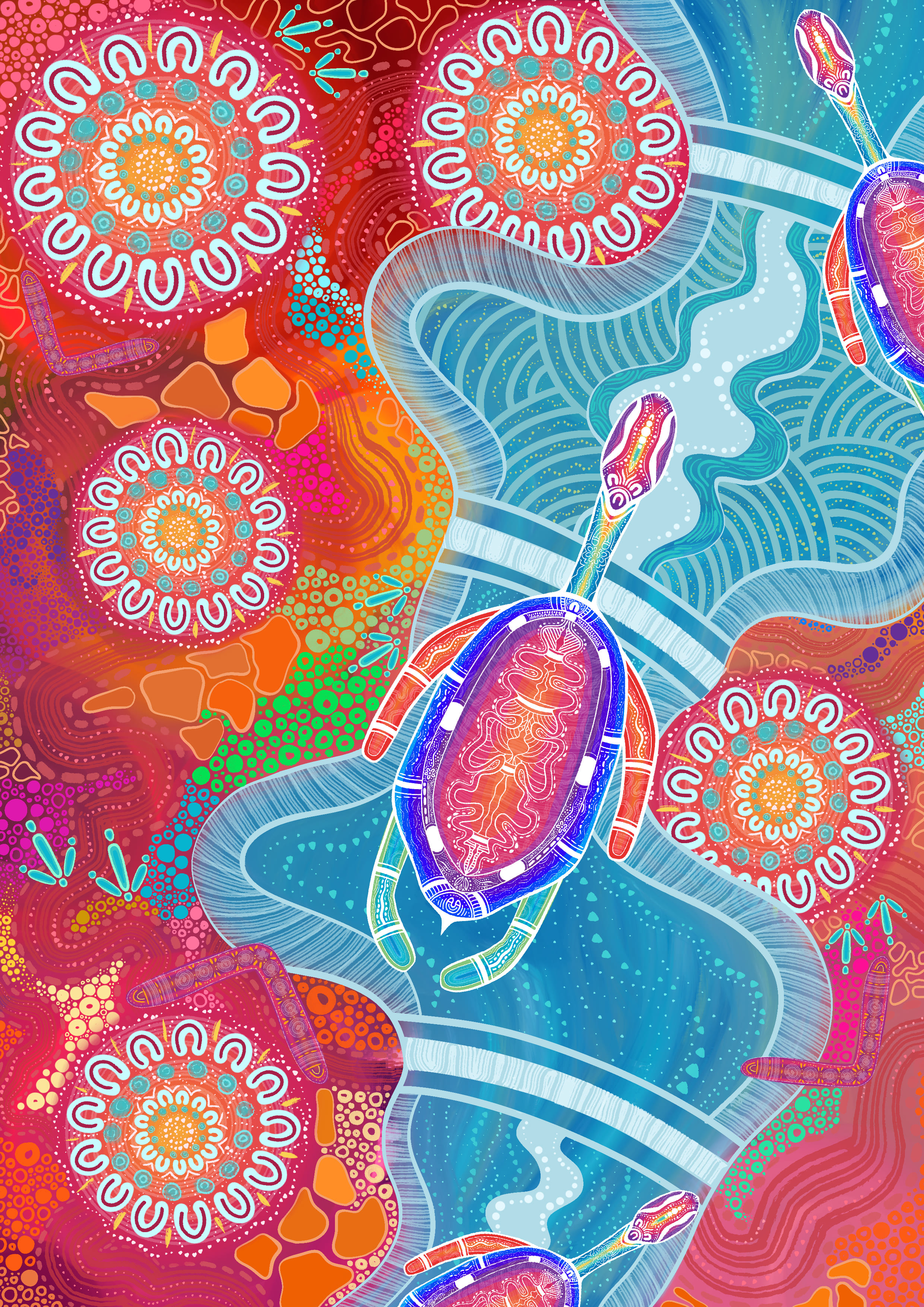
Description of Artwork
Journey of Healing, Strength & Connection - This artwork tells a story of healing, growth, resilience and reconnecting to self, culture and Country. The sacred waterways of Dhungala symbolise renewal and movement, while the long-neck turtles represent Ancestors carrying wisdom, protection and cultural knowledge.
Warm colours reflect the beauty and complexity of life, while gathering circles represent family, connection, yarning, ceremony and cultural knowledge passed through generations. The artwork is a reminder to keep moving forward, stay connected to who you are, and trust that your spirit, culture and Ancestors will guide you home.
About the artist
Alkina Edwards is a Yorta Yorta woman with matriarchal heritage spanning Yorta Yorta, Wemba Wemba, Mutthi Mutthi and Wiradjuri, and patriarchal roots in Bundjalung, Wakka Wakka and Jinibara peoples. Her strong family connections span the Northern Territory, Queensland, Victoria and New South Wales.
Drawing inspiration from Country, community and cultural stories, Alkina’s art reflects her lived experience as an Indigenous woman. Her work celebrates family, identity, self-determination and heritage, expressing deep pride in her ancestry and the strength and resilience of her people.
Barring yana-ngali gadhaba
Barring yana-ngali gadhaba means ‘The pathway we will walk together’ in the Boonwurrung language. Boonwurrung language name provided by Professor N’arwee’t Carolyn Briggs AM, a recognised Traditional Owner of the Yalukit Willam of the Boonwurrung.
Acknowledgement of Country
We acknowledge Aboriginal people in Victoria and their ongoing strength in practising the world’s oldest living cultures. We acknowledge the Traditional Owners of the lands and waters on which we live and work and pay our respect to their Elders past and present.
We recognise that from time immemorial, Aboriginal people have practised their law and lore, customs and languages, and nurtured Country through their spiritual, cultural, material and economic connections to land, water and resources.
We acknowledge that the long-lasting, far-reaching and intergenerational consequences of the dispossession of Aboriginal people of their Country are a direct result of colonisation. This history, and the systems it gave rise to, continue to harm Aboriginal people today. It is only through true self-determination that we can begin to right the wrongs of the past.
We acknowledge the strength and resilience of Aboriginal people in the face of historical and ongoing injustices, and the survival of their living cultures, knowledge and traditions.
Statement on language
Language is important and can change over time. Words can have different meanings for different people, and we acknowledge the diversity of Aboriginal peoples, communities and cultures throughout Victoria.
Aboriginal people
We recognise the diversity of Aboriginal people living throughout Victoria. The terms Koorie or Koori are commonly used by many Aboriginal people of southeast Australia and appear in the names of some government and Community policies and programs. The National Agreement on Closing the Gap uses the term Aboriginal and Torres Strait Islander peoples, while other policies and programs within Victoria and elsewhere in Australia may use the terms Indigenous or First Peoples to refer to the original inhabitants of the lands and waters now known as Australia.
The Implementation Plan uses the term Aboriginal to refer inclusively to all Aboriginal and Torres Strait Islander people living in Victoria, except when quoting from or using the names of specific programs, organisations or frameworks which use different terminology.
Aboriginal organisations
An ‘Aboriginal organisation’ means an Aboriginal Community-Controlled Organisation (ACCO), Traditional Owner group (including Traditional Owner Corporations (TOCs)), or other Aboriginal-led or Aboriginal-governed organisation.
We adopt the definition of an ACCO used in the National Agreement on Closing the Gap, to mean an organisation that delivers services, including land and resource management, that builds the strength and empowerment of Aboriginal communities and is:
a. incorporated under relevant legislation and not-for-profit
b. controlled and operated by Aboriginal and/or Torres Strait Islander people
c. connected to the community, or communities, in which they deliver the services
d. governed by a majority Aboriginal and/or Torres Strait Islander governing body.
In this Plan, ‘Traditional Owner group’ refers to a community of Aboriginal peoples who hold a distinct spiritual, cultural, and historical connection to a particular area of Country. A Traditional Owner group may be formally incorporated as a legal entity (e.g. a TOC), or it may exist as a non-incorporated community. A TOC is an incorporated group that represents the interests of Traditional Owners in a particular area. They may hold rights under federal or state legislation on behalf of the Traditional Owners they represent, or they may have no formal agreements in place.
Language, culture and Country
Aboriginal Language, culture, Country and Community are central to the identity, strength, resilience and wellbeing of Aboriginal people, families and communities. Connection to culture, Country, Community and kinship plays a vital role in supporting positive outcomes across all areas of life.
In this Implementation Plan, ‘Language’ refers to Aboriginal languages as the living expression of the world’s oldest continuing cultures, encompassing the cultural, spiritual and intellectual connections between people, Country, community and identity.
‘Culture’ refers to the knowledge systems, lore, customs, practices, values, objects and places that are culturally meaningful and connected to Aboriginal identity, community and Country.
‘Country’ refers to the lands, waterways and seas to which Aboriginal peoples are connected, including the cultural, spiritual, familial and ancestral relationships that underpin law, language, custom, identity and responsibility.
‘Community’ refers to the relationships and connections shared between Aboriginal people, families and kin. Community encompasses the cultural, emotional and social ties that create a sense of belonging and connect people to family, kinship, culture and Country.
The Victorian Government acknowledges the ongoing impacts of colonisation, including the disruption and loss of Aboriginal languages, cultural practices and traditional knowledge systems. We recognise that strengthening language, culture and connection to Country and Community is fundamental to advancing self-determination and achieving the outcomes of the National Agreement on Closing the Gap.
LGBTIQA+ and gender inclusivity
The Victorian Government acknowledges the diversity of gender identity, expression and experience among all people in Victoria, including Aboriginal people.
The term ‘LGBTIQA+’ refers to people who are lesbian, gay, bisexual, trans and gender diverse, intersex, queer or asexual. We also acknowledge that some communities use additional terms related to gender and sexuality which are encompassed in the ‘+’ included in the acronym. Some Aboriginal communities use the terms “sistergirl” and “brotherboy”. Sistergirl and brotherboy are terms used in Aboriginal and Torres Strait Islander communities to describe transgender people. Using these terms can validate and strengthen their gender identities and relationships. Sistergirls and brotherboys might be non-binary, female or male.
Queer is often used as an umbrella term for diverse genders or sexualities. Some people use it to describe their own gender or sexuality, as an identity that sits outside heterosexual norms. For some people, especially older people, the word carries negative connotations, because it was once used to discriminate.
We intend terms related to gender and sexuality to be read inclusively. They cover all people who identify with them, whether in whole or in part. The terms “woman/women” or “man/men” refer to all people who identify as women or men. This includes trans or cis people, regardless of their sex or gender assigned at birth. It also includes people who identify as non-binary or genderqueer. This approach respects the diversity of gender identities and experiences within the community. It also recognises that many issues in the Plan are gendered, and that colonialism and systemic injustice affect people of different genders in different ways.
Message from the Minister for First Peoples

I am proud to present Barring yana-ngali gadhaba - Victoria’s Closing the Gap Implementation Plan 2026–2031.
The Victorian Government’s nation-leading commitment to Treaty, Truth and Closing the Gap demonstrates our determination to confront the legacy of injustice and dispossession and the enduring harm of colonisation which has impacted the lives of Aboriginal people in Victoria for generations.
Barring yana-ngali gadhaba is a vital part of that commitment. It reflects an integrated vision for how the Victorian Government will work in partnership with the Aboriginal community to Close the Gap in the Treaty era. The landmark reforms being delivered through both the Treaty and truth-telling processes represent a significant step forward in the delivery of Victoria’s commitments under the National Agreement on Closing the Gap. Barring yana-ngali gadhaba will continue to build on that work - shifting away from business-as-usual approaches and placing Aboriginal self-determination at the heart of policy development, service design and implementation.
We know that lasting change is achieved when Aboriginal people lead the decisions that affect their lives. Barring yana-ngali gadhaba has been developed in close partnership with Ngaweeyan Maar-oo through an extensive co-design process over the past two years. I offer my profound thanks to every member of Ngaweeyan Maar-oo. Your collaboration in this process has ensured that the collective expertise, wisdom and deep understanding you hold of the needs, priorities and aspirations of Aboriginal communities across Victoria is reflected in this Implementation Plan and will continue to drive progress towards Closing the Gap over the next five years.
Barring yana-ngali gadhaba responds to the recommendations of the Productivity Commission’s review of the National Agreement, setting out a concrete, forward-looking vision for how we will deliver tangible progress under the National Agreement through 52 clear and deliverable actions. We will remain accountable to Community for delivering on this vision through regular public reporting and ongoing collaboration and shared leadership with Ngaweeyan Maar-oo and Gellung Warl.
The establishment of Gellung Warl and Nginma Ngainga Wara under the Statewide Treaty Act 2025 made Victoria the first jurisdiction in Australia to meet its commitment under the National Agreement to establish an independent mechanism to monitor and report on progress towards Closing the Gap.
Now that Victoria has entered the Treaty era, Closing the Gap has never been more important. The signing of Australia’s first Statewide Treaty was the result of generations of advocacy by Aboriginal people throughout Victoria – reflecting the long, steady path that the Victorian Government and Aboriginal people in Victoria have been walking for nearly a decade. Treaty represents a turning point in the relationship between government and Aboriginal people in Victoria, recognising the rightful place of Aboriginal people as decision-makers of their own futures and building the foundation for an enduring relationship built on respect, trust, accountability and integrity.
We know that Aboriginal community control is an act of self-determination, that Aboriginal people know what works best for their communities, and that a strong and sustainable ACCO sector is essential to Closing the Gap. We also know that strengthening the ACCO sector alone is not enough – delivering on government’s commitment to the structural transformation needed to Close the Gap requires clear and tangible action to drive system-wide reform. The establishment of Gellung Warl as the representative body for Aboriginal people in Victoria and Ngima Ngainga Wara as its accountability arm demonstrate the Victorian Government’s commitment to do what is needed to Close the Gap.
The ambitious program of work set out in Barring yana-ngali gadhaba will ensure that Closing the Gap is working hand-in-hand with Treaty to see the National Agreement’s vision of genuine partnership, shared-decision making and accountability transformed into action.
I offer my deepest thanks to the Community leaders who have offered their decades of collective expertise to make this Implementation Plan possible. Through Treaty, Truth and Closing the Gap we will work together to build a stronger, fairer future for Aboriginal people and all Victorians.
Gabrielle Williams MP
Minister for First Peoples
Message from the Co-Chairs of Ngaweeyan Maar-oo

Kaley Nicholson, Co-Chair, Ngaweeyan Maar-oo
James Atkinson, Co-Chair, Ngaweeyan Maar-oo
As Co-Chairs of Ngaweeyan Maar-oo, we are proud to present Barring yana-ngali gadhaba, a vital step towards closing the gap and uplifting Aboriginal communities across Victoria. Our focus is on partnership, not just delivery. This work is grounded in the National Agreement on Closing the Gap and its four Priority Reforms: shared decision-making, a strong and sustainable Aboriginal community-controlled organisation (ACCO) sector, transforming government organisations, and shared access to data and accountability. In Victoria, this is guided by the Victorian Aboriginal Affairs Framework and strengthened by the State's commitments to Treaty and truth-telling.
Guided by Treaty and truth-telling, our efforts lay the foundation for a self-determined future. Together, these initiatives aim to shift from simple consultation to shared decision-making in governance, commissioning, data management, and accountability. The service system must also be designed to be culturally safe. This work is also being developed in partnership with the First Peoples' Assembly of Victoria and follows the guidance of the Yoorrook Justice Commission.
Our starting point is clear. Aboriginal communities hold the knowledge and solutions for what works best. When Aboriginal organisations lead design, delivery, and evaluation, outcomes improve, and the benefits are felt across families, Country, and culture. This Implementation Plan reaffirms our commitment to embrace proven strategies and transform ineffective systems.
We recognise that progress has been uneven. Too many outcomes remain off track, and the pace of change is not yet matching the ambition set by communities. That is why Barring yana-ngali gadhaba puts Priority Reforms at the centre. For Ngaweeyan Maar-oo, partnership means actively sharing power and accountability. It involves who makes decisions, how money is shared, how information is exchanged, and whether services are safe and respectful for everyone involved.
We align our approach with the United Nations Declaration on the Rights of Indigenous Peoples (UNDRIP). UNDRIP affirms rights to self-determination, participation in decision-making, and control over data and knowledge. This means designing policies with communities, not for them, and ensuring that information and evidence are available to communities so they can set priorities and assess progress.
Across the life of this Plan, we will work with government and partners to deliver practical shifts that communities have called for:
- Multi-year, flexible investment that grows and sustains the ACCO sector, ensuring responsibility is matched with resources.
- Commissioning and procurement settings that preference ACCO leadership and embed cultural safety across mainstream services.
- Mechanisms for local agreements and place-based priorities to shape investment and delivery so that communities can see and feel the change in their area.
- A shared data and accountability system that includes community-held knowledge and aligns with data sovereignty and Treaty principles.
- A culturally safe workforce, with pathways for Aboriginal staff and accountability for respectful, trauma-aware practice in every service.
We will report openly on progress, learn from what does not work, and adapt quickly. The measures that matter are those defined with community, and the test of success is whether people experience better outcomes in their daily lives—children safe and thriving, families strong, languages and cultures flourishing, access to quality education, employment, housing and health care, and fairer justice outcomes.
Barring yana-ngali gadhaba reflects a shared commitment between the Victorian Government, the ACCO sector, and Community leaders. We invite all levels of government and the service system to join us in transforming our practices together. We ask that every action in this Implementation Plan be implemented with communities at the table, that investment follows evidence and need, and that accountability is public and clear.
Ngaweeyan Maar-oo will use Barring yana-ngali gadhaba to progress practical steps that make the system Treaty-ready, including building capability across agencies, aligning accountability and reporting with Treaty principles, and ensuring communities see tangible benefits now while longer-term arrangements continue to be negotiated and implemented.
Collectively, we share the responsibility to close the gap and create a brighter future for our communities. Ngaweeyan Maar-oo will continue to play our role as an Implementation Partner, holding ourselves to the same standards we seek from others. With support from the ACCO sector, our Community leaders, and a real partnership, we believe Victoria can make the changes our people have been asking for.
Kaley Nicholson and James Atkinson
Co-Chairs, Ngaweeyan Maar-oo
Executive summary
Barring yana-ngali gadhaba - Victoria’s Closing the Gap Implementation Plan 2026–2031 outlines the highest priority strategic actions that the Victorian Government will take over the next five years to drive progress on Closing the Gap.
Barring yana-ngali gadhaba has been developed in partnership with Ngaweeyan Maar-oo, the Koorie Caucus of Victoria’s Partnership Forum on Closing the Gap, through an extensive co-design process undertaken over the past two years. It reflects a shared commitment to improving accountability, strengthening partnerships with Aboriginal organisations, and advancing shared decision-making between government and Aboriginal people in Victoria.
The actions contained within Barring yana-ngali gadhaba are strategic, forward-looking and outcomes focused. They are designed to accelerate progress towards achieving the Priority Reforms and socio-economic targets (SETs) set out in the National Agreement on Closing the Gap (National Agreement) by addressing the structural and systemic barriers that continue to contribute to inequitable outcomes for Aboriginal people in Victoria. Consistent with the findings of the Productivity Commission’s review of the National Agreement, this Plan focuses on the transformational changes required to drive long-term progress, rather than presenting a comprehensive list of existing programs, services or commitments.
Barring yana-ngali gadhaba embeds a coordinated whole-of-government approach to Closing the Gap implementation. It recognises that the National Agreement is an interconnected cross-portfolio reform agenda that requires governments to fundamentally change the way they work with Aboriginal people and organisations. The actions included in the plan are underpinned by clear theories of change to ensure that each action will contribute to improved outcomes and support accountability for delivery.
The development and delivery of Barring yana-ngali gadhaba is occurring at a pivotal moment in the relationship between government and Aboriginal people in Victoria. Landmark reforms are underway through Truth and Treaty, creating unprecedented opportunities to transform systems, strengthen Aboriginal self-determination and reshape the relationship between Aboriginal people and government.
Barring yana-ngali gadhaba recognises that Truth, Treaty and Closing the Gap are inextricably connected and mutually reinforcing. Together, these reform agendas are strengthening Aboriginal voices in decision-making, creating new mechanisms for shared authority and accountability, and laying the foundations for long-term systemic change.
Following decades of advocacy by Aboriginal people, Victoria’s first Statewide Treaty formally commenced in December 2025. Alongside the Yoorrook Justice Commission, Australia’s first formal truth-telling process, Treaty represents a significant shift in the relationship between Aboriginal people and the State. These reforms support the transfer of power and resources, strengthen self-determination, and create new opportunities for Aboriginal people to influence the decisions that affect their lives, communities and futures.
The Implementation Plan builds on this momentum, recognising that achieving the ambitions of the National Agreement will require sustained effort across all parts of government and ongoing partnership with Aboriginal communities, organisations and Traditional Owners.
Barring yana-ngali gadhaba is structured to provide both strategic direction and accountability for delivering Closing the Gap outcomes in Victoria.
- The opening chapters establish the context for implementation, including the relationship between Closing the Gap, Truth and Treaty, and outlines the approach taken to develop the Plan.
- The Priority Reforms chapter outlines how the Victorian Government will drive the systemic and structural change envisaged by the four Priority Reforms. It includes nine whole-of-government actions that, alongside Treaty, will provide a strong foundation for transformational reform.
- The socio-economic targets chapter sets out 43 new actions across the 17 socio-economic outcome areas in the National Agreement. These actions will be delivered in partnership with Aboriginal organisations to support progress towards Closing the Gap targets across government.
- The accountability, monitoring and evaluation chapter outlines how government will work in partnership with community to ensure transparency and accountability for delivering the plan.
- The appendices provide detailed information on actions, implementation responsibilities, and supporting material.
The four Priority Reforms remain at the heart of this work. They represent the fundamental changes required to transform how governments work with and for Aboriginal people and are critical to achieving lasting improvements in outcomes. The Priority Reforms respond directly to the aspirations and priorities Aboriginal communities have long advocated for, including stronger shared decision-making, a sustainable and well-resourced Aboriginal community-controlled sector, greater access to and sharing of data, and transformed government organisations that are culturally safe and accountable.
The Priority Reforms require governments to move beyond business-as-usual approaches and embrace new ways of working that place Aboriginal self-determination at the centre of policy development, service design and implementation. Central to this work is a strong, sustainable and well-resourced Aboriginal community-controlled sector. Aboriginal organisations play a critical role in delivering culturally safe services, strengthening communities, preserving culture and driving accountability across government systems. Supporting the growth and capability of the Aboriginal community-controlled sector remains essential to achieving the objectives of the National Agreement and ensuring Aboriginal people have greater authority over decisions that affect their lives.
This Implementation Plan also reflects the importance of culture, connection and Community strengthening as foundations for improved outcomes. By prioritising self-determined solutions, revitalising language and culture, supporting Aboriginal Elders, expanding access to land and water, and empowering the next generation of proud, strong and thriving Aboriginal people, Victoria is helping to ensure Aboriginal culture continues to flourish for future generations.
The actions contained within this Plan are supported by accountability, monitoring and evaluation arrangements. Progress towards implementation will be publicly reported through annual Closing the Gap reporting. Evaluation approaches will be developed in partnership with relevant Aboriginal organisations to ensure actions remain effective, responsive and accountable to Aboriginal communities.
While progress has been made, significant disparities remain across many areas of social, economic and cultural wellbeing. Closing the Gap is therefore both an opportunity and an obligation. It is an opportunity to create a future where Aboriginal people in Victoria can thrive and enjoy equitable outcomes across all aspects of life. It is also an obligation on governments to address the legacy of policies, practices and systems that have contributed to enduring inequality.
The findings of the Yoorrook Justice Commission have highlighted the profound and ongoing impacts of colonisation and systemic injustice experienced by Aboriginal people in Victoria, while also recognising the strength, resilience and leadership of Aboriginal communities. These findings reinforce the importance of sustained action to address structural inequality and create lasting change.
Barring yana-ngali gadhaba represents an important step in that journey. Through partnership, accountability and a shared commitment to self-determination, the Victorian Government and Aboriginal communities can continue to drive the systemic change intended by the National Agreement. Together with Truth and Treaty, the actions outlined in this Plan will contribute to a future where Aboriginal people in Victoria determine their own futures, where culture and Community are strengthened, and where the gap in life outcomes is closed for current and future generations.
Introduction
The National Agreement on Closing the Gap, first signed in 2020, sets out a shared vision for fundamentally transforming the way that governments around Australia work with Aboriginal people to advance self-determination and improve life outcomes for Aboriginal people in a way that is genuine, sustainable and reflects the needs and priorities of Community. It aims to address the longstanding detrimental impacts of colonisation, systemic racism and the structural exclusion of Aboriginal people from core government decision-making processes.
Victoria’s Commitment to Closing the Gap
Since 2020, Victoria has witnessed once-in-a-generation shifts in the relationship between government and Aboriginal people. This has included:
- the first ever formal Truth-telling process inquiring into Aboriginal people’s ongoing lived experiences of colonialism and systemic injustice, the Yoorrook Justice Commission.
- the historic signing of the first ever Statewide Treaty, which recognises the unique and ongoing spiritual, social, cultural and economic relationship that Aboriginal people in Victoria have with their traditional lands and waters and creates a lasting framework for self-determination and genuine government accountability.
These landmark reforms have delivered, and will continue to deliver, ongoing and tangible benefits for Aboriginal Victorians, ensuring that their voices are heard and respected in the way that government makes decisions that affect their lives. Alongside the specific actions included in Barring yana-ngali gadhaba, Treaty and Truth will make a significant contribution to the National Agreement’s core aim of overcoming the entrenched inequality faced by Aboriginal people. The commencement of Victoria’s Treaty era will not delay Victoria’s commitments to Closing the Gap and delivering improved outcomes for Aboriginal people in the present. The Victorian Government remains committed to the vision of partnership, self-determination and transformative change set out in the National Agreement, and to Closing the Gap on socio-economic outcomes between Aboriginal and non-Aboriginal people that continues to impact the lived experience of Aboriginal people in Victoria and around Australia.
To deliver this vision, the Victorian Government is working in close partnership with Ngaweeyan Maar-oo – the Koorie Caucus of Victoria’s Partnership Forum on Closing the Gap – to improve accountability, build enduring and productive partnerships with Aboriginal organisations, and advance shared decision-making between government and Aboriginal Victorians. The Partnership Forum brings together the heads of every department and select agencies in the Victorian Public Service with Community leaders representing each Aboriginal Governance Forum and the ACCO sectors that provide services essential to advancing the wellbeing of Aboriginal people in Victoria. The Partnership Forum recognises that a strong Aboriginal Community-Controlled sector and strong Traditional Owner Corporations are essential to enabling Aboriginal people in Victoria to lead supported, self-determined and flourishing lives.
Partnering with Aboriginal people for shared decision-making on Closing the Gap implementation through Ngaweeyan Maar-oo Victoria’s Partnership Forum on Closing the Gap was established in May 2022 as the formal body for shared decision-making between the Victorian Government and Aboriginal Victorians on the implementation of the National Agreement. It is comprised of Ngaweeyan Maar-oo – the Koorie Caucus of the Partnership Forum – and senior executives from the Victorian Government, being the Secretary of every department in the Victorian Public Service, the Chief Commissioner of Police, the Chief Executive Officer of Homes Victoria and the Victorian Public Sector Commissioner. The Partnership Forum was responsible for overseeing the development of this Implementation Plan through a collaborative process of co-design between Community and government. It is the shared decision-making body that will be accountable for overseeing its delivery. Ngaweeyan Maar-oo, meaning “voice of and from the people” in Gunditjmara language, is comprised of delegates from eight Aboriginal Governance Forum Aboriginal Caucuses, and community-selected ACCO representatives across 14 sectors. Members of Ngaweeyan Maar-oo were selected through a community-led consultation process, ensuring representation is grounded in local knowledge, lived experience and Community authority. This selection process sought nominations from Aboriginal communities and ACCO sectors – reinforcing legitimacy, accountability and strong links to Community. Ngaweeyan Maar-oo members bring expertise, cultural knowledge and decades of experience and commitment to serving Community in Victoria. Ngaweeyan Maar-oo is also a member of the Coalition of Aboriginal and Torres Strait Islander Peak Organisations (Coalition of Peaks), the national body responsible for working with governments to Close the Gap as a party to the National Agreement. Together, through the Partnership Forum, Ngaweeyan Maar-oo and the Victorian Government are committed to delivering the National Agreement’s partnership actions, including policy and place-based partnerships and delivering a wide range of projects to strengthen the ACCO sector. Ensuring Aboriginal voices are heard and respected, and that government is working in genuine partnership with Community to deliver tangible progress on Closing the Gap, sits at the heart of the Partnership Forum’s approach. The Partnership Forum supports the Victorian Government to uphold the National Agreement’s strong partnership elements (clause 32) by ensuring that:
Since Ngaweeyan Maar-oo’s inception in 2022, the Victorian Government has provided over $9.3 million to Ngaweeyan Maar-oo members and the Ngaweeyan Maar-oo Secretariat to support participation in the Partnership Forum and enable a strong collaborative approach to Closing the Gap. |
NGAWEEYAN MAAR-OO (KOORIE CAUCUS) Co-Chairs James Atkinson and Kaley Nicholson | GOVERNMENT MEMBERS Co-Chair Chris Barrett | |
| ACCO sectors and their elected representatives | Aboriginal Governance Forum delegates | Heads of departments and selected agencies |
|
|
|
1As at September 2026
Closing the Gap, Truth and Treaty in Victoria
The development and delivery of Barring yana-ngali gadhaba is occurring at a pivotal moment of transformation in the relationship between government and Aboriginal people in Victoria, with landmark reforms being delivered through Truth and Treaty. Barring yana-ngali gadhaba builds on Victoria’s work to date to deliver on its commitments under the National Agreement and complements the significant shifts currently underway in Victoria to strengthen the voices of Aboriginal people in government decision making. To reflect the need for flexibility and ongoing alignment between these dynamic reforms, this Implementation Plan may also be subject to further updates over the course of its lifetime in consultation with Gellung Warl, the permanent representative and deliberative body for Aboriginal people in Victoria.
Barring yana-ngali gadhaba recognises that Truth, Treaty and Closing the Gap are inextricably connected and work together to deliver the best possible outcomes for Aboriginal Victorians. By aligning the objectives of the National Agreement on Closing the Gap with Victoria’s Truth and Treaty processes, and by committing to a more strategic, future focussed set of actions co-designed with Ngaweeyan Maar-oo, this plan seeks to accelerate change, reinforce partnerships, strengthen accountability and contribute to the long-term transformation required to close the gap for Aboriginal people in Victoria.
Progress to date
Over the last five years the Victorian Government has continued to deliver on its commitment to working in partnership with Aboriginal people to close the gap. This work has resulted in some improvements in key socio-economic outcomes, including improved participation in early childhood education, improved early childhood immunisation rates and reductions in perinatal mortality, and strengthened Aboriginal-led governance and partnership arrangements across government. As work on Closing the Gap progresses, Aboriginal voices are increasingly shaping policy design, service delivery and accountability across a wide range of service sectors.
Accountability for outcomes remains central to the Victorian government’s approach to Closing the Gap. Regular and transparent reporting through the annual Victorian Government Aboriginal Affairs Report (VGAAR) has highlighted that progress towards the National Agreement’s objectives remains uneven, with persistent overrepresentation of Aboriginal people in the justice and child protection systems and worsening outcomes in some areas of social and emotional wellbeing, including regarding levels of psychological distress and self-harm.
The Victorian Government recognises that more needs to be done to close the gap. That is why, in developing this Implementation Plan, the Victorian Government has prioritised shared decision-making and partnership, embedding Aboriginal voices in all stages of the project design to ensure the actions reflect the priorities of Aboriginal organisations and Aboriginal communities.
Key Initiatives
Priority Reform One: Formal partnerships and shared decision-making Place-based Partnership (PBP) and Community Data Project (CDP) The purpose of a PBP is to implement the National Agreement through a long-term community development approach that responds to local priorities in partnership with ACCOs. The Joint Council on Closing the Gap (Joint Council) and the Partnership Forum both endorsed Gippsland as the location for a PBP to be combined with a Community Data Project (CDP). This aligns with Ngaweeyan Maar-oo identifying the region as experiencing high demand for early childhood, child protection and justice services. The Victorian Aboriginal Child and Community Agency (VACCA) led the scoping exercises with ACCO representatives to identify local priorities and develop a project proposal. Aboriginal Governance Forums Victoria has shared decision-making structures across the system through Aboriginal Governance Forums ensuring Aboriginal leaders partner with government in policy design, delivery and accountability across key portfolios. All Aboriginal Governance Forums operate under formal partnership agreements aligned with the National Agreement. Local Council Audit Throughout 2024 and 2025, Ngaweeyan Maar-oo undertook a Local Government Area Closing the Gap Partnership Stocktake. This work audited local government action and benchmarked progress against the Closing the Gap Priority Reforms, recognising the important leadership, governance and advocacy role local councils play in critical areas of local community life – including place-based planning, community engagement and representation, public service provision, and local decision-making regarding legislation and budgeting. Specifically, this work considered how well Closing the Gap priorities are currently reflected across local government planning, reporting and engagement with Aboriginal communities and organisations, and identified opportunities to strengthen alignment with the National Agreement. The audit has helped build a clearer understanding of where stronger coordination, consistency and accountability may be needed across state and local systems to enhance Closing the Gap effort and outcomes. The audit findings highlight the need for a more connected approach to implementation, ensuring Closing the Gap is advanced not only through state-level reform, but also through action that reflects local priorities and needs. |
Partnership Stocktake
Clause 36: Government Parties to review and strengthen partnership arrangements
The Victorian Government’s 2022 Partnership Stocktake assessed departmental partnership arrangements against the National Agreement’s partnership elements, finding that all Victorian Aboriginal Governance Forums met these elements to a relatively high degree. Victoria’s 2023 Partnership Stocktake was also submitted to Joint Council and considered nationally in 2024.
More broadly, the annual VGAAR also shows continued improvement in the maturity and consistency of partnership arrangements – including clearer decision-making authority for Aboriginal partners, strengthened accountability mechanisms and improved resourcing to support Aboriginal participation.
Priority Reform Two: Building the Community-controlled sector Recent VGAARs highlight continued investment in ACCOs including expanded service delivery roles in justice, health, family violence response and housing. ACCOs are also increasingly being commissioned as preferred providers reflecting a shift from consultation to Aboriginal-led delivery. Sector strengthening projects Upon signing the National Agreement in July 2020, the Victorian Government committed $3.3 million over four years to ACCO sector strengthening. Throughout 2023 and 2024, the Partnership Forum approved the allocation of funding to projects developed and led by Ngaweeyan Maar-oo members across priority sectors including disability, early childhood development, health, housing, languages and culture. These projects were decided by Ngaweeyan Maar-oo through a self-determined process to focus on building capacity in priority ACCO sectors, recognising that ACCOs are critical for Aboriginal communities and culture. A strong ACCO sector will support improved service delivery and outcomes for Aboriginal Victorians. |
Victoria’s Closing the Gap Expenditure Review
Clause 113: Review and reprioritise expenditure to Aboriginal Community-Controlled Organisations
In partnership with Ngaweeyan Maar-oo, the Victorian Government reviewed and identified its spending on Aboriginal programs and services with a focus on the 2022-23 financial year, delivering Victoria’s Expenditure Review in late 2023. Delivering on Victoria’s commitment under clause 113 of the National Agreement, the review looked at government spending exclusively or predominantly targeted for Aboriginal people (‘targeted expenditure’) – such as a discrete grants program eligible to only Aboriginal organisations. The aim of the Expenditure Review was to identify reprioritisation and capacity strengthening opportunities for ACCOs.
This was the first time this kind of exercise had been undertaken in Victoria, representing a foundational step towards greater transparency and accountability of government expenditure for and with Aboriginal people. The Expenditure Review provided financial and non-financial data which could be used to inform decision-making by governments and ACCOs.
Priority Reform Three – Transforming government organisations Independent Mechanism Victoria is the first jurisdiction to legislate an independent accountability mechanism under the National Agreement through the Statewide Treaty Act 2025 (Vic). The establishment of Nginma Ngainga Wara within Gellung Warl fulfils the commitment to establish an Aboriginal-led mechanism to monitor, evaluate and report on government performance and impacts on Aboriginal people. Public sector transformation is further supported through legislated obligations under the Public Administration Act 2004 (Vic) for public service body and special body heads to support the development of a culturally capable workforce and provide ongoing education and training to develop and maintain an understanding of Treaty and ongoing truth-telling. |
Cross-cutting progress on socio-economic targets
Recent VGAARs show progress in selected areas, including declining rates of perinatal mortality, historically high childhood immunisation rates, improved participation in early childhood education and strengthened Aboriginal governance and leadership across systems.
At the same time, reporting acknowledges areas requiring ongoing focus, including over-representation in the justice and child protection systems and worsening outcomes in some measure of social and emotional wellbeing, reinforcing the need for sustained, structural reform.
More details regarding Victoria’s progress against the SETs are available in the annual Victorian Government Aboriginal Affairs Report.
Priority Reform Four – Shared access to data and information Victoria reports annually on Closing the Gap through the VGAAR, providing accessible, public reporting on outcomes, reform progress and system performance. Under Statewide Treaty, written guidelines detailing how departments will consult with the First Peoples’ Assembly of Gellung Warl in relation to Indigenous Data Sovereignty will be developed by each departmental Secretary and the Chief Commissioner of Victoria Police. The Victorian Government also funded a scoping exercise to identify community priorities for a Community Data Project in Gippsland (see ‘Priority Reform One’ section above), which could support ACCOs and communities to control how data is collected, used and applied to local decision making. |
Reviews of the National Agreement
The Productivity Commission’s first review of the National Agreement (Productivity Commission Review) was released in February 2024. It highlighted a severe lack of progress in delivering the Priority Reforms and found that more needed to be done to deliver the genuine change envisaged by the National Agreement. It recommended governments write strategic implementation plans, in collaboration with Aboriginal people that outline agreed strategies and actions for progressing the National Agreement’s objectives. Importantly, these implementation plan actions are to be underpinned by a clear theory of change.
The Independent Aboriginal and Torres Strait Islander-led Review of the National Agreement (Indigenous-led Review), conducted by the Jumbunna Institute and released in June 2025, also highlighted the need to re-examine the relationship between governments and Aboriginal people, along with a commitment to self-determination in action and the transformation of structures for all. The Indigenous-led Review provided recommendations as a lever for internal reflection to drive genuine transformation within governments through systemic and structural change and enable them to rise to the ambition of the National Agreement.
Developing the Implementation Plan
Reflecting these findings, the Victorian Government developed this Implementation Plan in close partnership with Ngaweeyan Maar-oo, through an extensive engagement process grounded in the principles of accountability and shared decision-making. Governance for the project included the establishment of a Joint Project Team and an Executive Leadership Group, where staff and executives from within the Victorian Government and Ngaweeyan Maar-oo came together to design, deliver and oversee the development of the Implementation Plan. This approach ensured that Aboriginal voices were embedded in all stages of the project and are reflected in the final plan.
Consultation and co-design of the Implementation Plan Multiple rounds of consultation, which involved close collaboration between departments and Ngaweeyan Maar-oo members across multiple sectors, were undertaken to support the development and refinement of the actions included in the plan (see table below). What we heard from Community during these consultations about their key concerns and priorities is highlighted throughout the plan in the “What we heard” sections included for each Priority Reform and socio-economic target. These actions have been agreed by Community and government as the highest priority strategic actions to be progressed over the next five years to realise the transformative change needed to close the gap. |
| Phase | Dates | Approach and outcomes |
| Information gathering | Nov 2024 – Jan 2025 |
|
| Reviewing draft actions | Feb 2025 – Apr 2025 |
|
| Finalising socio-economic target actions | Jul 2025 – Apr 2026 |
|
| Finalising Priority Reform actions | Mar 2026 – May 2026 |
|
| Finalising draft plan | Apr 2026 – Jun 2026 |
|
Theory of change
Barring yana-ngali gadhaba embeds a forward-looking approach to Closing the Gap implementation, reflecting a coordinated whole-of-government strategy for achieving the Priority Reforms and meeting the SETs in the National Agreement. They focus on the structural changes needed to Close the Gap in a strategic way, rather than focusing only on the delivery of discrete programs and services. This approach reflects the need to understand the National Agreement as an interconnected and systemic reform agenda, rather than a set of discrete targets. Barring yana-ngali gadhaba recognises that the Closing the Gap Priority Reforms and Treaty are interconnected drivers for systemic change to improve life outcomes for Aboriginal people in Victoria.
The actions included in this Barring yana-ngali gadhaba are specific and outcome-focused to support clarity, understanding and accountability for the Victorian Government’s implementation of the National Agreement in the coming years. As outlined in the Accountability, Monitoring and Evaluation chapter, progress towards implementing the actions will be publicly reported annually in a discrete Closing the Gap Annual Report. Each action will also include an evaluation approach to assess its effectiveness, which will be co-designed with relevant Aboriginal organisations and integrated into the delivery of the actions.
Each Priority Reform action includes a theory of change that clearly articulates how the proposed action will lead to the desired change and improve outcomes for Aboriginal Victorians over time. This helps ensure everyone is working from the same understanding of how change is expected to occur and how the objectives of each action will be achieved. Including a theory of change for each of the Priority Reform action provides a clear foundation for monitoring progress to support a better understanding of what is or is not working during the implementation phase.
Barring yana-ngali gadhaba also responds to the findings of the Productivity Commission Review and Indigenous-led Review by:
- developing and outlining a coordinated and strategic approach to Closing the Gap implementation in close partnership with Aboriginal people
- focusing on the fundamental transformation that needs to happen within government to enable the National Agreement to be embedded in government ways of working
- moving away from the ‘laundry list’ approach adopted in previous implementation plans, which listed all initiatives currently underway in government, to focus instead on strategic actions required to progress the Priority Reforms and socio-economic targets.
Embedding Closing the Gap within Victoria’s broader reform agenda
Barring yana-ngali gadhaba captures Victorian Government actions to progress the National Agreement Priority Reforms and socio-economic targets, aligning with complementary reforms seeking to embed self-determination in government ways of working and improve outcomes for Aboriginal Victorians.
The Victorian Government is undertaking a broad range of work in partnership with Aboriginal people and organisations to advance the National Agreement’s objectives and targets in Victoria. Beyond the actions captured in this Implementation Plan, this work includes the Truth and Treaty processes and implementing the Victorian Aboriginal Affairs Framework (VAAF), as well as the work of Aboriginal Governance Forums. This broader range of reform activity will continue alongside Closing the Gap, to deliver a progressive reform agenda and improve outcomes for Aboriginal people in Victoria. Barring yana-ngali gadhaba focuses specifically on taking a more strategic approach to implementing the National Agreement by identifying the highest priority future-focused actions required to drive progress on Closing the Gap.
As recognised in Victoria’s first Statewide Treaty and in the Yoorrook Justice Commission’s findings, the entrenched inequalities between Aboriginal people and non-Aboriginal people is the result of deliberate and systemic exclusion of Aboriginal people from the systems and structures of power being built around them, upon which others have prospered. This new era of Treaty-making presents opportunities – to embed self-determination, provide far-reaching benefits for Aboriginal people and create positive impacts for all Victorians, all of which will contribute to the delivery of Victoria’s commitments under the National Agreement.
These landmark processes will drive forward the ongoing transformation of how the Victorian Government works with and for Aboriginal people to deliver genuine and effective change for all Aboriginal people.
Treaty
Following decades of advocacy from Aboriginal people, Victoria’s first Statewide Treaty formally commenced on 12 December 2025. The Statewide Treaty Act 2025 gives effect to this Treaty and establishes a new entity, Gellung Warl, which has evolved from the First Peoples’ Assembly of Victoria.
Gellung Warl was established on 1 May 2026 and will operate as an ongoing democratic, representative and deliberative body for Aboriginal people in Victoria. It will lead the renewed relationship with the State created by Treaty. Gellung Warl consists of three parts:
- The First Peoples’ Assembly – consisting of democratically elected members to inform Parliament and the Victorian Government on matters that affect Aboriginal people and make decisions about issues that impact Aboriginal people.
- Nginma Ngainga Wara – to implement the commitment under the National Agreement to establish an independent accountability mechanism and improve outcomes.
- Nyerna Yoorrook Telkuna – to establish truth-telling in local communities about Victoria’s history and supporting ongoing education, healing and reconciliation.
Legislated engagement opportunities with the Victorian Government for the First Peoples’ Assembly will support self-determination by ensuring Aboriginal Victorians are engaged early on matters specifically directed towards them (Part 8, Statewide Treaty Act 2025). This includes a requirement for all department Secretaries and the Chief Commissioner of Police to develop, in consultation with the First Peoples’ Assembly, written guidelines providing for the manner of consultation with the First Peoples’ Assembly during the development of any legislative proposal, statutory rule (not including a court rule) or policy that is specifically directed to Aboriginal people and other matters specified in the Statewide Treaty (section 88, Statewide Treaty Act 2025). The Victorian Government has also committed to establishing processes that support the development of a culturally capable workforce (section 8A, Public Administration Act 2004).
Yoorrook Justice Commission
The first formal truth-telling process into historical and ongoing injustices experienced by Aboriginal people in Victoria, the Yoorrook Justice Commission (Commission), was set up in May 2021 – reshaping the way Victoria understood itself.
The Commission was established to share and record evidence about the historic and ongoing impact of colonisation on Aboriginal people, with a broad mandate to investigate injustices committed against Aboriginal people in Victoria across all areas of social, political, cultural and economic life.
Thousands of Aboriginal people shared their lived experiences with the Commission, forming the foundation of the Commission’s work. During the Commission’s inquiries, it also heard from Elders, community leaders, legal experts, historians, Victorian Government ministers and senior public servants (including the Chief Commissioner of Victoria Police). Notably, for the first time in Australian history, a state or territory government leader appeared before an Aboriginal-led truth-telling inquiry. This occurred when the Victorian Premier gave evidence to the Commission on 29 April 2024.
One of the key recommendations from the Commission, and a commitment of the first Statewide Treaty, was also addressed when the Victorian Premier formally apologised to Aboriginal people on 9 December 2025 for the impacts since colonisation. This apology represented another important step towards building a shared understanding of Victoria’s history and moving forward together to achieve better outcomes for Aboriginal people and close the gap.
The Commission promoted truth and understanding by creating an official public record that helps Victorians understand the State’s history from the perspective of Aboriginal people, how this history impacts the present, and how Treaty is the pathway to practical changes and solutions. The Commission also supported transformation by proposing changes to laws, institutions and systems that can be taken up through Treaty negotiations and other avenues, to remedy injustices against Aboriginal people and build new relationships between all Victorians.
Nyerna Yoorrook Telkuna will lead ongoing work on the Truth process in Victoria (see further information below).
Victorian Aboriginal Affairs Framework (VAAF)
The VAAF is Victoria’s overarching strategic framework for working with Aboriginal Victorians to drive improved outcomes, committing the Victorian Government to advancing Aboriginal self-determination.
It builds on and goes beyond previous government approaches by recognising that to improve outcomes for Aboriginal Victorians, government must enable self-determination through systemic and structural transformation.
The VAAF is complemented by the Self-Determination Reform Framework, which guides public service action to enable self-determination. The VAAF requires the Victorian Government to report on its efforts to enable self-determination in the annual VGAAR.
Aboriginal Governance Forums and sector-specific strategies and plans
Aboriginal Governance Forums
Victoria has a robust set of well-established strategic and coordinating bodies that ensure Aboriginal voices are heard in policymaking and service delivery across every sector. Victoria’s Aboriginal Governance Forums (listed below) comprise senior Aboriginal community leaders and Victorian Government representatives to enable shared decision-making with Aboriginal communities and organisations. They are responsible for overseeing the development, implementation and direction of Aboriginal-led policy and service delivery agendas.
|
Sector-specific strategies and plans
|
3Wungurilwil Gapgapduir: Aboriginal Children and Families Agreement, DFFH (2022).
<https://www.dffh.vic.gov.au/publications/wungurilwil-gapgapduir-aborigi…;
4Burra Lotjpa Dunguludja: Victorian Aboriginal Justice Agreement Phase 4, DJCS (2018) <https://www.aboriginaljustice.vic.gov.au/the-agreement/the-aboriginal-j…;
5 Wirkara Kulpa – Aboriginal Youth Justice Strategy 2022-2032, DJCS (2022).
<https://www.aboriginaljustice.vic.gov.au/wirkara-kulpa-aboriginal-youth…;
6 Aboriginal Governance and Accountability Framework, Department of Health (2017).
<https://www.health.vic.gov.au/publications/aboriginal-governance-and-ac…;
7Korin Korin Balit-Djak: Aboriginal Health, Wellbeing and Safety Strategic Plan 2017–2027, DFFH (2017)
<https://www.dffh.vic.gov.au/sites/default/files/documents/202302/korin-…
8Dhelk Dja: Safe Our Way - Strong Culture, Strong Peoples, Strong Families
<https://www.vic.gov.au/family-violence-reform-rolling-action-plan-2020-…;
9Marrung: Aboriginal Education Plan 2016–2026, Department of Education (2016)
<https://www.education.vic.gov.au/Documents/about/programs/aboriginal/Ma…;
10Pupangarli Marmarnepu: ‘Owning Our Future’ Aboriginal Self-Determination Strategy 2020–2025, DEECA (2020)
<https://www.deeca.vic.gov.au/aboriginalselfdetermination/self-determina…;
|
Statewide Treaty and Closing the Gap
Closing the Gap, Truth and Treaty are working together in Victoria to deliver strong outcomes for Aboriginal people. The below table identifies the connection between functions legislated through Treaty and related Priority Reforms under the National Agreement, demonstrating how the ongoing implementation of Treaty will make a significant contribution to progressing the commitments and objectives of the National Agreement.
| Treaty Element15 | Closing the Gap Priority Reform16 |
Establishment of Gellung Warl The Statewide Treaty Act 2025 establishes Gellung Warl as an ongoing democratic, representative and deliberative body for Aboriginal people in Victoria. Gellung Warl operates independently from the State (section 13). The First Peoples’ Assembly of Gellung Warl is a self-determined, democratically elected, enduring institution for the political representation of Aboriginal people (sections 16-17). Its mandate is to represent Aboriginal people in Victoria, inclusive of Aboriginal-led organisations. Gellung Warl has self-determination and autonomy to set its own funding priorities and allocate its resources (sections 143-144). Gellung Warl’s internal rules and Community answerability obligations require that Gellung Warl is democratically and publicly answerable to the Aboriginal community (sections 159-164). Guidelines to be developed between departments and the First Peoples’ Assembly of Gellung Warl will set out processes that seek to clarify the relationship between Aboriginal Governance Forums and structures, departments and the First Peoples’ Assembly of Gellung Warl (section 88 and Schedule C of the Statewide Treaty).
| Priority Reform One: Formal partnerships and shared decision-making Parties commit to building and strengthening structures that empower Aboriginal and Torres Strait Islander people to share decision-making authority with governments to accelerate policy and place-based progress against Closing the Gap (clause 28). The Parties agree that strong partnerships:
Parties recognise that adequate funding is needed to support Aboriginal and Torres Strait Islander parties to be partners with governments in formal partnerships (clause 33). |
Informing Parliament of the effect of proposed legislation on Aboriginal people The Statewide Treaty Act 2025 requires the First Peoples’ Assembly Gellung Warl to be notified of the introduction of a Bill to Parliament. A statement of Treaty compatibility must be tabled alongside every Bill which sets out whether the First Peoples’ Assembly of Gellung Warl was given an opportunity to advise on the Bill and whether the Bill is compatible with advancing the inherent rights of self-determination, addressing the unacceptable disadvantage inflicted on Aboriginal people by the historic wrongs and ongoing injustices of colonisation and ensuring the equal enjoyment of human rights and fundamental freedoms by Aboriginal people (sections 65-66).
| Priority Reform Three: Transforming government organisations Government Parties commit to improve engagement with Aboriginal and Torres Strait Islander people (clause 59f). This includes that when governments are undertaking significant changes to policy and programs that primarily impact on Aboriginal and Torres Strait Islander people, they engage fully and transparently (clause 59f). |
Annual address to Parliament The First Peoples’ Assembly of Gellung Warl will provide an annual address to Parliament about any matters that affect Aboriginal people (section 64). Representation Meetings The First Peoples’ Assembly of Gellung Warl will meet with Cabinet twice per year for the purpose of enabling the First Peoples’ Assembly of Gellung Warl to make representations to Cabinet about matters affecting Aboriginal people (sections 77-78). Engagement Hearings The First Peoples’ Assembly of Gellung Warl will hold an annual engagement hearing with Ministers, Secretaries and the Chief Commissioner of Police to ask questions about the priorities, operations, expenditure and budgets of the department for which that Minister or Secretary is responsible (sections 80-81). Briefing meetings with Secretaries and the Chief Commissioner of Police The First Peoples’ Assembly of Gellung Warl is to meet up to two times a year with Secretaries and the Chief Commissioner of Police. At least one meeting must be held to enable the First Peoples’ Assembly of Gellung’s briefing to inform annual state government budget priorities (sections 86-87). | Priority Reform Three: Transforming government organisations Government Parties commit to improve engagement with Aboriginal and Torres Strait Islander people (clause 59f). This includes engaging with Aboriginal and Torres Strait Islander people fully and transparently when undertaking significant changes to policy and programs that primarily impact on Aboriginal and Torres Strait Islander people (clause 59f). Productivity Commission Review Government Ministers meet with relevant Aboriginal and Torres Strait Islander peak bodies, without departmental officials present at least twice a year (Essential Action 1.3).
|
Duty to develop guidelines Each Secretary must develop, in consultation with the First Peoples’ Assembly of Gellung Warl, written guidelines providing for any matters relating to the manner of consultation with the First Peoples’ Assembly of Gellung Warl during the development of any legislative proposal, statutory rule or policy that is specifically directed to Aboriginal people (section 88 and Schedule C of the Statewide Treaty).
| Priority Reform Three: Transforming government organisations Government Parties commit to improve engagement with Aboriginal and Torres Strait Islander people (clause 59f). This includes engaging with Aboriginal people fully and transparently when undertaking significant changes to policy and programs that primarily impact on Aboriginal and Torres Strait Islander people (clause 59f). |
Establishment of Nginma Ngainga Wara The Statewide Treaty Act 2025 establishes Nginma Ngainga Wara as an accountability mechanism within Gellung Warl (section 93). Led by members appointed by the First Peoples’ Assembly of Gellung Warl, Nginma Ngainga Wara will conduct inquiries to evaluate and monitor how effective the state government is in achieving better outcomes for Aboriginal people (sections 93, 103). Nginma Ngainga Wara will recommend to the First Peoples’ Assembly of Gellung Warl practical and feasible measures to improve outcomes for Aboriginal people (section 92).
| Priority Reform Three: Transforming government organisations Government Parties agree to each identify, develop or strengthen an independent mechanism that will support, monitor and report on the transformation of mainstream agencies and institutions (clause 67). The mechanisms will:
|
The First Peoples’ Assembly of Gellung Warl may publish Nginma Ngainga Wara’s reports (section 116).
|
|
Establishment of Nyerna Yoorrook Telkuna The Statewide Treaty Act 2025 establishes Nyerna Yoorrook Telkuna to lead ongoing truth-telling, healing and reconciliation across Victorian towns and regions, promoting understanding of local history and place (sections 118-119). | Priority Reform Three: Transforming government organisations Government Parties commit to support Aboriginal and Torres Strait Islander culture (clause 59e). This includes that government organisations identify their history with Aboriginal and Torres Islander people and facilitate truth-telling to enable reconciliation and active, ongoing healing (clause 59e). |
Public Service Accountability The Statewide Treaty Act 2025 amends the Public Administration Act 2004 (Vic) to require public service body heads to establish processes that:
provide ongoing education and training to develop and maintain an understanding of Treaty and ongoing truth-telling (section 285).
| Priority Reform Three: Transforming government organisations Government Parties commit to embed and practice meaningful cultural safety (clause 59b). Productivity Commission Review Embed responsibility for improving cultural capability and relationships with Aboriginal and Torres Strait Islander people into public sector employment requirements (Essential Action 3.5).
|
11 Yuma Yirramboi: Invest in Tomorrow - Aboriginal Employment and Economic Strategy, DJSIR (2021)
<https://djsir.vic.gov.au/priorities-and-initiatives/yuma-yirramboi-stra…;
12 Victorian Aboriginal Health and Wellbeing Partnership Agreement and Action Plan, VACCHO and Department of Health (2023)
<https://www.vaccho.org.au/wp-content/uploads/2023/06/Aboriginal-Health-…;
13Mana-na Woorn-Tyeen Maar-Takoort: Every Aboriginal Person has a Home - Victorian Aboriginal Housing and Homelessness Framework, Aboriginal Housing Victoria (2020)
<victorian-aboriginal-housing-and-homelessness-framework_complete_26_02_20-2.pdf>
14 The Transport and Planning Portfolio First Peoples Self Determination and Reform Plan 2025-2029, DTP (2025) <https://www.vic.gov.au/dtp-plans-and-strategies#victorian-road-safety-s…;
15 Legislative sections referenced are from the Statewide Treaty Act 2025 (Vic), unless otherwise specified.
16 Clauses referenced are from the National Agreement, unless otherwise specified.
Closing the Gap Priority Reforms
Overview
The four Priority Reforms set out in the National Agreement sit at the heart of Closing the Gap and the agreement’s vision for transformative change. The Priority Reforms are the core pillars required to change the way governments – across all jurisdictions and departments – work with and for Aboriginal people to deliver genuine and lasting improvements in socio-economic outcomes and ultimately achieve the ambition of the National Agreement.
While outlined as distinct areas, the Priority Reforms are also deeply intertwined and mutually reinforcing. For example, timely and equitable access to data is vital to shared decision-making that is evidence-based and effective. Governments must be willing to change how they work with Community and challenge business-as-usual practices if they are to build the partnerships needed to close the gap.
The Priority Reforms also highlight that the change needed to close the gap cannot be achieved by looking at each of the socio-economic outcomes in isolation. While the seventeen socio-economic targets set out in the National Agreement focus on many areas of life which contribute to overall wellbeing and positive life outcomes, they focus primarily on contact with systems and services, rather than the unique life journey and lived experience of Aboriginal people that exists outside of those systems.
These unique needs and life experiences can significantly impact the accessibility of services across the full spectrum of socio-economic areas and the effectiveness of policies and programs. Supporting all Aboriginal Victorians to thrive – including people with disability, older people and Elders, those in the LGBTQIA+ community and those living in regional and remote areas – requires an interconnected and holistic approach to closing the gap. In Victoria, alongside Treaty, the Priority Reforms are the foundational vehicle for delivering this holistic, person-centred approach and the transformational change necessary for improved outcomes for all Aboriginal Victorians.
Priority Reform One: Formal partnerships and shared decision-making
Building and strengthening structures that empower Aboriginal people to share decision-making authority with government is key to furthering progress against the socio-economic targets and advancing Aboriginal self-determination. Applying the strong partnership elements set out in the National Agreement to more partnership arrangements between Aboriginal people and the Victorian Government will help drive Community-led and Community-focused outcomes that are vital to Closing the Gap.
Victoria’s nation-leading Treaty process was recognised in the Productivity Commission Review as an example of how power can be rebalanced to facilitate shared decision-making and support equal standing. Beyond the Treaty process, we have been working closely with Community to change the business-as-usual approach to engagement with Aboriginal people, with the aim of embedding shared decision-making throughout the policy design and delivery process. In the Closing the Gap space, this change has been exemplified by the establishment of the Victorian Closing the Gap Partnership Forum and Ngaweeyan Maar-oo, and the co-design of this Implementation Plan over a three-year period of extensive collaboration and engagement.
Implementation of the National Agreement is a collaborative effort between Aboriginal people and all levels of government. In addition to the elements outlined above, which are specific to the Victorian context, work is underway at the national level to strengthen shared decision-making through national Policy Partnerships and related national reforms such as the establishment of the First Nations Disability Forum (as recommended by the Disability Royal Commission). Many ACCOs operating in Victoria deliver services which are impacted by work taking place at the national level, including aged care and disability services. For Victoria’s approach to formal partnerships and shared decision-making to be effective in practice, it is vital that implementation of the National Agreement operates effectively alongside broader national reforms.
Priority Reform Two: Building the Community-Controlled sector
The Victorian Government recognises that Community-Control is an act of self-determination and that Aboriginal organisations produce better longer-term outcomes for Aboriginal people and their communities. Aboriginal organisations are major employers of Aboriginal people, offer greater cultural expertise, skills and knowledge and have a deep understanding of Community needs. For many Aboriginal people in Victoria, access to the holistic and person-centred services provided by Aboriginal organisations is vital to obtaining the culturally safe supports and services they need. It is critical that we respect and support Aboriginal organisations to deliver high-quality and culturally safe services to Aboriginal people, by building strong and sustainable Community-Controlled sectors. This includes working to implement actions agreed under national Sector Strengthening Plans. A holistic approach is required to ensure ACCOs are supported to meet the needs of diverse cohorts within the Aboriginal community and to enable lasting system wide reform – including planning for changing demographics and anticipated future needs. Treating Aboriginal organisations as essential partners in the design and delivery of services (as recommended by the Productivity Commission Review) sits at the heart of Victoria’s partnership arrangements and approach to Closing the Gap.
Priority Reform Three: Transforming government organisations
Transformation of mainstream government organisations at a systemic and structural level is required to improve delivery and accountability for closing the gap and to respond to the needs of Aboriginal people. This transformation includes ensuring that governments are culturally safe and responsive to the needs of Aboriginal people, including through all government bodies and government funded universal services. Victoria’s Treaty era reflects a fundamental shift in the Victorian Government’s systems, structures and processes – as well as how it approaches Aboriginal self-determination, cultural safety and government accountability.
Priority Reform Four: Shared access to data and information at a regional level
The National Agreement highlights that more needs to be done to rebalance the power between government and Community regarding the collection, management and use of data about Aboriginal people. The Victorian Government is committed to developing and implementing reforms to data systems and practices to improve Community’s access to relevant data and enable Aboriginal people to participate in the decision-making process connected to the data about their own communities. Data system reform also aims to strengthen the capability of Aboriginal people and organisations to use data to advance their self-determined priorities and initiatives. The Victorian Government recognises that Aboriginal data sovereignty is a key enabler of self-determination, and that Aboriginal communities and organisations need adequate access to, and control of data collected about their communities.
Context and issues
Interconnection between the Priority Reforms
The Priority Reforms respond directly to the voices and aspirations of Aboriginal people by addressing the key issues Community have long advocated about.
The depth and significance of the cross-cutting changes needed for governments to deliver on their commitments under these Priority Reforms cannot be understated. For example, as the Productivity Commission Review noted, Priority Reform Three commits governments to a systemic and structural transformation of the ways of working for over 2.4 million public sector workers across the country, and places requirements on how governments allocate billions of dollars of annual funding to service providers and other entities. Delivering change of this scale requires profound and enduring commitment from governments to change how they work.
Relationship to the socio-economic targets and cross-cutting issues
Just as the extent of change required to achieve the Priority Reforms is ambitious and cross-cutting, so too are the multi-faceted barriers and challenges to delivering the Priority Reforms. The breadth of the policy and program areas impacted by the socio-economic targets, and the wide range of services delivered by government and the ACCO sector that contribute to them, create significant challenges in aligning reform efforts to meet the unique needs of the Aboriginal community.
Victoria’s approach to Closing the Gap must meet the needs of Aboriginal people at all stages of life and address their experiences of a wide range of cross-cutting issues. Aboriginal people with disability may access a wide range of services, including both ACCO delivered and universal services. A holistic approach is required to ensure that accessibility and cultural safety of all services for Aboriginal people with disability is paramount.
Elders and older people play a unique role in the fabric of Aboriginal culture and Community. Through their resilience, enduring custodianship of Country, Culture, Language, and the uniquely important position they hold within family and kinship structures, they are the foundation of socio-economic thriving within the broader Aboriginal community. The role of Elders and older people as holders of cultural knowledge, and the significant benefits that young people and Community as a whole experience when Elders and older people are supported throughout their ageing journey, is recognised in many government strategies and programs. It is equally important to acknowledge that Elders and older people themselves have unique needs and perspectives, which must be recognised and integrated into policy and program approaches to support Elders and older people to live long and flourishing lives. Further work is required to better understand how the experience of Elders and older people is impacted by investment and service delivery approaches across multiple sectors and ensure that they and the communities they bind together continue to thrive.
What we heard
|
17Review of the National Agreement on Closing the Gap – Study report: volume 1, Productivity Commission (2024), page 55.
18 For example, Wungurilwil Gapgapduir: Aboriginal Children and Families Agreement recognises the crucial role that Elders and older people play in strengthening culture for families and children, while Wirkara Kulpa – Aboriginal Youth Justice Strategy 2022-2032 highlights the positive impact that contact with Elders and older people can have for Aboriginal young people in contact with the justice system.
Looking forward
Victoria’s nation-leading work on Truth and Treaty are central to transforming government practices and transferring power and resources and improving outcomes for Aboriginal people. These reforms and the contribution they will make to the delivery of the Priority Reforms are a unique and powerful feature of Victoria’s work towards Closing the Gap.
The Priority Reform actions in this Implementation Plan were developed in partnership with Ngaweeyan Maar-oo to complement this reform agenda and drive tangible progress to improve life outcomes for Aboriginal people. They are the cross-cutting, whole-of-government actions that will deliver the changes we know are needed to close the gap.
Implementation Plan Actions
PR Action 1.1 Develop and implement a Whole-of-Victorian Government (WOVG) Closing the Gap Coordination Framework (Coordination Framework). PR Action 2.1 Develop and implement a Victorian Flexible Funding and Evaluation Framework for Aboriginal organisations (Framework). PR Action 2.2 Develop and implement WOVG guidance on the implementation of clause 55 in the National Agreement. PR Action 2.3 Develop a Sector Strengthening Strategy for the ACCO and TOC sectors, in partnership with Aboriginal organisations and the First Peoples’ Assembly of Gellung Warl. PR Action 3.1 Conduct a review of Closing the Gap reporting arrangements for government departments (Reporting Review). PR Action 3.2 Develop WOVG guidance on embedding the Priority Reforms and National Agreement commitments in other intergovernmental agreements. PR Action 3.3 Develop a Victorian Closing the Gap Joint Communications Strategy. PR Action 4.1 Support the alignment of approaches to Indigenous Data Sovereignty and Indigenous Data Governance across government with the National Agreement Priority Reforms. PR Action 4.2 Identify and establish datasets aligned with the socio-economic targets in the National Agreement to enhance data access for Aboriginal organisations. |
See Appendix 2 for further action details.
Closing the Gap socio-economic targets
Socio-economic target 1
Outcome: Aboriginal people enjoy long and healthy lives.
Target: Close the gap in life expectancy within a generation, by 2031.
Outcomes
For Aboriginal people to enjoy long and healthy lives, health and wellbeing must be understood holistically, as encompassing not just physical health but also social, emotional, cultural, spiritual and ecological wellbeing for individuals and communities.
Life expectancy estimates cannot be produced for Aboriginal people in Victoria due to the small number of Aboriginal deaths reported. Nationally, Aboriginal males born in 2020-2022 are expected to live to 71.9 years and females to 75.6 years. This compares to life expectancy for non-Indigenous males at 80.6 years and females at 83.8 years. Nationally, the target shows some improvement but is not on track to be met.
Context and issues
This outcome is closely connected to other National Agreement socio-economic targets, including education and employment, access to health and social services, cultural connection and identity and appropriate housing. The disruption of Aboriginal ways of living by colonisation and government policies over a long period, along with the ongoing systemic racism experienced by Aboriginal people, has had harmful effects on their access to these basic human needs and rights, adversely impacting their health and wellbeing. A strong, well-resourced Aboriginal Community-Controlled sector is crucial for improving Aboriginal life expectancy and ensuring that the Aboriginal community has access to culturally safe care that is responsive to their needs, addresses systemic barriers and reflects their holistic understanding of health and wellbeing.
We are committed to building a self-determined, sustainable and culturally safe health system because we know that this is required to create equitable access to health services that deliver better health and wellbeing outcomes for Aboriginal people in Victoria. We are working in partnership with community to deliver this through the Aboriginal Health and Wellbeing Partnership Agreement and Action Plan 2023-2025.
What we heard
|
Looking forward
To close the gap in life expectancy for Aboriginal people we will take a whole-of-government approach to embedding Aboriginal understandings of health and wellbeing in government policies and practices.
Implementation Plan Actions
SET Action 1.1 Develop a WOVG strategy to acknowledge, prioritise and support Aboriginal-led holistic models of care in ACCO-delivered health and wellbeing services. |
See Appendix 3 for further action details.
19Socio-economic outcome area 1 - Closing the Gap data dashboard, Productivity Commission (2026) <https://www.pc.gov.au/closing-the-gap-data/dashboard/outcome-area/long-and-healthy-lives/>.
20Socio-economic outcome area 1 - Closing the Gap data dashboard, Productivity Commission (2026) <https://www.pc.gov.au/closing-the-gap-data/dashboard/outcome-area/long-and-healthy-lives/>.
21 Socio-economic outcome area 1 - Closing the Gap data dashboard, Productivity Commission (2026) <https://www.pc.gov.au/closing-the-gap-data/dashboard/outcome-area/long-and-healthy-lives/>.
Socio-economic target 2
Outcome: Aboriginal children are born healthy and strong.
Target: By 2031, increase the proportion of Aboriginal babies with a healthy birthweight to 91 per cent.
Outcomes
Being born healthy is fundamental to Aboriginal babies having a strong start to life, and ultimately the health and wellbeing of Aboriginal communities.
Disparities in birthweight between Aboriginal and non-Aboriginal babies also exist. In 2023, 88.9 per cent of Aboriginal babies born in Victoria were of a healthy birthweight, compared to 93.8 per cent of non-Aboriginal babies in Victoria.22 Victoria’s performance is on par with the national average of 88.9 per cent in 2023, but has not improved since 2017 (the baseline year). Victoria is currently not on track to meet this target without further action.23
Context and issues
Like all babies, Aboriginal babies are most likely to be born healthy and strong when their mothers, families and communities are healthy and supported. This highlights the importance of policies and services that take a family-centred approach and address the broader social determinants that influence outcomes for children. Maternal health, cultural safety, freedom from racism, and secure access to housing, food and family support are key determinants of healthy birthweight outcomes for Aboriginal babies, reinforcing the need for holistic, family-centred and culturally safe early life services.24
By taking a holistic approach to understanding family circumstances, Maternal and Child Health (MCH) services can identify and support Aboriginal families to respond to factors affecting health outcomes in culturally safe ways. These factors may include systemic racism, intergenerational trauma, housing stability, connection to culture, food security, employment and education – all of which play a critical role in maternal and child wellbeing. Ensuring these factors are considered is crucial to strengthening primary and preventative approaches that enable Aboriginal babies to have the best start in life.
Culturally safe pre- and post-natal services are therefore essential to ensuring Aboriginal children are born healthy and strong. Koori Maternity Services (KMS) play an integral role in improving outcomes for Aboriginal mothers and babies by providing flexible, holistic and culturally safe pregnancy care, birth support and post‑natal care for Aboriginal women, women having Aboriginal babies and their families. KMS are tailored to the needs of the local community and are delivered by ACCOs and public hospitals at 25 sites across Victoria.25
While this represents a significant increase in absolute numbers, growth in access to KMS has also occurred in relative terms, with both the number and proportion of Aboriginal women engaging with culturally safe maternity services increasing over time. However, continued gaps in coverage indicate that further expansion is required to reach all eligible families.26
What we heard
|
Looking forward
We know that more Aboriginal babies will thrive when mothers and families are connected to well-resourced, culturally safe services. By focusing on strengthening culturally safe, continuous and holistic maternity and early years care, we will work in partnership with Community to address systemic discrimination and consequential intergenerational trauma which have acted as drivers of unequal health outcomes for Aboriginal babies and children.
Implementation Plan Actions
SET Action 2.1 Support integrated models of care within health and wellbeing services that are centred around Aboriginal holistic approaches to family wellbeing. |
See Appendix 3 for further action details.
Socio-economic target 3
Outcome: Aboriginal children are engaged in high-quality, culturally appropriate early childhood education in their early years.
Target: By 2025, increase the proportion of Aboriginal children enrolled in Year Before Full-time Schooling (YBFS) early childhood education to 95 per cent.
Overview
Culturally focused early years programs can set an Aboriginal child up for a lifetime of learning and development. High-quality and strength-based programs enable them to connect to culture, language and Country, which are key protective factors for strong early years outcomes.
Victoria shows strong participation for Aboriginal children enrolled in a preschool (kindergarten) program, performing better than the national figure and with rates appearing approximately 100 per cent. Nationally, the target is on track to be met, with 94.2 per cent of Aboriginal and Torres Strait Islander children in the YBFS age cohort were enrolled in a preschool program in 2024 – and with broader work underway to develop a new target.
Context and issues
Aboriginal children experience strong learning and development outcomes when they learn in culturally safe environments, including positive outcomes in language, cognitive skills and social and emotional wellbeing.
What we heard
|
The Early Years Summit, a Closing the Gap sector strengthening initiative led by Bubup Wilam and the Victorian Aboriginal Corporation for Languages, reinforced the need for Victoria to recognise and strengthen an Aboriginal Community-Controlled early years education sector. The components of this sector would include:
- Respect and support for Aboriginal self-determination
- Strengths-based and potential focused settings and approaches that include Aboriginal Early Years long-day cares and kindergartens
- Family-centred services and approaches
- Identity Strengthening
- Language learning and Language revitalisation
- Embedding Country, culture and Community
- Integrated health and wellbeing to support overall development and learning potential
- A strong and supported Aboriginal workforce.
This requires long-term, sustainable funding, embedding Aboriginal self-determined accountability, and supporting workforce development and sector growth.
We remain committed to ensure the target for early childhood education continues to be met and that all Aboriginal children in Victoria have access to high-quality and culturally safe early childhood education – whether delivered through universal services or the Aboriginal early years sector. We will continue to support growth in Aboriginal teachers and educators delivering kindergarten and early years programs through the Aboriginal Pathways Scholarship program, which is part of the 2023 Best Start, Best Life Workforce Strategy.
Looking forward
To support Aboriginal children to thrive, we will focus on building a strong, clearly recognised Aboriginal early years sector, while ensuring all early years services respect and support Aboriginal children’s rights, inclusion and cultural safety.
Implementation Plan Actions
SET Action 3.1 Establish and recognise a clearly defined Aboriginal Community-Controlled early years education and development sector. SET Action 3.2 Support the rights of Aboriginal children and strengthen Aboriginal inclusion and cultural safety in universal early years services. |
See Appendix 3 for further action details.
Socio-economic target 4
Outcome: Aboriginal children thrive in their early years.
Target: By 2031, increase the proportion of Aboriginal children assessed as developmentally on track in all five domains of the Australian Early Development Census to 55 per cent.
Overview
Early childhood experiences are fundamental in shaping lifelong health, educational achievement and wellbeing outcomes.
The Australian Early Development Census (AEDC) is a measure of how young children across Australia are developing as they begin school. The AEDC assesses development across five domains: physical health and wellbeing; social competence; emotional maturity; language and cognitive skills (school based); and communication skills and general knowledge.
In 2024, 35.8 per cent of Aboriginal and 54.2 per cent of non-Aboriginal children in Victoria were assessed as being developmentally on track in all five domains of the AEDC.29 Victoria has shown limited improvement on this target since 2018 (the baseline year) and is not on track to achieve its target by 2031. Comparatively, Victoria is performing above the national average of 33.9 per cent for Aboriginal children, with national progress on this target worsening over time (dropping from 35.2 per cent in the baseline year of 2018 to 33.9 per cent in 2024).30
Context and issues
Aboriginal children and their families have the best outcomes when they have their basic health and wellbeing rights and needs met and are connected to Country, culture and Community at key stages of a child’s development.
Through Balert Gerrbik: Koorie Families as First Educators (KFFE), we are also funding nine ACCOs to deliver evidence-based parenting support in ten locations across Victoria. This provides families with culturally safe, evidence-based parenting support from pre-birth to school age. By recognising parents and families as a child’s first and most important teachers, we can support a holistic approach to strengthening Aboriginal children’s development.
What we heard
|
Looking forward
Culturally appropriate metrics to assess child development are needed to ensure that supports are meeting the genuine needs of Aboriginal children. With this information we will work in partnership with Community to assess needs and reshape how early years systems are designed, funded and delivered so that they work with and for Aboriginal children, families and communities. More focus is needed on Aboriginal-led design of data and support integrated models of care centred around holistic approaches to family wellbeing.
Implementation Plan Actions
SET Action 4.1 Aboriginal-led design and embedding of culturally appropriate metrics to assess the development of Aboriginal children. SET Action 4.2 Support integrated models of care that are centred around Aboriginal holistic approaches to family wellbeing, which may include an ACCO-led Early Parenting Model. |
See Appendix 3 for further action details.
Socio-economic target 5
Outcome: Aboriginal and Torres Strait Islander students achieve their full learning potential.
Target: By 2031, increase the proportion of Aboriginal and Torres Strait Islander people (age 20-24) attaining Year 12 or equivalent qualification to 96 per cent.
Overview
Access to high-quality and culturally safe education is integral to supporting Aboriginal students to reach their desired potential and achieve better life outcomes. Completing Year 12 or an equivalent qualification opens pathways for students to enter further education, access a broader range of career opportunities and potentially earn higher wages. This in turn enables them to enjoy a better quality of life and improved social and emotional wellbeing.31
While there has been a steady improvement over the past decade in the proportion of students completing secondary education, Victoria is not on track to close the gap between Aboriginal students and non-Aboriginal students.32 In 2021, the proportion of Aboriginal Victorians aged 20–24 years old attaining a Year 12 or equivalent qualification was 72.6 per cent, compared with 91.1 per cent for non-Aboriginal Victorians.33 This is an improvement on the 2016 baseline figure of 69.6 per cent, and above the average of 68.1 per cent for Aboriginal people nationally in 2021.34
Context and issues
To support Aboriginal students at every stage of their learning journey, Victoria is working in partnership with the Victorian Aboriginal Education Association Incorporated (VAEAI) to deliver Marrung: Aboriginal Education Plan 2016–2026 (Marrung). Marrung sets out a shared vision for an education system that is inclusive, responsive and respectful of Aboriginal people, and where Aboriginal learners are supported to succeed while feeling strong in their cultural identity. For example, in 2024 in regional Victoria, Early Years Engagement Program facilitators partnered with Koorie Engagement Support Officers and Department of Education Kindergarten Improvement Advisors to support hundreds of educators and early learning services to strengthen Aboriginal inclusion and self-determination in their programs. This successful collaboration reached over 135 educators and 320 early years services, demonstrating the value of structured engagement and partnership to enable lasting change in early years services.35
What we heard
|
Looking forward
Despite the significant work underway in Victoria, we need to improve Aboriginal children and young people’s access to, engagement with, and experiences of education throughout their entire schooling journey. We can achieve this by addressing barriers across the system and ensuring learning environments are flexible, culturally safe and supportive.
Implementation Plan Actions
SET Action 5.1 Develop an educational access and engagement strategy for Aboriginal children and young people. SET Action 5.2 Support schools and vocational education and training providers across Victoria to strengthen cultural safety and responsiveness, including compliance with Child Safe Standards. |
See Appendix 3 for further action details.
Socio-economic target 6
Outcome: Aboriginal and Torres Strait Islander students reach their full potential through further education pathways.
Target: By 2031, increase the proportion of Aboriginal and Torres Strait Islander people aged 25–34 years who have completed a tertiary qualification (Certificate III and above) to 70 per cent.
Overview
Access to tertiary education is an important pathway for Aboriginal people to achieve long-term economic security, strong wellbeing outcomes and greater opportunities to contribute to their communities.
Victoria has recorded year-on-year improvements in the proportion of Aboriginal people aged 25-34 years who have completed a tertiary qualification (Certificate III and above). In 2021, 58.5 per cent of Aboriginal Victorians aged 25-34 years completed a Certificate III qualification or higher, compared with 78.3 per cent of non-Aboriginal Victorians.36 This is significantly higher than the national average for Aboriginal people of 47 per cent in 2021, however Victoria is not on track to meet the target by 2031.37
Context and issues
We heard that Aboriginal students face persistent barriers to accessing and completing tertiary education, particularly within vocational education and training.
ACCOs have made significant contributions to improving educational outcomes for Aboriginal students. Three ACCO Registered Training Organisations (RTOs) currently offer certified accredited courses in areas such as mental and physical health, community services and management. They also provide Aboriginal-led education and training support for Aboriginal people of all ages, recognising that learning is a lifelong endeavour.
What we heard
|
Looking forward
To improve tertiary education outcomes for Aboriginal people, systemic barriers to tertiary participation must be addressed, including by supporting and strengthening the role of ACCOs as accredited training providers and building stronger, more effective partnerships with TAFEs, RTOs and universities. By recognising Aboriginal‑led training, supporting study on Country, strengthening career pathways within and into the Aboriginal sector workforce, and developing stronger and more supportive opportunities and pathways into the university sector, we will better support Aboriginal students to access, complete and benefit from tertiary education in ways that align with their aspirations.
Implementation Plan Actions
SET Action 6.1 Support in the process to review Registered Training Organisation (RTO) accreditation requirements for ACCOs. SET Action 6.2 Support the development of a framework to strengthen partnerships with tertiary education and training organisations (including TAFEs, RTOs and universities). SET Action 6.3 Develop an approach to address barriers to achieving tertiary qualifications for Aboriginal students, including for accessing systems and resources on Country. SET Action 6.4 Partner with the ACCO RTO sector to recognise, establish and resource universally accredited courses. SET Action 6.5 Recognise and support pathways into the Aboriginal sector workforce and support Aboriginal students to complete tertiary education. |
See Appendix 3 for further action details.
Socio-economic target 7
Outcome: Aboriginal youth are engaged in employment or education.
Target: By 2031, increase the proportion of Aboriginal youth (15-24 years) who are in employment, education or training to 67 per cent.
Overview
Employment and education are essential to improving life outcomes for Aboriginal young people, including economic stability and prosperity, health and wellbeing.
In 2021, 65.5 per cent of Aboriginal Victorians aged 15-24 years were recorded as being fully engaged in employment, education or training.38 While this figure has been improving, the proportion of Aboriginal young people in Victoria participating in employment, education or training remains significantly lower than for non-Aboriginal Victorian young people aged 15-24 years, with 81.6 per cent engagement in 2021.39 Victoria is performing better than the national average, nationally 58 per cent of Aboriginal young people were recorded as being engaged in education, training and employment in 2021, but is not on track to meet the target.40
Context and issues
We heard that Aboriginal young people disengage from education, often during the middle secondary years, due to a lack of culturally safe learning environments, limited access to community‑based supports and few opportunities to learn or train on Country. Financial barriers, limited career guidance and mentorship, experiences of racism and a lack of visible role models further contribute to disengagement, particularly for Aboriginal young people facing multiple and intersecting challenges.
ACCOs and TOCs have made a significant contribution to providing culturally safe education, training and employment opportunities, particularly through place‑based, community‑connected approaches. For example, the Victorian Aboriginal Community Controlled Health Organisation’s (VACCHO) Aboriginal Student Support Model provides wrap-around support, covering costs such as travel, accommodation and learning materials for students enrolled in their Education and Training Unit. By reducing financial strain, students can stay engaged in higher education and training, contributing to improvements in retention and completion rates.
While these Aboriginal-led organisations provide culturally safe and secure employment and learning pathways for many Aboriginal Victorians, significant barriers remain for Aboriginal young people accessing and retaining secure employment within the private and government sectors.
Furthermore, pay parity and career advancement opportunities for Aboriginal people within the Victorian Public Service (VPS) workforce are problematic. For example, in the whole VPS (including Aboriginal or Torres Strait Islander employees) 15.1 per cent were VPS Grade 6 and 16.8 per cent were VPS Grade 4 in 2025. Of the estimated 1.41 per cent of the VPS who identified as Aboriginal or Torres Strait Islander, only 11.5 per cent were VPS Grade 6, but 21.4 per cent were VPS Grade 4.41
Through Marrung, Victoria is supporting Aboriginal young people to transition successfully into further education, training and employment, and enabling access to education opportunities at all stages of life. The Yuma Yirramboi Strategy: Invest in Tomorrow (2022) further strengthens this focus by creating job opportunities and improving pathways to employment for Aboriginal Victorians. Together, these strategies reflect the Victorian Government’s commitment to working in partnership with Community to support meaningful learning and career pathways for Aboriginal young people.
What we heard
|
Looking forward
Improving outcomes for Aboriginal young people will require the development of a resource co-designed and led by Aboriginal young people, that addresses the systemic barriers to education, training and employment for Aboriginal young people. Successful development and implementation of this resource requires strong partnerships across government, education providers, Aboriginal organisations and the private sector.
Implementation Plan Actions
SET Action 7.1 Support the delivery and implementation of a resource to support Aboriginal young people as they transition to adulthood. |
See Appendix 3 for further action details.
Socio-economic target 8
Outcome: Strong economic participation and development of Aboriginal people and communities.
Target: By 2031, increase the proportion of Aboriginal people aged 25-64 who are employed to 62 per cent.
Overview
Economic participation is essential to Aboriginal people being able to determine their future. Aboriginal people have had sustainable economies for thousands of years based on their connection to, and care for, Country – its land, water and resources. The adverse economic outcomes experienced by Aboriginal people in Victoria today are directly linked to the ongoing effects of colonisation and systemic discrimination.
In 2021, 62 per cent of Aboriginal people in Victoria aged 25-64 years were employed, which is above the national figure of 55.7 per cent.42 However, a significant gap remains compared with non‑Aboriginal Victorians, where 78.4 per cent of people in the same age group were recorded as being employed in 2021.43 This gap highlights the need to focus on the factors underpinning the differential employment rates between Aboriginal and non-Aboriginal Victorians, as well as the availability, quality, security and sustainability of employment across all workforce sectors.44
Context and issues
The Yuma Yirramboi Strategy underpins the Victorian Government’s long‑term approach to advancing Aboriginal economic participation and prosperity through coordinated public and private sector action. The strategy recognises the central role of Aboriginal organisations in driving economic outcomes, with ACCOs being the largest employer of Aboriginal Victorians and TOCs providing significant employment opportunities, particularly in regional Victoria.
While ACCOs and TOCs employ the highest proportion of Aboriginal people within their workforces, the private and government sectors employ a larger number of Aboriginal workers overall due to their relative size. ACCOs, TOCs and Aboriginal‑owned businesses nonetheless play a uniquely important role by providing culturally safe workplaces that are embedded in community, and by offering employment, training, mentoring and supported career pathways. Together, these organisations form a critical foundation for strengthening Aboriginal employment outcomes and long‑term economic participation.
Aboriginal communities continue to face barriers to economic participation, including an overreliance on short‑term government funding, which can limit the financial sustainability and workforce stability of ACCOs and TOCs. Consistent with National Agreement Priority Reform Four, addressing this issue requires better access to, and use of, shared data to inform long‑term, sustainable investment and workforce planning. This includes action on two interconnected fronts:
- using improved data and evidence to support the sustainable growth and expansion of the ACCO and TOC sectors, strengthening their capacity to create additional culturally safe employment opportunities
- using data to identify and dismantle systemic barriers within mainstream government and non‑government employment systems – including recruitment, retention and progression practices – to improve Aboriginal access to secure employment pathways across the broader economy.
Beyond the ACCO and TOC sector, Aboriginal people experience additional workforce stressors that affect employment and long-term retention. This includes factors such as cultural responsibilities carried by Aboriginal workers, and the effort required to create culturally safe workplaces, which is not consistently recognised or resourced.
What we heard
|
Looking forward
Strengthening Aboriginal economic and workforce outcomes will require a partnership approach between ACCOs and the public and private sector to create and implement Aboriginal-led economic strategies that support sustainable employment, business growth and long-term economic security. Further action is also needed to support TOCs and Aboriginal businesses to monetise cultural capital in a Community-driven and culturally safe way.
Implementation Plan Actions
SET Action 8.1 Support the development and implementation of current Aboriginal economic strategies and approaches. SET Action 8.2 Support the development and implementation of Aboriginal Workforce Strategies. SET Action 8.3 Recognise the work performed by Aboriginal employees associated with a cultural responsibility and support greater retention of employees in the Aboriginal sector. |
See Appendix 3 for further action details.
Socio-economic target 9
Outcome: Aboriginal and Torres Strait Islander people secure appropriate, affordable housing that is aligned with their priorities and need.
Target 9a: By 2031, increase the proportion of Aboriginal and Torres Strait Islander people living in appropriately sized (not overcrowded) housing to 88 per cent.
Target 9b: By 2031, all Aboriginal and Torres Strait Islander households:
- within discrete Aboriginal and Torres Strait Islander communities receive essential services that meet or exceed the relevant jurisdictional standard.
- in or near to a town receive essential services that meet or exceed the same standard as applies generally within the town (including if the household might be classified for other purposes as a part of a discrete settlement such as a “town camp” or “town-based reserve”).
Overview
Safe, stable and culturally appropriate housing is fundamental to Aboriginal people’s health, wellbeing and ability to thrive socially and economically. Having a secure home supports strong family life, access to education and employment opportunities, and connection to culture and community.
As at 2021, Victoria was exceeding Target 9a with 88.8 per cent of Aboriginal people in Victoria were living in appropriately sized housing. This represents an improvement on performance in the baseline year of 2016, when 87.6 per cent of Aboriginal people in Victoria were living in appropriately sized housing.45 However, relative housing disadvantage for Aboriginal people persists, with 93.7 per cent of non-Aboriginal Victorians living in appropriately sized housing in 2021.46
Target 9b relates to the essential services that enable Aboriginal households in discrete Aboriginal communities to thrive. Victoria’s two discrete Aboriginal communities, the Lake Tyers and Framlingham communities, have access to essential services as defined by the National Agreement, including power, water, wastewater and solid waste management. Work to improve services in these communities is ongoing, led by DPC in partnership with the Framlingham and Lake Tyers Aboriginal Trusts.
Despite this progress, work is still required to ensure that all Aboriginal Victorians have access to stable, affordable and appropriate housing and to address ongoing disparities between Aboriginal and non-Aboriginal Victorians in this space.
Context and issues
Mana-na woorn-tyeen maar-takoort: Every Aboriginal Person Has a Home (2020), the self-determined Victorian Aboriginal Housing and Homelessness Framework (VAHHF), sets a long-term vision for ensuring Aboriginal people have access to safe, stable and culturally appropriate housing, grounded in self-determination and connection to Country, culture and Community. The VAHHF, which was developed in partnership with Community by Aboriginal Housing Victoria, recognises that housing outcomes are shaped by the historical and ongoing impacts of colonisation. The VAHHF calls for housing policy reform, including increased housing supply across the housing continuum and stronger coordination across housing services.
The Blueprint for the Aboriginal Specific Homelessness System in Victoria (Blueprint), launched in 2022, outlines reforms to redesign current homelessness responses so that they are Aboriginal-led, culturally safe and trauma-informed. The Blueprint focuses on preventing homelessness, strengthening coordinated pathways for people with complex needs, and shifting away from crisis-driven, reactive responses toward early intervention and proactive solutions for long-term housing stability.
Despite progress made to date, Aboriginal people continue to face significant barriers to accessing housing that reflects family size, kinship and intergenerational living arrangements with persistently high levels of housing stress, overcrowding and homelessness, and substantially lower rates of home ownership compared with the broader population.47 48
What we heard
|
Looking forward
Improving housing outcomes for Aboriginal people will require continued implementation of Mana-na woorn-tyeen maar-takoort and the Blueprint, ensuring responses are Aboriginal‑led and grounded in self‑determination. Strengthening cultural safety across public housing, community housing and homelessness services will be critical to supporting Aboriginal people and families to thrive in safe, stable and appropriate homes.
Implementation Plan Actions
SET Action 9.1 Support the ongoing implementation of Mana-na woorn-tyeen maar-takoort: Every Aboriginal Person has a home – the Victorian Aboriginal Housing and Homelessness Framework (VAHHF). SET Action 9.2 Support homelessness reforms and implementation of the Blueprint for the Aboriginal specific homelessness system in Victoria (Blueprint). SET Action 9.3 Embed the VAHHF’s goals of self-determination and strengthen Aboriginal cultural safety in public housing and the community housing and homelessness sector. |
See Appendix 3 for further action details.
Socio-economic target 10
Outcome: Aboriginal and Torres Strait Islander adults are not overrepresented in the criminal justice system.
Target: By 2031, reduce the rate of Aboriginal and Torres Strait Islander adults held in incarceration by at least 15 per cent.
Overview
This target recognises the systemic inequalities and structural biases that have resulted in the considerable ongoing overrepresentation of Aboriginal adults in the justice system, and the profound harm this causes to Aboriginal people and their communities. Reducing this overrepresentation is fundamental to supporting strong life outcomes and breaking cycles of intergenerational harm and disadvantage.
The imprisonment rate for Aboriginal adults in Victoria has fluctuated since the baseline year of 2019, with incarceration rates recorded both above and below the baseline of 1,444.4 per 100,000 people.49 Following temporary reductions during the coronavirus (COVID-19) pandemic, incarceration rates have trended upward again from around 2022, consistent with national patterns. In 2025, the incarceration rate for Aboriginal adults in Victoria was 1,636.2 per 100,000 Aboriginal people, representing a 6 per cent decrease from the baseline in 2019.50 This is a lower rate than the national average of 2,500.2 per 100,000 recorded during the same period.51 However, as at 2025, Aboriginal adults in Victoria remain 15.7 times more likely to be incarcerated than non-Aboriginal adults. While Victoria’s progress has regressed since 2024, Victoria has still seen a 6% reduction of adult Aboriginal incarceration in 2025 from the baseline52
Recent justice data shows that Aboriginal people continue to experience increasing contact with the criminal justice system at multiple stages, not just imprisonment. Key trends include the rapid growth of Aboriginal people on remand, particularly women, and high rates of repeat involvement with the criminal justice system. These trends suggest that recent increases in incarceration are driven by broader structural, legislative and policy factors, both within and outside the justice system. The continued and increasing overrepresentation of Aboriginal people in the justice system remains substantial and requires urgent and ongoing action.
Context and issues
The overrepresentation of Aboriginal people in the criminal justice system reflects the long-lasting, far-reaching and intergenerational consequences of colonisation, dispossession, systemic racism, child removal and other discriminatory government policies. It is driven by a range of interconnected risk factors that disproportionately affect Aboriginal communities, including homelessness and unsafe housing, family and gender-based violence, limited access to education and secure employment, unmet mental health needs, and poor social and emotional wellbeing. Key issues in other socio-economic target areas also contribute to Aboriginal overrepresentation in the justice system - these include the disproportionally high rates of removal for Aboriginal children (see SET 12) and the misidentification of Aboriginal women as the predominant aggressors in family violence incidents (see SET 13). Justice system responses often intervene late and fail to address these underlying drivers, increasing the likelihood of repeated system contact.54
Addressing these underlying drivers requires policies and practices within government that support a flourishing and interconnected Aboriginal Community-Controlled sector, working across the full spectrum of socio-economic outcomes set out in the National Agreement. Aboriginal Justice Agreements have been central to this work, progressing Aboriginal-led reform and improving justice outcomes through genuine partnership between government and Aboriginal communities.
Burra Lotjpa Dunguludja - Aboriginal Justice Agreement Phase 4 (2018) (AJA4) was developed in partnership with the Aboriginal Justice Caucus, providing a shared framework to reduce overrepresentation and strengthen culturally safe, Community-led responses across the justice system. Building on this foundation, work is underway in 2026 to develop the Aboriginal Justice Agreement Phase 5 (AJA5), which will continue to embed Aboriginal leadership, self-determination and government accountability in addressing the structural drivers of Aboriginal involvement in the justice system.
What we heard
|
Looking forward
Reducing Aboriginal overrepresentation in the justice system will require implementation of Aboriginal-led reforms through AJA5, alongside sustained action to address systemic racism and the ongoing impacts of colonisation. Alongside the implementation of Victoria’s anti-racism strategy 2024-2029, the establishment of Nginma Ngainga Wara under the Statewide Treaty Act 2025 will ensure that government remains accountable for progress towards the elimination of institutional racism, discrimination and unconscious bias. Strengthening Aboriginal-led early intervention and diversion, restorative justice and culturally safe support services will be critical to keeping Aboriginal Victorians out of custody, supporting healing and improving justice outcomes.
Implementation Plan Actions
SET Action 10.1 Develop and implement the Aboriginal Justice Agreement, Phase 5 (AJA5), an Aboriginal-led partnership to address the overrepresentation of Aboriginal people in the justice system and improve justice outcomes for Aboriginal people. SET Action 10.2 Take action to combat systemic racism and negative impacts of colonisation that increase the likelihood of Aboriginal people having contact with the justice system. SET Action 10.3 Develop and implement Aboriginal-led early intervention, and community investment initiatives to strengthen connection to culture and communities, reducing the likelihood of Aboriginal people having contact with the justice system and entering custody. SET Action 10.4 Develop and implement Aboriginal-led restorative justice and justice diversion programs and initiatives to reduce the negative impacts of the justice system on Aboriginal people. SET Action 10.5 Provide Aboriginal-led supports for Aboriginal people in contact with the justice system. |
See Appendix 3 for further action details.
Socio-economic target 11
Outcome: Aboriginal and Torres Strait Islander young people are not overrepresented in the criminal justice system.
Target: By 2031, reduce the rate of Aboriginal and Torres Strait Islander young people (10-17 years) in detention by at least 30 per cent.
Overview
Keeping Aboriginal children and young people out of detention is fundamental to supporting strong life outcomes and breaking intergenerational cycles of incarceration, harm and disadvantage. Reducing the overrepresentation of Aboriginal young people in the criminal justice system requires policies and practices that acknowledge and address the enduring impacts of colonisation that continue to drive overrepresentation.55 Aboriginal children face an increased risk of experiencing family violence and contact with the child protection system, which contributes to higher rates of contact with the justice system. Detention disrupts education and family connections, harms social and emotional wellbeing and increases the likelihood of ongoing involvement with the justice system.56
In Victoria, Aboriginal young people are over 8 times more likely to be in detention than non-Aboriginal young people.57 There has been a significant reduction in Aboriginal youth detention rates since the baseline year, with the rate of Aboriginal and Torres Strait Islander young people aged 10–17 years in detention on an average day falling from 15.3 per 10,000 in 2018-19 to 8.1 per 10,000 in 2024-25. However, disparity in detention rates between Aboriginal and non-Aboriginal young people remains substantial and requires urgent and ongoing action.
Context and issues
Victoria’s approach to youth justice reform is guided by Wirkara Kulpa, the Aboriginal Youth Justice Strategy 2022-2032, which centres Aboriginal self-determination, cultural strength and community leadership to reduce the overrepresentation of Aboriginal children and young people in the youth justice system. Wirkara Kulpa recognises that lasting change requires prevention, early intervention and diversion responses that are Aboriginal-led and grounded in culture, family and community, rather than punitive approaches.
This work sits within the broader governance, partnership and accountability framework established through Victoria’ss longstanding Aboriginal Justice Agreements. The Agreements have provided an enduring mechanism for Aboriginal communities to influence justice policy, priorities and reform, supporting greater Aboriginal leadership and more culturally safe responses across the justice system. Within this broader framework, Wirkara Kulpa operates as the dedicated strategy driving Aboriginal-led youth justice reform and responses for Aboriginal children, young people and their families. Wirkara Kulpa is complemented by programs directed at the root drivers of increased contact with the justice system including family violence, such as the Young Luv program which engages teenage Aboriginal women aged 13 to 18 to discuss healthy relationships.
Changes to the Youth Justice Act 2024 (Vic) also reflect this direction, seeking to strengthen community-based responses, improve safeguards for children and young people, and support alternatives to detention where appropriate.
What we heard
|
Looking forward
Reducing Aboriginal overrepresentation in the youth justice system will require the full implementation of the new AJA5 and Wirkara Kulpa, embedding Aboriginal leadership, accountability and culturally safe practice across all responses. Strengthening Aboriginal-led early intervention, diversion and restorative justice approaches and actively addressing systemic racism and the ongoing impacts of colonisation will be critical to keeping Aboriginal children and young people strong in culture, connected to family, Community and Country, and out of the justice system.
Implementation Plan Actions
SET Action 11.1 Develop and implement the Aboriginal Justice Agreement, Phase 5 (AJA5), an Aboriginal-led partnership to address the overrepresentation of Aboriginal children and young people in the justice system and improve justice outcomes for Aboriginal children and young people. SET Action 11.2 Implement Wirkara Kulpa Aboriginal Youth Justice Strategy 2022-2032 (Wirkara Kulpa) to improve justice outcomes for Aboriginal children and young people. SET Action 11.3 Take action to combat systemic racism and the ongoing impacts of colonisation, supporting healing and restoring fairness. Strengthen culturally safe and Community-led approaches that keep Aboriginal children and young people strong in culture and connected to family, Community and Country, and out of the justice system. SET Action 11.4 Develop and implement Aboriginal-led early intervention and community-based initiatives that strengthen cultural identity, family and Community connection, and prevent Aboriginal children and young people from offending. SET Action 11.5 Develop and implement Aboriginal-led diversion and restorative justice alternatives that are grounded in culture, family and Community, providing meaningful pathways for Aboriginal children and young people to repair harm and address offending behaviour outside the justice system. SET Action 11.6 Provide culturally safe and strong supports for Aboriginal children and young people in contact with the justice system, while strengthening accountability and Aboriginal community leadership in decisions that affect them. |
See Appendix 3 for further action details.
Socio-economic target 12
Outcome: Aboriginal children are not overrepresented in the child protection system.
Target: By 2031, reduce the rate of over-representation of Aboriginal and Torres Strait Islander children in out-of-home care by 45 per cent.
Context
As the Yoorrook Justice Commission identified, the high rates of Aboriginal children in out-of-home care in Victoria are driven by structural and systemic factors rooted in colonisation, racism and the intergenerational impacts of repeated policy failures. For Aboriginal Victorians, there is an unbroken connection between their experiences with colonial child removal practices and their experiences with the current Victorian Child Protection system.58
In Victoria in 2024, the rate of Aboriginal and Torres Strait Islander children aged 0-17 years in out‑of‑home care was 90.5 per 1,000 Aboriginal children.59 This figure represents an historic high, and is 20.5 times the out-of-home care rate for non-Aboriginal children. This is not a single year aberration – the rate of out-of-home care recorded for Aboriginal children has been increasing year-on-year since 2019 (the baseline year), when a rate of 72.8 per 1,000 was recorded. Victoria is the worst performing jurisdiction nationally for this target, with out-of-home care rates for Aboriginal children almost double the national average of 50.3 per 1,000 Aboriginal children.60
All Aboriginal children living in Victoria deserve to experience early years that are enriched by culture, Language and connection to Community and Country. Addressing the over-representation of Aboriginal children in out-of-home care is vital to ensuring that Aboriginal children in Victoria grow up in strong families, supported by extended family and kinship networks and Elders.
Context and issues
Wungurilwil Gapgapduir: Aboriginal Children and Families Agreement (Wungurilwil Gapgapduir) and Korin Korin Balit-Djak: Aboriginal Health, Wellbeing and Safety Strategic Plan 2017-2027 (Korin Korin Balit-Djak) are complementary whole-of-government frameworks that work together to improve outcomes for Aboriginal children, families and communities across Victoria.
Korin Korin Balit-Djak is the overarching Victorian framework for action to improve outcomes in health, wellbeing and safety for Aboriginal Victorians, while Wungurilwil Gapgapduir gives effect to this vision in the child and family services system. The two frameworks support a tripartite agreement between the Aboriginal community, child and family services sector and the government that focusses specifically on transforming prevention, early intervention and child protection responses so that Aboriginal children are better supported to remain safely connected to their family, culture and Community wherever possible.
While significant work is being progressed through these frameworks, the overrepresentation of Aboriginal children in out-of-home care is persistent and continues to rise.
What we heard
|
Looking forward
Improving outcomes for Aboriginal children and families will require the prioritisation of Aboriginal-led service design and long-term, sustainable investment that strengthens early, tailored and culturally safe supports across the child protection system, with clear indicators to track outcomes. The Supporting Stable and Strong Families scheme provides an opportunity for all Ministers and departments to ensure progress for at-risk children, young people, care leavers and families, against self-determined outcomes and measures. Increasingly redirecting funding toward prevention and early intervention services delivered by ACCOs will be critical to keeping families together, supporting reunification, and reducing harmful system involvement over time.
Implementation Plan Actions
SET Action 12.1 Prioritise Aboriginal-led service design and investment that strengthens early and tailored supports for Aboriginal people in contact with the child protection system, with agreed indicators to monitor outcomes. SET Action 12.2 Increasingly re-direct investment in prevention and early intervention services from government and Community Service Organisations (CSOs) to ACCOs delivering specialised child and family services, proportionate to the overrepresentation of Aboriginal and Torres Strait Islander children in the child protection system. |
See Appendix 3 for further action details.
Socio-economic target 13
Outcome: Aboriginal and Torres Strait Islander families and households are safe.
Target: By 2031, the rate of all forms of family violence and abuse against Aboriginal and Torres Strait Islander women and children is reduced at least by 50 per cent, as progress towards zero.
Overview
The right of all people to live safe and free from violence is a fundamental human right. Aboriginal and Torres Strait Islander people are overrepresented as both victim survivors and perpetrators of family and domestic violence.61 While family violence impacts people of all gender identities and expressions and many people in the LGBTIQA+ community, women62 continue to be disproportionally impacted by family violence. In Victoria, Aboriginal women in Victoria are 45 times more likely to experience family violence than non-Aboriginal women and, where violence occurs, 25 times more likely to be killed or injured63. At the national level, updated data for this target has not yet been reported beyond the 2018-19 baseline reporting period. As a result, recent progress towards meeting this target under the National Agreement cannot yet be assessed using nationally reported data.64
Context and issues
The effects of colonisation continue to harm Aboriginal families in Victoria. Family violence is a gendered issue and not a part of traditional Aboriginal culture.65 Dispossession, cultural dislocation, the imposition of foreign gender hierarchies and policies of forced child removal have compounded intergenerational trauma for Aboriginal people and been linked with increased rates of family violence in Victoria.66 Experiences of family violence are also heavily impacted by other socio-economic risk factors including homelessness, mental health and interaction with the child protection system.
Racist, persistent stereotypes can also lead to assumptions that violence against Aboriginal women is primarily perpetrated by Aboriginal men. Although the Indigenous status of perpetrators of violence against Aboriginal women is not available for reporting, such violence is perpetrated by men of all cultural backgrounds with anecdotal evidence suggesting that non-Aboriginal men make up a significant proportion of perpetrators.67 In addition, Aboriginal women are disproportionately misidentified as the predominant aggressor. This can have devastating impacts and worsen the violence and racism they are experiencing.68
Despite Victoria’s nation-leading family violence reforms, family violence remains a significant social and public policy issue. Reported rates of Aboriginal people experiencing family violence have steadily increased over time in Victoria, noting significant policy changes and reforms over recent years have improved awareness and understanding of family violence and have contributed to increased reporting and recording of experiences of family violence. Notwithstanding the data limitations, family violence and its impacts remain an unacceptable reality for many Victorian Aboriginal families.
Dhelk Dja: Safe Our Way – Strong Culture, Strong Peoples, Strong Families (2018) (Dhelk Dja) is Victoria’s Aboriginal-led framework that commits to strengthening the lives of Aboriginal people and enabling Aboriginal people to live free from family violence. The Dhelk Dja Partnership Forum oversees whole-of-government action plans aimed at ensuring Aboriginal people experiencing or using family and sexual violence can access Aboriginal-led, culturally safe services when they need them. An example of a priority delivered under Dhelk Dja is the design and implementation of Aboriginal Access Points as a complementary service model to The Orange Door, the statewide intake and brief intervention service for people experiencing (or at risk of experiencing) or using family violence or requiring support for child and family safety and wellbeing issues. Aboriginal Access Points offer Aboriginal-led family violence supports that are culturally safe, responsive and delivered by Aboriginal people.
Since the 2015 Royal Commission into Family Violence, the Victorian Government has been working with ACCOs to deliver family and sexual violence services, including Aboriginal-designed sexual assault services, healing programs and responses for people using violence. The Victorian Government is committed to continuing this work with ACCOs and Community to deliver on Aboriginal-led strategic priorities that address family violence under Dhelk Dja.
What we heard
|
Looking forward
Addressing family violence will require strengthening Aboriginal-led service models, expanding culturally safe responses across Victoria, and investing in Aboriginal-led prevention initiatives that address the drivers of family violence before it starts.
Implementation Plan Actions
SET Action 13.1 Review family, domestic and sexual violence service models for Aboriginal people in Victoria. SET Action 13.2 Develop a strategy to support the expansion of family violence services to meet demand across Victoria, including on Country where possible. SET Action 13.3 Support Aboriginal-led prevention programs that address the drivers of violence against Aboriginal women and children before it starts. |
See Appendix 3 for further action details.
Socio-economic target 14
Outcome: Aboriginal people enjoy high levels of social and emotional wellbeing.
Target 14: Significant sustained reduction in suicide of Aboriginal people towards zero.
Overview
Social and emotional wellbeing is a holistic concept of health for Aboriginal people that extends beyond mental health to include connection to Country, culture, spirituality, ancestry, family and Community. Strong social and emotional wellbeing builds resilience, helping Aboriginal people navigate stress and adversity while reducing the risk and impact of poor mental health outcomes.
In 2026, the Productivity Commission released data for the first time on the suicide age-standardised rate for Aboriginal people that includes Victorian data.69 Aggregate data shows that this target is worsening, with the suicide age-standardised rate for Aboriginal people in 2024 being 33.9 per 100,000 people (for New South Wales, Victoria, Queensland, Western Australia, South Australia and the Northern Territory combined).70
The Coroners Court of Victoria has found that Aboriginal Victorians continue to die by suicide at nearly three times the rate of non-Aboriginal Victorians, with a disproportionate impact on younger people and those living in regional areas.71
Context and issues
Many Aboriginal people and communities in Victoria are strong, resilient and thriving, with high levels of social and emotional wellbeing.72 At the same time, significant inequities remain, driven by structural and systemic factors that continue to affect Aboriginal people’s mental health and wellbeing.
Victoria’s approach to improving Aboriginal social and emotional wellbeing is guided by Balit Murrup – Aboriginal Social and Emotional Wellbeing Framework 2017–2027 (Balit Murrup). Balit Murrup sets out a holistic, strengths-based understanding of wellbeing that extends beyond mental health to include connection to culture, Country, community, family, identity, spirituality and self‑determination, and recognises the impacts of colonisation, intergenerational trauma and racism.
The 2021 Royal Commission into Victoria’s Mental Health System (Royal Commission) reinforced the need for this holistic approach, finding that Aboriginal people are often harmed by crisis responses that are police-led or hospital-based and lack cultural safety. The Royal Commission emphasised the need for health-led, trauma-informed and culturally appropriate crisis responses, with Aboriginal people involved in the design and delivery of new models. Similarly, the Yoorrook Justice Commission heard that government systems too often respond reactively rather than focusing on prevention and early intervention that provide healing-focused supports, with Aboriginal people coming into contact with emergency departments, police services or the justice system at the point of crisis.73 In contrast to this reactive approach, ACCOs maintain a focus on primary prevention and early intervention through their important work to support Aboriginal Victorians in a holistic and culturally safe way.
What we heard
|
Looking forward
Improving social and emotional wellbeing will require long-term, sustainable investment in Aboriginal‑led, culturally grounded models of care, guided by frameworks such as Balit Murrup. Strengthening prevention, early intervention and culturally safe crisis responses – while addressing racism and systemic barriers – will be critical to supporting Aboriginal people to thrive throughout life.
Implementation Plan Actions
SET Action 14.1 Continue to support the Aboriginal community-controlled sector and broader health and wellbeing sectors to improve Aboriginal social and emotional wellbeing (SEWB); and evaluate the Balit Murrup - Aboriginal Social Emotional Wellbeing Framework 2017-2027 (Balit Marrup framework). SET Action 14.2 Continue to work towards implementation of tailored Aboriginal responses to mental health crisis aligned with Royal Commission recommendations 8, 9 and 10 and commitments made to the Yoorrook Justice Commission Social Justice Hearings. |
See Appendix 3 for further action details.
Socio-economic target 15
Outcome: Aboriginal people maintain a distinctive cultural, spiritual, physical and economic relationship with their land water.
Target 15a: By 2030, a 15 per cent increase in Australia’s landmass subject to Aboriginal people’s legal rights or interests.
Target 15b: By 2030, a 15 per cent increase in areas covered by Aboriginal people’s legal rights or interests in the sea.
Overview
For many Aboriginal Victorians, understandings of wellbeing are holistic, grounded in the interconnection between physical, social, cultural and spiritual elements. Connection and access to land, inland waters and Sea Country are central pillars in this integrated system. Disruption of Aboriginal people’s relationship to land and sea leads to poor outcomes in health, wellbeing and community connection.
Between 2020 and 2025, Victoria has made measurable improvements towards achieving Target 15. The area of land subject to Aboriginal people’s legal rights or interests increased from 14,934 km2 in 2020 to 16,350 km2 in 2025, representing a 10 per cent increase over five years.74 Over the same period, seas subject to Aboriginal rights or interests increased from 261 km2 to 295 km2, a 14.6 per cent increase.75 While these changes indicate positive improvement, the current rate of growth suggests that sustained effort by government and Community partners will be required to meet the 2030 targets.
Context and issues
Access to land, inland waters and Sea Country is fundamental to Aboriginal cultural identity, spiritual wellbeing, economic opportunity and the ability to care for Country. TOCs emphasised that land and water are not only commercial assets, but also living systems that must be supported and managed through long-term stewardship grounded in cultural responsibility.
What we heard
|
Looking forward
The ability to meet this target is contingent on the establishment and maintenance of genuine, formal partnerships with formally recognised and non-formally recognised Traditional Owner groups to allow access to land, inland waters and Sea Country and support the exercise of legal rights. Setting clear targets, progressing legislative reform, and co‑designing policies, monitoring and reporting mechanism will be critical to improving the accountability and long‑term stewardship of Country.
The Victorian Government is working with Closing the Gap partners to develop Victoria’s jurisdictional Inland Waters Target, using Water is Life: Traditional Owner Access to Water Roadmap (2022) (Water is Life) as the foundation for negotiations to return water to Traditional Owners.
Implementation Plan Actions
SET Action 15.1 Set the inland waters target and enable Traditional Owner groups to exercise their legal rights and interests over inland waters. SET Action 15.2 Develop a clear strategy in partnership with formally and non-formally recognised Traditional Owner groups to meet target 15a set out under the National Agreement and enable Traditional Owners to exercise their legal rights and interests over land. SET Action 15.3 Develop a clear strategy in partnership with formally and non-formally recognised Traditional Owner groups to meet target 15b set out under the National Agreement and enable Traditional Owners to exercise their legal rights and interests over Sea Country. |
See Appendix 3 for further action details.
Socio-economic target 16
Outcome: Aboriginal cultures and languages are strong, supported and flourishing.
Target: By 2031, there is a sustained increase in number and strength of Aboriginal languages being spoken.
Overview
Aboriginal culture is the world’s oldest living culture and remains central to the identity, wellbeing and self‑determination of Aboriginal people. Culture and Language are intimately intertwined, together expressing Aboriginal connection to Country, lore, spirituality, kinship and practices that have been passed down for generations. Celebrating and supporting Aboriginal culture and Language across Victoria builds stronger communities, not just for Aboriginal people, but for all Victorians. This recognises that language first and foremost reconstitutes identity and belonging and is a foundational aspect of healing from intergenerational trauma and of the continuation of cultural practices. Language revitalisation occurs at all ages and across many settings, including home and community settings as well as in formal educational environments.
The 2021 Census of Population and Housing from the Australian Bureau of Statistics found that, in Victoria, 1.5 per cent of Aboriginal people used an Aboriginal language at home. The most common language spoken was Yorta Yorta, spoken by 10.8 per cent of respondents who speak an Aboriginal language.76 The Victorian Aboriginal Corporation for Languages (VACL) has identified 38 Aboriginal languages across 11 language families in Victoria, with language families grouped according to shared words, grammar and sounds.77
Aboriginal language use and learning in Victoria has increased over time, reflecting sustained Community‑led language revival and reclamation efforts. However, compared to other jurisdictions nationally, Aboriginal language use in Victoria remains relatively low.78 All Aboriginal languages spoken in Victoria are classified as revival or reclamation languages and are not currently considered ‘strong’, meaning they are not spoken fluently across all age groups and do not have widespread intergenerational transmission. Nationally, there are only 14 Aboriginal and Torres Strait Islander languages being spoken that are considered ‘strong’ in this sense.79
Context and issues
Aboriginal people in Victoria have maintained and strengthened their cultures and languages through resilience, continuity and leadership across generations. Aboriginal culture is rich and dynamic, expressed through Language, songlines, ancestry, kinship systems and deep connection to Country, including places of cultural significance. These Community foundations continue to sustain identity, wellbeing and the transmission of knowledge and values to future generations. Community-led programs and events that celebrate Aboriginal culture and languages continue to be held across Victoria. Annual initiatives such as the Ricci Marks Awards, NAIDOC Awards and the Aboriginal Honour Roll recognise and honour the contributions, leadership and achievements of Aboriginal people.
The Victorian Aboriginal Corporation for Languages (VACL) is the peak body for Language revitalisation in Victoria, working with language groups across the state to develop resources, promote Language use and secure Language for future generations. As part of the Victorian Government's commitment to sector strengthening, VACL has been funded to deliver a Strategic Development Plan to revitalise Aboriginal languages. The project scope includes reviewing how Aboriginal organisations embed Language in their work and developing a blueprint for work required to revitalise Aboriginal languages across the sector.
Language revitalisation is also supported by the Victorian Government through investment in initiatives such as the Koorie Oral History Program80 and Marrung: Aboriginal Education Plan 2016–2026, which has expanded Language teaching in schools, reaching 35 Victorian government schools in 2024.81 While revitalisation through formal education plays an important role, grassroots and community-led revival, protection and transmission of language and culture remains essential to ensuring preservation and continuity for future generations. Identifying and progressing Aboriginal language revitalisation opportunities across portfolios can create positive impacts for Aboriginal people in many other aspects of life, including health, wellbeing, education, justice, employment, housing, land and waterways, economic development and arts.
Evidence demonstrates that strong connections to culture – particularly through Language use – are associated with positive outcomes across social and emotional wellbeing, education, economic participation and community safety.82
What we heard
|
Looking forward
Delivering this target will require a long-term, Aboriginal-led language revitalisation strategy that supports community-led programs, protects cultural and intellectual property, and enables Aboriginal languages to flourish for future generations.
Implementation Plan Actions
SET Action 16.1 Develop a long-term Aboriginal-led Language revitalisation strategy and accompanying implementation plan. |
See Appendix 3 for further action details.
Socio-economic target 17
Outcome: Aboriginal people have access to information and services enabling participation in informed decision-making regarding their own lives.
Target: By 2026, Aboriginal people have equal levels of digital inclusion.
Overview
Digital inclusion is essential for Aboriginal self-determination, facilitating access to a range of economic and social opportunities, as well as health, education, government and utility services.83 Socio-economic factors such as education, housing and employment affect digital inclusion – similarly, digital inclusion (or lack thereof) impacts socio-economic standing.
Digital inclusion means having access to reliable internet infrastructure, affordable digital services and devices, and the skills and confidence to use technology safely and effectively.84 In Victoria, insufficient and incomplete data makes it difficult to measure progress toward digital inclusion for Aboriginal people or to fully understand and address existing barriers.85
Available data shows that in 2022-23, 92.5 per cent of Aboriginal people in Victoria reported using the internet in the past three months, and 89.2 per cent reported using it daily.86 These figures exceed digital usage reported nationally by Aboriginal people over the same period, which were 88.3 per cent and 81.3 per cent respectively.87 However, as there is no comparable data for non-Aboriginal people in Victoria or nationally, it is not currently possible to determine the gap in digital inclusion, nor to measure progress towards achieving parity between Aboriginal and non-Aboriginal Victorians.88
Context and issues
The 2022 Digital Inclusion Statement (DIS) outlines how the Victorian Government will invest in technology, infrastructure and skills to improve digital access for all Victorians. The DIS includes initiatives to address barriers related to access, affordability, capability and online safety, including the Connecting Victoria program, which is delivering more than 1,300 mobile and broadband upgrades across the state communities. While the DIS does not include Aboriginal-specific modelling of impacts, national evidence and digital inclusion modelling indicate that large-scale connectivity investments are expected to deliver significant benefits for Aboriginal communities, particularly in regional and rural areas where digital exclusion is most pronounced. As a result, these initiatives are considered key enablers of improved access to services, education, employment and participation for Aboriginal Victorians and support progress toward Closing the Gap digital inclusion commitments.
What we heard
|
Looking forward
Delivering this target will focus on strengthening Aboriginal digital inclusion, building digital skills and capability, supporting Aboriginal-led data governance, and improving access to safe, affordable and reliable digital services to reduce isolation and support informed decision-making across all stages of life.
Implementation Plan Actions
SET Action 17.1 Support national responses and work to progress Aboriginal digital inclusion to ensure progress is made towards all Aboriginal people having equal access to digital information and services. |
See Appendix 3 for further action details.
Accountability, monitoring and evaluation
The Victorian Government will work in close partnership with Ngaweeyan Maar-oo and Gellung Warl to ensure public transparency and accountability for the progress of actions outlined in this Implementation Plan. This includes a commitment to comprehensive monitoring and evaluation of all actions delivered under this Implementation Plan to ensure that all Victorians have clear, accessible and up-to-date information on efforts to close the gap and establish a strong foundation to guide future action.
Monitoring and accountability for the delivery of Implementation Plan actions
The Partnership Forum on Closing the Gap will be responsible for monitoring the delivery of the Implementation Plan actions. Regular updates will be provided by Partnership Forum members on steps taken to implement the actions, including each action’s delivery and evaluation status, and anticipated timelines for completion.
To ensure accountability and transparency, the action details set out in Appendix 2: Priority Reform actions and Appendix 3: Socio-economic target actions include information about which departments and agencies will lead and support the delivery of each action. Departments and agencies will work closely with Ngaweeyan Maar-oo members on the delivery of each action, including establishing appropriate governance and engagement arrangements to facilitate effective collaboration on their delivery.
Clear lines of accountability will enable the Partnership Forum to provide effective strategic oversight for the delivery of the Implementation Plan over its five-year lifespan.
Reporting on the Implementation Plan
Under the National Agreement, all jurisdictions are required to report annually on their progress towards meeting their commitments under the National Agreement and Implementation Plans. Currently, Victorian progress on Closing the Gap is reported through the annual VGAAR. The VGAAR also reports against the Victorian Aboriginal Affairs Framework (VAAF), which includes a wide range of goals and measures beyond those in the National Agreement.
While this reporting approach meets the requirements detailed in the National Agreement, we have heard from Community leaders and Aboriginal organisations that the current approach has not been effective in ensuring that Aboriginal Victorians have clear and accessible information about how the Victorian Government is working to close the gap.
To address these concerns, the Victorian Government will publish a dedicated Closing the Gap Annual Report (Annual Report) that clearly outlines how we are progressing delivery of the Implementation Plan actions and Victoria’s commitments under the National Agreement. We will work in partnership with Ngaweeyan Maar-oo to ensure that information presented in the Annual Report is clear and accessible and that it meets Community expectations for effective monitoring and accountability for the delivery of the Implementation Plan’s commitments.
The Annual Report will focus on the delivery of Implementation Plan actions and programs. It will also outline the findings of program evaluations and identify opportunities for learning and improvement, so that we can establish a strong foundation to guide the development and delivery of future Implementation Plan actions.
The Annual Report will complement the Productivity Commission’s reporting on Victoria’s progress on Closing the Gap targets, and the VGAAR’s reporting on VAAF measures. In the Treaty era, the Victorian Government’s broader accountability to Aboriginal Victorians for how it makes decisions that affect their lives will be overseen by Gellung Warl and Nginma Ngainga Wara.
This approach will ensure that the information published in the Closing the Gap Annual Report is clear and discrete, and that the reporting burden for Aboriginal organisations and government bodies is kept to the minimum necessary to ensure effective accountability.
Evaluating Implementation Plan actions
Evidence-based evaluation of actions delivered under the Implementation Plan is vital to ensuring continuous improvement in Victoria’s approach to achieving the goals of the National Agreement. By assessing the effectiveness and impact of Implementation Plan actions in collaboration with Aboriginal organisations, we will identify what changes are needed to continue delivering better outcomes for Aboriginal Victorians.
To enable greater State accountability for programs and policies impacting Aboriginal people, actions in this Implementation Plan will be evaluated in accordance with Recommendation 3 of the Yoorrook for Justice report. This recommendation requires that monitoring and evaluation processes are consistent with Aboriginal people’s values and reflect Aboriginal people’s priorities for what is measured and how it is measured.
The results of all evaluations of Implementation Plan actions will be publicly reported through the Closing the Gap Annual Report. For each action, the approach to evaluation will be designed and implemented concurrently. Evaluation will not be retrospective – it will be integrated into the delivery of each action.
Appendix 1: Implementation Plan Actions
| PR Action 1.1 | Develop and implement a Whole-of-Victorian Government (WOVG) Closing the Gap Coordination Framework (Coordination Framework). |
| PR Action 2.1 | Develop and implement a Victorian Flexible Funding and Evaluation Framework for Aboriginal organisations (Framework). |
| PR Action 2.2 | Develop and implement WOVG guidance on the implementation of clause 55 in the National Agreement. |
| PR Action 2.3 | Develop a Sector Strengthening Strategy for the ACCO and TOC sectors, in partnership with Aboriginal organisations and the First Peoples’ Assembly of Gellung Warl. |
| PR Action 3.1 | Conduct a review of Closing the Gap reporting arrangements for government departments (Reporting Review). |
| PR Action 3.2 | Develop WOVG guidance on embedding the Priority Reforms and National Agreement commitments in other intergovernmental agreements. |
| PR Action 3.3 | Develop a Victorian Closing the Gap Joint Communications Strategy. |
| PR Action 4.1 | Support the alignment of approaches to Indigenous Data Sovereignty and Indigenous Data Governance across government with the National Agreement Priority Reforms. |
| PR Action 4.2 | Identify and establish datasets aligned with the socio-economic targets in the National Agreement to enhance data access for Aboriginal organisations. |
| SET Action 1.1 | Develop a WOVG strategy to acknowledge, prioritise and support Aboriginal-led holistic models of care in ACCO-delivered health and wellbeing services. |
| SET Action 2.1 | Support integrated models of care within health and wellbeing services that are centred around Aboriginal holistic approaches to family wellbeing. |
| SET Action 3.1 | Establish and recognise a clearly defined Aboriginal Community-Controlled early years education and development sector. |
| SET Action 3.2 | Support the rights of Aboriginal children and strengthen Aboriginal inclusion and cultural safety in universal early years services. |
| SET Action 4.1 | Aboriginal-led design and embedding of culturally appropriate metrics to assess the development of Aboriginal children. |
| SET Action 4.2 | Support integrated models of care that are centred around Aboriginal holistic approaches to family wellbeing, which may include an ACCO-led Early Parenting Model. |
| SET Action 5.1 | Develop an educational access and engagement strategy for Aboriginal children and young people. |
| SET Action 5.2 | Support schools and vocational education and training providers across Victoria to strengthen cultural safety and responsiveness, including compliance with Child Safe Standards. |
| SET Action 6.1 | Support in the process to review Registered Training Organisation (RTO) accreditation requirements for ACCOs. |
| SET Action 6.2 | Support the development of a framework to strengthen partnerships with tertiary education and training organisations (including TAFEs, RTOs and universities). |
| SET Action 6.3 | Develop an approach to address barriers to achieving tertiary qualifications for Aboriginal students, including for accessing systems and resources on Country. |
| SET Action 6.4 | Partner with the ACCO RTO sector to recognise, establish and resource universally accredited courses. |
| SET Action 6.5 | Recognise and support pathways into the Aboriginal sector workforce and support Aboriginal students to complete tertiary education. |
| SET Action 7.1 | Support the delivery and implementation of a resource to support Aboriginal young people as they transition to adulthood. |
| SET Action 8.1 | Support the development and implementation of current Aboriginal economic strategies and approaches. |
| SET Action 8.2 | Support the development and implementation of Aboriginal Workforce Strategies. |
| SET Action 8.3 | Recognise the work performed by Aboriginal employees associated with a cultural responsibility and support greater retention of employees in the Aboriginal sector. |
| SET Action 9.1 | Support the ongoing implementation of Mana-na woorn-tyeen maar-takoort: Every Aboriginal Person has a home – the Victorian Aboriginal Housing and Homelessness Framework (VAHHF). |
| SET Action 9.2 | Support homelessness reforms and implementation of the Blueprint for the Aboriginal specific homelessness system in Victoria (Blueprint). |
| SET Action 9.3 | Embed the VAHHF’s goals of self-determination and strengthen Aboriginal cultural safety in public housing and the community housing and homelessness sector. |
| SET Action 10.1 | Develop and implement the Aboriginal Justice Agreement, Phase 5 (AJA5), an Aboriginal-led partnership to address the overrepresentation of Aboriginal people in the justice system and improve justice outcomes for Aboriginal people. |
| SET Action 10.2 | Take action to combat systemic racism and negative impacts of colonisation that increase the likelihood of Aboriginal people having contact with the justice system. |
| SET Action 10.3 | Develop and implement Aboriginal-led early intervention, and community investment initiatives to strengthen connection to culture and communities, reducing the likelihood of Aboriginal people having contact with the justice system and entering custody. |
| SET Action 10.4 | Develop and implement Aboriginal-led restorative justice and justice diversion programs and initiatives to reduce the negative impacts of the justice system on Aboriginal people. |
| SET Action 10.5 | Provide Aboriginal-led supports for Aboriginal people in contact with the justice system. |
| SET Action 11.1 | Develop and implement the Aboriginal Justice Agreement, Phase 5 (AJA5), an Aboriginal-led partnership to address the overrepresentation of Aboriginal children and young people in the justice system and improve justice outcomes for Aboriginal children and young people. |
| SET Action 11.2 | Implement Wirkara Kulpa Aboriginal Youth Justice Strategy 2022-2032 (Wirkara Kulpa) to improve justice outcomes for Aboriginal children and young people. |
| SET Action 11.3 | Take action to combat systemic racism and the ongoing impacts of colonisation, supporting healing and restoring fairness. Strengthen culturally safe and Community-led approaches that keep Aboriginal children and young people strong in culture and connected to family, Community and Country, and out of the justice system. |
| SET Action 11.4 | Develop and implement Aboriginal-led early intervention and community-based initiatives that strengthen cultural identity, family and Community connection, and prevent Aboriginal children and young people from offending. |
| SET Action 11.5 | Develop and implement Aboriginal-led diversion and restorative justice alternatives that are grounded in culture, family and Community, providing meaningful pathways for Aboriginal children and young people to repair harm and address offending behaviour outside the justice system. |
| SET Action 11.6 | Provide culturally safe and strong supports for Aboriginal children and young people in contact with the justice system, while strengthening accountability and Aboriginal community leadership in decisions that affect them. |
| SET Action 12.1 | Prioritise Aboriginal-led service design and investment that strengthens early and tailored supports for Aboriginal people in contact with the child protection system, with agreed indicators to monitor outcomes. |
| SET Action 12.2 | Increasingly re-direct investment in prevention and early intervention services from government and Community Service Organisations (CSOs) to ACCOs delivering specialised child and family services, proportionate to the overrepresentation of Aboriginal and Torres Strait Islander children in the child protection system. |
| SET Action 13.1 | Review family, domestic and sexual violence service models for Aboriginal people in Victoria. |
| SET Action 13.2 | Develop a strategy to support the expansion of family violence services to meet demand across Victoria, including on Country where possible. |
| SET Action 13.3 | Support Aboriginal-led prevention programs that address the drivers of violence against Aboriginal women and children before it starts. |
| SET Action 14.1 | Continue to support the Aboriginal community-controlled sector and broader health and wellbeing sectors to improve Aboriginal social and emotional wellbeing (SEWB); and evaluate the Balit Murrup - Aboriginal Social Emotional Wellbeing Framework 2017-2027 (Balit Marrup framework). |
| SET Action 14.2 | Continue to work towards implementation of tailored Aboriginal responses to mental health crisis aligned with Royal Commission recommendations 8, 9 and 10 and commitments made to the Yoorrook Justice Commission Social Justice Hearings. |
| SET Action 15.1 | Set the inland waters target and enable Traditional Owner groups to exercise their legal rights and interests over inland waters. |
| SET Action 15.2 | Develop a clear strategy in partnership with formally and non-formally recognised Traditional Owner groups to meet target 15a set out under the National Agreement and enable Traditional Owners to exercise their legal rights and interests over land. |
| SET Action 15.3 | Develop a clear strategy in partnership with formally and non-formally recognised Traditional Owner groups to meet target 15b set out under the National Agreement and enable Traditional Owners to exercise their legal rights and interests over Sea Country. |
| SET Action 16.1 | Develop a long-term Aboriginal-led Language revitalisation strategy and accompanying implementation plan. |
| SET Action 17.1 | Support national responses and work to progress Aboriginal digital inclusion to ensure progress is made towards all Aboriginal people having equal access to digital information and services. |
Appendix 2: Priority Reform actions
Priority Reform One: Formal partnerships and shared decision-making
Outcome: Aboriginal people are empowered to share decision-making authority with governments to accelerate policy and place-based progress on Closing the Gap through formal partnership arrangements.
Target: There will be formal partnership arrangements to support Closing the Gap in place between Aboriginal people and governments in each state and territory enshrining agreed joint decision-making roles and responsibilities and where Aboriginal people have chosen their own representatives.
PR Action 1.1 – Develop and implement a Whole-of-Victorian Government (WOVG) Closing the Gap Coordination Framework (Coordination Framework). |
Objective
To strengthen leadership, coordination and shared decision-making in work across government and with the sector to drive progress on Closing the Gap. To align with Statewide Treaty implementation by providing greater role clarity and improving information flows.
Action details
The Coordination Framework will set out how the Victorian Government will work in partnership and share decision-making with Aboriginal people and organisations to implement the National Agreement on Closing the Gap (National Agreement) in Victoria. It will be developed in partnership with Ngaweeyan Maar-oo, the Victorian Government’s implementation partner on Closing the Gap, in consultation with the First Peoples’ Assembly of Gellung Warl.
The Coordination Framework will improve role clarity and information flows in Closing the Gap by:
- reviewing existing governance structures, processes and partnership approach of the Partnership Forum on Closing the Gap (Partnership Forum) to assess how to best utilise the forum and improve its operations
- setting out a clear governance structure and decision-making framework for the implementation of the National Agreement in Victoria
- documenting clear lines of responsibility and accountability across government for the implementation of the commitments and achievement of outcomes set out in the National Agreement
- outlining the role of the Partnership Forum as the senior leadership group responsible for monitoring the delivery of Victoria’s commitments under the National Agreement and the Implementation Plan and driving progress towards Closing the Gap within the public sector (Productivity Commission recommendation 3.4)
- outlining how the Partnership Forum will support alignment and coordination of Closing the Gap work taking place across government, including through Aboriginal Governance Forums and whole-of-government governance implications of the implementation of Statewide Treaty.
The Coordination Framework will also clarify and improve alignment between the Victorian and national Closing the Gap architecture including by:
- ensuring the work of national Policy Partnerships and national Sector Strengthening Plans is reflected in Victoria’s approach to Closing the Gap
- improving information flows between Victorian and national decision-making bodies, including Joint Council and the Partnership Working Group
- ensuring that Victoria’s approach to Closing the Gap provide holistic support to all Victorian ACCOs, including ACCOs delivering services regulated by the Commonwealth such as aged care and disability services.
The Coordination Framework will support delivery of commitments under the National Agreement including by:
- taking a partnership approach according to the ‘Strong Partnership Elements’ under clause 32 of the National Agreement
- ensuring that Victoria’s Closing the Gap architecture includes policy partnerships that respond to local priorities in accordance with clause 35 of the National Agreement.
The Coordination Framework will ensure that Victoria’s work towards Closing the Gap is aligned with, draws upon and supports Statewide Treaty implementation. This will ensure that Treaty and Closing the Gap are working together to deliver the best possible outcomes for Aboriginal Victorians. The Coordination Framework will reflect and, where relevant, integrate key features of Statewide Treaty, including:
- the role of the First Peoples’ Assembly of Gellung Warl in making representations to government regarding matters that impact Aboriginal people
- the processes set out in the departmental guidelines established under section 88 of the Statewide Treaty Act 2025 (departmental guidelines), including processes to clarify the relationships between the First Peoples’ Assembly of Gellung Warl, the State and Aboriginal governance structures established by the State in relation to the Assembly’s representation powers and functions
- the relationship between the First Peoples’ Assembly of Gellung Warl and the State as set out in Statewide Treaty and the departmental guidelines. In particular, the Coordination Framework will reflect that Gellung Warl is directly accountable to Community for the performance of its functions and is not subject to direction or oversight by government except as set out in the Statewide Treaty Act 2025.
Theory of change
The Coordination Framework will strengthen Victoria’s Closing the Gap governance, enhance formal partnerships and advance self-determination by:
- providing clarity and transparency regarding responsibility and accountability within government for the delivery of commitments under the National Agreement
- improving communication and collaboration across the multiple streams of work between government, the First Peoples’ Assembly of Gellung Warl, the ACCO sector and TOCs
- ensuring all relevant parties have access to relevant information and evidence to enable informed decision-making, investment and innovation
- establishing a streamlined, coordinated and cohesive approach to Closing the Gap in Victoria’s Treaty era.
Reporting and accountability
- The development of the Coordination Framework will be led by DPC, in partnership with Ngaweeyan Maar-oo and in consultation with the First Peoples’ Assembly of Gellung Warl.
- Responsible Minister: Minister for First Peoples.
Priority Reform Two: Building the Community-controlled sector
Outcome: There is a strong and sustainable ACCO sector delivering high quality services to meet the needs of Aboriginal people across the country.
Target: Increase the amount of government funding for Aboriginal programs and services going through ACCOs.
PR Action 2.1 – Develop and implement a Victorian Flexible Funding and Evaluation Framework for Aboriginal organisations (Framework). |
Objective
To promote long-term, sustainable and outcomes-based funding models for Aboriginal organisations, that reflect the true cost of delivering culturally safe services and engaging with government decision-making and reporting processes.
Action details
The Framework will be developed in partnership with Ngaweeyan Maar-oo, the Victorian Government’s implementation partner on Closing the Gap, in consultation with the First Peoples’ Assembly of Gellung Warl.
The Framework will be informed by a review of existing approaches across government to funding of Aboriginal organisations, which will:
- build a clear picture of current funding agreement practices, including similarities and differences across sectors, common issues and sector-specific challenges
- bring together work undertaken to date by government departments and Aboriginal Governance Forums to review and improve funding and commissioning practices
- understand the limitations of current funding approaches and how they impact administration, strategic planning, engagement with government and service delivery for Aboriginal organisations
- building on the findings of Victoria’s Closing the Gap Expenditure Review, identify gaps in reporting on funding for Aboriginal organisations, including opportunities to improve understanding of expenditure on specific demographic cohorts (such as older people and people with disability)
- consider relevant findings and recommendations of the Yoorrook Justice Commission, including recommendation 9c of the Yoorrook for Transformation report which calls on government to streamline funding and reporting requirements for ACCOs
- identify systemic barriers, including competitive grant processes, that disproportionately favour larger organisations and may prevent smaller Aboriginal organisations from accessing funding
- set consistent standards for the evaluation of funded programs and services.
The Framework will:
- embed the principles of self-determination and the Closing the Gap Priority Reforms in the design and implementation of funding agreements with Aboriginal organisations
- promote the consolidation of funding streams and alignment of monitoring and reporting requirements across funding agreements, to reduce the administrative burden on Aboriginal organisations
- ensure that funding agreements provide autonomy and enable flexible implementation approaches, in alignment with the principles of accountability and self-determination, and that barriers to the effective use of funds are minimised
- embed a shift towards longer-term, sustainable and flexible funding approaches, including outcomes-focused and demand-based funding, with consideration given to minimum funding periods (noting the Productivity Commission recommended a seven-year minimum)
- address siloing challenges which arise when Aboriginal organisations receive funding from multiple sources across government
- improve transparency, coordination and communication to ensure the timely release of departmental funding.
To support Aboriginal organisations with workforce growth and capability maturity, the Framework will also:
- explore opportunities to build loading for Aboriginal workforce overhead costs into future funding arrangements (e.g. governance, cultural authority, Community accountability, technology and administrative functions)
- explore opportunities to include workforce supports and funding for professional development opportunities to assist staff to upskill and/or move into different roles, including leadership positions.
The Framework will also:
- support Aboriginal organisations to provide better targeted services and expand service delivery capacity where necessary to respond to local demand
- ensure that funding models are aligned with the needs of Aboriginal communities and support Aboriginal organisations to prioritise culturally safe and responsive services
- enable holistic, person-focused service delivery which is prevention-informed and reflects the non-linear nature of service delivery by Aboriginal organisations
- recognise the cultural load and costs of delivering and designing Aboriginal-led services and policies for Community
- support collective funding approaches to enable Aboriginal organisations to operate in partnership with one another to meet community needs
- reflect the needs of smaller, regional, and rural Aboriginal organisations and create appropriate pathways for these organisations to access the necessary resources
- align where relevant with the Burra Lotjpa Dunguludga (AJA4) Monitoring and Evaluation Learning Framework (Yoorrook for Justice, recommendation 3e).
The Framework will embed, as guiding principles, recognition:
- of the legislated functions of the First Peoples’ Assembly of Gellung Warl in representing and advocating for all Aboriginal people and organisations in Victoria, building capacity in Aboriginal communities and managing and allocating funds provided to or generated by Gellung Warl for the benefit of Aboriginal peoples
- that Community control is an act of self-determination, and ACCOs are essential partners that bring knowledges and expertise to developing service models and solutions (Productivity Commission recommendation 1.2)
- of ACCOs’ expertise in representing the perspectives and priorities of their communities and to determine how best to reflect these in the design and delivery of services (Productivity Commission recommendation 3.2)
- that Aboriginal organisations should be resourced equitably to deliver on shared outcomes (Independent Aboriginal and Torres Strait Islander-led review of the National Agreement recommendation 3a)
- as per clause 66 of the National Agreement, that investment in universal institutions and agencies should not come at the expense of investment in Community-controlled services
- that adequate funding is needed to support ACCOs to be genuine partners with governments in formal partnerships, as outlined in clause 33 of the National Agreement.
Theory of change
With long-term, sustainable and outcomes-based funding, Aboriginal organisations will have greater certainty and control over the design of the programs and services they provide. This approach will better reflect the holistic way that Aboriginal organisations work – which includes a focus on prevention and early intervention – and help to reduce crisis-driven demand.
The Framework will strengthen organisational capability and viability by supporting longer-term employment, retention and progression of Aboriginal staff and increase the capacity of Aboriginal organisations to deliver high-quality culturally safe services, meet Community needs, and respond to changing priorities.
The adoption of outcomes-based funding models will better position Aboriginal organisations to secure long-term, sustainable and reprioritised funding from universal services, and strengthen local and regional economies.
Reporting and accountability
- Lead departments: DPC and DTF.
- Responsible Ministers: Minister for First Peoples and the Treasurer.
PR Action 2.2 – Develop and implement WOVG guidance on the implementation of clause 55 in the National Agreement. |
Objective
To support departments and agencies to meet their obligations under clause 55 when making funding decisions.
Action details
The guidance will:
- include information on what is required to meet the obligation under clause 55 of the National Agreement, to:
- increase the proportion of services delivered by Aboriginal organisations, particularly community-controlled organisations
- preference Aboriginal organisations when funding the provision of services to Aboriginal people
- ensure that a meaningful proportion of new universal funding initiatives are allocated to Aboriginal organisations
- include information on assessing the capacity of Aboriginal organisations to meet demand if additional service delivery responsibilities were transferred to them, and supporting Aboriginal organisations to address any identified gaps in capacity
- include definitions of ‘ACCO’, ‘TOC’ and ‘Aboriginal organisation’, to be developed in partnership with the sector, with safeguards to prevent exploitation by non-Aboriginal organisations and address the issue of ‘black-cladding’
- identify how to build on existing policies across government to increase the proportion of services delivered by Aboriginal organisations
- align with Statewide Treaty outcomes, including the departmental guidelines under section 88 of the Statewide Treaty Act 2025.
Theory of change
Consistent implementation of clause 55 will increase opportunities for Aboriginal organisations to access a meaningful proportion of funding to support the delivery of high-quality services and the development of strong and sustainable ACCO and TOC sectors.
Reporting and accountability
- Lead departments: DPC and DTF.
- Responsible Ministers: Minister for First Peoples and the Treasurer.
PR Action 2.3 – Develop a Sector Strengthening Strategy for the ACCO and TOC sectors, in partnership with Aboriginal organisations and the First Peoples’ Assembly of Gellung Warl. |
Objective
To build strong Aboriginal organisations that are supported to deliver services and programs to Aboriginal communities in line with the strong community-controlled sector elements, as detailed in clause 45 of the National Agreement.
Action details
The Strategy will:
- support the development and strengthening of relevant sectors aligned to national priorities, to enable Aboriginal organisations to offer consistent, timely, reliable and culturally safe services to the Aboriginal community
- align with national Sector Strengthening Plans where they exist and support the development of future Sector Strengthening Plans
- align with Victorian Closing the Gap sector strengthening projects
- support internal ACCO and TOC capacity-building and enable Aboriginal organisations to expand service delivery, in line with clause 55 of the National Agreement
- enable stronger sector-wide standards, data, research and evaluation capabilities, which may include the establishment of Centres for Excellence or other Statewide Treaty reforms such as a First Peoples’ Institute as mentioned in the Statewide Treaty
- support arrangements that ensure regional and rural Aboriginal organisations across Victoria have consistent and direct representation on cross-sectoral issues. This will ensure their unique needs are reflected in sector-wide decisions and facilitate the scaling of successful regional strategies across the state.
- align with Statewide Treaty outcomes including each Secretary’s departmental guidelines required under section 88 of the Statewide Treaty Act 2025, and self-determined models of representation determined between the First Peoples’ Assembly of Gellung Warl and Victorian Aboriginal organisations.
Theory of change
Strengthening the broader sectors, while ensuring alignment with Statewide Treaty processes and providing space for Aboriginal organisations to organise themselves in a self-determined way, will ensure that individual Aboriginal organisations have the capacity to:
- advocate for community needs
- provide high-quality services
- expand services to ensure that all Aboriginal people in the community have access to Aboriginal-led, culturally safe services.
Reporting and accountability
- Lead departments: DPC and DTF.
- Responsible Ministers: Minister for First Peoples and the Treasurer.
Priority Reform Three: Transforming government organisations
Outcome: Governments, their organisations and their institutions are accountable for Closing the Gap and are culturally safe and responsive to the needs of Aboriginal people, including through the services they fund.
Target: Decrease the proportion of Aboriginal people who have experiences of racism.
PR Action 3.1 – Conduct a review of Closing the Gap reporting arrangements for government departments (Reporting Review). |
Objective
To ensure alignment between Closing the Gap, Statewide Treaty and other annual reporting processes, avoid duplication and improve transparency and accountability.
Action details
The Reporting Review will:
- assess the effectiveness of current Closing the Gap reporting arrangements and identify opportunities to reduce overlap and administrative burden
- ensure that Closing the Gap reporting is aligned with other reporting processes, including those established under Statewide Treaty
- align with the Victorian Government’s response to recommendation 9b from the Yoorrook Justice Commission’s Yoorrook for Transformation report, which recommends ‘for all policies, strategies, frameworks and plans related to First Peoples for which the Victorian Government is responsible, develop an easily accessible online tool showing implementation stages, funding, days outstanding and date of completion, and identify the person responsible for implementation’
- consider whether, in the light of Statewide Treaty outcomes, further changes to reporting requirements are required to realise the intended benefits of the Productivity Commission’s recommendations that each government department develop and execute a transformation strategy to embed the Priority Reforms (recommendation 3.1) and include a statement on Closing the Gap in their annual report (recommendation 4.2)
- consider ways to improve Closing the Gap reporting processes to increase Aboriginal people’s visibility of actions being undertaken across government to implement the National Agreement.
Theory of change
Aligning Closing the Gap reporting with other government annual reporting processes will reduce unnecessary administrative burden on departments while identifying opportunities to improve transparency and accountability in relation to the implementation of the National Agreement in Victoria.
Reporting and accountability
- Lead department: DPC.
- Responsible Minister: Minister for First Peoples.
PR Action 3.2 – Develop WOVG guidance on embedding the Priority Reforms and National Agreement commitments in other intergovernmental agreements. |
Objective
To ensure the commitments in the National Agreement are consistently reflected in other intergovernmental agreements to which Victoria is a party, in line with recommendation 4.2 of the Productivity Commission Review.
Action details
The guidance will:
- be developed in partnership with Ngaweeyan Maar-oo and in consultation with the First Peoples’ Assembly of Gellung Warl
- document roles and responsibilities across the Victorian Government for embedding the National Agreement into other intergovernmental agreements
- outline best practice and identify opportunities for departments and agencies to support implementation of Victoria’s commitments under the National Agreement – for example, by prioritising funding to ACCOs in line with clause 55
- set out which area(s) are responsible for:
- maintaining and updating the guidance
- implementing the guidance
- providing advice to departments and agencies regarding the guidance
- assist departments and agencies working on intergovernmental agreements to understand and meet the commitments made under the National Agreement, utilising existing and future intergovernmental agreements to drive progress
- improve transparency around when and how Aboriginal people have been engaged in the development of intergovernmental agreements
- align with work and processes under the Statewide Treaty, including the First Peoples’ Assembly of Gellung Warl’s self-determined processes relating to their role in representing Aboriginal people in national forums.
Theory of change
Intergovernmental agreements provide funding to states and territories for universal service delivery in a range of sectors such as health, education, infrastructure and community services. Intergovernmental agreements also support Aboriginal organisations to care for Country, promote Language and culture and deliver services, which relate to many of the socio-economic outcomes in the National Agreement. Embedding the National Agreement in other intergovernmental agreements improves the cultural safety and service delivery of universal community organisations, opens avenues to addressing the gaps experienced by Aboriginal people at a national and state level, and creates opportunities for funding to strengthen the capacity of Aboriginal organisations to deliver policies and programs to drive progress on the National Agreement.
Reporting and accountability
- Lead department: DPC.
- Responsible Minister: Minister for First Peoples.
PR Action 3.3 – Develop a Victorian Closing the Gap Joint Communications Strategy. |
Objective
To promote community awareness and ownership of the National Agreement through accessible communications and promotion of community-controlled media. To ensure transparency and public accountability in reporting progress under the National Agreement, in line with the commitment in clauses 132 to 136 of the National Agreement.
Action details
The Joint Communications Strategy will:
- be a shared strategy between the Victorian Government, Ngaweeyan Maar-oo and the First Peoples’ Assembly of Gellung Warl
- promote and communicate progress and provide updates on the National Agreement through a strengths-based lens
- ensure accessible and culturally appropriate communication to Community, by requiring the Victorian Government to partner with Aboriginal media outlets
- ensure that shared decision-making informs the development of all communications materials relating to Closing the Gap
- align with Statewide Treaty processes, including any relevant matters under departmental guidelines agreed under section 88 of the Statewide Treaty Act 2025 and other Treaty communications work.
Theory of change
The Joint Communications Strategy will strengthen government transparency and accountability for delivering its commitments under the National Agreement and this Implementation Plan. Improved communications enable Aboriginal people to build their understanding and ownership of the National Agreement and support them to engage directly with government on Aboriginal people’s priorities or issues.
Reporting and accountability
- Lead department: DPC.
- Responsible Minister: Minister for First Peoples.
Priority Reform Four: Shared access to data and information at a regional level
Outcome: Aboriginal people have access to, and the capability to use, locally relevant data and information to set and monitor the implementation of efforts to close the gap, their priorities and drive their own development.
Target: Increase the number of regional data projects to support Aboriginal communities to make decisions about Closing the Gap and their development.
PR Action 4.1 – Support the alignment of approaches to Indigenous Data Sovereignty (IDS) and Indigenous Data Governance (IDG) across government with the National Agreement Priority Reforms. |
Objective
To ensure that approaches to IDS and IDG across government as progressed through Statewide Treaty are informed by the National Agreement’s Priority Reforms.
Action details
- Engage with the First Peoples’ Assembly of Gellung Warl as they progress work on IDS and IDG, to consider alignment with the National Agreement, including with regard to:
- Victoria’s obligations under Priority Reform Four, including the data and information elements set out in clause 72
- the recommendations of the Productivity Commission’s Review of the National Agreement on Closing the Gap
- the consultation processes established under the Statewide Treaty Act 2025
- work underway in collaboration with other jurisdictions, including the Data Development Plan and the Data Policy Partnership.
- Engage with the First Peoples’ Assembly of Gellung Warl to support Aboriginal organisations to build their capacity to collect, manage and use data that directly impacts their communities, including language data and cultural data. This may include:
- skills and workforce development opportunities
- identifying types of secure data storage infrastructure and resourcing needs to support Aboriginal organisations
- ongoing training and support for Aboriginal organisations in research, evaluation, data management, analysis, and interpretation in ways that reflect Aboriginal ways of knowing and promote knowledge transfer and translation
- varying data capture, storage and sharing requirements – including e.g. requirements specifically related to TOCs and Traditional Owner groups and their data.
Theory of change
Advancing IDS and IDG and empowering Aboriginal people and organisations to access and manage data – including through enhancing digital inclusion and access to information and services – will improve the quality of partnerships, reframe deficit narratives about Aboriginal people that are often built from poor interpretations of data, and improve Aboriginal people’s trust in data collection and management. This will ultimately lead to better and more accurate design of policy and programs to close the gap.
Reporting and accountability
- Lead departments: DPC and DGS.
- Responsible Ministers: Minister for First Peoples and Minister for Government Services.
PR Action 4.2 – Identify and establish datasets aligned with the socio-economic targets in the National Agreement to enhance data access for Aboriginal organisations. |
Objective
To build a robust range of datasets aligned with the socio-economic targets to inform policy and service design and delivery and improve the utility and safety of data collection for Aboriginal organisations and Aboriginal people, in alignment with Statewide Treaty and WOVG data sharing principles and agreements.
Action details
- Conduct a WOVG stocktake of data relevant to the socio-economic targets, to understand the types and quality of the data that are currently being collected and stored by the Victorian Government (Yoorrook for Transformation recommendation 11). This includes identifying:
- datasets currently held by government that could best support Aboriginal communities and organisations in meeting the Closing Gap socio-economic targets
- knowledge blind spots and issues that have been identified by Aboriginal organisations, communities or government (including where data should be captured and is not currently, data fragmentation, inconsistent standards and accessibility constraints)
- gaps in data that measure progress under the National Agreement
- potential pathways to address barriers and identified gaps
- options to manage data that specifically relate to individuals and/or may be subject to consent, privacy and Freedom of Information requirements
- opportunities to leverage work that may be conducted under the national Data Policy Partnership to address this action.
- Engage with the First Peoples’ Assembly of Gellung Warl and Nginma Ngainga Wara regarding:
- intersections between their functions and identified datasets relevant to the socio-economic targets, including potential pathways to improve access to data
- how to address knowledge blind spots and other issues identified through the WOVG stocktake in the longer-term
- managing the transfer of data from government to Aboriginal organisations, including to Traditional Owner groups regarding data that specifically relates to Traditional Owner Country.
Theory of change
Reviewing and improving the collection and sharing of socio-economic target data with Aboriginal organisations and Aboriginal people will enable them to make informed, self-determined decisions about service design and delivery to drive progress towards the socio-economic targets.
Reporting and accountability
- Lead departments: DPC and DGS.
- Responsible Ministers: Minister for First Peoples and Minister for Government Services.
Appendix 3: Socio-economic target actions
Socio-economic target 1 – Life Expectancy
Outcome: Aboriginal people enjoy long and healthy lives.
Target: Close the Gap in life expectancy within a generation, by 2031.
SET Action 1.1 – Develop a WOVG strategy to acknowledge, prioritise and support Aboriginal-led holistic models of care in ACCO-delivered health and wellbeing services. |
Objective
To recognise that holistic models of care are a core part of ACCO-delivered health and wellbeing services in Victoria and ensure that policies and practices within government acknowledge, prioritise and support this model.
Action Details
- The strategy will acknowledge established Aboriginal models of care and work to embed the principles necessary to activate and implement an Aboriginal-led holistic model of care in government ways of working.
- The principles should enable ACCOs to deliver their self-determined model or models of care, including by:
- Embedding initiatives that elevate the integral role that cultural practice (i.e. traditional ways of knowing, being and doing and connection to Country) plays in health and wellbeing
- Addressing the whole person from pre-birth through to their return to Dreaming, including comorbidities and risk and protective factors
- Supporting Elders and Traditional Owners to share and implement knowledge about traditional foods, healing, medicine and cultural practices (e.g. through bush gardens)
- Covering the spectrum from health promotion and prevention through to primary care and tertiary clinical interventions
- Supporting Aboriginal organisations to design and implement culturally appropriate preventive health and early intervention initiatives and campaigns to address and respond to preventable and avoidable health conditions
- Identifying and targeting health and wellbeing issues through proactive and localised responses (e.g. in response to maternal child health issues, smoking or gambling)
- Designing targeted programs to address health issues disproportionately affecting at-risk groups within Aboriginal communities.
Responsible Departments
Lead department: DH.
Supporting department: DGS.
Socio-economic target 2 – Birthweight
Outcome: Aboriginal children are born healthy and strong.
Target: By 2031, increase the proportion of Aboriginal babies with a healthy birthweight to 91 per cent.
SET Action 2.1 – Support integrated models of care within health and wellbeing services that are centred around Aboriginal holistic approaches to family wellbeing. |
Objective
Strengthen and expand Aboriginal-led journey to parenthood services and family wellbeing supports to improve maternal and infant health outcomes.
Action details
- Strengthen cultural safety, support mechanisms and partnerships with ACCHOs in all maternity services to improve engagement and outcomes for Aboriginal families.
- Support the expansion of culturally safe and holistic antenatal and postnatal care through expansion of Koori Maternity Services (KMS), improving continuity of care throughout the journey to motherhood, including pathways between ACCHOs, birthing services and Maternal and Child Health (MCH) services.
- Strengthen KMS across Victoria to respond to community need and improve access to flexible services through the review of program guidelines and minimum dataset approach.
- Review and develop Aboriginal maternity care outcome measures and evaluation through the Supporting Aboriginal Women on their Journey to Motherhood initiative.
- Support the transition of KMS in universal maternity services into ACCHOs.
- Work with universal service providers and stakeholders to identify gaps in service and areas of growth and identify opportunities to support ACCOs to fill these gaps.
- Review ACCO perinatal workforce development requirements and ACCO sector pay parity opportunities.
- Develop and distribute Aboriginal-led health promotion materials and campaigns that address the social, familial and health factors that influence children’s wellbeing, including on smoking and alcohol use during pregnancy.
- Provide supports to strengthen the family unit, including financial counselling, employment supports, housing, social and emotional wellbeing services (including alcohol and other drugs services), and addressing family violence.
- Develop pathways and collaborative relationships between the community KMS and hospital ante-natal services that are responsive to the needs of Aboriginal women and people who are pregnant in custody.
- Custodial health services facilitate in-reach, community-based KMS care to support maternity care before and after release from custody.
- Connect families with relevant services where children are identified as needing specialised care or support, including for developmental delays.
- Ensure that data collection and assessment and measurement tools are culturally led, appropriate, and reflect the holistic wellbeing of children, mothers, parents and families.
Responsible departments
Lead department: DH.
Supporting departments: DGS and DJCS.
Socio-economic target 3 – Early Childhood Education
Outcome: Aboriginal children are engaged in high quality, culturally appropriate early childhood education in their early years.
Target: By 2025, increase the proportion of Aboriginal children enrolled in Year Before Fulltime Schooling (YBFS) early childhood education to 95 per cent.
SET Action 3.1 – Establish and recognise a clearly defined Aboriginal Community-Controlled early years education and development sector. |
Objective
Increase the proportion of Aboriginal children receiving culturally appropriate early childhood education.
Action details
Develop an Aboriginal-led sector strengthening plan to support the sector’s establishment. The plan should:
- Define a clear Aboriginal Community-Controlled early years education and development sector.
- Include a targeted Aboriginal workforce strategy that addresses demand, qualifications, training, and staff retention in the early childhood and development sector (i.e. support for Aboriginal people working in the early childhood and development sector).
- Develop a growth and sustainability strategy to grow services, to meet projected demand for Aboriginal Community-Controlled early years education and development services across Victoria. The strategy should support existing Aboriginal early years services (for example, support for capital infrastructure, business operations, professional learning).
- Identify, analyse and facilitate access to clear funding streams and pathways from the Commonwealth, Victorian and local governments.
- Improve and increase access to universal service funding for ACCOs, including advocating for the removal of red tape or other barriers faced by Aboriginal service providers and supporting ACCOs to competitively apply for grants.
- Support ACCOs and Aboriginal-led organisations delivering Aboriginal Community-Controlled early years education and development services by enabling them to competitively apply for grants and receive direct funding.
- Scope increased needs-based funding so that Aboriginal children can reach their full potential, overcome educational and developmental disadvantage, and be ready for school (supported with strong accountability).
Responsible departments
Lead department: DE.
Supporting departments: DFFH, DH.
SET Action 3.2 – Support the rights of Aboriginal children and strengthen Aboriginal inclusion and cultural safety in universal early years services. |
Objective
Improve cultural safety in early years centres and the cultural capability of the early years workforce.
Action details
- Identify and scope current Aboriginal inclusion and cultural safety/responsiveness frameworks and standards, including in training curriculums.
- Through an Aboriginal-led process, identify current gaps in frameworks and standards and opportunities to strengthen where existing standards are not adequately implemented, governed and reported on.
- Partner with regulatory bodies to discuss recommended changes to existing standards and how they may be applied in early year centres.
- To support implementation, there should be Aboriginal-led professional development learning programs, resources and materials for early years educators to meet Child Safe Standards for Aboriginal inclusion and cultural safety/responsiveness.
- Support Aboriginal inclusion in:
- Aboriginal early years services, through resourcing the Aboriginal community (ACCOs/TOCs/Elders) to design and deliver curriculum.
- Universal service providers.
Responsible departments
Lead department: DE.
Supporting departments: DFFH, DH.
Socio-economic target 4 – Child Development
Outcome: Aboriginal children thrive in their early years.
Target: By 2031, increase the proportion of Aboriginal children assessed as developmentally on track in all five domains of the Australian Early Development Census (AEDC) to 55 per cent.
SET Action 4.1 - Aboriginal-led design and embedding of culturally appropriate metrics to assess the development of Aboriginal children. |
Objective
Enable effective policy and decision-making by ensuring that data metrics used to assess development of Aboriginal children are culturally appropriate and contextually relevant.
Action details
- Ensure Aboriginal-led and self-determined approaches as set out in the Victorian Aboriginal Early Years Framework are socialised and finalised through both Aboriginal and government decision-making processes.
- Participate in budget processes that support the implementation of approaches as set out in the Victorian Aboriginal Early Years Framework.
- Support the use of culturally appropriate assessment tools where preferred and appropriate to the local context
- Support children to meet development goals through increased access to funding and supports such as school-readiness funding.
- The assessment tools should be accompanied by practice guidelines that set out the minimum standards for conducting assessments, processes and use of the tools. This includes:
- Requiring the assessments to be undertaken by Aboriginal practitioners where possible (unless otherwise requested by the family)
- Setting out the necessary supports that must be available for families before, during and after assessment
- Ensuring that information regarding the assessment and informed consent is accessible and understood
- Environmental/setting requirements for where assessments are conducted
- How information is stored, reported and used (in accordance with Indigenous Data Sovereignty and relevant legislation).
Responsible departments
Lead department: DH.
Supporting departments: DE, DFFH.
SET Action 4.2 - Support integrated models of care that are centred around Aboriginal holistic approaches to family wellbeing, which may include an ACCO-led Early Parenting Model. |
Objective
Support Aboriginal children to thrive through holistic family support models from pre-conception through to early years.
Action details
- Ensure Aboriginal led and self-determined approaches as set out in the Victorian Aboriginal Early Years Framework are socialised and finalised through both Aboriginal and government decision-making processes.
- Participate in budget processes that support the implementation of approaches as set out in the Victorian Aboriginal Early Years Framework.
- Support opportunities for KMS to be integrated with Aboriginal Maternal and Child Health services to ensure seamless continuous care from pregnancy through to a child’s early years.
- Provide wrap-around Aboriginal-led services to children and families focused on prevention and early intervention that are centred on culture and kinship. This may include:
- Cultural counselling
- Facilitating identity-building processes to support children to understand and value the role of Aboriginal culture in their lives
- Facilitating connection to Country, family and culture through the sharing of knowledge, history and experiences
- Connecting Elders with Aboriginal early years services to support intergenerational relationships within Community
- Wrap-around support plans that assess the needs of families (e.g. family violence support, financial literacy, emergency housing)
- Strengthen the quality and accessibility of Aboriginal-led supports available to families experiencing or at risk of experiencing hardship, by:
- Evaluating current supports available, outcomes and return on investment
- Working with ACCOs, universal service providers and stakeholders to identify gaps in sector and areas of growth
- Assessing current and future service demands and matching resourcing to demand.
- Establishing long-term service growth and development plans
- Support Aboriginal families to transition from early years education to primary school, by:
- Employing more early childhood Aboriginal engagement officers to provide support for children throughout early years and their transition into primary school
- Supporting continuity of cultural education, identity building and connection to culture, language and Community for children
- Conducting Cultural safety training for universal service providers which are supporting Aboriginal families to manage their children’s growth and development from prenatal to primary school.
Responsible departments
Lead department: DH.
Supporting departments: DE, DFFH.
Socio-economic target 5 – Year 12 Completion
Outcome: Aboriginal and Torres Strait Islander students achieve their full learning potential.
Target: By 2031, increase the proportion of Aboriginal and Torres Strait Islander people (age 20-24) attaining year 12 or equivalent qualification to 96 per cent.
SET Action 5.1 – Develop an educational access and engagement strategy for Aboriginal children and young people. |
Objective
Support Aboriginal children and young people to attend and remain engaged in quality education and training.
Action details
- The strategy should support choice and opportunity to go to schools that meet the needs of Aboriginal students, by:
- Evaluating Aboriginal enrolment and attendance rates, and identifying how to measure student engagement and participation (including school-based extra-curricular activities)
- Confirming accessibility to schools and tertiary education (including VET in schools), including access via public and private transport and uptake of relevant supports
- Working with Community to determine factors they consider when choosing schools and training organisations
- Supporting select-entry schools to identify opportunities to increase their intake and support of Aboriginal students
- Partnering with the non-government school sector to identify opportunities for collaboration in sharing best practice.
- Proactively address other socio-economic factors that may impact a student’s engagement and participation at school, especially options that support Aboriginal children and young people to live on Country. This includes:
- Identifying or further developing relevant strategies that address transport needs for children and young people who want to attend school and tertiary education (including VET in schools)
- Supporting students to access the necessary technology and equipment to participate in training (including Year 12 in TAFE), and appropriate implementation of relevant government policies, especially if undertaking the training remotely
- Coordinating and promoting financial and other supports to help families meet the costs of education and training (such as uniforms, excursions and books).
- Support students to participate in cultural events, by:
- Consulting with relevant Community partners to refresh guidelines for supporting students to take cultural leave (including for Sorry Business)
- Promoting processes for ensuring that students on cultural leave are not disadvantaged or at risk of falling behind.
Responsible departments
Lead departments: DE and DJSIR.
Supporting department: DTP.
SET Action 5.2 – Support schools and vocational education and training providers across Victoria to strengthen cultural safety and responsiveness, including compliance with Child Safe Standards. |
Objective
Reduce and respond to racism in schools and support Aboriginal and Torres Strait Islander staff and students to report instances of racism.
Action details
- In partnership with relevant stakeholders and ACCOs:
- Review and identify gaps in guidance, processes and training to comply with Child Safe Standards
- Design and deliver a professional development learning program that helps educators better understand Child Safe Standards, Aboriginal culture, knowledge, history and social experiences
- Review and where appropriate, strengthen processes to support all schools and TAFEs to implement Child Safe Standards.
- Strengthen actions taken to increase reporting of racism and improve how schools and training organisations respond to racism, by:
- Developing age-appropriate communications to encourage reporting of racism and reduce instances of racism. This includes communications for non-Aboriginal students and staff to report incidents they witness
- Support Aboriginal staff and students to report racism to the relevant bodies
- Providing social and emotional support to address the effects and impacts that racism has on students and their families that augment and support existing supports and mechanisms
- Promoting existing policy requirements for schools and training organisations to report and respond to racism.
Responsible departments
Lead departments: DE and DJSIR.
Socio-economic target 6 – Tertiary Education
Outcome: Aboriginal and Torres Strait Islander students reach their full potential through further education pathways.
Target: By 2031, increase the proportion of Aboriginal and Torres Strait Islander people aged 25-34 years who have completed a tertiary qualification (Certificate III and above) to 70 per cent.
SET Action 6.1 – Support in the process to review Registered Training Organisation (RTO) accreditation requirements for ACCOs. |
Objective
Build a strong Aboriginal-led tertiary sector to deliver accredited training.
Action details
Enable the review of current RTO accreditation requirements, to:
- Support the removal of barriers for ACCOs to become RTOs and increase supports to enable them to deliver education and training for Community and on Country.
- Consult with Aboriginal RTOs to identify problems, barriers and key gaps that arise when operating within the current RTO accreditation category.
- Give ACCOs greater access to public RTO funding streams.
- Partner with ACCOs to develop a separate RTO category for ACCOs that recognises their community basis to reduce the financial and operational burden of private registration and reporting requirements.
- Support the ongoing financial viability and sustainability of ACCO RTOs.
- Look at strategies to reduce operating costs, including those associated with accreditation and auditing to enable long term sustainability, scalability and the opportunity for other ACCOs to become RTOs.
Responsible departments
Lead department: DJSIR.
Supporting department: DE.
SET Action 6.2 – Support the development of a framework to strengthen partnerships with tertiary education and training organisations (including TAFEs, RTOs and universities). |
Objective
Build a strong Aboriginal-led tertiary sector, with strong partnerships to non-Aboriginal tertiary education and training organisations (including TAFEs, RTOs and universities).
Action details
- Strengthen partnerships between ACCOs and other organisations that support Aboriginal students to participate in training and tertiary education and non-Aboriginal providers (including TAFEs, RTOs and universities).
- Identify key barriers faced by Aboriginal students and what supports are available.
- Develop an approach to increase enrolment in tertiary education and training, including making it easier to navigate across universities and increasing availability of scholarships and other financial supports.
- Expand and build on the principles of the Toorong Marnong partnership to support Aboriginal students to engage in education and progress across qualifications.
- Expand and build on the Wurreker Program in TAFEs which funds the Aboriginal workforce and assists with Koorie student outcomes.
- Continue to support Koorie/Aboriginal units within TAFEs and universities so that they can assist students with services and needs associated with education and training (i.e. transport and accommodation).
- Support ACCO RTOs to develop an equipment loan program and explore opportunities to subsidise or fully fund course-specific materials (i.e. health diagnostic tools, uniforms and textbooks).
- Partner with universities and TAFEs to assess their investment in supporting Aboriginal students.
Responsible departments
Lead department: DJSIR.
Supporting department: DE.
SET Action 6.3 – Develop an approach to address barriers to achieving tertiary qualifications for Aboriginal students, including for accessing systems and resources on Country. |
Objective
Support Aboriginal students to access tertiary qualifications and participate in the social student experience offered by tertiary education and training providers, including universities and TAFEs.
Action details
- Bridge the digital divide by ensuring that Aboriginal students have access to the devices and technology that they need to succeed.
- Scope current Aboriginal student cohort for technological needs
- Scope ACCO RTOs’ technological requirements to ensure students can complete courses.
- Strengthen technological and physical infrastructure so that Aboriginal students can access educational resources on Country.
- Identify and assess current educational infrastructural needs, reduce barriers and support enablers experienced by students working in remote and regional areas, such as telecommunication towers, study areas and libraries, transport and accessibility (including access to tutoring, mentoring, regional or community hubs)
- Where relevant, support local ACCOs to develop the necessary infrastructure to support student needs
- Develop a technological infrastructure development plan to accompany existing strategic plans for regions.
- The approach should aim to increase the accessibility to events hosted by education and training providers (and any associated clubs) ensuring all students—regardless of location—can fully participate in the social aspects of student life. This includes supporting remote and regional students to engage meaningfully, not just through face-to-face (F2F) opportunities but also via consistent and inclusive online options.
- To achieve this, the Strategy should promote a balanced and equitable approach to online and F2F engagement. Where possible, events and activities should offer duplicate formats (e.g., livestreams, recordings, virtual participation) to ensure all students can access and benefit from the experience. This approach should align with accessibility standards and be applied consistently across institutions and programs.
- The approach should explore options to develop and establish communities of practice across higher education and training organisations to support Aboriginal student inclusion such as access to wrap-around supports and enabling resources.
- A coordinated and culturally safe scholarship framework should be explored to support First Peoples students across higher education pathways such as TAFEs etc. This should include a standardised yet adaptable approach to scholarship criteria and assessment—ensuring consistency across government-funded programs while allowing flexibility to meet individual needs.
Responsible departments
Lead department: DJSIR.
Supporting departments: DE and DTP.
SET Action 6.4 – Partner with the ACCO RTO sector to recognise, establish and resource universally accredited courses. |
Objective
Build the Aboriginal-led tertiary sector and support Aboriginal-led organisations to develop and deliver Aboriginal designed courses and resources.
Action details
- Scope and assess current courses and accreditations that are being provided by ACCOs (including RTOs).
- Support the development of clear expectations and requirements to ensure Aboriginal courses are universally accredited and meet requirements for recognition of prior learning (especially where there are jurisdictional-specific requirements).
- Partner with the ACCO RTO sector to explore barriers to accreditation and develop streamlined processes and pathways to ensure established courses are recognised.
- Support in seeking funding for ACCO RTOs to write and develop their own resources instead of purchasing off-the-shelf materials that require contextualising to be made culturally safe.
Responsible departments
Lead department: DJSIR.
Supporting department: DE.
SET Action 6.5 – Recognise and support pathways into the Aboriginal sector workforce and support Aboriginal students to complete tertiary education. |
Objective
To improve pathways into the Aboriginal sector workforce and increase the tertiary education completion rate for Aboriginal students.
Action details
- Strengthen and promote articulation agreements between Registered Training Organisations (RTOs) and universities (between Certificate and Diploma level courses and bachelor’s degrees) in priority sectors.
- Pilot a recognition of current competency process in a priority sector with an identified ACCO service provider/s.
- Government continues to work with ACCO RTOs to progress opportunities through the National Skills Agreement, including the First Nations VET Policy Partnership.
- Routinely collect data on Aboriginal sector workforce trends and tertiary education completion to inform the development of supports.
Responsible departments
Lead department: DJSIR.
Socio-economic target 7 – Youth
Outcome: Aboriginal and Torres Strait Islander youth are engaged in employment or education.
Target: By 2031, increase the proportion of Aboriginal and Torres Strait Islander youth (15-24 years) who are in employment, education or training to 67 per cent.
SET Action 7.1 – Support the delivery and implementation of a resource to support Aboriginal young people as they transition to adulthood. |
Objective
Empower Aboriginal young people to reach their full potential by supporting them to choose and follow their interests through education and employment.
Action details
- The approach should be co-designed and led by Aboriginal young people and provide them with the opportunity to be actively involved in its implementation and oversight, to ensure that it continues to meet the needs of young people over time. Organisations including the Koorie Youth Council could support this work.
- The approach should include integrated education, mentorship and employment initiatives and pathways and be supported by partnerships across schools, training and higher education organisations, government, private businesses and Aboriginal organisations.
- These initiatives could include cadetships, traineeships, apprenticeships, graduate programs, micro credentials, those with small businesses and on-the-job training. It also includes support to apply for jobs, including preparing a resume and building a professional network.
- The approach should also incorporate the necessary programs, policies and supports young people need as they transition into adulthood. This includes assistance with obtaining key identification documents (e.g. driver’s license), access to housing, digital and financial literacy programs, sexual health education, and social and emotional wellbeing services.
- Programs should be made available to support young people who are more at risk of disadvantage, including those exiting child protection, young people with a disability and young people who are experiencing hardship.
- It should also include supports to enable young people to work and study on Country (either in person or remotely), while remaining connected to their community and culture. This should also reflect the needs of young people who have moved off Country and may require additional support to maintain cultural and community connections while pursuing education or employment opportunities.
- Support the development of a strategic approach to increasing sustainable employment opportunities, including culturally safe ways of targeted recruitment, retention, and professional development initiatives.
- Assess and enhance employment services by identifying systemic and structural barriers to workforce participation.
- Evaluate mainstream employment support services in regard to the inclusivity and effectiveness in supporting Aboriginal young people to enter the workforce, training and higher education.
Responsible departments
Lead department: DJSIR.
Supporting departments: DFFH, DE and DTP.
Socio-economic target 8 – Employment
Outcome: Strong economic participation and development of Aboriginal and Torres Strait Islander people and communities.
Target: By 2031, increase the proportion of Aboriginal and Torres Strait Islander people aged 25-64 who are employed to 62 per cent.
SET Action 8.1 – Support the development and implementation of current Aboriginal economic strategies and approaches. |
Objective
Increase and strengthen Aboriginal economic participation, including Aboriginal economies.
Action details
- Revise the implementation timeline and proposed goals of the Yuma Yirramboi Strategy, including developing a publicly accessible monitoring and accountability plan for the strategy.
- The approach should consider:
- Focusing on creating long-term, outcomes-based funding models for Aboriginal organisations, ensuring financial stability and workforce development, and enhancing procurement opportunities for Aboriginal businesses.
- Recognising and valuing the vital role of Elders, senior community members, and knowledge-holders in the custodianship and transmission of culture. Their contributions should be appropriately acknowledged and remunerated as a core element of advancing collective self-determination. This approach should also support ongoing engagement of Elders through mentoring, cultural guidance, and participation in education and training initiatives.
- Supporting TOC economic development activities through their own prescribed initiatives.
- Address infrastructure gaps that limit economic participation in remote and rural areas by supporting continued transport solutions to improve access to training and employment.
- Support place-based initiatives that promote economic self-determination, including:
- Supporting existing organisations dedicated to the development of Aboriginal economies and Aboriginal-owned businesses including Aboriginal-led enterprise hubs that provide business support and funding access
- Supporting the implementation of policy partnerships with such institutions
- Developing skills development programs tailored to regional economic opportunities
- Supporting existing funding streams for regional ACCOs and TOCs to drive economic growth and job creation.
- Identify opportunities for increased recognition of Traditional Owner rights, and resourcing to activate economic development opportunities from existing business plans and strategies.
- Support the development of economic strategies, such as eco-tourism or land-based enterprises, ensuring sustainable benefits for Aboriginal communities. This may include:
- Supporting and enabling existing Aboriginal economic forums and partnerships that identify growth of business opportunities
- In collaboration with TOCs and relevant stakeholders, supporting the development of a long-term development plan to support Aboriginal cultural enterprise
- Supporting pre-qualification pathways to provide visibility of Aboriginal businesses in tenders, addressing deficit-based assumptions about capability.
- Identifying support for businesses to increase their scalability and to become international trade ready.
- Supporting businesses in First Nation-to-First Nation trade initiatives.
Responsible departments
Lead department: DJSIR.
Supporting departments: DFFH, DTP, DGS.
SET Action 8.2 – Support the development and implementation of Aboriginal Workforce Strategies. |
Objective
Support long-term Aboriginal employment, workforce development and workforce stability.
Action details
- Seek ways to ensure Aboriginal staff in government have stable, well-paid roles that reduce reliance on short-term contracts (i.e. less than 12 months).
- Conduct an assessment to identify ways government can influence the private sector to support Aboriginal employment outcomes.
- Conduct a job stocktake of Victorian ACCOs and TOCs to identify current workforce needs, in-demand roles, and opportunities in emerging sectors. This process should:
- be led by ACCOs and TOCs to reflect their priorities and community aspirations
- consider how long-term government investment and funding in key industries can support sustainable workforce development within these organisations
- aim to address occupation shortages and future-proof workforce planning
- support activation of rights and delivery of outcomes under Recognition and Settlement Agreements and future treaties
- align with broader economic and community development goals.
- Assess the feasibility to support on-Country training models that support workforce development.
- Support ACCOs and TOCs to establish culturally appropriate training pathways for priority roles.
Responsible departments
Lead department: DJSIR.
Supporting departments: DFFH and DTP.
SET Action 8.3 – Recognise the work performed by Aboriginal employees associated with a cultural responsibility and support greater retention of employees in the Aboriginal sector. |
Objective
To support employees to remain in, or join, the Aboriginal sector by addressing disparities in pay and other employment conditions.
Action details
- Conduct further research to better understand specific issues around pay disparities between Aboriginal sector organisations and other employers such as government and mainstream organisations, including but not limited to the application of the Social, Community, Home Care and Disability Services Industry Award, other relevant awards and enterprise agreements, and informal employment practices. Research should also consider approaches to recognise cultural responsibility in role design and remuneration frameworks.
- Implement relevant supports at an organisational level to recognise the work performed by Aboriginal employees associated with a cultural responsibility.
- Explore expansion of Victoria's existing Portable Long Service Benefits Scheme for community services to be accessible by the whole Aboriginal sector workforce.
- Explore other options to support workforce mobility across the Aboriginal sector, including portability of other leave and entitlements, recognition of prior learning and experience, and common role classifications.
Responsible departments
Lead department: All departments. DPC, DTF, DFFH and other relevant departments to conduct research on pay disparities. DPC and DTF to lead research on a broader portable leave scheme, informed by relevant departments.
Socio-economic target 9 – Housing
Outcome: Aboriginal people secure appropriate, affordable housing that is aligned with their priorities and needs.
Target 9A: By 2031, increase the proportion of Aboriginal people living in appropriately sized (not overcrowded) housing to 88 per cent.
Target 9B: By 2031, all Aboriginal households:
- within discrete Aboriginal communities receive essential services that meet or exceed the relevant jurisdictional standard
- in or near to a town receive essential services that meet or exceed the same standard as applies generally within the town.
SET Action 9.1 – Support the ongoing implementation of Mana-na woorn-tyeen maar-takoort: Every Aboriginal Person has a home – the Victorian Aboriginal Housing and Homelessness Framework (VAHHF). |
Objective
Support Aboriginal people to access secure, affordable and appropriate housing and increase the rate of home ownership for Aboriginal people. Ensure that all Aboriginal people living in Victoria have access to a home within a generation.
Action details
The plan will:
- Continue the strong partnership and support to the VAHHF governance forum.
- Continue to explore implementation of an Aboriginal-led rent-to-buy pilot program.
- Delivery of the $20 million First Peoples Home Ownership Program.
- Victoria is launching a targeted First Peoples Home Ownership Program that will provide grants to support the upfront costs of buying a home and will include a dedicated support service delivered by an ACCO.
- Delivery of more housing for Aboriginal People in Victoria. The Victorian Government is delivering these existing housing programs, including:
- Big Housing Build – Homes Victoria is delivering 820 new social dwellings for Aboriginal People. The Social Housing Growth Fund (SHGF) will deliver 420 of the dwellings via grant funding with the remaining 400 dwellings through spot purchasing and developments on existing Homes Victoria land
- Regional Housing Fund – Includes 130 new social dwellings across regional Victoria
- Social Housing Accelerator Program – Includes 78 spot purchased social dwellings across metropolitan Melbourne.
- Delivery of the Aboriginal Public Housing Management Transfer Pilot to test an approach which transfers management responsibilities to an Aboriginal registered housing provider that will enhance the ability for government to provide culturally safe tenancy to Aboriginal People in Victoria living in Public Housing.
- Delivery of Community Sector Development Fund programs - including Supporting Aboriginal Registration and Breaking Down Barriers to the Big Housing Build.
- Aboriginal Housing Placement Program – transfers newly built or spot purchased, Homes Victoria-owned dwellings currently on interim general leases (i.e. short-term leases) with Aboriginal Housing providers, to long-term leases with Aboriginal Housing Providers.
- Continue to explore the feasibility of reforms to planning, release of government land and social housing funding and procurement to increase Aboriginal social housing supply.
- Delivery of the Framlingham and Lake Tyers Aboriginal Trusts’ masterplan that supports the ongoing implementation of the VAHHF.
Responsible departments
Lead department: DFFH (Homes Victoria).
Supporting departments: DEECA, DJCS, DPC, DTP.
SET Action 9.2 – Support homelessness reforms and implementation of the Blueprint for the Aboriginal specific homelessness system in Victoria (Blueprint). |
Objective
Create a self-determined, culturally safe, and responsive homelessness system for Aboriginal Victorians.
Action details
- Continue to support the ongoing work of the Blueprint Steering Committee.
- In partnership with the Aboriginal housing and homelessness sector, develop a homelessness target that reflects the homelessness need of Aboriginal people in Victoria.
- Continue to support the Aboriginal Homelessness Target Working Group tasked with developing a headline homelessness target and subsequent measures to reduce Aboriginal homelessness (by 10 per cent each year compounding for 10 years).
- Continue to support the Aboriginal Homelessness Entry Points and Multidisciplinary Teams.
- Develop and document the model for expanding Aboriginal Homelessness Entry Point services across Victoria to ensure all Aboriginal Victorians have culturally safe and responsive support to access the Victorian specialist homelessness system.
- Finalise the transfer of the Aboriginal Tenants at Risk (ATAR) program funding and responsibility from four mainstream homelessness service providers to ACCOs.
- Continue to deliver the Aboriginal Private Rental Assistance Program (APRAP) in 10 sites across Victoria to operate at scale and meet the needs of Aboriginal Victorians to secure and sustain their private rental tenancies.
- Support the co-design and implementation of a model for Stewardship of the Aboriginal homelessness system in Victoria.
- Work toward the target that at least 10 per cent of all homelessness funding in Victoria is going to Aboriginal specialist homelessness service providers.
Responsible departments
Lead department: DFFH (Homes Victoria).
SET Action 9.3 – Embed the VAHHF’s goals of self-determination and strengthen Aboriginal cultural safety in public housing and the community housing and homelessness sector. |
Objective
Ensure continuous improvement of public housing and the community housing and homelessness sectors.
Action details
- Support the implementation of the Social Housing Regulation Review (SHRR) Recommendation 3.9 – implementing culturally safe services.
- Establish a series of workshops and a working group to develop Aboriginal cultural safety standards across public housing and the community housing and homelessness sectors, and explore the feasibility of implementing broader reforms including:
- a system of accreditation, delivered and monitored by the Aboriginal community
- accountability and enforcement mechanisms, systems and processes that demonstrate housing and homeless providers meet the Aboriginal cultural safety performance standard.
Responsible departments
Lead department: DFFH (Homes Victoria)
Supporting department: DTF.
Socio-economic target 10 – Justice
Outcome: Aboriginal adults are not overrepresented in the criminal justice system.
Target: By 2031, reduce the rate of Aboriginal adults held in incarceration by at least 15 per cent.
SET Action 10.1 – Develop and implement the Aboriginal Justice Agreement, Phase 5 (AJA5), an Aboriginal-led partnership to address the overrepresentation of Aboriginal people in the justice system and improve justice outcomes for Aboriginal people. |
Objective
To reduce the overrepresentation of Aboriginal people and promote greater self-determination in the Victorian justice system.
Action details
- The AJA partnership between government and the Aboriginal community has been a powerful mechanism to address overrepresentation and the disproportionate impact of the justice system on Aboriginal peoples. AJA5 will build on the successes and strengths of previous phases of the AJA and be the State’s key strategy for addressing the overrepresentation of Aboriginal people in the justice system and preventing Aboriginal deaths in custody.
- The development and implementation of AJA5 will be undertaken in partnership with the Victorian Government and the Aboriginal Justice Caucus. To further deepen engagement with Aboriginal communities in development of AJA5, and to ensure consistency with the in-principle agreed Statewide Treaty, the First Peoples’ Assembly of Gellung Warl will be invited to work alongside Aboriginal Justice Caucus (AJC) in its partnership with government in this process. AJA5 will align with and support broader recent reforms in Victoria around self-determination, including developments through Victoria’s Treaty process.
- AJA5 will be a comprehensive and contemporary strategy and theory of change that responds to the current Victorian justice environment. The development methodology for AJA5 has been carefully designed to ensure its inputs identify the most effective, efficient and appropriate enablers for breaking the cycle of incarceration experienced by Aboriginal people. AJA5 will build on the legacy of previous AJAs but represents an evolution based on 25 years of learning what works, why barriers remain, and how to address them.
- AJA5 is expected to identify and implement self-determined and evidence-informed actions to reduce Aboriginal people’s risk of contact with the criminal justice system. It will work to ensure Aboriginal people have access to an equitable justice system that protects and upholds their human, civil, legal and cultural rights. AJA5 is currently under development. Key AJA5 milestones to be tracked through the Closing the Gap Implementation Plan are therefore yet to be determined. The AJA5 is expected to include the following actions:
- Developing and implementing strategies to meaningfully transfer power and resources from government and universal services to Aboriginal organisations. This could include shifting long-term service responsibility, extending current funding arrangements, and building the capability and capacity of Aboriginal-led supports through appropriate and proportionate funding, training and workforce pipelines.
- Prioritising systemic and legislative reform opportunities to reduce overrepresentation of Aboriginal people in the criminal justice system
- Addressing the high rates of remand and identifying and investing in Aboriginal-led non-custodial alternatives, including diversion, community-based supervision, and bail support programs such as the Prison Support Program (PSP) and specialist women’s services
- Establishing robust accountability, reporting and evaluation mechanisms to measure progress against SET 10 and ensuring that AJA5 remains progressive and outcomes focused
- Ensuring Indigenous Data Sovereignty is recognised and operationalised with Aboriginal communities having ownership and control of justice-related data
- Resources to expand services beyond existing allocations, ensuring resourcing meets demand created by new reforms
- Considering research to better understand the opportunities for early intervention and community investment within the justice system
- Exploring additional funding options to strengthen community-based programs at the local level.
Responsible departments
Lead department: DJCS.
SET Action 10.2 – Take action to combat systemic racism and negative impacts of colonisation that increase the likelihood of Aboriginal people having contact with the justice system. |
Objective
To reduce the overrepresentation of Aboriginal people and promote greater self-determination in the Victorian justice system.
Action details
- Strengthen cultural safety, responsiveness and understanding of Aboriginal culture and peoples within government and government services, including finalising and considering the Review of Aboriginal Cultural Spaces in Prisons and implementing new minimum standards (endorsed by the Aboriginal Justice Caucus in March 2025) for cultural spaces across the public and private prison system. The standards have been designed to promote consistency in how cultural spaces are used to support Aboriginal people connecting to culture while in prison, including by requiring prisons to establish a regular schedule of access and use of cultural spaces.
- Continue existing supports and consider additional supports for Aboriginal peoples overrepresented as victim survivors of crime, including family violence and intimate partner violence support services, including by implementing the Aboriginal Victims of Crime Strategy to improve supports for Aboriginal victims of crime.
- Facilitate greater transparency and sharing of data and information about Aboriginal peoples in contact with the system, focusing on improving and developing health custodial discharge planning and processes, linking with ACCOs and community supports, including through:
- Distributing quarterly data dashboards to the Regional Aboriginal Justice Advisory Committees (RAJAC), providing regional updates on key justice and Wirkara Kulpa – Aboriginal Youth Justice Strategy 2022-2032 (Wirkara Kulpa) indicators, including average daily supervision numbers and custody and community trends with gender and age cohort breakdowns, to support data-informed discussions and the ongoing monitoring of local priorities
- Monitor public prisons health care providers performance against key metrics including Aboriginal Health Checks and Integrated Care Plans for Aboriginal people in custody and share this information as part of the Aboriginal Justice Forum
- Examining data focusing on remand data disaggregated from sentenced data, and the impacts of remand on housing security and child protection involvement.
- Undertake evaluations, research and reviews of Victorian Government policies, initiatives and programs impacting Aboriginal peoples in contact with justice systems, including:
- Continue the implementation of the Cultural Review of the Adult Custodial Corrections System’s reform directions in line with Corrections Victoria’s vision of Safer Prisons, Safer People, Safer Communities. Corrections Victoria’s Prison Workforce Strategy (the Prison Workforce Strategy), developed through extensive consultation with staff, sets out the cultural reform agenda over the next decade, with priority actions being reviewed and updated every two years. The strategy identifies five priority areas:
- Building and retaining a skilled, knowledgeable and capable workforce
- Attraction, recruitment and merit-based recruitment
- Promoting the safety and wellbeing of the workforce
- Enhancing Aboriginal cultural safety
- Building a continuous improvement culture.
- Evaluate the Family-Centred Approaches project to assess the effectiveness of community-led, culturally safe responses that strengthen Aboriginal family's engagement with justice supports. The evaluation will examine:
- The extent to which the Family-Centred Approach model supports early intervention and family healing across the three pilot sites, Winda-Mara Aboriginal Corporation (Barwon Southwest), Dardi Munwurro (Southern Metro) and Yoowinna Wurnalung Aboriginal Healing Service (East Gippsland)
- Outcomes for Aboriginal families experiencing or at risk of involvement with family violence or child protection systems
- Lessons learned to inform the model’s potential adaptation, scale up and integration with other justice and social service programs.
- Deliver a landmark perpetrator study to explore the latest evidence on the behaviours and motivations of perpetrators, with a view to improve early intervention and perpetrator intervention programs. This will help to ensure Victoria's suite of interventions is contemporary, effective and accessible to perpetrators from a range of backgrounds and experiences. The outcomes should inform commissioning of new perpetrator behaviour change programs and services to address identified gaps
- Finalise and consider Monash University’s final independent evaluation report on the justice-based impacts of the public intoxication reform. This includes consideration of findings on the reform’s impacts on reducing justice system contact, particularly for Aboriginal people.
- Continue the implementation of the Cultural Review of the Adult Custodial Corrections System’s reform directions in line with Corrections Victoria’s vision of Safer Prisons, Safer People, Safer Communities. Corrections Victoria’s Prison Workforce Strategy (the Prison Workforce Strategy), developed through extensive consultation with staff, sets out the cultural reform agenda over the next decade, with priority actions being reviewed and updated every two years. The strategy identifies five priority areas:
- Embed and protect Aboriginal people’s rights, including the right to self-determination, within Victorian Government processes and legislation, including through:
- Implementing Aboriginal specific reforms in the Youth Justice Act 2024 including a statement of recognition in respect of Aboriginal young people (18 – 25 years), developing an Aboriginal-led Early Diversion Group Conferencing Model, cultural supporting planning and embedding Aboriginal representation on the Youth Parole Board
- Developing a Cultural Capability Framework in partnership with the Aboriginal Justice Caucus to articulate the key knowledge, skills and capabilities the staff (who work in prisons) need to work in a culturally responsive way, to inform development of cultural capability training that is tailored to the custodial environment.
- In partnership with the Aboriginal Justice Caucus, ACCOs, ACCHOs and primary health service providers, continue to develop and implement ACCO/ACCHO delivered models of culturally safe and strong health and social and emotional wellbeing initiatives within justice systems, including through:
- Continuing to pilot ACCHO service delivery through working collaboratively with individual ACCHOs and existing service providers to identify, develop, test and refine service delivery models, including strengthening discharge planning
- Monitoring the expansion of Aboriginal Health Checks for Aboriginal people in private prisons.
Responsible departments
Lead departments: DJCS and Victoria Police.
SET Action 10.3 – Develop and implement Aboriginal-led early intervention, and community investment initiatives to strengthen connection to culture and communities, reducing the likelihood of Aboriginal people having contact with the justice system and entering custody. |
Objective
To reduce the overrepresentation of Aboriginal people and promote greater self-determination in the Victorian justice system
Action details
- Develop and invest in local and regional-specific Aboriginal-led initiatives and service models focused on early intervention, community investment, legal supports, and broader wellbeing supports to address the drivers of criminal justice system contact, including:
- Maintaining the RAJAC Implementation Fund in each of the nine RAJAC regions to support local projects that contribute to achieving the outcomes and priorities of each RAJAC
- Developing the Baroona Healing Redevelopment Project, led by Njernda Aboriginal Corporation, to provide a residential healing place for Aboriginal youth at risk of entering the justice system
- Continue support for Dardi Munwurro to deliver specialist programs and services including:
- Bramung Jaarn program which seeks to engage and empower young Aboriginal men (aged 10 to 18) to heal and build resilience with the aim of diverting them from the criminal justice system
- Brother to Brother program which includes a crisis phone line operated 24/7 to provide support to Aboriginal men to talk about relationships issues, family violence, parenting, or drug and alcohol issues
- Ngarra Jarranounith Place which provides a residential diversion program for Aboriginal men who use, or are at risk of using, family violence
- Continue support for Djirra in delivering legal services (including family law, child protection, victims of crime compensation, intervention orders) and the Koori Women's Place, which includes a cultural program providing various supports to Aboriginal women
- Maintain support for Djirra in delivering early intervention programs including:
- Sisters Day Out – regular one-day wellbeing workshops delivered in the community
- Dilly Bag – residential on-country gathering for Aboriginal women
- Young Luv – regular half-day activity to engage teenage Aboriginal women aged 13 to 18 to discuss healthy relationships
- Continue to support the three Aboriginal organisations delivering the Family-Centred Approaches program, which supports Aboriginal families experiencing or at risk of contact with the justice system through early intervention and culturally safe, holistic service responses. The program focuses on strengthening family wellbeing, improving system navigation, and preventing escalation into the justice system
- Continue to support the Kaka Wangity Wangin Mirrie (KWWM) Corrections Victoria Aboriginal Cultural Program Grants
- Continue the Victorian Aboriginal Health Service – Aboriginal Family Engagement Program, as part of the KWWM grants program.
Responsible departments
Lead departments: DJCS and Victoria Police.
SET Action 10.4 – Develop and implement Aboriginal-led restorative justice and justice diversion programs and initiatives to reduce the negative impacts of the justice system on Aboriginal people. |
Objective
To reduce the overrepresentation of Aboriginal people and promote greater self-determination in the Victorian justice system.
Action details
- Deliver and strengthen community-based bail supports to reduce remand, particularly for women and those with complex needs, recognising the intersectional and intergenerational impacts of remand on Aboriginal women and children, delivered by ACCOs by:
- Working with the Aboriginal Justice Caucus on the design of the statutory review in response to the Bail Amendment Act 2025
- Developing and delivering a $20 million self-determined grants program to support Aboriginal people on bail and remand, in partnership with the Aboriginal Justice Caucus.
- Develop and invest in local and region-specific Aboriginal-led initiatives and service models focused on restorative justice and diversion programs, community supervision, and other alternative justice programs, including continuing:
- Lotjapadhan and other restorative justice projects, including evaluation of the two existing pilots and undertaking a demand analysis to inform potential program expansion
- The Koori Women’s/Men’s Diversion Program across three locations (Morwell, Mildura and Northen Metro) to provide intensive case management to Aboriginal men and women to reduce their risk of reoffending
- The Koori Night Patrol Program in two locations (Shepparton and Mildura), by providing a safe, after-hours travel option for Aboriginal communities to reduce potential contact with the justice system and prevent people becoming victims of crime
- The Local Justice Worker Program (LJWP), through the provision of funding to Aboriginal Community Organisations to deliver the program in 19 locations across the state. The LJWP will also continue to support Stage 3 of the Yawal Mugadjina Cultural Mentoring Program. Part of the role of Local Justice Workers will include supporting Aboriginal men and women in custody transitioning back to community and to assist Aboriginal people to successfully complete their Community Corrections Orders
- Community-based Intensive Diversion Programs, through investment in local and regionally specific Aboriginal-led initiatives such as the Massive Murray Paddle Program and the Wathaurong Youth Hub. These programs provide culturally grounded, community-led approaches that support early intervention, diversion from the justice system, and improved wellbeing outcomes for Aboriginal people
- The Aboriginal Healing Unit, delivered by Elizabeth Morgan House at Dame Phyllis Frost Centre, which provides culturally safe, trauma-informed supports for Aboriginal women in custody
- The Aboriginal Wellbeing Officer (AWO) and Aboriginal Engagement Advisor (AEA) roles, to increase cultural and wellbeing support for Aboriginal people in custody. This includes new AWO positions and other dedicated roles to enhance connection to culture, improve outcomes and respond to the growing Aboriginal prison population following bail reform
- The Restorative Justice Program pilot, through investment in locally led Aboriginal restorative justice initiatives across the Hume and Eastern Metropolitan regions. These pilots aim to build evidence for sustainable, community-based restorative justice models
- Strengthen and expand the Yawal Mugadjina Cultural Mentoring Program (Yawal Program) across Stages 1 and 2 of the Yawal Program and continuing support for Stage 3. Stage 1 is being enhanced through additional Aboriginal staffing such as Aboriginal Wellbeing Officers to support the development of Cultural Journeys, and Stage 2 through increased support for Elders and Respected Persons to mentor Aboriginal men and women while in custody. Stage 3 continues to be supported through the LJWP, supporting transition from custody to community.
- Research and model the benefits of restorative justice to inform the expansion of service models, ensuring holistic, whole-of-government approaches, including through considering the findings of a report by Centre for Innovative Justice in partnership with Djirra, Dardi Munwurro and Elizabeth Morgan House, titled ‘Ensuring that Aboriginal perspectives inform responses to Aboriginal victims of crime’.
- Develop and extend services and supports for Aboriginal young people (aged 18-35) in the adult system, such as youth and culturally focused programs including strengthening the Wadamba Prison to Work Program to expand services into Western Plains Correctional Centre and Marngoneet Correctional Centre. From 2025-26 onwards, further funding will strengthen Wadamba’s capacity to support an increasing remand population of young Aboriginal men and women through pre-release employment and training pathways.
- Develop and expand adult cautioning initiatives and programs, including those modelled on youth cautioning programs, including through continuing to explore policy enhancements to expand cautioning and diversions Victoria Police Adult Cautioning policy update 2024.
Responsible departments
Lead departments: DJCS and Victoria Police.
SET Action 10.5 – Provide Aboriginal-led supports for Aboriginal people in contact with the justice system. |
Objective
To reduce the overrepresentation of Aboriginal people and promote greater self-determination in the Victorian justice system.
Action details
- Provide Aboriginal-led services for Aboriginal people in contact with the justice system, ensuring that services are tailored to community needs and demand including:
- Continue working with VACCHO to develop and seek funding for an Aboriginal-led Model of Care for Aboriginal people in custody
- Continue to pilot ACCHO service delivery through working collaboratively with individual ACCHOs and existing service providers to identify, develop, test and refine service-delivery models including strengthening discharge planning
- Continue the AEA roles to strengthen cultural safety and support AWOs across Victorian prisons. An evaluation of the program will be undertaken in 2026 to inform a future funding application aimed at securing ongoing support and exploring opportunities for expansion of the program, recognising the vital role AEAs play in supporting Aboriginal people in custody and the AWOs
- Strengthen and expand the Yawal Program through additional funding to enhance cultural mentoring across custody and community across all stages of the program. This includes greater support for Elders, Aboriginal staff, and cultural journey activities that strengthen connection, identity and rehabilitation outcomes
- Continue to subsidise the cost of mobile phone calls for people in custody, to enable connection to family and Community, support wellbeing and rehabilitation, and assist with transitioning back to the wider community
- Continue working with VALS to seek funding for Regional Hubs to meet the growing demand for culturally appropriate legal assistance for Aboriginal people living in regional Victoria
- Strengthen the delivery of the Aboriginal Independent Prison Visitors Scheme by increasing the number of volunteers and undertaking a redesign of the model
- Strengthen Djirra’s PSP to enhance in-prison casework, advocacy and culturally safe support for Aboriginal women
- Strengthen the Statewide Art Program (The Torch) which utilises cultural art as a foundation for rehabilitation and reintegration
- Strengthen VACCA’s Beyond Survival Program to support the program’s trauma-informed narrative group work and post-release supports that help Aboriginal men reconnect with culture, family and Community to reduce reoffending
- Strengthen the Djirra Sisters Day In Program for Aboriginal women in prison (via the KWWM grants program).
- Provide culturally safe and strong transitional support services for Aboriginal people exiting custody with a focus on housing and employment supports, including through:
- Continuing the Baggarrook Aboriginal Women’s Transitional Housing program in partnership with VALS to provide culturally safe transitional housing, reintegration and wraparound supports for Aboriginal women exiting custody
- Continuing the Yawal Program to support Aboriginal men and women transitioning from custody to the community and supporting them to complete their Community Corrections Orders
- Expanding funding for Restart and ReConnect Services, enabling service providers to increase supports for Aboriginal participants with complex needs who are leaving prison in crisis
- Continuing operation of Wulgunggo Ngalu Learning Place (WNLP), a culturally appropriate residential diversion program for Aboriginal men on Community Corrections Orders. Three evaluations of the program have been undertaken to date, which have found the WNLP had positive outcomes for participants and that cultural strengthening processes reflected best practice
- Supporting processes to implement the National Access to Justice Partnership 2025 – 2030 (NAJP) to prioritise and support progress towards SET 10. Under the NAJP, Victoria administers Commonwealth funding and supports Aboriginal and Torres Strait Islander Legal Services (ATSILS) and Family Violence Prevention and Legal Services (FVPLS) to deliver legal assistance services consistent with self-determination to:
- drive progress on Closing the Gap, including SETs 10 and 11 to reduce incarceration rates for Aboriginal adults and youth
- empower Aboriginal peoples’ self-determined access to justice, including addressing legal and non-legal wraparound support needs to facilitate legal outcomes
- improve access to justice outcomes for Aboriginal people.
- Ensuring that Aboriginal people in contact with the justice system have access to Aboriginal-led, culturally safe, specialist legal and non-legal support services.
Responsible departments
Lead departments: DJCS and Victoria Police.
Socio-economic target 11 – Youth Justice
Outcome: Aboriginal young people are not overrepresented in the criminal justice systems.
Target: By 2031, reduce the rate of Aboriginal young people (10-17 years) in detention by at least 30 per cent.
SET Action 11.1 – Develop and implement the Aboriginal Justice Agreement, Phase 5 (AJA5), an Aboriginal-led partnership to address the overrepresentation of Aboriginal children and young people in the justice system and improve justice outcomes for Aboriginal children and young people. |
Objective
To reduce the overrepresentation of Aboriginal children and young people and promote greater self-determination in the Victorian justice system.
Action details
- The AJA partnership between government and the Aboriginal community has been a powerful mechanism to address overrepresentation and the disproportionate impact of the justice system on Aboriginal peoples. AJA5 will build on the successes and strengths of previous phases of the AJA and be the State’s key strategy for addressing the overrepresentation of Aboriginal people in the justice system and preventing Aboriginal deaths in custody.
- The development and implementation of AJA5 will be undertaken in partnership with the Victorian Government and the Aboriginal Justice Caucus. To further deepen engagement with Aboriginal communities in development of AJA5, and to ensure consistency with the in-principle agreed Statewide Treaty, the First Peoples’ Assembly of Gellung Warl will be invited to work alongside AJC in its partnership with government in this process. AJA5 will align with and support broader recent reforms in Victoria around self-determination, including developments through Victoria’s Treaty process.
- AJA5 will be a comprehensive and contemporary strategy and theory of change that responds to the current Victorian justice environment. The development methodology for AJA5 has been carefully designed to ensure its inputs identify the most effective, efficient and appropriate enablers for breaking the cycle of incarceration experienced by Aboriginal people. AJA5 will build on the legacy of previous AJAs but represents an evolution based on 25 years of learning what works, why barriers remain, and how to address them.
- AJA5 is expected to identify and implement self-determined and evidence-informed actions to reduce Aboriginal people’s risk of contact with the criminal justice system. It will work to ensure Aboriginal people have access to an equitable justice system that protects and upholds their human, civil, legal and cultural rights.
- AJA5 is currently under development. Key AJA5 milestones to be tracked through the Closing the Gap Implementation Plan are therefore yet to be determined. The AJA5 is expected to include the following actions:
- Developing and implementing strategies to meaningfully transfer power and resources from government and universal services to Aboriginal organisations. This could include shifting long-term service responsibility, extending current funding arrangements, and building the capability and capacity of Aboriginal-led supports through appropriate and proportionate funding, training, and workforce pipelines
- Prioritising systemic and legislative reform opportunities to reduce overrepresentation of Aboriginal people in the criminal justice system
- Addressing the high rates of remand, and identifying and investing in Aboriginal-led non-custodial alternatives, including diversion, community-based supervision, and bail support programs such as the PSP and specialist women’s services
- Establishing robust accountability, reporting and evaluation mechanisms to measure progress against SET 11 and ensuring that AJA5 remains progressive and outcomes focused
- Ensuring Indigenous Data Sovereignty is recognised and operationalised with Aboriginal communities having ownership and control of justice-related data
- Resources to expand services beyond existing allocations, ensuring resourcing meets demand created by new reforms
- Consider research to better understand the opportunities for early intervention and community investment within the justice system
- Explore additional funding options to strengthen community-based programs at the local level.
Responsible departments
Lead department: DJCS.
SET Action 11.2 – Implement Wirkara Kulpa Aboriginal Youth Justice Strategy 2022-2032 (Wirkara Kulpa) to improve justice outcomes for Aboriginal children and young people. |
Objective
To reduce the overrepresentation of Aboriginal children and young people and promote greater self-determination in the Victorian justice system.
Action details
- Wirkara Kulpa’s vision is that no Aboriginal child or young person is in the youth justice system. Implementation of actions contained in Wirkara Kulpa will be completed in four tranches, with all 75 actions commenced by 2027-28. Evaluation of Wirkara Kulpa will commence from 2030-31.
- Under Wirkara Kulpa and the Youth Justice Act 2024, implementation of a range of Aboriginal-specific reforms will work towards supporting an Aboriginal-led youth justice system guided by the voices of Aboriginal children and young people.
- Implementation of Wirkara Kulpa is progressing through Aboriginal leadership and partnership with Aboriginal community, driving reforms that aim to achieve better outcomes for Aboriginal children and young people. While still in its early stages, implementation has established a strong foundation for progress, with continued effort now needed to build momentum and deliver on commitments to Closing the Gap. The government remains committed to the full implementation of Wirkara Kulpa, noting that further investment is required to support delivery of outstanding actions.
Responsible departments
Lead department: DJCS.
SET Action 11.3 – Take action to combat systemic racism and the ongoing impacts of colonisation, supporting healing and restoring fairness. Strengthen culturally safe and Community-led approaches that keep Aboriginal children and young people strong in culture and connected to family, Community and Country, and out of the justice system. |
Objective
To reduce the overrepresentation of Aboriginal children and young people and promote greater self-determination in the Victorian justice system.
Action details
Aboriginal children and young people are deeply affected by systemic racism, which influences their interactions both inside and outside of the justice system. The persistent overrepresentation of Aboriginal children and young people in youth justice reflects the continuing impacts of colonisation, dispossession, and discrimination.
Under Wirkara Kulpa, Youth Justice Victoria is committed to identifying and responding to system biases to address overrepresentation and ensure a fair and equitable justice system. Addressing racism and discrimination, unconscious bias, and cultural ignorance is critical to achieving this goal. The following actions outline how government will drive systemic reform and strengthen culturally safe, self-determined outcomes for Aboriginal children and young people:
- Improve Aboriginal young people’s participation in youth justice processes, including in policy, practice and program design and implementation, through funding the Koorie Youth Council to develop a model for Aboriginal young people’s voice and participation in youth justice.
- Develop linkages with ACCOs to provide culturally safe support to young Aboriginal victims of crime through the Child Witness Service and Intermediary Program.
- Implement the Youth Justice Act 2024, ensuring full delivery of its strengthened Aboriginal-specific principles, duties and reform mechanisms across Youth Justice. This includes giving effect to:
- the Act’s Aboriginal guiding principles, sentencing principles, custodial principles and rights
- the requirement for the Minister or Secretary to consult with representatives of the Aboriginal community on specified justice-related matters
- the positive duty to develop strategic partnerships with Aboriginal communities
- the establishment of Aboriginal representation on the Youth Parole Board, including an Aboriginal Division
- the requirement to offer every Aboriginal child or young person a Cultural Support Plan
- the development and roll-out of Early Diversion Group Conferences (EDGCs), including an Aboriginal-led EDGC model
- the Act’s framework for the progressive transfer of Youth Justice functions to ACCOs through the creation and recognition of Aboriginal Youth Justice Agencies.
- Integrate cultural support planning processes in case management.
- Facilitate greater transparency and sharing of data and information about Aboriginal peoples in contact with the system, linking with ACCOs and community supports, including through:
- distribution of quarterly data dashboards to RAJAC, providing regional updates on key Youth Justice and Wirkara Kulpa indicators, including:
- average daily supervision numbers and custody and community trends with gender and age cohort breakdowns, to support data-informed discussions and the ongoing monitoring of local priorities
- provision of data and reporting to key partnership governance forums, including the AJF and Youth Collaborative Working Group (Youth CWG), on system trends and performance relating to Aboriginal children and young people in Youth Justice
- implementation of the Wirkara Kulpa Performance Measurement Framework, finalised and endorsed by both the Youth CWG and the AJC in late 2024, completing the development phase of the strategy’s monitoring approach:
- the framework provides a structured, phased approach for tracking delivery of all 75 actions and progress against the 22 outcomes of Wirkara Kulpa
- it aligns with Indigenous Data Sovereignty principles and draws on existing data sources such as the AJA4 monitoring indicators, Youth CWG Data Pack, and AJF Youth Justice Report, while introducing new reporting mechanisms including an annual Wirkara Kulpa Action and Outcome Progress Report.
- Deliver the Aboriginal Youth Social and Emotional Wellbeing Strategy that aims to achieve the goal of Aboriginal young people are no longer involved in the justice system and are strong in their identity, resilient and thriving, connected to family and Community, and living healthy, safe and culturally rich lives.
- Embed a dedicated course unit in the Certificate IV in Youth Justice to deliver a culturally safe and responsive Youth Justice Custodial Service. Strengthen induction and refresher training for community-based youth justice staff on how to deliver a culturally safe and responsive service.
- Ensure all Aboriginal young people in custody have access to an Aboriginal Liaison Officer.
- Increase police referrals to Aboriginal services, such as the Aboriginal Youth Support Service, when Aboriginal young people come into contact with the police.
- Provide cultural and unconscious bias awareness workforce training and programs and services that are inclusive.
- Design EDGCs with DFFH, DE and other agencies, and in partnership with the Aboriginal Community, progress the pre-charge family group conferencing recommendation as part of the Youth Justice Act 2024 reforms.
- Endeavour to work with DFFH to explore opportunities to address the intersection between child protection and youth justice involvement, particularly for Aboriginal children and young people.
Responsible departments
- Lead departments: DJCS and Victoria Police.
SET Action 11.4 – Develop and implement Aboriginal-led early intervention and community-based initiatives that strengthen cultural identity, family and Community connection, and prevent Aboriginal children and young people from offending. |
Objective
To reduce the overrepresentation of Aboriginal children and young people and promote greater self-determination in the Victorian justice system.
Action details
- Support the wellbeing of Aboriginal children and young people and strengthen their connections with family, Community and culture. Ensure they have the knowledge, skills and supports to thrive, take responsibility in culturally appropriate ways, and are empowered through early intervention and prevention measures that keep them out of the youth justice system. The following actions outline specific initiatives to achieve these outcomes:
- Develop and invest in local and regional-specific Aboriginal-led initiatives and service models, including for prevention, early intervention and diversionary programs, legal support, wellbeing support, community supervision support, and other alternative justice programs. Encompassing but not limited to:
- Increasing wrap-around supports that build Aboriginal cultural identity, strengthen connection and responsibility to family, Community and Country
- Embedding initiatives that elevate the integral role that cultural practice (traditional ways of knowing, being and doing and connection to Country) plays in supporting positive engagements with Community.
- Develop and invest in local and regional-specific Aboriginal-led initiatives and service models, including for prevention, early intervention and diversionary programs, legal support, wellbeing support, community supervision support, and other alternative justice programs. Encompassing but not limited to:
- Expand the Community-Based Aboriginal Justice Worker program to keep Aboriginal children and young people out of the youth justice system by working on their strengths:
- The suite of programs provides preventative, early-intervention and case managements services for Aboriginal children and young people at risk of youth justice involvement, or subject to a Youth Justice Order or Children's Court Youth Diversion Order (CCYD)
- The program suite includes the Community Based Aboriginal Youth Justice Program, Aboriginal Early School Leavers Program and the Aboriginal Youth Support Service.
- Deliver early intervention family service and specialist family practitioners to support Aboriginal children aged 10-13 to stay in school and at home and be actively engaged in their communities.
- Implement the new scheme under the Youth Justice Act 2024, which includes a provision for a caution to be given by persons other than a police officer. If a youth caution is to be given to an Aboriginal child, a cautioning police officer must ask the child whether the child agrees to an Elder of the child's Aboriginal community giving the youth caution and (if the child agrees) request the Elder to give the youth caution to that child.
- Support delivery of the government’s new Crime Prevention Strategy to intervene early to help young people avoid offending and prevent contact with police, the courts and Youth Justice.
Responsible departments
Lead departments: DJCS and Victoria Police.
SET Action 11.5 – Develop and implement Aboriginal-led diversion and restorative justice alternatives that are grounded in culture, family and Community, providing meaningful pathways for Aboriginal children and young people to repair harm and address offending behaviour outside the justice system. |
Objective
To reduce the overrepresentation of Aboriginal children and young people and promote greater self-determination in the Victorian justice system.
Action details
- Strengthen community-based bail supports to reduce remand, particularly for those with complex needs, delivered by ACCOs by:
- Working with the AJC on the design of the statutory review in response to the Bail Amendment Act 2025
- Developing and delivering a $20 million self-determined grants program to support Aboriginal people on bail and remand, in partnership with the AJC.
- Work with Aboriginal community representatives to develop an Aboriginal EDGC model, as required under the Youth Justice Act 2024. The model will embed Aboriginal culture, knowledge and expertise, recognising that strong connections to family, kin, Community, culture, Country and Elders are essential for Aboriginal children to thrive.
- Invest in alternative models to be designed and delivered by the AJC, ACCOs and TOCs, with a focus on building Aboriginal cultural identity, strengthening connection to Community and Country and building up Aboriginal children and young people to see their potential, including through establishment of Aboriginal Youth Justice Hubs that are culturally based, holistic supports for Aboriginal children and young people who are in contact with, or at risk of entering the youth justice system.
- Supporting the overall wellbeing of children and young people involved in youth justice, including their health, mental health, disability needs and social and emotional wellbeing. As work to address these needs progresses, consideration of the evolving influence of the online environment is recognised as a part of this work.
- Increase participation by Aboriginal children and young people in the Children’s Court Youth Diversion Service.
- Deliver an effective cultural support plan that can be shared by all agencies working with Aboriginal children, with the child’s consent, and ensure effective quality assurance and monitoring mechanisms are in place.
- Research and model the benefits of restorative justice and diversionary services to inform the expansion of service models, ensuring holistic, whole-of-government approaches.
- Expand the Community-Based Aboriginal Justice Worker program to keep Aboriginal children and young people out of the youth justice system by working on their strengths:
- The suite of programs provides preventative, early intervention and case managements services for Aboriginal children and young people at risk of youth justice involvement, or subject to a Youth Justice Order or CCYD
- The program suite includes the Community Based Aboriginal Youth Justice Program, Aboriginal Early School Leavers Program and the Aboriginal Youth Support Service.
Responsible departments
Lead departments: DJCS and Victoria Police.
SET Action 11.6 – Provide culturally safe and strong supports for Aboriginal children and young people in contact with the justice system, while strengthening accountability and Aboriginal community leadership in decisions that affect them. |
Objective
To reduce the overrepresentation of Aboriginal children and young people and promote greater self-determination in the Victorian justice system.
Action details
- Strengthen a culturally responsive system that is accessible to Aboriginal children and young people, ensuring that all programs, services and staff operate with cultural competence and uphold cultural authority. This will include the following specific initiatives:
- Implementing the Youth Justice Act 2024, which includes the following measures:
- Establishing a new framework for the progressive transfer of functions and powers from the DJCS Secretary to registered Aboriginal organisations
- Introducing a positive duty on the DJCS Secretary to develop strategic partnerships with Aboriginal communities
- Requiring the DJCS Secretary to develop an Aboriginal-led EDGC model in collaboration with representatives of the Aboriginal community on justice-related issues. This model must be tailored to the particular needs of Aboriginal children by incorporating Aboriginal culture, knowledge and expertise
- Embedding Aboriginal representation on the Youth Parole Board and establishing an Aboriginal division of the Board to consider parole matters for Aboriginal children and young people requiring the DJCS Secretary to publish prescribed information relating to accountability measures that have been developed to improve outcomes for Aboriginal children and young persons each year.
- Strengthen Aboriginal-led and culturally safe services for Aboriginal people in contact with the justice system
- Increase and retain Aboriginal staff in justice systems, with a focus on wellbeing and reducing cultural load
- Strengthen culturally safe and strong transitional support services for Aboriginal people exiting custody with a focus on housing, health and employment supports
- Engage Aboriginal leaders, organisations and young people to design fit-for-purpose training programs to ensure youth justice custodial and community staff develop skills that are culturally appropriate and culturally competent
- Continue Aboriginal young people’s participation in youth justice processes, including in policy, practice and program design and implementation
- Continue educational opportunities and focus on engaging Aboriginal children and young people in education jointly with DE. It helps the young person to re-engage with school education, enrol at a new educational setting and/or gain employment once they exit from custody
- Support Aboriginal young people to remain connected to education and training through the Education Justice Initiative
- Ensure all Aboriginal young people who are under youth justice custodial supervision have access to an Aboriginal Liaison Officer to respond to their cultural needs and proactively support family visits and communication support
- Continue delivery of the Trauma-Informed Practice training program in both the Youth Justice community and custodial Aboriginal Cultural Awareness Training
- Support Aboriginal children and young people with a disability by employing an Aboriginal specific disability advisor role
- Deliver the Aboriginal Youth Social and Emotional Wellbeing Strategy that addresses the specific needs of Aboriginal young men, young women, young people with a disability, and LGBTIQA+ children and young people
- Facilitate greater transparency and sharing of data and information about Aboriginal peoples in contact with the system, linking with ACCOs and community supports, including through:
- distribution of quarterly data dashboards to RAJACs, providing regional updates on key youth justice and Wirkara Kulpa indicators, including average daily supervision numbers and custody and community trends with gender and age cohort breakdowns, to support data-informed discussions and the ongoing monitoring of local priorities
- Provision of data and reporting to key partnership governance forums, including the AJF and Youth Collaborative Working Group, on system trends and performance relating to Aboriginal children and young people in youth justice
- Implementation of the Wirkara Kulpa Performance Measurement Framework.
- Support processes to implement the NAJP to prioritise and support progress towards SET 11. Under the NAJP, Victoria administers Commonwealth funding and supports Aboriginal and Torres Strait Islander Legal Services (ATSILS) and Family Violence Prevention and Legal Services (FVPLS) to deliver legal assistance services consistent with self-determination to:
- drive progress on Closing the Gap, including SETs 10 and 11 to reduce incarceration rates for Aboriginal adults and youth
- empower Aboriginal peoples’ self-determined access to justice, including addressing legal and non-legal wraparound support needs to facilitate legal outcomes
- improve access to justice outcomes for Aboriginal people.
- Implementing the Youth Justice Act 2024, which includes the following measures:
Responsible departments
Lead departments: DJCS and Victoria Police.
Socio-economic target 12 – Child Protection
Outcome: Aboriginal and Torres Strait Islander children are not overrepresented in the child protection system.
Target: By 2031, reduce the rate of over-representation of Aboriginal and Torres Strait Islander children in out-of-home care by 45 per cent.
SET Action 12.1 – Prioritise Aboriginal-led service design and investment that strengthens early and tailored supports for Aboriginal people in contact with the child protection system, with agreed indicators to monitor outcomes. |
Objective
To embed self-determination in the child protection system and significantly reduce the overrepresentation of Aboriginal children in care through Aboriginal-led, evidence-based approaches that target the underlying social determinants that lead to statutory care engagement.
Action details
- In partnership with the Aboriginal Children’s Forum and ACCOs, develop an agreed pathway with clear metrics to strengthen cross-portfolio collaboration across child protection, health and education, to reduce statutory intervention and support the delivery of Aboriginal-led earlier intervention and prevention services. This includes:
- Improving information and data sharing by providing an early intervention interface and accountability to address initial protective concerns with ACCOs and determine appropriate non-statutory responses, including referral pathways and how they are monitored
- Continuing to implement cross-portfolio initiatives and programs to support Aboriginal children in care, such as the ACCO-led Pathways to Good Health pilots, and actively identify opportunities to evaluate and expand successful pilots with ACCOs who provide wrap-around child and family services, and health and wellbeing services.
- Aboriginal-led evidence and research informs self-determined approaches to policy design, program models, service delivery and ways of working for Aboriginal children and families involved in the child protection system. Consistent with the principles of Indigenous Data Sovereignty, this is achieved by prioritising ACCO-led approaches to data collection, analysis and use that will inform:
- evaluations of the impact of early and tailored support models, including economic benefits for children, families and the service system
- development of longer-term, sustainable funding models that ensure the availability of culturally responsive, comprehensive, therapeutic and Aboriginal-led supports, including pilot programs that have been found to be successful through evaluations (as recommended by the Yoorrook Justice Commission).
- Continue to prioritise and expand the transfer of decision-making through section 18 of the Children, Youth and Families Act 2005 regarding Aboriginal children and families within the child protection system to ACCOs at all phases of child protection involvement, including investigations through Community Protecting Boorais.
- Increase and leverage existing mechanisms to embed the voice of specialist child and family ACCOs in policy and program design, implementation, monitoring, evaluation and accountability as required by the Recognition Principles set out in section 7E of the Children, Youth and Families Act 2005.
- Deliver the Supporting Stable and Strong Families scheme, which establishes responsibilities for all Ministers and Departments to improve outcomes for at-risk children, young people, care leavers and families. As articulated in the Children, Youth and Families Amendment (Supporting Stable and Strong Families) Act 2025, the scheme includes a legislated focus on Aboriginal self-determination outcomes and measures. The scheme will commence in September 2026. Work in 2026 is focussing on developing an initial set of the Supporting Stable and Strong Families outcomes and measures. From September 2026, plans for each portfolio area will be developed with Ministers ahead of tabling in Parliament by September 2027.
- Continue to build government and universal community service organisations’ capacity and capability to work more effectively with, and support the growth of ACCOs, including through addressing structural bias and systemic racism, and increasing cultural safety and humility across the service system.
- Improve services and supports for people pregnant with Aboriginal children and subject to an unborn report in partnership with ACCOs, including Aboriginal legal services, by:
- Prioritising and developing streamlined pathways to engage with ACCO-led legal and non-legal supports
- Improving the unborn reporting process, including through the establishment of a new, targeted referral pathway that strengthens access to holistic wrap-around support services and legal supports for mothers pregnant with Aboriginal children through local ACCOs
- Assessing and prioritising approaches that ensure regional and smaller ACCOs have the capacity and capability to deliver support for women subject to unborn reports.
- Develop a demonstrated understanding of the needs of Aboriginal young people transitioning out of care to ensure adequate support is provided to young people through improved and revised policy, program and service design focusing on:
- Recognising the aspirations of Aboriginal young people leaving care and ensuring adequate support is provided to achieve and continue stability, welfare and independence when leaving care
- Strengthening the delivery of ACCO-led supports before, during and after Aboriginal young people leave care which includes transition programs that support the young person early, before they are eligible to leave care
- Increasing access to stable housing, job readiness training, financial literacy supports, as well as better linkages and continuity of health care
- Over the first five years of an Aboriginal young person leaving care, achieving a reduction in homeless and transgenerational involvement with child protection as well as an increase in sustained employment.
- This action will be guided and aligned to SET Action 12.2 and continued work underway to progress Wungurilwil Gapgapduir: Aboriginal Children and Families Agreement and its associated four-year Strategic Action Plans, findings of the Yoorrook Justice Commission and other national and state-wide strategies and frameworks.
Responsible departments
Lead department: DFFH.
Supporting departments: DH, DE, DPC and DTF.
SET Action 12.2 – Increasingly re-direct investment in prevention and early intervention services from government and Community Service Organisations (CSOs) to ACCOs delivering specialised child and family services, proportionate to the overrepresentation of Aboriginal and Torres Strait Islander children in the child protection system. |
Objective
To increase the capacity and capability of Aboriginal-led services across the child and family services continuum through greater long-term, sustainable investment in ACCO-led service delivery models, with an initial focus on early intervention and prevention services that divert Aboriginal children away from the statutory child protection system.
Action details
- Increase cultural competence and humility in procurement requirements and processes, including through the development of an Aboriginal procurement strategy and utilisation of the Early Intervention Investment Framework (EIIF) Cultural Safety Framework. This includes applying a localised, needs-based approach to service delivery funding that is culturally strengthening.
- Develop:
- Policy guidelines to support current and future transfers of proportionate funding from government and CSOs, aligned with commitments through Wungurilwil Gapgapduir
- An agreed pathway to enable proportionate transfer of funding at scale supported by service mapping and pricing models, which reflects the need to ensure transferred programs are sustainable and complements longer-term system re-design and funding transformation work in line with Truth and Treaty
- Alignment with work to strengthen cross-portfolio collaboration across child protection, health and education to streamline funding processes to ACCOs and ensure outcomes for each individual child.
- Strengthen the approach to and use of current investment, including by:
- Prioritising Aboriginal-led and self-determined approaches to funding and resourcing to support the delivery of Aboriginal-led services across the child and family services continuum
- Reprioritising current investment and where appropriate transferring reprioritised funding
- Undertaking demand modelling to understand current and projected demand for ACCO-led child and family services, including early intervention and support services, to ensure funding allocations are responsive to the needs of the local community, including smaller and regional ACCOs. This includes assessing protective factors and services for parents leaving situations where family violence is present, such as legal and non-legal advocacy and support, and understanding social determinants of child protection involvement such as poverty, alcohol and other drug use and housing instability
- Evaluating the long-term savings of investing in Aboriginal-led alternative models and preventative and early intervention services, informed through evaluations of current initiatives, such as the Aboriginal Children in Care, Community Protecting Boorais programs, Aboriginal-led Case Conferencing and Bringing Up Aboriginal Babies at Home programs
- Collaborating with specialist child and family ACCOs to enable continuous improvement of the child protection system and enhancing the impact of Aboriginal-led services in supporting Aboriginal children and families. This may include identifying gaps and barriers across the continuum of a child's life (from pre-birth to transitioning into adulthood) and identifying areas for the transfer or reprioritisation of funding.
- Co-design metrics with ACCOs to define and measure the approach to SET Action 12.2 to establish a demonstrated pathway to progress Aboriginal-led funding reform and strengthen ACCO-led monitoring and oversight of cross-governmental and cross-sector accountability for SET 12 outcomes.
- This action will be guided and aligned to SET Action 12.1 and continued work underway to progress Wungurilwil Gapgapduir: Aboriginal Children and Families Agreement and its associated four-year Strategic Action Plans, findings of the Yoorrook Justice Commission and other national and state-wide strategies and frameworks.
Responsible departments
Lead department: DFFH.
Supporting departments: DH, DE, DPC and DTF.
Socio-economic target 13 – Family Violence
Outcome: Aboriginal and Torres Strait Islander families and households are safe.
Target: By 2031, the rate of all forms of family violence and abuse against Aboriginal and Torres Strait Islander women and children is reduced at least by 50%, as progress towards zero.
SET Action 13.1 – Review family, domestic and sexual violence service models for Aboriginal people in Victoria. |
Objective
Strengthen and build on existing efforts to reduce family, domestic and sexual violence across Victoria and to ensure any Aboriginal woman or child experiencing violence receives culturally appropriate specialist family violence services, including legal services.
Action details
- Work across government to monitor existing strategic plans and development of aligned plans and frameworks to ensure a coordinated, cross-sectoral approach that extends beyond social and health services to address family, domestic and sexual violence impacting Aboriginal communities. This ongoing work across government should identify opportunities for change, including:
- Improved access to culturally safe therapeutic specialist family violence services (including case management, counselling, accommodation responses, flexible funding and legal services) for Aboriginal women and children experiencing family and sexual violence, with a focus on referrals to Aboriginal-led holistic specialist organisations
- Improved access to health and disability services, including for women and children in custody (both on remand and sentenced)
- Reviewing and reforming approaches to address the financial harms of family, domestic and sexual violence, including transport, financial counselling, employment and education support. Local options should be made available to enable ongoing connection to support in communities and on Country where possible.
- Continue to engage with ACCOs and people with lived experience to address systemic barriers and gaps in support for those experiencing or at risk of experiencing family, domestic and sexual violence, ensuring women’s, children’s and Community voice are at the centre of all policy, service design and delivery and sector reform.
- Strengthen and embed principles that ensure all implementation is culturally led (not just culturally informed), self-determined, and informed by transparent and accurate data and evidence across:
- Specialist family violence services including legal services for Aboriginal women and children experiencing family, domestic and sexual violence
- Responses and supports for Aboriginal people experiencing Elder abuse
- Responses to people using violence, including non-Aboriginal men using violence against Aboriginal women and children
- Responses for young people using violence in the home.
- Improve the collection, analysis, transparency and reporting of data in relation to family, domestic and sexual violence perpetrated against Aboriginal people, to adhere to Indigenous Data Sovereignty principles, by:
- Supporting ACCOs to increase data collection, monitoring and evaluation capabilities and to progress Indigenous Data Sovereignty
- Working towards ensuring that data collected and reported by government is disaggregated to reflect the experiences of Aboriginal women and children.
- Support accurate identification of the predominant aggressor and address misidentification, by:
- Strengthening system-wide oversight and accountability mechanisms to prevent, identify and correct misidentification across police, courts and child protection
- Building capability across systems and workforces to accurately identify the predominant aggressor
- Working across departments and agencies to streamline timely rectification of predominant aggressor misidentification, including through strengthened information sharing practices
- Improving access to tailored support for women who have been misidentified as the predominant aggressor at all levels of the justice and family violence system
- Identifying and addressing data gaps relating to the misidentification of Aboriginal women, ensuring data collection and analysis reflect the high rate of misidentification.
- Improving access to early legal advice to prevent escalation of family violence and child removal, including by continuing to:
- Improve access to legal advice and specialist family violence case management and therapeutic supports for Aboriginal women and children experiencing or at risk of experiencing further violence, to ensure an appropriate response to the violence and to secure their short- and long-term safety
- Support work to ensure that referral pathways for all Aboriginal women and children involved in family violence incidents attended by Victoria Police facilitate access to specialist legal advice and support, regardless of whether they are identified as the predominant aggressor or victim
- Support work to ensure that all Aboriginal women and children involved in family violence incidents who attend hospital or other crisis support services are able to access specialist family violence support (including specialist legal advice), regardless of whether they are identified as the predominant aggressor or victim.
Responsible departments
Lead departments: DFFH, DJCS and Victoria Police.
Supporting department: DTP
Objective
Provide localised support options to enable local access to family, domestic and sexual violence legal and non-legal service provision, including support on Country where possible.
Action details
- Work towards accessibility and the regional expansion of culturally safe specialist family violence services including legal services to ensure Aboriginal women and children affected by family violence can access local support.
- Support place-based partnership initiatives to provide coordinated holistic, wraparound supports and services to Aboriginal people and families, by:
- Working towards culturally tailored, place-based services for Aboriginal people and families, including Aboriginal women’s centres as Aboriginal-led, women- and children-only safe spaces
- Modelling demand to strategically identify locations with high or increasing demand to proactively meet local needs and reduce wait times for services
- Ensuring accountable practical partnerships with other jurisdictions to better coordinate support in border communities.
Responsible departments
Lead department: DFFH.
SET Action 13.3 – Support Aboriginal-led prevention programs that address the drivers of violence against Aboriginal women and children before it starts. |
Objective
Support and expand Aboriginal-led prevention programs and initiatives, including through longer-term funding.
Action details
- Embed Aboriginal-led culturally appropriate content on the specific drivers on violence against Aboriginal women and children in mainstream primary prevention initiatives. This includes consideration of the use of campaigns to change societal perceptions of Aboriginal women and to call out gendered discriminatory violence.
- Identify opportunities to expand Aboriginal-led prevention programs, including:
- Developing and implementing initiatives that educate and support men and boys to maintain respectful relationships with women, rather than stigmatise or discourage them
- Promoting programs that support family and cultural strengthening, where safe to do so, noting Aboriginal women and children’s safety is the top priority
- Programs that support Aboriginal people, particularly Aboriginal women and children, to respond to and heal from grief and trauma
- Programs for children and young people to identify healthy and safe relationships and strengthen culture and healing
- Promoting prevention approaches that are holistic, strengths-based, and grounded in family, Community and culture
- Working in intersectional ways and acknowledging the diverse experiences and identities of all Aboriginal people, which are critical to prevention efforts
- Supporting monitoring and evaluation to build the evidence base for effective Aboriginal-led efforts to prevent family, domestic and sexual violence against Aboriginal women and children.
Responsible departments
Lead department: DFFH.
Socio-economic target 14 – Suicide Prevention
Outcome: Aboriginal people enjoy high levels of social and emotional wellbeing.
Target: Significant and sustained reduction in suicide of Aboriginal people towards zero.
SET Action 14.1 – Continue to support the Aboriginal community-controlled sector and broader health and wellbeing sectors to improve Aboriginal social and emotional wellbeing (SEWB); and evaluate the Balit Murrup - Aboriginal Social Emotional Wellbeing Framework 2017-2027 (Balit Marrup framework). |
Objective
Provide early intervention and prevention support to reduce harm and support Aboriginal people to enjoy high levels of SEWB.
Action details
- The Department of Health, together with VACCHO and local ACCHOs, to continue to implement specific recommendations from the Royal Commission into Victoria’s Mental Health system (the Royal Commission) to improve Aboriginal SEWB.
- VACCHO’s Balit Durn Durn Centre of Excellence in Aboriginal Social and Emotional Wellbeing (the Balit Durn Durn Centre), established in 2022, will continue to provide sector leadership and support excellence in Aboriginal social and emotional wellbeing practice. This includes, but is not limited to:
- VACCHO completing a SEWB sector strengthening project - Pathway to Closing the Gap in Social and Emotional Wellbeing for First People living in Victoria
- VACCHO undertaking extensive Aboriginal-led co-design processes - building on best-practice co-design models such as those used to design the service model for the establishment of two Aboriginal Healing Centres (Royal Commission final report recommendation 33.1) and the Nest (Royal Commission final report recommendation 33.4) - an intensive mental health and SEWB service for children aged 0 -11 and their families. Note: The establishment timing of the Aboriginal Healing Centres and the Nest is subject to future government decision making.
- Review and assess current SEWB frameworks, including the National Strategic Framework for Aboriginal and Torres Strait Islander Peoples’ Mental Health and Social and Emotional Wellbeing Framework 2017-2023.
- Undertake an evaluation of the Balit Murrup framework.
- Pending the findings and recommendations of the evaluation of the Balit Murrup framework, consider developing an updated SEWB framework that:
- Guides the development of programs policies, programs and delivery of services to improve SEWB outcomes across the lifespan and for people and groups at risk of or experiencing disadvantage
- Includes focused actions for children, young people, families and Elders
- Promotes best-practice models of Aboriginal-led SEWB services and programs, currently being delivered by Aboriginal SEWB teams across Victoria
- Includes cultural and clinical measures that focuses on early intervention and prevention
- Supports and expand Healing on Country initiatives and programs.
- Develops minimum standards and practice guidelines to embed culturally led, trauma-informed care in service delivery, both within ACCOs and in universal services, including acute mental health services
- Focuses on building a skilled and supported workforce to undertake the unique requirements of cultural and clinical care and support for Aboriginal people
- Identifies where infrastructure and development are required to deliver critical services (e.g. live-in settings, clinical settings, facilities on Country, online infrastructure)
- Recognises the challenges facing Aboriginal people, including intergenerational trauma, colonisation, racism and systemic disadvantage and dispossession
- Builds on research that details the factors that influence the day-to-day social and emotional well-being of Aboriginal people based on factors such as age, location and socio-economic status
- Addresses the impact of harmful behaviours such as alcohol and other drugs, and gambling.
- Scale and tailor preferred alternative service models to Community needs to:
- Provide support across Victoria
- Include prevention, early intervention, clinical and cultural supports
- Identify and address barriers to accessibility and safety, including actions and accountability for embedding culturally safe practice within acute mental health services.
- Under, the Victorian Alcohol and Other Drugs Strategy 2025-2035, partner with Aboriginal communities to deliver an Aboriginal alcohol and other drugs implementation action plan. Together with Aboriginal communities and the Aboriginal community- controlled sector, promote models that embed Elders, cultural practice, dance, art, language and traditional healing.
- Establish formal partnerships between government and Aboriginal-led organisations to support the implementation and monitoring of an updated SEWB Framework, including:
- Engaging relevant ACCOs and TOCs to scope opportunities and current demand for programs, including Healing on Country initiatives
- Establishing and resourcing partnerships across all levels of government to provide Commonwealth, state and localised supports to Community.
- Explore opportunities to develop and implement innovative place-based strategies that support social and emotional wellbeing, including by providing brokerage for communities to fund place-based initiatives that support their community's SEWB (e.g. improving transport options for young people living in regional areas so that they can connect with friends, family and Community).
- Some action details outlined in this action are subject to investment in budget cycles.
- Balit Murrup-led evaluation of Royal Commission into Victoria’s Mental Health System recommendations for improving Aboriginal SEWB will be undertaken in 2025-26 and 2026-27 (2026-27 to be confirmed).
Responsible departments
Lead department: DH.
SET Action 14.2 – Continue to work towards implementation of tailored Aboriginal responses to mental health crisis aligned with Royal Commission recommendations 8, 9 and 10 and commitments made to the Yoorrook Justice Commission Social Justice Hearings. |
Objective
Progress work to establish Aboriginal service responses to Aboriginal people experiencing mental health crisis, contributing to improvements to SEWB for Aboriginal people and the cultural safety of service responses, and reduce unnecessary contact with emergency services.
Action details
- The Royal Commission’s guidance and the Yoorrook Justice Commission social justice hearings highlighted the importance of embedding cultural safety in future mental health crisis service models. The department is committed to ensuring Aboriginal peoples’ input underpins new and redesigned models to create better access to culturally sensitive care for Aboriginal people.
- The Royal Commission made a series of recommendations to establish a comprehensive network-system of crisis supports and to shift towards a health-led response to mental health crises. Design work has been undertaken to understand what Aboriginal responses can be embedded across these recommendations to deliver enhanced Aboriginal mental health crisis responses to:
- Enhance crisis telephone and outreach support so more people can access the care they need in Community, delivered by Area Mental Health and Wellbeing Services (recommendation 8.1 and 8.2)
- Offer Safe Spaces as an alternative to emergency departments, which are tailored to the local Community (recommendation 9.1)
- Establish enhanced practical supports and resources for first responders, including both in-person and virtual models to reduce unnecessary transportation to emergency departments (recommendation 10)
- Divert people away from an unnecessary emergency response where safe and clinically appropriate.
- The timing for implementing the changes described in recommendations 8, 9 and 10 will depend on system readiness — so that the government can be confident that changes are being made in a way that is safe, effective and sustainable. It will also depend on future government funding decisions.
- Implementation and evaluation of any Aboriginal-specific mental health crisis initiatives will be undertaken in collaboration with VACCHO and its members.
- Initiatives outlined in this action are subject to future government decisions. Until funding is confirmed, evaluation process is not identified.
- Reporting on data related to Aboriginal mental health crisis responses is included in the Department’s Monitoring, Reporting and Decision-Making Framework and Baseline Report with data agreement in place between DH, DJCS, Victoria Police, Ambulance Victoria and Triple Zero Victoria.
Responsible departments
Lead department: DH.
Socio-economic target 15 – Land and Waters
Outcome: Aboriginal and Torres Strait Islander people maintain a distinctive cultural, spiritual, physical and economic relationship with their land and waters.
Target 15A: By 2030, a 15 per cent increase in Australia’s landmass subject to Aboriginal and Torres Strait Islander people’s legal rights or interests.
Target 15B: By 2030, a 15 per cent increase in areas covered by Aboriginal and Torres Strait Islander people’s legal rights or interests in the sea.
SET Action 15.1 – Set the inland waters target and enable Traditional Owner groups to exercise their legal rights and interests over inland waters. |
Objective
Increase Aboriginal people’s access to and legal rights over inland waters in accordance with the National Agreement target.
Action details
- Establish a clear target for jurisdictional inland waters aligned with national agreements.
- Work with Aboriginal stakeholders to co-design the target and strategies to achieve the target, including capacity-building and resource allocation.
- Investigate options to issue new and existing water entitlements to Traditional Owner groups as a priority.
- Work with Traditional Owner groups on a case-by-case basis to provide policy guidance on decisions that support unallocated water and water returns from water infrastructure projects, and on developing future opportunities as part of infrastructure projects and regional management plans.
- Establish clear monitoring and reporting requirements for the target to ensure accountability.
- Implement strategies endorsed by Traditional Owners including Water is Life.
- Progress legislative options to amend the Water Act 1989 to support Traditional Owner outcomes as outlined in Water is Life.
- Support Traditional Owner water returns as detailed in Sustainable Water Strategies.
Responsible departments
Lead department: DEECA.
Supporting departments: DPC, DTP.
SET Action 15.2 – Develop a clear strategy in partnership with formally and non-formally recognised Traditional Owner groups to meet target 15a set out under the National Agreement and enable Traditional Owners to exercise their legal rights and interests over land. |
Objective
Increase Aboriginal people’s access to and legal rights over land in accordance with the National Agreement target.
Action details
- Develop a strategic plan to meet the target of increasing Aboriginal people’s legal rights or interests in land by 2030.
- Engage formally and non-formally recognised Traditional Owner groups in identifying their priorities based on cultural, environmental and community needs.
- Commit to the implementation of existing and the development of new Traditional Owner natural resources management strategies including:
- Cultural Landscapes Strategy
- Cultural Fire Strategy
- Traditional Owner Game Management Strategy
- Native Food and Botanicals Strategy
- Water is Life: Traditional Owner Access to Water Roadmap
- First Peoples Renewable Energy Strategic Plan.
- Support implementation of Traditional Owner climate action activities under the Traditional Owner Climate Action Grant Program.
- Co-design monitoring indicators and reporting mechanisms with TOCs to support transparency and alignment with community priorities, within the limits of existing resourcing.
Responsible departments
Lead departments: DEECA and DPC
Supporting department: DTP.
SET Action 15.3 – Develop a clear strategy in partnership with formally and non-formally recognised Traditional Owner groups to meet target 15b set out under the National Agreement and enable Traditional Owners to exercise their legal rights and interests over Sea Country. |
Objective
Increase Aboriginal people’s access to and legal rights and interests in the sea in accordance with the National Agreement target.
Action details
- Develop a strategic plan to meet the target of increasing Aboriginal people’s legal rights or interests in the sea by 2030.
- Engage formally and non-formally recognised Traditional Owner groups in identifying priorities based on cultural, environmental and Community needs.
- Continue to support the Sea Country partnership and Saltwater Council to support engagement and coordination on Sea Country issues, including providing advice, developing Sea Country Plans and managing the growing demands of both offshore energy developments and the decommissioning of oil and gas infrastructure.
- Scope areas of strategic policy development and reform to better support Traditional Owners to increase their access to Sea Country, including through management and economic and commercial practices and rights (such as commercial aquaculture and commercial fishing).
- Finalise and implement the First Peoples Renewable Energy Strategic Plan.
- Support implementation of Traditional Owner climate action activities under the Traditional Owner Climate Action Grant Program.
- Co-design monitoring indicators and reporting mechanisms with TOCs to support transparency and alignment with community priorities, within the limits of existing resourcing.
Responsible departments
Lead departments: DEECA and DPC
Supporting department: DTP.
Socio-economic target 16 – Languages
Outcome: Aboriginal and Torres Strait Islander cultures and languages are strong, supported and flourishing.
Target: By 2031, there is a sustained increase in number and strength of Aboriginal and Torres Strait Islander languages being spoken.
SET Action 16.1 – Develop a long-term Aboriginal-led Language revitalisation strategy and accompanying implementation plan. |
Objective
Support Aboriginal-led and community-centred Language revitalisation initiatives and programs to support strong, supported and flourishing Aboriginal languages.
Action details
- The strategy will establish a long-term, sustainable roadmap for Language revitalisation
- The strategy must consider:
- VACL’s Closing the Gap sector strengthening project and the national Closing the Gap Languages Sector Strengthening Plan
- Facilities and hubs that support local community-led and community-based Language revitalisation programs and support TOCs and Community groups to lead local Language development and revitalisation processes and programs outside of the education system
- Programs that enable Elders to share knowledge with younger people
- Undertaking Aboriginal-led research to address gaps in existing research and contribute to an evidence base on Aboriginal languages within Victoria
- Community-controlled infrastructure that enables communities to collect and hold information about their languages
- Indigenous Cultural and Intellectual Property
- Digital and data records integrity for language storage, access and retrieval.
- Developing a best-practice guide for the use of Language in government.
Responsible departments
Lead departments: DPC and DE.
Supporting department: DTP.
Socio-economic target 17 – Digital Inclusion
Outcome: Aboriginal people have access to information and services enabling participation in informed decision-making regarding their own lives.
Target: By 2026, Aboriginal people have equal levels of digital inclusion.
SET Action 17.1 – Support national responses and work to progress Aboriginal digital inclusion to ensure progress is made towards all Aboriginal people having equal access to digital information and services. |
Objective
Aboriginal people have equal access to digital information and online services to make informed decisions about their own lives. This includes recognition of rights of Aboriginal people and communities to strengthen their data collection and controls and manage their own data and systems to do their work effectively and efficiently.
Action details
- Support the establishment of a robust data management framework focusing on digital skills and inclusion for Aboriginal people and communities, by:
- Supporting Aboriginal researchers and data experts to determine how to measure levels of digital inclusion in Victoria
- Undertaking an environmental scan of existing data sets available that provide metrics on digital inclusion
- Scoping a survey to further identify data gaps and opportunities to address digital inclusion
- Identifying mechanisms to strengthen Aboriginal-led data collection, storage and controls.
- Refresh the Victorian Government Digital Strategy 2021-2026 so it covers levels of digital access, affordability, ability and safety of Aboriginal people and communities.
- Work with TOCs to identify current digital and data capabilities and limitations, and build digital and data capacity that enables the exercise of self-determination, including digital and data capability that supports caring for Country, revitalisation of culture and Language, and effective governing of TOC’s communities, including through the administration of future Treaty agreements.
- Explore opportunities to access relevant Aboriginal-related government archives and data to enhance ACCO’s and TOC’s access to data across Land, Language and health.
- Participate in and support national work to address Aboriginal digital inclusion, which may include:
- Advocating for implementation of recommendations from the Regional Telecommunications Review 2024 and First Nations Digital Inclusion Advisory Group, including addressing data gaps on digital skills and inclusion
- Supporting a states and territories connectivity literacy reference group to better understand the current connectivity literacy challenges, identify existing jurisdictional activities and consider opportunities to complement future Commonwealth activities that target broader national-based connectivity literacy
- Continue implementation of the Connecting Victoria program to deliver mobile, broadband and Wi-Fi connectivity enhancements
- Improving access to affordable devices through the national device bank.
- Identify steps to increase safe and equitable access to online services, including:
- Building competency in the skills needed to safely navigate the online world, including developing tools and resources in partnership with Aboriginal organisations to address and prevent experiences of cyberbullying
- Support culturally safe access to digital information and services to support consumer rights and to increase awareness and prevention of scams, including through Consumer Affairs Victoria’s Yarrka Barring program and through Aboriginal Community-Controlled Learn Locals.
- Supporting Aboriginal organisations to effectively engage with Aboriginal communities digitally to communicate information about current events, sharing alerts and other information to address community isolation.
- Increase opportunities for Aboriginal people to access the online training that they need through existing initiatives like the Digital Skills Places stream of the Adult, Community and Further Education pre-accredited training programs, funded until 2029. This may also include exploring access to digital technology to increase engagement in online learning, ensuring better access to technology and technology that is fit for purpose.
- Scoping existing digital programs that could be better marketed to Aboriginal people and explore how funding arrangements can be long term to mitigate risks of project cessation.
- Creating a central directory of libraries and archives available to Aboriginal people, ensuring privacy and protection is sustained, including Indigenous Cultural and Intellectual Property rights.
Responsible departments
Lead department: DGS.
Supporting departments: DJSIR and DTP.
Appendix 4: Acronyms and Glossary
| ACCO | Aboriginal Community-Controlled Organisation |
| ACCHO | Aboriginal Community-Controlled Health Organisation |
| AEA | Aboriginal Engagement Advisor |
| AEDC | Australian Early Development Census |
| AJA | Aboriginal Justice Agreement |
| AJC | Aboriginal Justice Caucus |
| AJF | Aboriginal Justice Forum |
| AWO | Aboriginal Wellbeing Officer |
| CCYD | Children's Court Youth Diversion Order |
| CDP | Community Data Project |
| DEECA | Department of Energy, Environment and Climate Action |
| DE | Department of Education |
| DFFH | Department of Families, Fairness and Housing |
| DGS | Department of Government Services |
| DH | Department of Health |
| DJCS | Department of Justice and Community Safety |
| DJSIR | Department of Jobs, Skills, Industry and Regions |
| DPC | Department of Premier and Cabinet |
| DTF | Department of Treasury and Finance |
| DTP | Department of Transport and Planning |
| EDGC | Early Diversion Group Conferences |
| IDG | Indigenous Data Governance |
| IDS | Indigenous Data Sovereignty |
| KMS | Koori Maternity Services |
| KWWM | Kaka Wangity Wangin Mirrie - Corrections Victoria Aboriginal Cultural Program Grants |
| LJWP | Local Justice Worker Program |
| MCH | Maternal and Child Health |
| NAJP | National Access to Justice Partnership 2025 – 2030 |
| PBP | Place-based Partnership |
| PSP | Prison Support Program |
| RAJAC | Regional Aboriginal Justice Advisory Committees |
| RTO | Registered Training Organisation |
| SET | Socio-economic target |
| SEWB | Social and emotional wellbeing |
| VAAF | Victorian Aboriginal Affairs Framework |
| VACCA | Victorian Aboriginal Child and Community Agency |
| VACCHO | Victorian Aboriginal Community Controlled Health Organisation |
| VACL | Victorian Aboriginal Corporation for Languages |
| VAEAI | Victorian Aboriginal Education Association Incorporated |
| VAHHF | Victorian Aboriginal Housing and Homelessness Framework |
| VALS | Victorian Aboriginal Legal Service |
| VET | Vocational Education Training |
| VGAAR | Victorian Government Aboriginal Affairs Report |
| VPS | Victorian Public Sector |
| WOVG | Whole-of-Victorian Government |
| YBFS | Year Before Full-Time Schooling |
| Aboriginal Community-Controlled Organisation (ACCO) | An organisation that delivers services, including land and resource management, that builds the strength and empowerment of Aboriginal communities and is:
As per clause 44 of the National Agreement on Closing the Gap |
| Aboriginal organisation | An Aboriginal Community-Controlled Organisation, Traditional Owner Corporation or other Aboriginal-led or Aboriginal-governed organisation. |
| Coalition of Peaks | The Coalition of Aboriginal and Torres Strait Islander Community-Controlled Peak Organisations. The Coalition of Peaks is a representative body consisting of Aboriginal and Torres Strait Islander national and state and territory community-controlled peak organisations who work to improve life outcomes for Aboriginal and Torres Strait Islander people. |
First Peoples’ Assembly of Gellung Warl
| Consisting of democratically elected members to inform Parliament and the Victorian Government on matters that affect Aboriginal people and make decisions about issues that impact Aboriginal people. |
| Gellung Warl | Gellung Warl, meaning ‘tip of the spear’ in in the Gunaikurnai language, is the First Peoples’ representative and deliberative body established under the Statewide Treaty Act 2025. Gellung Warl consists of three parts:
|
| Governments/Government Parties | All Australian Governments, consisting of the Commonwealth, states and territories, and the Australian Local Government Association. |
| Joint Council on Closing the Gap | Ministerial Council on Closing the Gap, with representation from Government Parties and the Coalition of Peaks. |
| Jurisdictions | The Commonwealth, states and territories. |
| Mainstream institutions and agencies | Government agencies, institutions, organisations and services they fund that develop policies or deliver services to all Australians, including Aboriginal and Torres Strait Islander people. |
| National Agreement | The National Agreement on Closing the Gap. |
| Ngaweeyan Maar-oo | The Koorie Caucus of Victoria’s Partnership Forum on Closing the Gap. Ngaweeyan Maar-oo is comprised of delegates from eight Aboriginal Governance Forum Aboriginal Caucuses, and community-selected ACCO representatives across 14 sectors. |
| Nginma Ngainga Wara | The Statewide Treaty Act 2025 establishes Nginma Ngainga Wara as an accountability mechanism within Gellung Warl. |
| Nyerna Yoorrook Telkuna | The Statewide Treaty Act 2025 establishes Nyerna Yoorrook Telkuna to lead ongoing truth-telling, healing and reconciliation across Victorian towns and regions, promoting understanding of local history and place. |
| Partnership Forum on Closing the Gap | The Partnership Forum on Closing the Gap is a group that oversees Victoria's action on the National Agreement on Closing the Gap. |
| Productivity Commission | The Australian Government’s independent research and advisory body on economic, social and environmental issues affecting the welfare of Australians. |
| Statewide Treaty | Victoria’s first Statewide Treaty formally commenced on 12 December 2025. The Statewide Treaty Act 2025 gives effect to this Treaty and establishes a new entity, Gellung Warl, which has evolved from the First Peoples’ Assembly of Victoria. |
| Traditional Owner | An Aboriginal person who has traditional connections to an identified geographical area of Country. |
| Traditional Owner Corporation | An incorporated group that represents the interests of Traditional Owners in a particular area. They may hold rights under federal or state legislation on behalf of the Traditional Owners they represent, or they may have no formal agreements in place. |
| Yoorrook Justice Commission | The first ever formal Truth-telling process in Australia inquiring into Aboriginal people’s ongoing lived experiences of colonialism and systemic injustice in Victoria. |