

RAPs are empowered under the Act to refuse to approve CHMPs when they are not satisfied the measures proposed are adequate. The RAP should consider the measures themselves and the cultural heritage significance of the Aboriginal heritage to be impacted when making this determination.
Background
DPC distributed guidelines in 2021 about when a RAP can refuse to approve a cultural heritage management plan. This advice has not changed, and we refer people to those guidelines for reference.
The following seeks to assist RAPs in making decisions about approving or refusing CHMPs with reference to the 2021 guidelines.
When can a RAP refuse to approve a CHMP?
RAPs are empowered to decide whether to approve or refuse to approve CHMPs in accordance with sections 61 and 63 of the Act.
The Act presents two circumstances in which a CHMP may be refused by a RAP:
- If a CHMP does not meet the minimum standards as set out in the Aboriginal Heritage Regulations, a RAP must refuse to approve a CHMP [Sections 53 and 63(3) of the Act]. In this case, the RAP has no discretion.
- If a RAP is not satisfied the CHMP adequately addresses one or more of the matters listed in section 61 [Section 63(4)] a RAP may refuse to approve a CHMP. In this case, the RAP has discretion.
It is the clear intention of Parliament that a RAP may refuse to approve a CHMP “if it is not satisfied that the plan adequately addresses one or more of the listed matters in clause 61” (Explanatory Memorandum, 2006, cl 63).
How should a RAP determine whether to approve or refuse a CHMP?
RAPs should seek their own advice and use their own internal decision-making processes when evaluating a CHMP for approval. Generally, however, the following Guidelines may be useful to assist.
Sections 61 and 63(4) of the Act
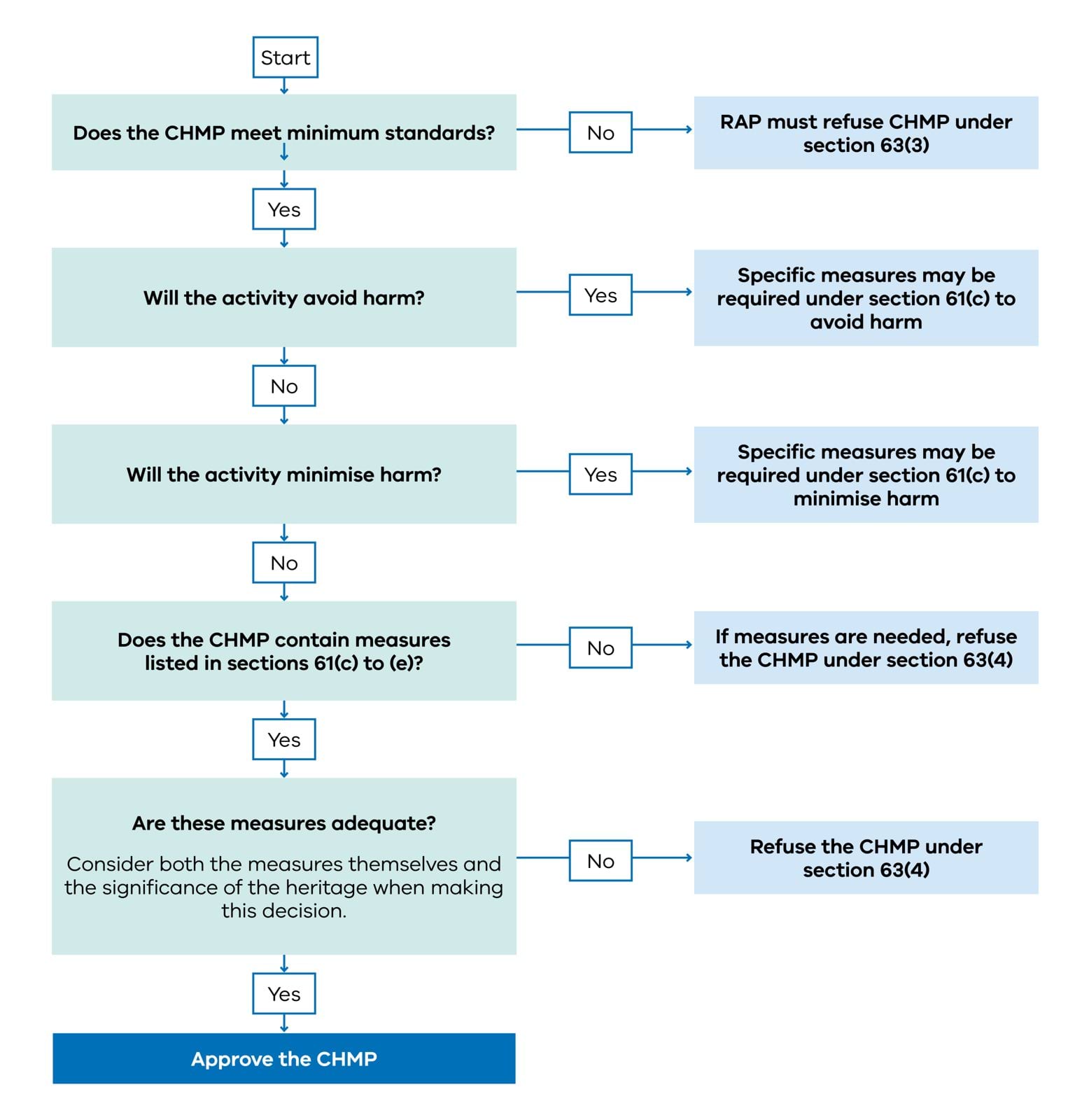
- The RAP should consider each matter under section 61 and can refuse to approve the CHMP if not satisfied the CHMP adequately addresses any of these matters [see section 63(4)]. So, when assessing whether the CHMP should be approved, the RAP should consider whether it is satisfied the plan adequately addresses the following main questions:
- Whether the activity will be conducted in a way that avoids harm to Aboriginal cultural heritage?
- If avoidance of harm does not appear possible, whether the activity will be conducted in a way that minimises harm to Aboriginal cultural heritage?
- Are there:
- specific measures required to manage Aboriginal cultural heritage that is likely to be affected by the activity;
- contingency plans required relating to disputes, delays and other obstacles that might affect the conduct of the activity; and
- requirements relating to custody and management of Aboriginal cultural heritage during the course of the activity
- If measures, contingency plans or requirements related to custody and management of cultural heritage are required but are not provided as set out in section 61(d) or (e) – then this may be a basis to refuse to approve the CHMP. The same applies if the RAP is not satisfied the measures, contingencies or requirements relating to the custody and management of cultural heritage proposed are adequate.
- When assessing the matters in section 61(a) and (b), a RAP may be assisted by answering the following questions:
- What is the activity and will the activity cause harm to Aboriginal cultural heritage?
- Is it possible to avoid harm when conducting the activity?
- If so, have measures to avoid the harm been included in the proposed CHMP?
- Is the RAP satisfied that the proposed measures adequately address the matters in section 61?
- If not, the RAP may refuse to approve the proposed CHMP on the basis that they are not satisfied the matter in section 61(a) has been adequately addressed.
- If it does not appear possible to avoid harm when conducting the activity, can the harm to Aboriginal cultural heritage be minimised?
- If the harm can be minimised, does the proposed CHMP contain specific harm minimisation measures, and are they adequate to the RAPs satisfaction?
- If the harm cannot be minimised, this is a factor for the RAP in considering whether to approve the proposed CHMP. Again, the RAP may not be satisfied the matter in section 61(b) has been adequately addressed.
- In considering the adequacy of any measures proposed (conditions), the RAP should also take account of the significance of the heritage to be affected.
Minimising harm - making reasonable decisions
The potential for VCAT to review a decision to refuse a CHMP means that a RAP should be able to justify – logically and reasonably – why a CHMP does not adequately minimise harm to Aboriginal cultural heritage. VCAT will independently consider all the evidence available about the nature of the Aboriginal cultural heritage, how impacts were assessed in the CHMP, the level of harm to that Aboriginal heritage and what measures can be put in place to avoid or minimise harm. After considering the evidence, if a RAP decision is not reasonable or logical, then VCAT can overturn that decision and approve the CHMP in the same form or with amendments. It is critical for RAPs, then, to be able to demonstrate that decisions to refuse to approve a CHMP are reasonable and logical.
There might be different reasonable and logical reasons, such as:
- If the measures themselves proposed to minimise harm are unsatisfactory to the RAP. For example, the removal and salvage of three-quarters of a shell midden might not be satisfactory when half of the midden could reasonably be left intact and in place.
- If the activity cannot be conducted in a way that minimises harm to Aboriginal cultural heritage. For example, if the activity cannot be conducted without partially destroying a rock shelter containing rare and significant Aboriginal art and material objects. Under this circumstance, it would be reasonable to argue that it is not possible for the proposed measure to minimise damage or desecration (as examples of “harm”) to the satisfaction of the RAP.
- If the measures proposed are unsatisfactory given the cultural heritage significance of the heritage to be impacted. For example, if an activity cannot be conducted without partially destroying a rock shelter containing rare and culturally important rock art. Under this circumstance, the RAP may reasonably argue that no harm minimisation measures would be adequate to its satisfaction given the cultural significance of the rock shelter.
Note that harm may lawfully be caused to Aboriginal cultural heritage if actions causing harm are in accordance with a CHMP [per section 29(a)(i) of the Act]. The key consideration under section 61(b) of the Act is whether the activity will be conducted in such a way that minimises harm to the satisfaction of the RAP.
The Sponsor and RAP evaluating a CHMP must make every reasonable effort to reach agreement on the matters set out in section 61 [see section 62(4)].
It is important to remember a RAP does not have to accept arguments made by a Sponsor or HA that the RAP should be satisfied that the CHMP adequately minimises harm.
The RAP should seek its own independent legal advice on the likelihood of VCAT overturning a CHMP decision, and materials required to support the RAP’s decision.
Aboriginal cultural heritage significance - how should this be considered in CHMP decisions?
RAPs are empowered with making decisions about CHMPs based on a combination of their understanding of the Aboriginal cultural heritage significance of heritage proposed to be harmed, and their opinion of the expert archaeological evidence and harm minimisation measures proposed by the HA in the CHMP. The significance of an Aboriginal place is important in determining its adequate protection and adequate harm minimisation measures. This is why significance is critical for a RAP when considering the adequacy of the measures proposed at Step 12.
The HA is expected to assist with informing the Sponsor and RAP about the archaeological significance of heritage to be impacted by a proposed activity. The RAP is expected, in turn, to inform the Sponsor and HA about the cultural significance of the activity area and the heritage to be impacted. Bringing the skills and expertise of the HAs and RAPs together should enable conditions to be developed that avoid and/or minimise harm to both archaeological and cultural significance.
Can a RAP refuse to approve a CHMP outright because an activity will harm heritage?
Not without first considering the matters required to refuse a CHMP.
The Act provides a process for negotiating and considering harm avoidance and minimisation measures. This is why it steps into a decision-making framework based on rigorous assessment of cultural heritage management proposals. The key consideration under section 61(b) and (c) of the Act is whether the activity will be conducted in such a way that minimises harm and, even if so, are the measures proposed in the CHMP for managing Aboriginal heritage satisfactory in the opinion of the RAP. If the RAP is not satisfied the measures proposed are adequate given the circumstances and/or the significance of the heritage, then the CHMP can be refused. However, the CHMP consideration process must be engaged first before coming to this conclusion.
Figure 2: Simplified CHMP Decision-making Flow Chart for RAPs
Updated