

Context
The Recognition and Settlement Agreement
The Land Use Activity Agreement (LUAA) is part of a broader settlement package called the Recognition and Settlement Agreement (RSA). This agreement came into legal effect in 2022, having been negotiated between the State and the Wotjobaluk, Jaadwa, Jadawadjali, Wergaia and Jupagulk Peoples of the Wotjobaluk Nations (the WJJWJ Peoples).
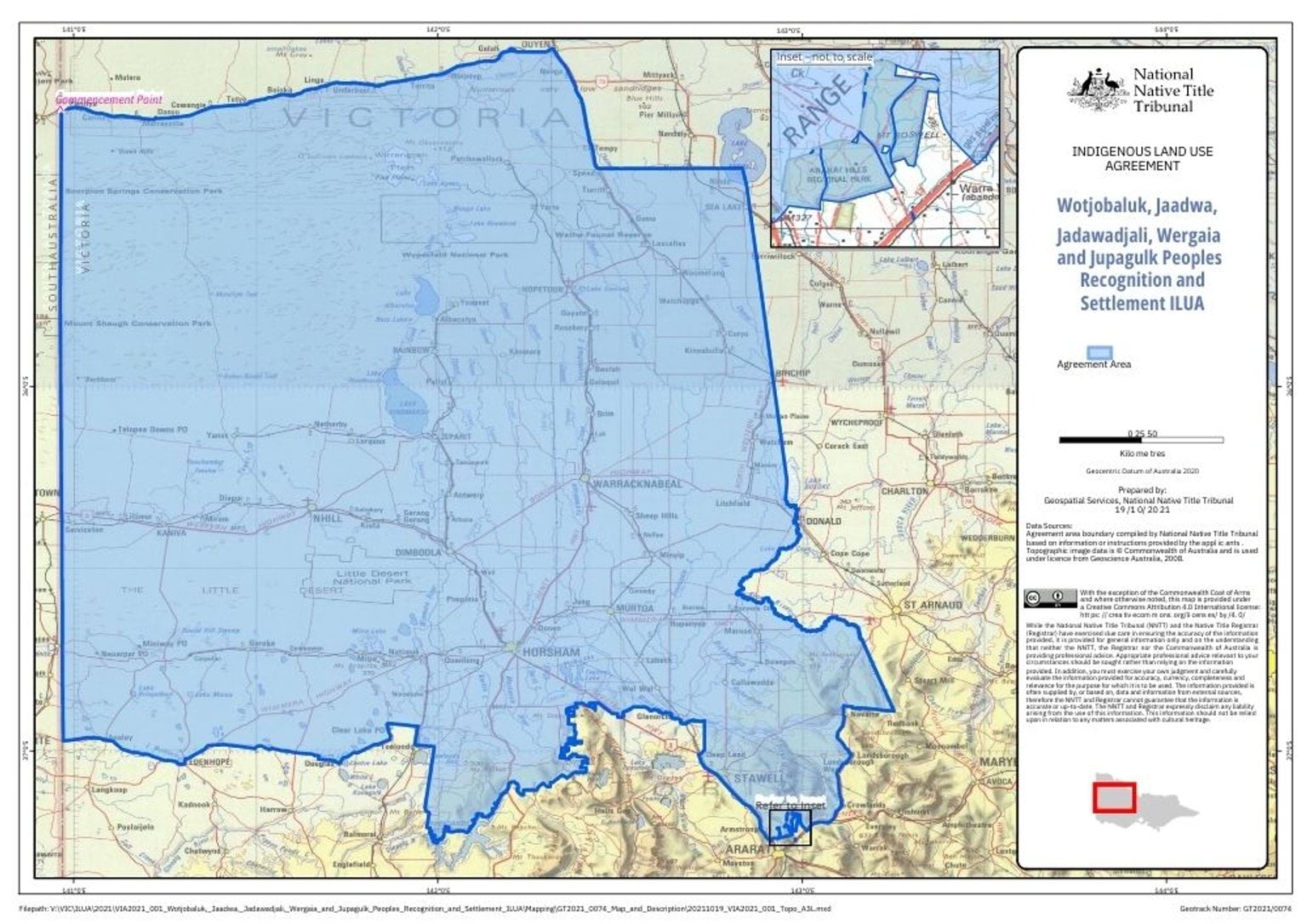
In the RSA, the State of Victoria recognised the WJJWJ Peoples as the Traditional Owners of an area of Victoria. A map of this area can be found below. The State also agreed to continue negotiating towards adding a Land Use Activity Agreement to the RSA. This LUAA was agreed in 2026, together with some associated agreements to enable the LUAA to take full effect.
The RSA, now including the LUAA, is a set of agreements that are legally binding on the State of Victoria, including all government agencies, and on the Barengi Gadjin Land Council (BGLC) as the corporate body representing the WJJWJ peoples.
Note that the LUAA is not yet in effect. These guidance pages will be updated when the commencement date is known.
These agreements, including the LUAA, recognise and protect the Traditional Owner rights of the WJJWJ Peoples.
These agreements are complementary with Aboriginal heritage protection laws – see further information below.
The Land Use Activity Agreement
The LUAA gives procedural rights to the WJJWJ Peoples regarding proposed activities on public land (also known as Crown land). The greater the impact of those activities on Traditional Owner rights, the higher the level of procedural rights under the LUAA.
The LUAA replaces the Future Act provisions of the Native Title Act 1993 (Cth) that would otherwise apply. It seeks to provide a simpler and more streamlined approach. Like other parts of the settlement agreement, the LUAA is based on the the Traditional Owner Settlement Act 2010 . Under this Act, proposed activities on public land must comply with the LUAA.
That Act, together with the LUAA, sets out the processes that managers of public land must follow before dealing with public land, or carrying out works on it. Those land managers include departments, statutory authorities, local governments, and committees of management.
Introductory examples
Under the LUAA, each activity on public land needs to be assessed on a case-by-case basis. These hypothetical examples give you some quick illustrations. Please continue reading these guidance pages for a full explanation.
The LUAA and Aboriginal Heritage protection
As the examples above illustrate, LUAA processes are separate from any cultural heritage protection requirements under the Aboriginal Heritage Act 2006 (the AHA).
That legislation continues to apply, on both public and private land. Its requirements are independent of those in the LUAA and the Traditional Owner Settlement Act 2010.
BGLC is both the WJJWJ representative body for LUAA purposes and the RAP (Registered Aboriginal Party) under the AHA .
BGLC's procedural rights under the LUAA and the management of AHA matters are complementary and there will be no duplication of processes. BGLC may raise cultural heritage matters as part of a response or negotiation under the LUAA. However, any issues raised would be resolved through the mechanisms under the AHA.
A new relationship
Many government agencies regularly consult with stakeholders in their communities, including Aboriginal and Torres Strait Islander people.
However, the RSA established a different kind of relationship between government and the WJJWJ Peoples as Traditional Owners:
"The agreement marks the beginning of a renewed and enduring relationship between us [the WJJWJ Peoples] and the people of Victoria, represented by the State, and based on mutual trust and cooperation, good faith and respect.
The agreement will help pave the way for a future for our people that is founded on principles of justice and self-determination. It will provide the means to provide for our economic self-determination and for our culture, traditional practices, and unique relationship to country to be recognised, strengthened, protected and promoted, for us and for all Victorians, now and into the future.”
- Recognition Statement, 2022
The LUAA should be interpreted and applied consistently with this commitment to "mutual trust and cooperation, good faith and respect".
For example, public land managers have engaged in dialogue with Traditional Owners when questions of interpretation have arisen, rather than seeking advice from lawyers on how to minimise their compliance.
Such an approach is also consistent with the principle of ensuring the ‘free, prior and informed consent’ of Indigenous people in matters affecting their rights.
The need for compliance
All Decision Makers in relation to land covered by the LUAA must ensure that they are complying with the LUAA. This includes departments, statutory authorities, local governments and committees of management.
Who exactly is responsible for complying with the LUAA?
Local Government authorities can download a tailored adaptation of the above information here.
VCAT can make orders
If BGLC believes that the LUAA has not been complied with, it can seek orders from the Victorian Civil and Administrative Tribunal (VCAT). VCAT can determine, or order:
- whether a land use activity was correctly classified
- whether negotiations were in good faith
- whether the reasonable costs of negotiation (which must be reimbursed to BGLC) were correctly calculated
- to stop, not start, cancel or suspend a land-use activity (including interim enforcement orders in urgent cases)
- to restore land as nearly as practicable to its condition immediately before the land use activity started.
The Responsible Person can also seek orders from VCAT regarding the first three of the points above.
Two key questions
To determine what (if anything) the LUAA requires before a land manager can carry out a “land use activity” on Crown land, there are two main questions:
1. Does the LUAA apply to this land?
- Is the land “public land” (reserved or unreserved Crown land)?
- Is it within the LUAA area?
- Is it excluded from the operation of the LUAA for one of several listed reasons, including the existence of certain kinds of infrastructure?
Read more at Does the LUAA apply to this land?
2. What kind of activity is it?
- Routine: No action needed
- Advisory: Notification and consultation process
- Negotiation: Negotiation process. VCAT or the minister can break deadlocks after 6 months
- Agreement: Negotiation process. The activity can only proceed with BGLC agreement
Read more, including additional details not covered in the summary points above, at What kind of activity is it?
Each type of activity has specific processes to be followed. These are explained on What's the process?, along with recommended templates you can use.
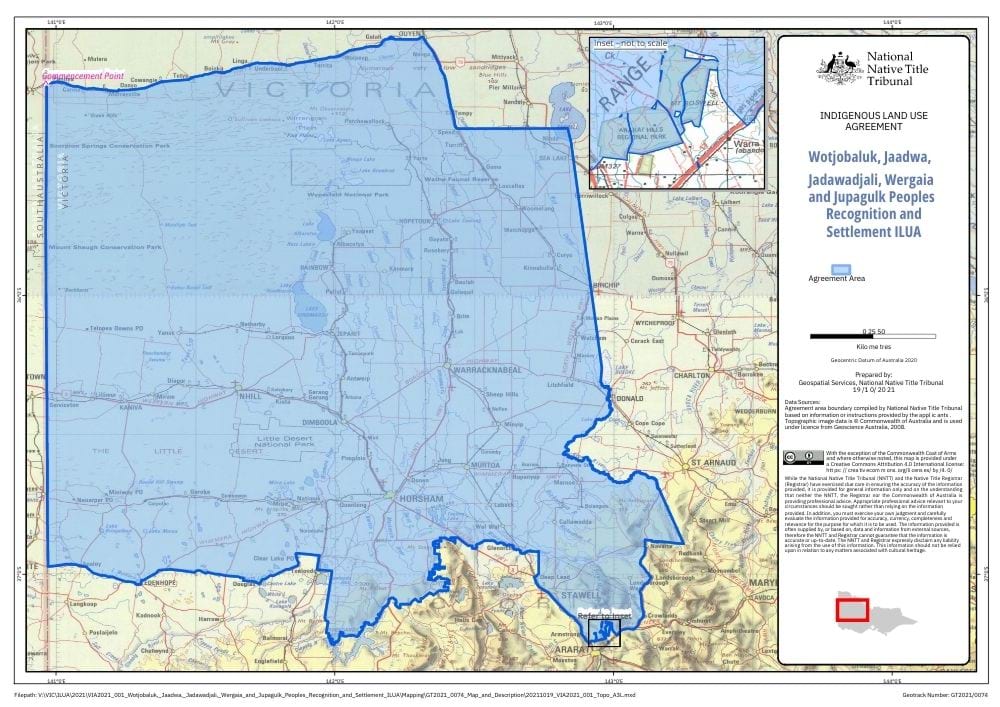
The WJJWJ Peoples RSA and LUAA area
WJJWJ Land Use Activity Agreement map
Updated