

Secretary’s Foreword
Government action to enable self-determination acknowledges that First Peoples hold the knowledge and expertise about what is best for themselves, their families and their communities.

I am pleased to present the fourth Report under the SDRF, demonstrating DPC’s commitment to embedding principles of self-determination into core business and enabling self-determination through systemic and structural transformation.
I would like to thank the former Minister for Treaty and First Peoples, Gabrielle Williams MP, for her work advancing self-determination in Victoria. Importantly, I would also like to acknowledge the ongoing strength and advocacy of First Peoples communities and leaders, upon which our work to enable self-determination sits.
In November 2023, Cabinet endorsed the extension of the VAAF to 30 June 2025. The SDRF’s position within the VAAF architecture means that it is also extended to 30 June 2025. This ensures Government’s future work under the SDRF will maintain momentum, while also providing time for the next governance frameworks to be self-determined and aligned with Treaty.
Treaty in Victoria is the embodiment of self-determination and the primary vehicle to negotiate the transfer of power and resources so that First Peoples can control matters which impact their lives. The SDRF complements this work by enabling First Peoples to hold government to account by committing departments to report on their self-determination reform actions and require critical reflection, collaboration and innovation.
DPC continues to strive for progress along the self-determination continuum, growing its level of ambition each year. This is why the 2023 SDRF Report builds on existing self-determination commitments with new, more targeted actions. While these commitments have resulted in a better balance of responsibility across branches for delivering on action, modest progress demonstrates a clear need to move beyond business-as-usual approaches and look deeper into the way systems, the department and public servants work to see real transformation.
Of the 24 self-determination actions that were reported on for 2023, 18 are ongoing, 5 are in progress, and 1 is delayed. Key actions are being progressed to strengthen DPC’s Aboriginal workforce, increase understanding of self-determination across the department, embed culturally safe practices and improve data sharing.
While it is an exciting time for self-determination reform in Victoria, with Treaty negotiations commencing this year and the Yoorrook Justice Commission undertaking a line of inquiry into land injustice, we must acknowledge the wide-ranging impacts on the First Peoples community in Victoria in the wake of the Commonwealth Voice Referendum campaign. Victoria remains committed to working in partnership with First Peoples to deliver a Treaty and truth process that achieves meaningful outcomes for First Peoples.
Through this work, we have an opportunity to reframe our relationship with First Peoples in Victoria through transforming our way of working to truly deliver on self-determination reform.

Jeremi Moule
Secretary, Department of Premier and Cabinet
About this Report
This Report focuses on the department’s progress toward embedding the VAAF self-determination enablers, aim to measure where on the VAAF self-determination continuum our actions are landing and invoke reflection on how to move further along that spectrum.
This year, the Report demonstrates some progress from across DPC’s five groups. Key achievements include:
- Facilitated work to embed self-determination through budget, legal and Cabinet processes
- Released state and sub-state data on the VAAF data dashboard
- Drafted Victoria's first statewide Anti-Racism Strategy
- Coordinated responses to and engagement with the Yoorrook Justice Commission.
Resourcing and capacity restraints are common barriers to completing actions reported by groups. Opportunities to help groups progress further include undertaking evaluations and honing targeted actions to ensure intended outcomes are met.
Overall, the Report shows mixed progress towards implementing self-determination commitments. While some groups have embedded actions into business-as-usual, there is potential for more focused efforts and strategy.
VAAF self-determination continuum
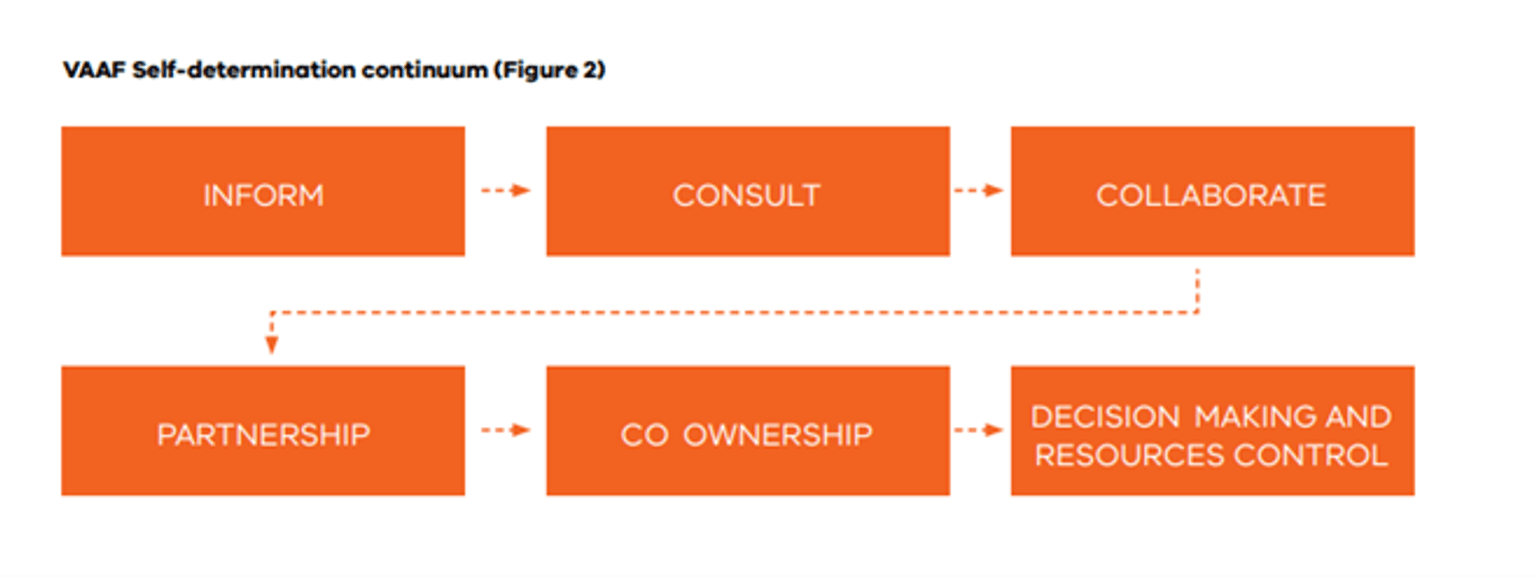
DPC acknowledges that significant transformation is required to overcome the legacy of colonisation and dispossession. We must challenge existing ways of working to strive towards transferring decision-making control to First Peoples on the matters that affect their lives. The Board of Management Self-Determination Subcommittee (BOMSC) remains an important mechanism to this effect, providing opportunities for DPC to focus attention on planning to achieve structural change in line with the SDRF.
DPC’s First Peoples workforce
DPC is not on track to meet the Barring Djinang First Peoples employment target of 2% for the Victorian Public Service. As at 21 August 2023, DPC’s workforce data indicated that 19 DPC staff identify as Aboriginal and/or Torres Strait Islander. This is a reduction of 17% since 17 June 2022, where 23 DPC staff identified as Aboriginal and/or Torres Strait Islander. All 19 of these staff are employed in FPSR.
While the Aboriginal Staff Network continues to play an important role in supporting First Peoples staff, there is a significant need for DPC to increase the representation of First Peoples in DPC and across the VPS, while also improving the quality of the workplace and experiences of current and future First Peoples staff. This will in turn, build the capacity of the VPS to enable self-determination in all policies and programs.
Progress on current DPC self-determination actions
This Report lays out DPC’s work thus far to bring about systemic and structural change across the four public sector reform domains of People, Systems, Outcomes and Accountability.
Progress Summary
People
Reporting highlights that many of the People domain actions were delayed or remained business-as-usual due to resource constraints. This hindered progress on actions to build knowledge of self-determination across the department and provide support to Aboriginal staff. The launch of the Aboriginal Workforce Strategy in 2023 and the recruitment of a dedicated resource to implement the strategy (subject to approval and funding) will be important in progressing key actions in this domain. Read more about the work being done in the people domain.
Systems
A number of systems commitments were delivered through the day-to-day work of the department, such as: ongoing policy liaison advice; adopting a self-determination lens to processes such as budget and legal; and promoting implementation of various First-Peoples-related strategies. Whilst important, these actions are business as usual and demonstrate a need to target new and different systems for true transformation. Some actions have been hindered by staffing or other resource constraints. Read more about the work being done in the systems domain.
Outcomes
The status of these actions remains ‘in progress’ and ‘ongoing’ with the release of sub-state data dependent on the availability of data and the release of the 2022 and 2023 VGAAR due in 2023 and 2024 respectively. Ongoing engagement with departments and agencies on data sharing agreements and with the Partnership Forum will be integral to progressing key actions in this domain in 2023. DPC recognises that the limited action in this domain highlights the need for a better focus on outcomes reform. A strong outcomes-based approach will enhance government accountability. Read more about the work being done in the outcomes domain.
Accountability
Some actions were delayed due to inadequate success metrics and lack of inter-departmental buy-in to initiatives. This hindered progress on actions in accountability across the department. The establishment and operation of the Partnership Forum and updates to the VAAF data dashboard will be integral to progressing key actions in this domain in 2023. Read more about the work being done in the accountability domain.
People
Change only occurs through the actions of people. DPC acknowledges it is essential all DPC staff understand the importance of self-determination and the various related commitments across government. DPC will prioritise ensuring all DPC staff understand that self-determination should inform all work, across all portfolio areas.
Notable achievements in this domain include:
- Supporting the prioritisation of culture through implementation of the Cultural and Ceremonial Leave policy.
- Exceeding the Barring Djinang employment target of 2 per cent in the 2021-22 financial year.
Reporting highlights that many of the People domain actions were delayed or remained business-as-usual due to resource constraints. This hindered progress on actions to build knowledge of self-determination across the department and provide support to Aboriginal staff.
The launch of the Aboriginal Workforce Strategy in 2023 and the recruitment of a dedicated resource to implement the strategy (subject to approval and funding) will be important in progressing key actions in this domain.
2.1.2 DPC actions to support Aboriginal staff, including through recruitment
Outcomes
This chapter outlines DPC’s actions to measuring impact, in particular how we collect, manage and share data related to Treaty and First Peoples policy
Key achievements for this domain include:
- State and sub-state (lower geographic) data on the VAAF data dashboard.
- Progress against the 2021-2023 Victorian Closing the Gap Implementation Plan (Implementation Plan) through the 2021 VGAAR.
The status of these actions remains ‘in progress’ and ‘ongoing’ with the release of sub-state data dependent on the availability of data and the release of the 2023 and 2024 VGAAR. Ongoing engagement with departments and agencies on data sharing agreements and with Ngaweeyan Maar-oo, the Koorie Caucus of the Closing the Gap Partnership Forum, will be integral to progressing key actions in this domain in 2024.
FPSR is the only group with actions in this domain, highlighting a need for a stronger collective focus on outcomes reform.
2.3.1 DPC's contribution to whole of government outcomes
Systems
This chapter outlines DPC’s actions to leverage existing systems, processes and policies whilst also preparing for system transformation, particularly in response to Treaty.
Key achievements for this domain include:
- Early engagement with FSPR in Stage 1 of the Budget Process, to identify budget bids with self-determination elements.
- Drafted Victoria's first statewide Anti-Racism Strategy.
A number of systems commitments were delivered through the day-to-day work of the department, such as ongoing policy liaison advice and adopting a self-determination lens to processes such as budget and legal. Whilst important, these actions are business-as-usual and demonstrate a need to target new and different systems for true transformation.
Some actions in this domain report limited impact for First Peoples, highlighting the need for more targeted and transformational reform.
2.2.1 DPC actions to leverage existing structures to enable self-determination
2.2.2 DPC actions to begin fundamentally transforming systems
Accountability
This chapter outlines DPC’s actions to increase accountability and transparency in our efforts to enable self-determination, for example through public reporting.
Key achievements for this domain include:
- Extending the VAAF until June 2025.
- Coordinating key decision-making activities through the Closing the Gap Partnership Forum (Partnership Forum).
FPSR is the only group with actions in this domain. A whole of department effort is required to strengthen and embed accountability in government.
Addressing these gaps in accountability across DPC will be integral to drive more meaningful, effective and widespread actions across the department.