

The following information will help you to understand and carry out your obligations under the Dja Dja Wurrung Land Use Activity Agreement (LUAA). It was originally developed for use by local government, but is now suitable for general use.
These pages provide general information, not legal advice.
For land use activities on Taungurung Country, read about the Taungurung Land Use Activity Agreement.
Overview
Context
The Dja Dja Wurrung Recognition and Settlement Agreement
The Land Use Activity Agreement (LUAA) is part of a broader settlement package called the Recognition and Settlement Agreement (RSA). This agreement came into legal effect on 24 October 2013.
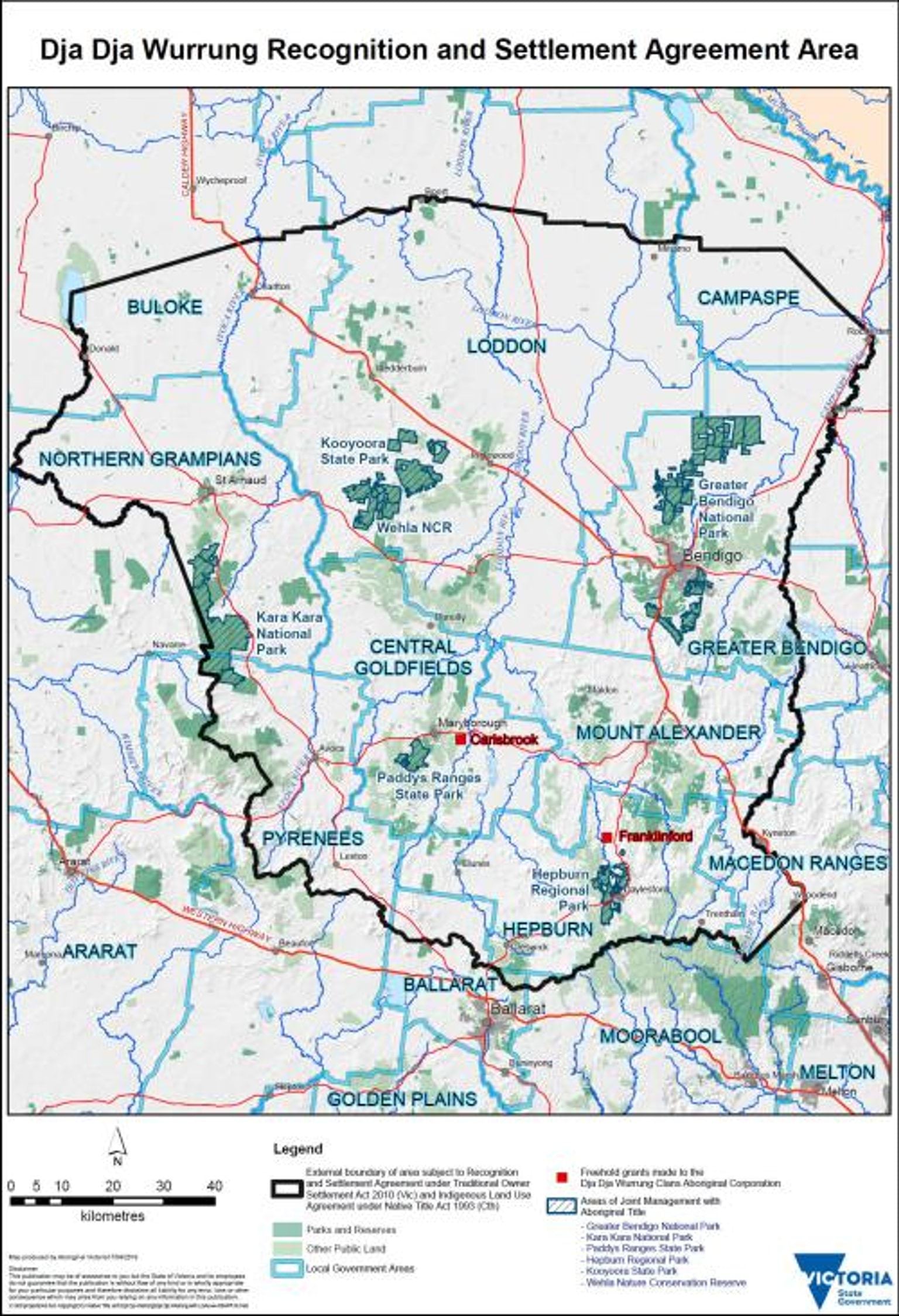
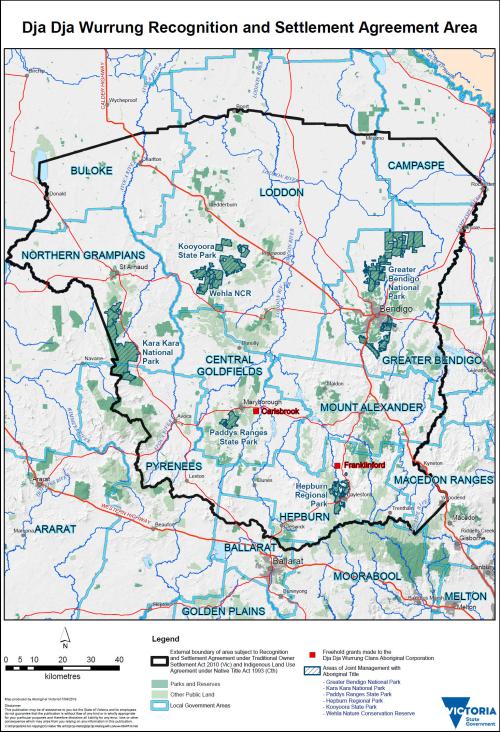
In the RSA, the State of Victoria recognised the Dja Dja Wurrung people as the Traditional Owners of an area of Victoria. A map of this area can be found below.
The RSA is made up of a set of agreements that are legally binding on the State of Victoria, including all government agencies, and on DJAARA (the Dja Dja Wurrung Clans Aboriginal Corporation) as the representative body of the Dja Dja Wurrung people.
These agreements, including the LUAA, recognise and protect the Traditional Owner rights of the Dja Dja Wurrung people. In return, the Dja Dja Wurrung people agreed not to pursue the legal recognition of native title rights that they may hold.
These agreements are complementary with cultural heritage protection – see further information below.
The Land Use Activity Agreement
The LUAA gives procedural rights to the Dja Dja Wurrung people regarding proposed activities on public land (also known as Crown land). The greater the impact of those activities on Traditional Owner rights, the higher the level of procedural rights under the LUAA.
The LUAA replaces the Future Act provisions of the Native Title Act 1993 (Cth) that would otherwise apply. It seeks to provide a simpler and more streamlined approach. Like other parts of the settlement agreement, the LUAA is based on the the Traditional Owner Settlement Act 2010 . Under this Act, proposed activities on public land must comply with the LUAA.
That Act, together with the LUAA, sets out the processes that managers of public land must follow before dealing with public land, or carrying out works on it. Those land managers include departments, statutory authorities, local governments, and committees of management.
Introductory examples
Under the LUAA, each activity on public land needs to be assessed on a case-by-case basis. These hypothetical examples give you some quick illustrations. Please continue reading these pages for a full explanation.
The LUAA and Aboriginal Heritage protection
As the examples above illustrate, LUAA processes are separate from any cultural heritage protection requirements under the Aboriginal Heritage Act 2006 (the AHA).
That legislation continues to apply, on both public and private land. Its requirements are independent of those in the LUAA and the Traditional Owner Settlement Act 2010.
DJAARA is both the Dja Dja Wurrung representative body for LUAA purposes and the RAP (Registered Aboriginal Party) under the AHA .
DJAARA's procedural rights under the LUAA and the management of AHA matters are complementary and there will be no duplication of processes. DJAARA may raise cultural heritage matters as part of a response or negotiation under the LUAA. However, any issues raised would be resolved through the mechanisms under the AHA.
A new relationship
Many government agencies regularly consult with stakeholders in their communities, including Aboriginal and Torres Strait Islander people.
However, the RSA established a different kind of relationship between government and the Dja Dja Wurrung people as Traditional Owners:
"This Recognition and Settlement Agreement binds the State of Victoria and the Dja Dja Wurrung People to a meaningful partnership founded on mutual respect.
It is a means by which Dja Dja Wurrung culture and traditional practices and the unique relationship of Dja Dja Wurrung People to their traditional country are recognised, strengthened, protected and promoted, for the benefit of all Victorians, now and into the future.”
- Recognition Statement, 2013 (emphasis added)
The LUAA should be interpreted and applied consistently with this commitment to a "meaningful partnership founded on mutual respect".
For example, public land managers have engaged in dialogue with the Traditional Owners when questions of interpretation have arisen, rather than seeking advice from lawyers on how to minimise their compliance.
Such an approach is also consistent with the principle of ensuring the ‘free, prior and informed consent’ of Indigenous people in matters affecting their rights.
The need for compliance
All Decision Makers in relation to land covered by the LUAA must ensure that they are complying with the LUAA. This includes departments, statutory authorities, local governments and committees of management.
Who exactly is responsible for complying with the LUAA?
Local Government authorities can download a tailored adaptation of the above information here.
VCAT can make orders
If DJAARA believes that the LUAA has not been complied with, it can seek orders from the Victorian Civil and Administrative Tribunal (VCAT). VCAT can determine, or order:
- whether a land use activity was correctly classified
- whether negotiations were in good faith
- whether the reasonable costs of negotiation (which must be reimbursed to DJAARA) were correctly calculated
- to stop, not start, cancel or suspend a land-use activity (including interim enforcement orders in urgent cases)
- to restore land as nearly as practicable to its condition immediately before the land use activity started.
Two key questions
To determine what (if anything) the LUAA requires before a land manager can carry out a “land use activity” on Crown land, there are two main questions:
1. Does the LUAA apply to this land?
- Is the land “public land” (reserved or unreserved Crown land)?
- Is it within the LUAA area?
- Is it excluded from the operation of the LUAA for one of several listed reasons, including the existence of certain kinds of infrastructure?
Read more at Does the LUAA apply to this land?
2. What kind of activity is it?
- Routine: No action needed
- Advisory: Notification and consultation process
- Negotiation: Negotiation process. VCAT and the minister can break deadlocks after 6 months
- Agreement: Negotiation process. The activity can only proceed with DJAARA agreement
Read more at What kind of activity is it?
Each type of activity has specific processes to be followed. These are explained on What's the process?, along with recommended templates you can use.
Dja Dja Wurrung RSA and LUAA area
Dja Dja Wurrung Land Use Activity Agreement map
Does the Dja Dja Wurrung Land Use Activity Agreement apply?
The first major question to ask before considering what type of activity is proposed is whether the Land Use Activity Agreement (LUAA) applies to the relevant land.
'Public land'
The LUAA applies only to 'public land' (often called Crown land).
This means:
- Unreserved Crown land
- Reserved Crown land
- Reserved forests, national parks, nature reserves and state wildlife reserves
The LUAA does not apply to
- freehold land
- land vested in VicTrack (by legislation)
- land vested in a local council under s 16 of the Crown Land (Reserves) Act 1978.
Regardless of any use by the public, these freehold areas are not ‘public land’ as defined above. The Aboriginal Heritage Act 2006 still protects cultural heritage on that land, but DJAARA does not have procedural rights under the LUAA.
Unlike native title, the LUAA does not concern itself with the history of the land. No tenure history searches are needed. This is one of the benefits of the LUAA, compared with the equivalent Native Title processes.
In effect, the LUAA asks only: at the date of the proposed activity, is the land public land?
The LUAA area
The LUAA applies to all public land (subject to certain exclusions) within the boundaries of the Dja Dja Wurrung agreement area, as shown on the overview map.
Dja Dja Wurrung Land Use Activity Agreement map
For further detail about the boundary, you can:
- download detailed maps(opens in a new window) showing each section of that boundary
- refer to the detailed description, containing specific boundary parcels and location co-ordinates, in Schedule 2 of the LUAA itself
- obtain the GIS data from DEECA to show the LUAA boundary as a layer in your mapping system.
Existing infrastructure
The LUAA does not apply to land covered by certain kinds of existing infrastructure (see below).
Where that infrastructure has been demolished in order to replace or refurbish it, for the same purpose, the land continues to be excluded.
However, where former infrastructure has been removed so as to permit safe public access to the former footprint of the infrastructure, that land is no longer excluded.
This makes practical sense: that land is once again ‘public land’, without any infrastructure, and so it is subject to the LUAA.
Click on the following headings to show additional information. If you are uncertain whether particular land is excluded from the LUAA, you are encouraged to discuss it with DJAARA.
Specific parcel exclusions
The LUAA lists parcels of land that are specifically excluded from the LUAA. These were identified for specific purposes at the time of signing the Recognition and Settlement Agreement (2013).
Few of these will still be public land as time goes on, but it may be important to check this list for potential exclusions.
If you have assessed that the land in question is subject to the LUAA, continue reading What kind of activity is it?
If not, and you are a decision maker for the relevant land, you should make records of your assessment that the LUAA does not apply to that land. You may wish to use the template below, or other record-keeping systems appropriate to your organisation. You need not read any further pages in this section.
What kind of activity is it? - Dja Dja Wurrung LUAA
After you have determined whether the Dja Dja Wurrung Land Use Activity Agreement (LUAA) applies to the land in question, you must then determine how the LUAA categorises your intended activity.
The following questions will help you to work out how the LUAA classifies the activity you are interested in. Work your way through the questions from top to bottom. For each question, click on the heading to see an explanation. In some sections there are references to detailed definitions found near the end of this page.
If you are unsure how an activity is classified in the LUAA, after reading the LUAA and these guidance materials, consult with others in your organisation and with DJAARA (the Dja Dja Wurrung Clans Aboriginal Corporation).
If an activity is capable of falling into two categories, the LUAA states that the higher level of procedural rights shall apply.
Preliminary questions
First consider these preliminary questions.
Then consider the type of works involved, checking the information provided below and the definitions provided in the glossary.
Works on public land
Change to legal status of land
Important definitions
Now that you have determined what kind of activity is being proposed, read What’s the process? to see the steps you need to follow.
If you are still uncertain about how the activity is classified, contact DJAARA to discuss it with them.
What's the process? - Dja Dja Wurrung LUAA
See LUAA Contacts for information about how to contact DJAARA (the Dja Dja Wurrung Clans Aboriginal Corporation).
Process for Routine activities
For Routine activities there is no requirement to notify DJAARA. The activity may proceed immediately.
Decision Makers are encouraged to discuss the categorisation of the activity with DJAARA if there is any doubt, bearing in mind the LUAA principle that If an activity is capable of falling into two categories, the higher level of procedural rights shall apply.
In any case, decision makers are encouraged to keep appropriate records of their assessments that certain activities are Routine. These could be called upon in an audit of LUAA assessments, or if DJAARA were to apply to VCAT for a determination on the classification of a land use activity.
A sample template for recording such assessments is included here:
Process for Advisory activities
Advisory activities require notification of DJAARA and, depending on DJAARA's response, a process of meaningful consultation.
Ministerial Directions as to Advisory activities (made by the Attorney-General on 24 October 2013) specify the minimum content of the notification. These include a 28-day minimum period to allow DJAARA to respond.
Document templates have been developed to assist with meeting these requirements, but use of the templates is not mandatory.
The Directions also encourage Decision Makers to exceed the minimum standards. That is, to go beyond formal procedures and to establish a relationship between Parties that is flexible enough to respect and accommodate the needs of each party.
As with any decision affecting people’s rights, Decision Makers for Advisory activities under the LUAA must also observe the principles of natural justice.
This table suggests a step-by-step approach that meets (and in some steps exceeds) the minimum standards. It is intended as a guide, noting that the steps may be adapted to meet the circumstances of each Advisory process.
See also Engaging with DJAARA, and the Advisory Process Guidelines document below, for information about ways to make the process efficient and effective for both parties.
| Step | Process for Advisory activities |
|---|---|
| 1. | Notify DJAARA of the proposed activity |
| 2. | Await response from DJAARA until the date specified in your notice (minimum 28 days) |
| 3. | If no response received, or a response with no objection or comments: the activity can proceed |
| 4. | If comments or requests received: acknowledge the comments in writing. Consider the comments in the spirit of "a meaningful partnership based on mutual respect", and meet with DJAARA if requested |
| 5. | Make your decision, taking relevant comments into account |
| 6. | Record your decision and notify DJAARA, explaining the reasoning for your decision. |
Templates and supporting documents for Advisory activities
Process for Negotiation activities
Negotiation activities require notification of DJAARA and good faith negotiations. The Victorian Civil and Administrative Tribunal (VCAT) can adjudicate if agreement cannot be reached.
The minimum content of the notification is set out in the Traditional Owner Settlement Regulations 2017(opens in a new window).
Document templates are available below to assist with meeting these requirements, but organisations may develop their own documents that meet the minimum requirements.
See also Engaging with DJAARA, and the Negotiation Guidelines document below, for information about ways to make the process efficient and effective for both parties.
Good faith negotiations
The Traditional Owner Settlement Act 2010 specifies the requirement to negotiate in good faith (s.50).
The term “good faith” is not defined in the Act, but an explanatory guide is available in the downloads section below.
VCAT may make a determination as to whether or not either party has met the requirement for good faith.
Community benefits
The State has agreed to provide Community Benefits for Negotiation activities according to formulas in Schedule 7 of the LUAA whenever the State, or a State agency:
- is the Responsible Person, or
- issues a Public Land Authorisation (PLA) or a new timber release plan.
These formulas calculate the monetary value of the Community Benefits based on a percentage of value of the land, rent received, etc. Land values are determined by the Valuer-General of Victoria. The State may negotiate to provide some or all of the community benefits in non-monetary form, by agreement with DJAARA.
When the Responsible Person is anyone other than the State, and the State is not issuing a PLA, these formulas do not automatically apply. This includes, for example, negotiation by a local government regarding major public works, or negotiation by an applicant for a mining authorisation.
In those negotiations, the Responsible Person and DJAARA may agree to adopt the formulas, or not. They must negotiate the value of any Community Benefits, and whether they will be provided in monetary or non-monetary form.
Role of VCAT
If the parties are unable to reach agreement, after six months of good faith negotiating, either party may apply to VCAT for a variety of orders to resolve the dispute. As of September 2024, no such orders have been sought.
Steps in the negotiation process
This table suggests a step-by-step approach that is consistent with the LUAA, the Act and its Regulations. It sets out the roles of the:
- Decision Maker (DM)
- Responsible Person (RP).
| Step | Process for Negotiation activities |
|---|---|
| 1. | Decision Maker (DM) identifies whether it, or another person, is the Responsible Person (RP). DM also identifies who is responsible for Community Benefits. DM explains the RP’s obligations under the LUAA to the relevant person (DM’s employee or external RP). |
| 2. | RP notifies DJAARA of the proposed activity |
| 3. | RP negotiates in good faith with DJAARA regarding the activity – whether it may proceed, and on what conditions. If a State agency is the RP, or is issuing a PLA or a new timber release plan, it also negotiates whether the Community Benefits payable under LUAA Schedule 7 will be paid in cash, in kind, or in some combination. If the RP is another statutory authority, a local government, or an applicant for an Earth Resources Authority, it negotiates with DJAARA the Community Benefits to be provided for the Dja Dja Wurrung community |
| 4. | If agreement is reached, the RP provides evidence of the agreement to the DM. The activity can now proceed (in accordance with any standard or agreed conditions). |
| 5. | If agreement cannot be reached, after 6 months of negotiation in good faith, either party may apply to VCAT for an order. |
| 6. | RP pays DJAARA’s reasonable costs of negotiating, regardless of the outcome. |
Templates and supporting documents for Negotiation activities
Process for Agreement activities
Agreement activities require notification of DJAARA and good faith negotiations, as for Negotiation activities. However, the activity cannot proceed unless and until DJAARA agrees. There is no appeal to VCAT if agreement cannot be reached.
Notification
The minimum content of the notification is set out in the Traditional Owner Settlement Regulations 2017.
Responsibility for negotiation and Community Benefits
For most Agreement activities, the Decision Maker is also the Responsible Person (RP). However, where the activity is the granting of a lease for more than 21 years for commercial purposes, the applicant for the lease is the Responsible Person.
For all Agreement activities where a State agency is the Decision Maker, including where it issues such a lease, it has agreed to provide Community Benefits according to formulas in Schedule 7 of the LUAA. The State may negotiate to provide some or all of the community benefits in non-monetary form, by agreement with DJAARA.
If a local government, statutory authority or other non-State body is ever the Decision Maker for an Agreement activity, these formulas do not automatically apply. The Decision Maker and DJAARA must reach agreement about the value of the Community Benefits, and whether they will be provided in monetary or non-monetary form.
Steps in the process
This table suggests a step-by-step approach that is consistent with the LUAA, the Act and its Regulations.
It sets out the roles of the:
- Decision Maker (DM)
- Responsible Person (RP).
| Step | Process for Agreement activities |
|---|---|
| 1 | DM identifies whether it, or another person, is the Responsible Person (RP). DM also identifies who is responsible for Community Benefits. DM explains the RP’s obligations under the LUAA to the relevant person (DM’s employee or external RP). |
| 2 | RP notifies DJAARA of the proposed activity. |
| 3 | RP negotiates in good faith with DJAARA regarding the activity – whether it may proceed, and on what conditions. If a State agency is the RP, or is issuing a PLA, it also negotiates whether the Community Benefits payable under LUAA Schedule 7 will be paid in cash, in kind, or in some combination. If the RP is another statutory authority or a local government, it negotiates with DJAARA the Community Benefits to be provided for the Dja Dja Wurrung community. |
| 4. | If agreement is reached with DJAARA, the RP provides evidence of the agreement to the DM. The activity can now proceed (in accordance with any standard or agreed conditions). |
| 5. | If agreement is not reached, the activity cannot proceed. |
| 6. | RP pays DJAARA’s reasonable costs of negotiating, regardless of the outcome. |
Engaging with Dja Dja Wurrung - Dja Dja Wurrung LUAA
What can you expect when engaging with DJAARA, the Dja Dja Wurrung Clans Aboriginal Corporation, e.g. for an Advisory or Negotiation (Class B) process?
This page was drafted in close consultation with DJAARA (opens in new tab). Of course, nothing stated here binds or limits the ways that DJAARA might respond to a notification.
Dja Dja Wurrung aspirations
DJAARA will always seek opportunities to contribute to the wellbeing of the Dja Dja Wurrung people through LUAA notifications.
The LUAA is part of the broader Recognition and Settlement Agreement that is aimed at respecting the Dja Dja Wurrung as Traditional Owners. This goal includes acknowledging their unique culture and knowledge of traditional land, and addressing the consequences of government policy and practice that led to dispossession and disadvantage.
Outcomes from the RSA include:
- recognition of the Dja Dja Wurrung as Traditional Owners
- promoting respect for Dja Dja Wurrung culture
- protection of cultural heritage
- employment and enterprise opportunities
- land management outcomes.
DJAARA's Dhelkunya Dja Country Plan sets out the aspirations of the Dja Dja Wurrung people for the short, medium and long term. It informs DJAARA’s responses to LUAA notification. The plan looks ahead to the next 20 years, with topics related to the personal, cultural and economic wellbeing of the Dja Dja Wurrung and their responsibilities to care for the country.
Examples of LUAA outcomes
Outcomes from LUAA notifications may include, for example:
- installing signs at strategic locations that recognise the Dja Dja Wurrung as Traditional Owners
- acknowledging Dja Dja Wurrung support for important community facilities
- engaging Dja Dja Wurrung to provide design input or interpretative information, which can enhance visitor or user experience of the relevant facilities
- incorporating Dja Dja Wurrung language in projects
- securing internships/job placements for Dja Dja Wurrung members and grants to Dja Dja Wurrung artists
- ensuring that Dja Dja Wurrung cultural heritage is protected (as is required by the Aboriginal Heritage Act 2006).
DJAARA’s enterprise arm, DJANDAK, provides a range of services, including revegetation works, Dja Dja Wurrung-specific design input, fencing, environmental enhancement works, Aboriginal waterway assessments, and the construction of recreational facilities and public structures. Visit DJANDAK's website for more information.
Benefits to land managers
Active engagement with DJAARA also benefit organisations who are public land managers. These can include:
- relationship building (leading to a more cohesive and inclusive community)
- access to unique design and landscape knowledge
- efficient and cost-effective services
- more diverse workplaces
- enhanced perspectives on proposed developments
- progress towards social responsibility and reconciliation goals.
Timeframes
Land managers should consider LUAA requirements when planning projects. Each project will differ, but some general guidance on timeframes specified in the LUAA (and related documents) follows, along with ideas about how to make LUAA processes as efficient as possible.
Advisory activities
Notifications for Advisory activities must allow 28 days for DJAARA to respond. On occasions, DJAARA might request additional time, to allow more information to be provided or to enable traditional owners to properly consider the matter.
After receiving a response, there’s no fixed timeline for further consultation and decision making. You should allow a reasonable time to consider DJAARA’s response on its merits, take any further steps as appropriate (which might include, for example, meeting with DJAARA or visits to the site), and then decide whether and how to proceed with the land use activity.
Negotiation activities
Notifications for Negotiation activities don’t specify a time for the initial response. However, they may mention that if agreement cannot be reached within 6 months of good faith negotiations, either party may seek an order from VCAT. (See LUAA Guidance Overview for more information about VCAT orders.)
Making the processes efficient
DJAARA is governed by a board of directors that meets monthly to consider LUAA notifications (along with its other business). DJAARA can usually respond within 28 days if all necessary information is provided at the outset, including precise information and clear maps. (See What’s the process? for details of what information is required.)
Please note that DJAARA has limited staff, and its directors are volunteers. At times, DJAARA cannot easily respond promptly. Engaging with DJAARA about planned activities before formal notification can reduce response time and, more importantly, enhance outcomes.
Delays can also occur if legal issues arise, such as the correct method of valuing land affected by a Negotiation activity.
Financial considerations
Land managers should also factor financial considerations into their planning and budgeting. While it is not possible to identify these with precision, the following information may assist.
Advisory activities
The LUAA and legislation do not prescribe financial costs for Advisory activities. Of course, suggestions or requests from DJAARA (such as for signage or project design alterations) may have financial implications; councils should decide such requests with reference to benefits and costs.
For some Advisory activities, DJAARA may remind land managers of their obligations under the Aboriginal Heritage Act 2006. These costs could include, for example, that of providing the opportunity for DJAARA to undertake a site visit prior to excavation or construction, or of having a cultural heritage monitor present during works. But these are not new or additional costs arising from the LUAA.
Negotiation and Agreement activities
The LUAA and Traditional Owner Settlement Act mention two sets of financial considerations regarding Negotiation and Agreement activities: community benefits, and reasonable negotiation costs.
Community benefits are one matter negotiated with DJAARA in any negotiation or agreement process under the LUAA. The state has committed to paying community benefits for Negotiation (Class B) activities according to formulae in the LUAA. The formulae are based on percentages of the unimproved market value of the land (or on the value of the lease, licence or permit taken by a utility for its major public works on public land). By agreement with DJAARA, the state may pay some or all of the value of the community benefits in non-monetary form.
These formulae do not automatically apply when a local council is the decision maker, or the Responsible Person is an applicant for an Earth Resources Authorisation. Whether community benefits are paid, and their extent, is a matter for negotiation, along with any other conditions on the proposed activity. In the absence of agreement (after 6 months of good faith negotiation), these matters may be determined by VCAT.
“Reasonable negotiation costs” of the DJAARA must be reimbursed by the “responsible person” for the proposed activity. The Traditional Owner Settlement (Negotiation Costs) Regulations 2015 (Vic) specify that these may include:
- decision-making costs, such as site analysis, report writing and consideration of recommendations
- professional services costs, such as legal, economic, geological or engineering services, and
- travel costs, such as car expenses associated with site visits, or public transport to attend a special meeting.
Tips for senior leaders - Dja Dja Wurrung LUAA
This page outlines suggestions for senior leaders to improve their organisation’s compliance with with the LUAA. It was originally developed for local government, but most of these tips can benefit leaders in all organisations.
Understand the LUAA, RSA Schedule 6, and Reconciliation Action Plans
Senior leaders are in a great position to lead by example – but only if they understand what is needed, at least broadly.
These web pages focus on the LUAA. But you may also be aware of Schedule 6 of the Dja Dja Wurrung Recognition and Settlement Agreement (RSA) – the Local Government Engagement Strategy. And your organisation may have, or be working towards, a Reconciliation Action Plan, or another similar set of commitments. How do these documents relate to each other?
Two considerations can help to distinguish them:
- Focus: Traditional Owners / all Aboriginal and Torres Strait Islander people
- Requirements: mandatory / recommended.
Focus
The LUAA and RSA (including Schedule 6 – the Local Government Engagement Strategy), focus on the Dja Dja Wurrung as Traditional Owners. While some Dja Dja Wurrung people may live within your Council area, all Dja Dja Wurrung people hold Traditional Owner rights in relation to their recognised country by virtue of these agreements and the enabling legislation.
Reconciliation Action Plans, by contrast, usually relate to all Aboriginal and Torres Strait Islander people who live in your area. Other organisational strategies related to Indigenous people may also have this broad focus.
Requirements
Compliance with the LUAA is legally mandatory, as is compliance with the Aboriginal Heritage Act 2006 (Vic).
Schedule 6 of the RSA is framed as a commitment by the State to facilitate engagement between local councils and DJAARA (the Dja Dja Wurrung Clans Aboriginal Corporation). It lists a number of actions (items A–L) that may be the focus of these engagements. The first of these – compliance with the LUAA and the Aboriginal Heritage Act – are mandatory actions for all councils.
The remaining items in Schedule 6 are, in effect, recommended actions for councils.
Use and improve your existing systems
To make LUAA compliance part of business as usual in your organisation, consider ways you can use or improve existing systems. For example:
- Identify LUAA compliance in Risk Registers, noting that failure to comply with the LUAA can lead to VCAT ordering that land to be returned to its previous condition.
- Add LUAA assessments to checklists, project management software, or other tools already in use. For example, does the LUAA apply to the land, what kind of activity is it, have we followed the relevant process to conclusion?
- Ensure that standard record-keeping includes file notes or other records of LUAA-related assessments and activities.
- Include links to these web materials in relevant documents, websites and digital portals.
Training
Training promotes compliance with the LUAA. Consider possible approaches for ensuring that all relevant staff have the required knowledge and skills. For example:
- General discussion of the LUAA for all relevant roles during staff induction
- In-depth training for relevant roles, such as in-house training, or attendance at multi-organisation workshops
- Refresher training after a specified period (such as 2 to 3 years)
- Networks and forums among people with similar roles at other organisations.
Note that for the first few years of the LUAA’s operation, the state has taken the lead in organising and promoting LUAA training. In future years this will increasingly become each organisation’s responsibility.
Update position descriptions
Do position descriptions or task lists in your organisation refer to LUAA-related responsibilities or tasks? Updating these might be an immediate and valuable way of building compliance into business as usual.
For position descriptions, consider:
- Who in your organisation is formally responsible for LUAA compliance?
- Who, in practical terms, needs to be involved in each step?
- Who needs to be aware of LUAA requirements (even if not responsible for carrying them out), such as people engaged in planning and budgeting?
For tasks and responsibilities, consider the following phrasing:
- “Responsible for ensuring organisation’s compliance with the Dja Dja Wurrung Land Use Activity Agreement”
- “Assess whether the LUAA applies to a project and, if so, what kind of activity and with what resulting process”
- “Notify DJAARA of advisory and negotiation activities under the LUAA”
- “Consult and/or negotiate with DJAARA regarding proposed activities under the LUAA”
- “Estimate time and cost implications, as well as opportunities, arising from LUAA requirements or engagement with the DJAARA”.
Questions for performance reviews
When relevant, consider building accountability for LUAA-related tasks into performance-review processes. For example:
- Adapt self-assessment forms with LUAA-related questions, as appropriate for role description.
- Ask questions in regular catch-up, coaching or mentoring meetings. (How are you going with…?; Tell me about some examples where…; Do you need any assistance or support with…?)
- Ask questions in annual performance review processes. (How effective have you been at…? Can you describe some instances, and walk me through what you did in each case…)
Support compliance by other parties
Each organisation is directly responsible for compliance with the LUAA on crown land that it manages. Strictly speaking, organisations are not responsible for ensuring that other parties who manage public land comply. However, you are encouraged to assist other, less experienced organiations and individuals to understand and comply with the LUAA.
For example, DEECA has assisted local councils to meet their LUAA obligations as Committees of Management, and will continue to assist volunteer Committees of Management.
Councils should consider including notes or conditions about LUAA compliance when issuing permits under planning and environment legislation. Council staff might also be able to provide information to residents and other stakeholders.
Build direct relationships
As noted on the first page of these materials, the LUAA is part of an overall Recognition and Settlement Agreement package, which aims to create a new relationship of “meaningful partnership founded on mutual respect”.
This relationship will emerge through dealings between government and the Dja Dja Wurrung over time, but also through direct personal relationships between key people.
For local government, people who might seek to build these direct relationships with DJAARA counterparts include:
- Mayors and Councillors
- CEOs
- Senior managers with overall responsibility for the LUAA and/or other components of the RSA (such as Schedule 6 actions)
- Staff with day-to-day responsibility for the LUAA and other relevant matters.
Because DJAARA has limited staff and resources, it cannot build meaningful relationships at all of these levels across 12 local council areas (as well as with relevant state government agencies). Instead, DJAARA asks that organisations contact them to discuss what will work best for each party.
Dja Dja Wurrung LUAA contacts
You are not alone! While it is ultimately the responsibility of each organisation to ensure its own compliance with the Land Use Activity Agreement (LUAA), there are people who can assist.
DJAARA
The first point of contact at Dja Dja Wurrung Clans Aboriginal Corporation (DJAARA) for inquiries and notifications regarding the LUAA is the Program Manager – Agreements:
The postal address (if needed) is:
DJAARA (Dja Dja Wurrung Clans Aboriginal Corporation)
PO Box 1026 Bendigo
VIC, 3552
Department of Energy, Environment and Climate Action
The Department of Energy, Environment and Climate Action (DEECA) manages a large proportion of public land in the LUAA area.
DEECA will usually be the "decision maker" for leases, and for many kinds of licences and permits.
DEECA supports volunteer Committees of Management with their LUAA responsibilities, and can answer inquiries from local governments regarding their LUAA responsibilities as an appointed Committee of Management.
Contact DEECA through its online customer service page or via phone on 136 186.
Grampians region
Program Manager, Land and Built Environment – Grampians Region, or Land and Built Environment Program Officer (Native Title) – Grampians Region:
Email publicland.ballarat@delwp.vic.gov.au(opens in a new window)
Loddon Mallee region
Program Manager, Land and Built Environment - Loddon Mallee Region, or Land and Built Environment Program Officer (Native Title) - Loddon Mallee Region:
Department of Premier and Cabinet
The Land Justice Unit at the Department of Premier and Cabinet (DPC) plays a lead role in negotiating LUAAs. Although the Unit is not able to provide legal advice, for general inquiries you can contact Land Justice Unit at:
Training
For the time being, refer all training-related inquiries to the Land Justice Unit at: