

These web pages will help you to understand and carry out your obligations under the Taungurung Land Use Activity Agreement (LUAA).
These pages provide general information, not legal advice.
For land use activities on Dja Dja Wurrung Country, read about the Dja Dja Wurrung Land Use Activity Agreement
Overview
Overview
Context: The Taungurung Recognition and Settlement Agreement
The Land Use Activity Agreement (LUAA) is part of a broader settlement package called the Recognition and Settlement Agreement (RSA).
This agreement was signed on 26 October 2018, and the LUAA came into full legal effect on 11 August 2020.
In the RSA, the State of Victoria recognised the Taungurung people as the Traditional Owners of an area of Victoria.
The RSA is made up of a set of agreements that are legally binding on the State of Victoria, including all government agencies, and on the Taungurung Land and Waters Council (TLaWC) as the representative body of the Taungurung people.
These agreements, including the LUAA, recognise and protect the Traditional Owner rights of the Taungurung people. In return, the Taungurung people agreed not to pursue the legal recognition of native title rights that they may hold.
These agreements are complementary with cultural heritage protection – see further information below.
The Land Use Activity Agreement
The LUAA gives procedural rights to the Taungurung people regarding proposed activities on public land (also known as Crown land). The greater the impact of those activities on Traditional Owner rights, the higher the level of procedural rights under the LUAA.
The LUAA replaces the Future Act provisions of the Native Title Act 1993 (Cth) that would otherwise apply. It seeks to provide a simpler and more streamlined approach. Like other parts of the settlement agreement, the LUAA is based on the the Traditional Owner Settlement Act 2010 . Under this Act, proposed activities on public land must comply with the LUAA.
That Act, together with the LUAA, sets out the processes that managers of public land must follow before dealing with public land, or carrying out works on it. Those land managers include departments, statutory authorities, local governments, and committees of management.
Introductory examples
Under the LUAA, each activity on public land needs to be assessed on a case-by-case basis. These hypothetical examples give you some quick illustrations. Please continue reading these pages for a full explanation.
The LUAA and Aboriginal Heritage protection
As the examples above illustrate, LUAA processes are separate from any cultural heritage protection requirements under the Aboriginal Heritage Act 2006 (the AHA).
That legislation continues to apply, on both public and private land. Its requirements are independent of those in the LUAA and the Traditional Owner Settlement Act 2010.
TLaWC is both the Taungurung representative body for LUAA purposes and the RAP (Registered Aboriginal Party) under the AHA .
TLaWC’s procedural rights under the LUAA and the management of AHA matters are complementary and there will be no duplication of processes. TLaWC may raise cultural heritage matters as part of a response or negotiation under the LUAA. However, any issues raised would be resolved through the mechanisms under the AHA.
A new relationship
Many government agencies regularly consult with stakeholders in their communities, including Aboriginal and Torres Strait Islander people.
However, the Recognition and Settlement Agreement confirms a different kind of relationship between government and the Taungurung people as Traditional Owners.
This Recognition and Settlement Agreement binds the State of Victoria and the Taungurung People to a meaningful partnership founded on mutual respect.
It is a means through which Taungurung people can provide a strong future for their children, and is an avenue for their culture and relationship to country to be recognised, supported, safeguarded and promoted.
- Recognition Statement, 2018 (emphasis added)
The LUAA should be interpreted and applied consistently with this commitment to a ‘meaningful partnership founded on mutual respect'.
For example, public land managers have engaged in dialogue with the Traditional Owners when questions of interpretation have arisen, rather than seeking advice from lawyers on how to minimise their compliance.
Such an approach is also consistent with the principle of ensuring the ‘free, prior and informed consent’ of Indigenous people in matters affecting their rights.
The need for compliance
All Decision Makers in relation to land covered by the LUAA must ensure that they are complying with the LUAA. This includes departments, statutory authorities, local governments and committees of management.
Who exactly is responsible for complying with the LUAA?
VCAT can make orders
If TLaWC believes that the LUAA has not been complied with, it can seek orders from the Victorian Civil and Administrative Tribunal (VCAT). VCAT can determine, or order:
- whether a land use activity was correctly classified
- whether negotiations were in good faith
- whether the reasonable costs of negotiation (which must be reimbursed to TLaWC) were correctly calculated
- to stop, not start, cancel or suspend a land use activity (including interim enforcement orders in urgent cases)
- to restore land as nearly as practicable to its condition immediately before the land use activity started.
Two key questions
To determine what (if anything) the LUAA requires before a public land manager can carry out a land use activity, there are two main questions.
1. Does the LUAA apply to this land?
- Is the land ‘public land’ (reserved or unreserved Crown land)?
- Is it within the LUAA area?
- Is it excluded from the operation of the LUAA for one of several listed reasons, including the existence of certain kinds of infrastructure?
Read more at Does the Taungurung Land Use Activity Agreement apply?
2.What kind of activity is it?
Identify which of the four LUAA categories applies:
- Routine: No notification needed (but keep records).
- Advisory: Notification and (if requested) consultation process.
- Negotiation: Negotiation process. VCAT and the Minister can break deadlocks after 6 months.
- Agreement: Negotiation process. The activity can only proceed with TLaWC agreement.
Read more at What kind of activity is it?
Each type of activity requires specific processes to be followed. These are explained in What's the process?, along with mandatory or recommended template you can use.
Taungurung Recognition and Settlement Agreement area
Does the Taungurung Land Use Activity Agreement apply?
The first major question to ask, before considering what type of activity is proposed, is whether the Taungurung Land Use Activity Agreement (LUAA) applies to the relevant land.
'Public land'
The LUAA applies only to ‘public land’ (often called Crown land). This means:
- Unreserved Crown land
- Reserved Crown land
- Reserved forests, national parks, nature reserves and state wildlife reserves.
The LUAA does not apply to:
- freehold land
- land vested in VicTrack (by legislation)
- land vested in a local council under s 16 of the Crown Land (Reserves) Act 1978.
Regardless of any use by the public, these freehold areas are not ‘public land’ as defined above. The Aboriginal Heritage Act 2006 still protects sites on that land, but the Taungurung Land and Waters Council (TLaWC) does not have procedural rights under the LUAA.
Unlike native title, the LUAA does not concern itself with the legal history of the land. No tenure history searches are needed. This is one of the benefits of the LUAA, compared with the equivalent Native Title processes.
In effect, the LUAA asks only: at the date of the proposed activity, is the land ‘public land’?
The LUAA area
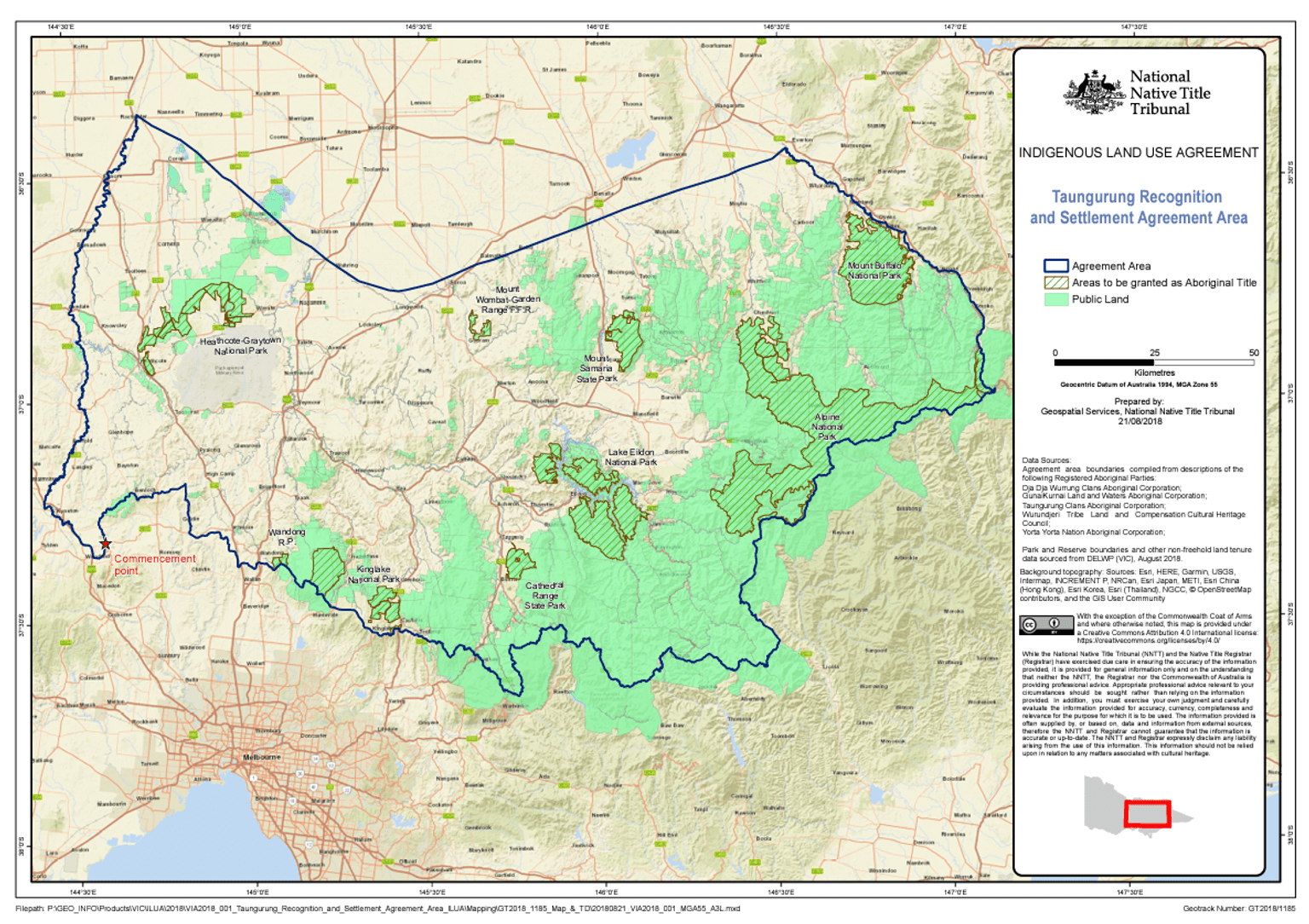
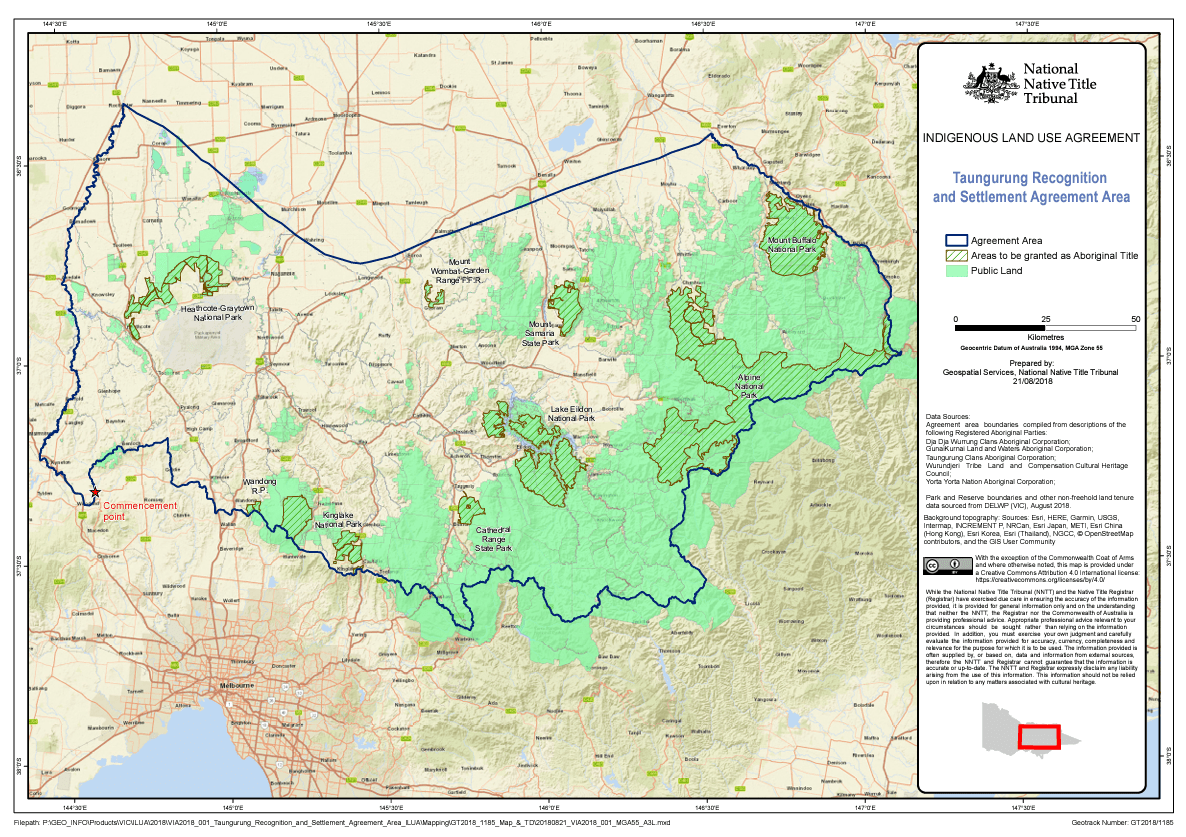
The LUAA applies to all public land (subject to certain exclusions) within the boundaries now recognised as Taungurung country, as shown on this overview map.
Agreement area in Central Victoria for the Recognition and Settlement Agreement with the Taungurung Traditional Owner group
For further detail about the boundary, you can:
- refer to the detailed description, containing specific boundary parcels and location co-ordinates, in Schedule 2 of the LUAA itself(opens in a new window)
- obtain the GIS data to show the LUAA boundary as a layer in your mapping system.
Exclusions from the LUAA
Leases within Alpine Resorts
The LUAA does not apply to leases of land within the boundaries of an Alpine Resort, or to activities carried out under those leases.
Existing Infrastructure
The LUAA does not apply to land covered by certain kinds of existing infrastructure (see below).
Where that infrastructure has been demolished in order to replace or refurbish it, for the same purpose, the land continues to be excluded.
However, where former infrastructure has been removed so as to permit safe public access to the former footprint of the infrastructure, that land is no longer excluded.
This makes practical sense: that land is once again ‘public land’, without any infrastructure, and so it is subject to the LUAA.
Click on the following headings to show additional information. If you are uncertain whether particular land is excluded from the LUAA, you are encouraged to discuss it with TLaWC(opens in a new window).
Church land
The LUAA does not apply to land that is subject to the State Aid to Religion Abolition Act 1871.
This refers to Crown land that had been granted, promised or reserved for church use by 1871. In that year, a process was established by which such land could be granted to those churches as freehold, by application to the Minister.
Land that has been acquired by churches since that time will likely be freehold land, also excluded the LUAA.
Specific parcel exclusions
The LUAA lists parcels of land that are specifically excluded from the LUAA. These were planned for future use or sale at the signing of the Recognition and Settlement Agreement (2018).
Few of these will still be public land as time goes on, but it may be important to check this list for potential exclusions.
If you have assessed that the land in question is subject to the LUAA, continue reading What kind of activity is it?
If not, and you are a decision maker for the relevant land, you should make records of your assessment that the LUAA does not apply to that land. You may wish to use the template below, or other record-keeping systems appropriate to your organisation. You need not read any further pages in this section.
What kind of activity is it? - Taungurung LUAA
After you have determined whether the Taungurung Land Use Activity Agreement (LUAA) applies to the land in question, you must then determine how the LUAA categorises your intended activity.
The following questions will help you to work out how the LUAA classifies the activity you are interested in. Work your way through the questions from top to bottom. For each question, click on the heading to see an explanation. In some sections there are links to detailed definitions in the Taungurung LUAA glossary of terms.
If you are unsure how an activity is classified in the LUAA, after reading the LUAA and these guidance materials, consult with others in your organisation and with the Taungurung Land and Waters Council (TLaWC).
If an activity is capable of falling into two categories, the LUAA states that the higher level of procedural rights shall apply.
Preliminary questions
First consider these preliminary questions.
Then consider the type of works involved, checking the information provided below and the definitions provided in the glossary.
Works on public land
Change to legal status of land
What's the process? - Taungurung LUAA
See the LUAA Contacts page for information about how to contact the Taungurung Land and Waters Council (TLaWC).
Process for Routine activities
For Routine activities there is no requirement to notify TLaWC. The activity may proceed immediately.
Decision Makers are encouraged to discuss the categorisation of the activity with TLaWC if there is any doubt.
In any case, Decision Makers are encouraged to make appropriate records of their assessments that certain activities are Routine. These could be called upon in an audit of LUAA assessments, or if TLaWC were to apply to VCAT for a determination on the classification of a land use activity.
A sample template for recording such assessments is included here:
Process for Advisory activities
Advisory activities require notification of TLaWC and, depending on TLaWC’s response, a consultation process.
Ministerial Directions as to Advisory Activities (made by the Attorney-General on 7 August 2020) specify minimum standards for the notification and consultation process. These include a 28-day minimum period to allow TLaWC to respond.
Document templates have been developed to assist with meeting these requirements, but use of the templates is not mandatory.
The Directions also encourage Decision Makers to exceed the minimum standards. That is, to go beyond formal procedures and to establish a relationship between Parties that is flexible enough to respect and accommodate the needs of each party.
As with any decision affecting people’s rights, Decision Makers for Advisory activities under the LUAA must also observe the principles of natural justice.
This table suggests a step-by-step approach that meets (and in some steps exceeds) the minimum standards. It is intended as a guide, noting that the steps may be adapted to meet the circumstances of each Advisory process.
| Step | Process for Advisory activities |
|---|---|
| 1. | Notify TLaWC of the proposed activity |
| 2. | Await response from TLaWC until the date specified in your notice (minimum 28 days). |
| 3. | If no response received, or a response with no objection or comments: the activity can proceed. You are encouraged to confirm by email or letter that you are proceeding. |
| 4. | If comments or requests received: acknowledge the comments or requests in writing. Respond to the requests and actively consider the comments. Where appropriate, discuss those comments, and possible ways to resolve issues with TLaWC |
| 5. | Make your decision, taking relevant comments into account, as part of a process based on the principles of natural justice. |
| 6. | Record your decision, and notify TLaWC. |
Templates and supporting documents for Advisory activities
Process for Negotiation activities
Negotiation activities require notification of TLaWC and good faith negotiations. VCAT can adjudicate if agreement cannot be reached.
The minimum content of the notification is set out in the Traditional Owner Settlement Regulations 2017.
Document templates are available at the bottom of the page to assist with meeting these requirements, but organisations may develop their own documents that meet the minimum requirements.
Good faith negotiations
The Traditional Owner Settlement Act 2010 includes a requirement for both parties to negotiate in good faith (s.50).
The term ‘good faith’ is not defined in the Act, but an explanatory guide is available in the downloads section below. ‘Good faith’ does not require Decision Makers or Responsible Persons to negotiate under the LUAA in relation to cultural heritage protection, as this is managed under separate processes.
VCAT may make a determination as to whether or not either party has met the requirement for good faith.
Community Benefits
The State has agreed to provide Community Benefits for Negotiation activities according to formulas in Schedule 7 of the LUAA whenever the State, or a State agency:
- is the Responsible Person, or
- issues a Public Land Authorisation (PLA).
These formulas calculate the monetary value of the Community Benefits based on a percentage of value of the land, rent received, etc. Land values are determined by the Valuer-General of Victoria. The State may negotiate to provide some or all of the community benefits in non-monetary form, by agreement with TLaWC.
When the Responsible Person is anyone other than the State, and the State is not issuing a PLA, these formulas do not automatically apply.
In those negotiations, the Responsible Person and TLaWC may agree to adopt the formulas, or not. They must negotiate the value of any Community Benefits, and whether they will be provided in monetary or non-monetary form.
Role of VCAT
If the parties are unable to reach agreement on all matters, after 6 months of good faith negotiating, either party may apply to VCAT for a variety of orders to resolve the dispute.
Steps in the process
This table suggests a step-by-step approach that is consistent with the LUAA, the Act and its Regulations. It sets out the roles of the:
- Decision Maker (DM)
- Responsible Person (RP).
| Step | Process for Negotiation activities |
|---|---|
| 1. | DM identifies whether it, or another person, is the Responsible Person (RP). DM also identifies who is responsible for Community Benefits. DM explains the RP’s obligations under the LUAA to the relevant person (DM’s employee or external RP). |
| 2. | RP notifies TLaWC of the proposed activity |
| 3. | RP negotiates in good faith with TLaWC regarding the activity – whether it may proceed, and on what conditions. If a State agency or VicForests is the RP, or is issuing a PLA, it also negotiates whether the Community Benefits payable under LUAA Schedule 7 will be paid in cash, in kind, or in some combination. If the RP is another statutory authority, a local government, or an applicant for an Earth Resources Authority, it negotiates with TLaWC the Community Benefits to be provided for the Taungurung community |
| 4. | If agreement is reached, the RP provides evidence of the agreement to the DM. The activity can now proceed (in accordance with any standard or agreed conditions). |
| 5. | If agreement cannot be reached, after 6 months of negotiation in good faith, the RP may apply to VCAT for an order. |
| 6. | RP pays TLaWC’s reasonable costs of negotiating, regardless of the outcome. |
Templates and supporting documents for Negotiation and Agreement activities
Process for Agreement activities
Agreement activities require notification of TLaWC and good faith negotiations, as for Negotiation activities. However, the activity cannot proceed unless and until TLaWC agrees. There is no appeal to VCAT if agreement cannot be reached.
Notification
The minimum content of the notification is set out in the Traditional Owner Settlement Regulations 2017.
Document templates are available at the bottom of the page to assist with meeting these requirements, but organisations may develop their own documents that meet the minimum requirements.
Responsibility for negotiation and Community Benefits
For most Agreement activities, the Decision Maker is also the Responsible Person (RP). However, where the activity is the granting of a lease for more than 21 years for commercial purposes, the applicant for the lease is the Responsible Person.
For all Agreement activities where a State agency is the Decision Maker, including where it issues such a lease, it has agreed to provide Community Benefits according to formulas in Schedule 7 of the LUAA. The State may negotiate to provide some or all of the community benefits in non-monetary form, by agreement with TLaWC.
If a local government, statutory authority or other non-State body is the Decision Maker, these formulas do not automatically apply. The Decision Maker and TLaWC must reach agreement about the value of the Community Benefits, and whether they will be provided in monetary or non-monetary form.
Steps in the process
This table suggests a step-by-step approach that is consistent with the LUAA, the Act and its Regulations.
It sets out the roles of the:
- Decision Maker (DM)
- Responsible Person (RP).
| Step | Process for Agreement activities |
|---|---|
| 1 | DM identifies whether it, or another person, is the Responsible Person (RP). DM also identifies who is responsible for Community Benefits. DM explains the RP’s obligations under the LUAA to the relevant person (DM’s employee or external RP). |
| 2 | RP notifies TLaWC of the proposed activity. |
| 3 | RP negotiates in good faith with TLaWC regarding the activity – whether it may proceed, and on what conditions. If a State agency is the RP, or is issuing a PLA, it also negotiates whether the Community Benefits payable under LUAA Schedule 7 will be paid in cash, in kind, or in some combination. If the RP is another statutory authority or a local government, it negotiates with TLaWC the Community Benefits to be provided for the Taungurung community. |
| 4. | If agreement is reached with TLaWC, the RP provides evidence of the agreement to the DM. The activity can now proceed (in accordance with any standard or agreed conditions). |
| 5. | If agreement is not reached, the activity cannot proceed. |
| 6. | RP pays TLaWC’s reasonable costs of negotiating, regardless of the outcome. |
Templates and supporting documents for Agreement activities
Please use the templates and supporting documents found in the 'Negotiation activities' section.
Engaging with TLaWC - Taungurung LUAA
What can you expect when engaging with the Taungurung Land and Waters Council (TLaWC) for an Advisory, Negotiation or Agreement process? This page was drafted in close consultation with TLaWC. However, nothing stated here binds or limits the ways that TLaWC might respond to a notification.
Taungurung aspirations
TLaWC will always seek opportunities to contribute to the wellbeing of the Taungurung people through LUAA notifications.
The LUAA is part of the broader RSA (Recognition and Settlement Agreement), which is founded on acknowledgement and respect for the Taungurung community as the Traditional Owners of the land.
This includes acknowledging their unique culture and knowledge of their land, and addressing the consequences of government policy and practice that led to Taungurung dispossession and disadvantage.
Outcomes from the Settlement Package include:
- legal recognition of the rights of the Taungurung as Traditional Owners of public land
- protection of culture and biik (country)
- promoting respect for Taungurung culture
- employment and enterprise opportunities
- legal acknowledgment and respect for the decision-making role the Taungurung play in caring for their country
- land and natural resource management outcomes.
Examples of LUAA outcomes
Outcomes from LUAA processes may include, for example:
- installing signs at strategic locations that recognise Taungurung Traditional Ownership
- acknowledging Taungurung support for important community facilities
- engaging Taungurung to co-design interpretative information, which can enhance visitor or user experience of the relevant facilities
- securing internships/job placements for Taungurung members and grants to Taungurung artists
- drawing attention to the requirements of the Aboriginal Heritage Act 2006, which must be followed independently of the LUAA
- engaging Taungurung suppliers to provide a range of Natural Resource Management services
- monetary and/or non-monetary benefits to the Taungurung community, in recognition of the impact of land use activities on their Traditional Owner rights.
Some of these outcomes from LUAA processes may also be relevant to meeting other goals and requirements under the RSA. For example, the Natural Resource Agreement requires State agencies to meet or exceed a target of 10% of their annual ‘total spend’ on Natural Resource Management in Taungurung Country from TLaWC’s suppliers.
Benefits to others
Active engagement with TLaWC also benefits the State, statutory authorities, local governments and others. These benefits can include:
- relationship building (leading to a more cohesive and inclusive community)
- access to unique design and landscape knowledge
- efficient and cost-effective services
- more diverse workplaces
- enhanced perspectives on proposed developments
- progress towards social responsibility and reconciliation goals.
Timeframes
Decision Makers and applicants/proponents should consider LUAA requirements when planning projects.
Each project will differ. The following offers general guidance on timeframes specified in the LUAA (and related documents). There are also some ideas about how to make LUAA processes as efficient as possible.
Advisory activities
Notifications for Advisory activities must allow at least 28 days for TLaWC to respond from the date of notification. TLaWC might request additional time to respond to some notifications. More information may be needed, or time for Traditional Owners to properly consider the matter. Any requests for extra time or further information from TLaWC should be properly considered having regard to the principles of natural justice.
After receiving a response, there’s no fixed timeline for further consultation and decision making. Decision Makers should:
- allow a reasonable time to consider TLaWC’s response on its merits,
- take any further steps as appropriate (which might include, for example, meeting with TLaWC or visits to the site), and then
- decide whether and how to proceed with the land use activity.
Negotiation activities
TLaWC must use its best endeavours to acknowledge receipt of a Notification for a Negotiation activity within 14 days of receipt. It will provide a further response within 3 months of receipt.
If agreement cannot be reached within 6 months of good faith negotiations, either party may seek an order from VCAT. (See The need for compliance for more information about VCAT orders.)
Agreement activities
There is no set timeframe for Agreement activities. An Agreement activity cannot proceed unless TLaWC agrees. Naturally, early notification of a proposed Agreement activity will assist both parties, as opposed to leaving notification until late in the lifecycle of the proposed activity.
Making the processes efficient
TLaWC is governed by a board of directors, all volunteers. The Board meets quarterly to consider LUAA notifications (along with its other business). TLaWC has limited staff to assist the Board with LUAA matters, so it cannot always provide a quick response to notifications.
TLaWC can usually respond within 28 days if all necessary information is provided at the outset, including precise information and clear maps. (See What’s the process? for details of what information is required.)
Engaging with TLaWC about planned activities before sending formal notifications can reduce TLaWC’s response time. More importantly, it may enhance outcomes for both parties. For example, it enables a State party to build the costs of LUAA compliance (see below) into their project plans and budgets.
Delays can also occur if issues arise regarding the interpretation or application of the LUAA. For example, the LUAA classification of an activity may need clarification. Again, early discussion with TLaWC may help minimise such delays.
Financial considerations
Decision Makers and Responsible Persons should also factor financial considerations into their planning and budgeting. While it is not possible to identify these with precision, the following information may assist.
Advisory activities
The LUAA does not mandate the payment of Community Benefits, or the consultation costs of TLaWC, for Advisory activities. This is at the discretion of the Decision Maker.
Suggestions or requests from TLaWC in response to Advisory activity notifications may have financial implications. For example, TLaWC will request site visits and meetings where appropriate to better understand the project or activity. TLaWC may also request project design alterations.
Decision Makers should decide upon such requests on their merits, having regard to the goals of the LUAA and RSA.
For some Advisory activities, TLaWC may remind other parties of their obligations under the Aboriginal Heritage Act 2006. Those obligations may have budgetary implications. But these are not new or additional costs arising from the LUAA.
Negotiation and Agreement activities
Negotiation and Agreement activities give rise to two kinds of financial considerations: Community Benefits, and reasonable negotiation costs.
Community Benefits
Community Benefits are provided to the Taungurung Community in recognition of the land use activity’s impact on their Traditional Owner Rights. They may be monetary payments, in-kind benefits, or a combination of both.
Further information about who pays Community Benefits, and how their value is determined, is available on the page What’s the process?
Costs of negotiation
The reasonable negotiation costs of TLaWC must be reimbursed by the Responsible Person for the proposed activity. The Traditional Owner Settlement (Negotiation Costs) Regulations 2015 specify that these may include:
- decision-making costs, such as site analysis, report writing and consideration of recommendations
- professional services costs, such as legal, economic, geological or engineering services, and
- travel costs, such as car expenses associated with site visits, or public transport to attend a special meeting.
As a practical matter, TLaWC may request the payment of some of their interim costs before the conclusion of negotiations.
Tips for senior leaders - Taungurung LUAA
This page outlines considerations for senior leaders to ensure their organisation’s compliance with the Taungurung Land Use Activity Agreement (LUAA).
The information is relevant to state government agencies, statutory authorities, local government and any other bodies that the LUAA considers Decision Makers or Responsible Persons.
Build relationships
As noted on the first page of these materials, the LUAA is part of an overall RSA (Recognition and Settlement Agreement) package, which aims to create a new relationship of ‘meaningful partnership founded on mutual respect’.
This relationship will be expressed between the Taungurung Land and Waters Council (TLaWC), government agencies and others:
- through their general dealings with each other, over time
- through specific agreements or protocols they might develop together
- through the interaction of key people in each organisation.
Who should hold direct relationships?
For your organisation, people who might seek to build these direct relationships with TLaWC counterparts include:
- elected officials
- CEOs and Secretaries
- senior leaders with overall responsibility for the LUAA and/or other components of the RSA
- staff with day-to-day responsibility for the LUAA and other relevant matters.
Because TLaWC has limited staff and resources, it cannot build meaningful relationships at all of these levels with all local and state government agencies.
Instead, they ask that appropriate leaders from each organisation contact TLaWC to discuss what will work best for each party. This will require some internal coordination within your organisation.
Understand the LUAA’s relationship to other relevant agreements
CEOs and other senior leaders are in a great position to lead by example – so long as they understand what is needed, at least in broad terms.
These web pages focus on the LUAA. You may also have obligations under the Natural Resources Agreement, another component of the RSA. For example, State agencies have targets under the Procurement Strategy for natural resource management.
Local government authorities need to understand Schedule 5 of the RSA (Local Government Engagement Strategy). Your organisation may also have, or be working towards, a Reconciliation Action Plan, or another similar set of commitments.
How do these documents relate to each other?
Two considerations can help to distinguish them:
- Focus: do they relate to Traditional Owners only, or to all Aboriginal and Torres Strait Islander people?
- Requirements: are the actions they describe mandatory or recommended?
Focus
The LUAA and RSA focus on the Taungurung as Traditional Owners of the land. Regardless of where they live, all Taungurung people hold unique rights as Traditional Owners by virtue of these agreements and the enabling legislation.
Reconciliation Action Plans, by contrast, usually relate to all Aboriginal and Torres Strait Islander people who live in your area or relate to your organisation. Other organisational strategies related to Indigenous people may also have this broad focus.
Requirements
Compliance with the LUAA is legally mandatory, as is compliance with the Aboriginal Heritage Act 2006.
The Natural Resource Agreement (including participation in the Annual Partnership Forum and the Procurement Strategy for NRM) is also mandatory for the State, where it has NRM functions or responsibilities - but not for local government.
The Local Government Engagement Strategy (RSA Schedule 5) is a commitment by the State to facilitate engagement between TLaWC and local governments in Taungurung Country. It lists a number of actions (items A–M) that may be the focus of these engagements.
The first of these – compliance with the LUAA and the Aboriginal Heritage Act – are mandatory actions for all local councils. The remaining items in Schedule 5 are, in effect, recommended actions for local government.
Use and improve your existing systems
To make LUAA compliance part of business as usual in your organisation, consider ways you can use or improve your existing systems. Here are some examples.
Identify LUUA compliance in risk registers
The risks of failure to comply with the LUAA include legal consequences. Among other things, VCAT could order that land affected by an activity be returned to its previous condition.
Add LUAA assessments to the tools you already use
Review your checklists, project management software and other tools. Consider adding items that cover:
- Does the LUAA apply to the land?
- What kind of activity is it under the LUAA definitions?
- Do we have specific agreements with TLaWC about this kind of activity?
- Have we completed the relevant process?
Make sure your record keeping includes LUAA-related notes and documents
Retain file notes and other records of your assessments of your agency’s ‘land use activities’ on public land in the LUAA. Store them so they can be retrieved to verify your compliance with the LUAA, if required.
Make it easy to refer to guidance
You can include links to these web materials in the documents, websites and digital portals that your teams routinely use.
Training
Training promotes compliance with the LUAA. Consider different ways you can ensure that all relevant staff have the knowledge and skills they need.
For example:
- general discussion of the LUAA for all relevant roles during staff induction
- in-depth training for relevant roles, such as in-house training, or attendance at multi-organisation workshops
- refresher training after a specified period (such as 2 to 3 years)
- networks and ‘communities of practice’ among people with similar roles at other similar organisations.
Note that for an initial period of the LUAA’s operation, DPC will take the lead in organising and promoting LUAA training for local government as well as state agencies and statutory authorities. This training will be organised in consultation with TLaWC.
In future years, state agencies and local government may need to organise relevant training independent of DPC (either individually or collectively).
Update position descriptions
Do position descriptions or task lists in your organisation refer to LUAA-related responsibilities or tasks? Updating these might be an immediate and valuable way of building compliance into business as usual.
For position descriptions, consider:
- Who in your organisation is formally responsible for LUAA compliance?
- Who, in practical terms, needs to be involved in each step?
- Who needs to be aware of LUAA requirements (even if not responsible for carrying them out), such as people engaged in planning and budgeting?
For tasks and responsibilities, consider phrases like these:
- responsible for ensuring [your organisation’s] compliance with the Taungurung LUAA
- assess whether the LUAA applies to a project and, if so, what kind of activity and with what resulting process
- notify TLaWC of Advisory, Negotiation and Agreement activities under the LUAA
- consult and/or negotiate with TLaWC regarding proposed activities under the LUAA
- maintain accurate and retrievable records of LUAA activities, processes followed, and outcomes
- estimate time and cost implications, as well as opportunities, arising from LUAA requirements or other engagement with TLaWC
- embed LUAA compliance in project design and management processes.
Questions for performance reviews
When relevant, consider building accountability for LUAA-related tasks into performance review processes.
Adapt self-assessment forms with LUAA-related questions, as appropriate for role description.
Ask questions in regular catch-up, coaching or mentoring meetings:
- "How are you going with…?"
- "Tell me about some examples where…"
- "Do you need any assistance or support with…?"
Ask questions in annual performance review processes:
- "How effective have you been at…?"
- "Describe some instances when you…"
- "Walk me through what you did in each case where…"
Support compliance by other parties
Your organisation is directly responsible for compliance with the LUAA on public land that it manages, or for relevant decisions under the legislation you implement.
Strictly speaking, you are not responsible for other organisations that manage or make decisions about public land. However, consider providing information to others who interact with your organisation about their likely responsibilities under the LUAA.
As one example, local government could include notes or conditions about LUAA compliance when issuing permits under planning and environment legislation. Council staff might also be able to provide information to residents and other stakeholders.
Taungurung LUAA contacts
While it is ultimately the responsibility of each organisation to ensure its own compliance with the Taungurung Land Use Activity Agreement (LUAA), there are people who can assist.
In addition to the contacts listed below, you are encouraged to develop your own networks of colleagues.
Taungurung Land and Waters Council (TLaWC)
The first point of contact at Taungurung Land and Waters Council (TLaWC) for inquiries regarding the LUAA is:
Anne Burns, LUAA Manager
Taungurung Land and Waters Council
Email: LUAAadmin@tlawc.com.au
Formal notices of LUAA activities should be addressed to:
Taungurung Land and Waters Council
PO Box 505
Broadford VIC 3658
Department of Energy, Environment and Climate Action (DEECA)
The Department of Energy, Environment and Climate Action (DEECA) manages a large proportion of public land in the LUAA area. DEECA will usually be the Decision Maker for leases, and for many kinds of licences and permits.
Contact DEECA through its online customer service page or via phone on 136 186.
Land Justice Unit at the Department of Premier and Cabinet
The Land Justice Unit at the Department of Premier and Cabinet (DPC) plays a lead role in negotiating LUAAs. It can also coordinate initial training about the LUAA. Although the Unit is not able to provide legal advice, for general inquiries you can contact:
Email: LandJustice@dpc.vic.gov.au
Earth Resources Regulation
Phone: 136 186, 8 am – 6 pm Monday to Friday
Email: customer.service@ecodev.vic.gov.au
Training
For the time being, local government, state agencies and statutory authorities should contact the Land Justice Unit at DPC regarding initial training about the LUAA.
Glossary of terms - Taungurung LUAA
This glossary includes direct or paraphrased definitions, and some explanatory notes, for many key terms used in the LUAA and on these information pages.
Acronyms
DEECA – Department of Energy, Environment and Climate Action
DPC – Department of Premier and Cabinet
DTF – Department of Treasury and Finance
ERIA – Earth Resource or Infrastructure Agreement
LUAA – (Taungurung) Land Use Activity Agreement
PLA – Public Land Authorisation
RSA – (Taungurung) Recognition and Settlement Agreement
SPW – Specified Public Work
TLaWC – Taungurung Land and Waters Council
Agricultural Lease
Agricultural Lease means a lease where the primary purpose of the lease is to use the land for:
- cultivation for the purpose of selling the produce of the cultivation (whether in a natural, processed or converted state)
- the maintenance of animals or poultry for the purpose of selling the animals or poultry or their natural increase or bodily produce
- the cultivation or propagation for sale of plants, or
- keeping, or breeding aquatic animals or cultivating or propagating aquatic plants.
Related information: Is the activity a Public Land Authorisation (lease, licence and permits)? at What kind of activity is it?
Commercial Purpose vs Community Purpose
In the LUAA, the TLaWC has accepted lower procedural rights for certain activities when they occur for the benefit of the wider community. This concession is reflected in the definitions of the terms 'community' and 'commercial' in the LUAA.
For example, Commercial Purposes do not necessarily have a strong ‘business’ or ‘for-profit’ character.
In the case of works on land, anything that is not covered by the definition of Specified Public Work is considered works for a Commercial purpose.
In the case of Public Land Authorisations, ‘Commercial purpose’ is defined to mean everything that doesn’t fit within the strict definition of ‘community purpose’.
To qualify as being for a ‘community’ purpose under the LUAA, a lease, licence or permit must meet two criteria: one for its actual purpose, and another for the grantee organisation.
1. Purpose: the lease, licence or permit must be:
- solely or primarily for non-commercial community, social, religious, educational, health, charitable or sporting purposes, or
- for non-commercial services aimed at improving community safety or welfare and not of a commercial nature.
AND
2. Organisation: the organisation receiving the public land authorisation must:
- be not-for-profit
- not operate gaming equipment under the Gambling Regulation Act 2003 (poker machines, etc.), and
- not have, or plan to have, a turnover of $1 million in operating the leased premises.
A lease, licence or permit would be considered ‘commercial’ if it failed any of the above limitations on what is considered ‘community purpose’.
Related information at What kind of activity is it?:
- Is the activity a Public Land Authorisation (lease, licence and permits)?
- Is the activity land clearing and other major works for commercial purposes?
Decision Maker
Under the Traditional Owner Settlement Act 2010, the responsibility for ensuring LUAA compliance falls on the person or organisation that is the legal Decision Maker for the activity. This includes those who have the statutory responsibility to:
- manage public land,
- issue legal authorisations such as permits, licences, or leases, or
- transfer title to that land, or revoke or change its reservation.
See also the definition of a Responsible Person
Earth resource or infrastructure authorisation (ERIA)
The Act defines ‘earth resource or infrastructure authorisation’ to mean any of the following:
- a licence granted under section 25 of the Mineral Resources (Sustainable Development) Act 1990
- an extractive industry work authority granted under section 77I of the Mineral Resources (Sustainable Development) Act 1990
- a written consent for petroleum operation given under section 138 of the Petroleum Act 1998
- the acceptance under Division 3 of Part 9 of the Pipelines Act 2005 of an Environment Management Plan
- a written consent given for geothermal energy operation under section 80 of the Geothermal Energy Resources Act 2005
- the acceptance by the Minister of an environment plan under the regulations made under the Offshore Petroleum and Greenhouse Gas Storage Act 2010, or
- an approval for greenhouse gas operation under section 193 of the Greenhouse Gas Geological Sequestration Act 2008.
Related information: Earth Resource or Infrastructure Authorisation at What kind of activity is it?
New Vehicular Road
The LUAA defines New Vehicular Road as ‘any part of any new road, track, railway or bridge designed for the purpose of carrying vehicular traffic which is constructed on land that has not previously had a road, track, railway or bridge constructed upon it, but not including any Road Works'.
New vehicular roads (which are Major Public Works and hence Negotiation activities) are also distinguished from ‘other tracks (where the affected land has been disturbed from prior works)’, which are Minor Public Works and Advisory activities.
Related information:
- Exclusions from the LUAA at Does the Taungurung Land Use Activity Agreement apply?
- Specified public works at What kind of activity is it?
Public Land Authorisation
Public Land Authorisation (PLA) means any of the following:
- a lease, licence, permit or other authority under the:
- National Parks Act 1975
- Crown Land (Reserves) Act 1978
- Forests Act 1958
- Land Act 1958
- a tour operator licence under Part IIA of the Wildlife Act 1975
- a consent within the meaning of the Marine and Coastal Act 2018
- a lease under section 3 of the Land (Surf Life Saving Association) Act 1967
- a licence under Division 2 of Part 5 of the Water Act 1989 to construct any works on a waterway or a bore, or
- a Carbon Sequestration Agreement under section 45 of the Climate Change Act 2010.
Note that Agricultural Leases are a type of PLA, if they are issued under any of the above Acts.
However, their activity classification depends on the size of their area rather than their duration.
Note also that issuing other kinds of permits, including Planning Permits under the Planning and Environment Act 1987, are not ‘land use activities’ regulated by the LUAA.
Related information:
- Is the activity already authorised? at What kind of activity is it?
- Is the activity a Public Land Authorisation (lease, licence and permits)? at What kind of activity is it?
Responsible Person
The Traditional Owner Settlement Act 2010 defines the ‘Responsible Person’ as the person who is required, under that Act, to reach agreement with TLaWC in a Negotiation or Agreement activity. Depending on the type of land use activity, that may be the decision maker or another person, such as the applicant for a PLA.
The Responsible Person (RP) is required to negotiate in good faith with TLaWC about whether and on what conditions the activity may proceed. The RP must also pay TLaWC’s reasonable costs of negotiating.
The RP may or may not be the person ‘responsible’ for negotiating and paying Community Benefits. In some cases, the State has undertaken this responsibility, even where the RP is another person (such as an applicant for a PLA).
The following table specifies who, in practical terms, is ‘responsible’ for these different matters, depending on the type of activity and who is the Decision Maker (DM).
The second column identifies the Responsible Person (RP).
The third column identifies who provides Community Benefits, and the basis on which their value is determined (i.e., according to Schedule 7 or by negotiation with TLaWC).
| Activity | Responsible Person (negotiates about the activity and pays TLaWC’s costs) | Community Benefits - who pays, and on what basis? |
|---|---|---|
| Alienation in fee simple | Decision Maker (always Department of Treasury and Finance for this activity) | If State is DM: State, per LUAA Schedule 7. If local government, statutory authority or another person is DM: DM, negotiable. |
| Clearing land (other than for Major Public Works or under Public Land Authorisation) | Decision Maker | If State is DM: State, per LUAA Schedule 7. If local government, statutory authority or another person is DM: DM, negotiable. |
| Major works for commercial purpose | Decision Maker | If State is DM: State, per LUAA Schedule 7. If local government, statutory authority or another person is DM: DM, negotiable. |
| Major Public Works | Decision Maker | If local government, statutory authority or another person is DM: DM, negotiable. |
Public Land Authorisation that is a Negotiation or Agreement activity (includes Agricultural Leases >40ha) | Applicant | If State is DM: State, per LUAA Schedule If ever State is not DM: Applicant, negotiable. |
| Earth Resource or Infrastructure Authorisation (ERIA) for commercial production, or where applicant does not agree to standard conditions. | Applicant | Applicant, negotiable. |
Related information at What's the process?:
- Negotiation activities
- Agreement activities
Road Works
Broadly speaking, Road Works (as defined in the LUAA) are significant works on and around existing roads. They are different from New Vehicular Roads, and they do not include maintenance works on roads.
Specifically, Road Works in the LUAA means the construction, installation, or improvement of infrastructure associated with an existing road. It includes the specific items in the list below, and any road work activities that will have a similar impact on the land, or on Traditional Owner Rights, to these items:
- intersection and junction improvements
- pedestrian and cyclist facilities (including overpasses, underpasses, shared user paths and trails)
- bridgeworks
- roadside rest areas and wayside stops
- new stand sites and stack sites
- overtaking lanes
- shoulder widening
- lane widening
- road realignment, and
- duplication of a road.
Note that there are many kinds of works on roads that would not fall within this definition, such as maintenance and repair works.
Road Works may be Major or Minor Public Works, depending on where they occur in relation to the road reserve or existing footprint.
Road Works will be Major Public Works if any of the works extend:
- beyond the road reserve (if any), or else
- more than 1m beyond the footprint of the existing road and any infrastructure which is required for the construction, establishment, operation or use of the road.
Road Works will be Minor Public Works if they occur entirely:
- within the road reserve (if any), or else
- on land that is no more than 1m beyond the footprint of the existing road and any infrastructure which is required for the construction, establishment, operation or use of the road.
Related information:
- Roads at Does the Taungurung LUUA apply?
- Is the activity specified public works? at What kind of activity is it?
Specified Public Works
Specified Public Works are any of the following works, providing they are for a public purpose:
- a road, railway, bridge or other transport facility (other than an airport or port)
- a jetty or wharf
- a navigation marker or other navigational facility
- an electricity transmission or distribution facility
- a gas transmission or distribution facility
- lighting of streets or other public places
- a well or bore for obtaining water
- a pipeline or other water supply or reticulation facility
- a drainage facility, or a levee or other device for the management of water flows
- an irrigation channel or other irrigation facility
- a sewerage facility other than a treatment facility
- a cable, antenna, tower or other communication facility
- an automatic weather station
- a public recreation facility
- any other works carried out by or on behalf of the Crown.
This last point appears to be a fairly broad catch-all. Works carried out ‘on behalf of the Crown’ would include works carried out by a utility, statutory authority, etc, on behalf of the government.
Specified Public Works are either major or minor. These terms are defined by reference to inclusive lists of examples, which appear at What kind of activity is it?
Related information:
- definitions for Commercial and Community Purposes at Glossary of terms
- Is the activity land clearing and other major works for commercial purposes? at What kind of activity is it?
- Infrastructure which has the effect of excluding or restricting public access at Does the Land Use Activity Agreement apply?
Traditional Owner rights
The Traditional Owner rights protected by the LUAA (and by the broader Recognition and Settlement Agreement) are:
- the enjoyment of the culture and identity of the traditional owner group
- the maintenance of a distinctive spiritual, material and economic relationship with the land and the natural resources on or depending on the land
- the ability to access and remain on the land
- the ability to camp on the land
- the ability to use and enjoy the land
- the ability to take natural resources on or depending on the land
- the ability to conduct cultural and spiritual activities on the land
- the protection of places and areas of importance on the land.
Related information: Taungurung Land Use Activity Agreement guidance